Author Archives: keeneshort

Unknown's avatar

About keeneshort

I am a writer in Southern Indiana.

Navigating the Language of Genocide

ubiquity

Recently, some activists called for the U.S. to formally charge the self-proclaimed Islamic State with acts of genocide. I can use the word informally on a blog post, but Secretary of State Kerry’s hesitation to use the word formally proves the power of language. If he makes a formal accusation of genocide, the word brings certain political ramifications, and expectations that may not be fulfilled.

U.S. officials have avoided using the word in the past, in order to avoid necessitating political and military action. During the Clinton Administration, U.S. officials were explicitly told to refrain from using the word genocide to describe the situation in Rwanda, which is now recognized as very obviously a genocide. Reluctance alone to use the word allowed the U.S. to justify not intervening.

This is where language falls short: refusing to call something murder does not change the fact that it is murder. Regardless of whether or not Secretary Kerry calls the destruction of Yazidi, Shi’i, Sunni, and Christian life genocide, that destruction counts as genocide.

However, there is a deeper, more complex narrative. To begin with, most of the groups pushing for a formal accusation are Christian organizations, and focusing on the Christian victims alone risks ignoring the multitude of other victims of the self-proclaimed Islamic State. Kerry would also need to contend with the fact that the U.S. has supported other genocidal regimes in the region complicit in aiding the Islamic State. Saudi Arabia, for instance, is religiously and politically invested in the destruction of Shi’i Muslims and Sufi shrines. Turkey, another U.S. ally, is involved in crimes against its Kurdish population, another group the Islamic State has targeted.

There is also Palestine. While the contexts and implementation for the Israel and the Islamic’s State’s actions against innocent civilian populations differ in a few crucial ways, they are overwhelmingly similar. Palestinians, in many cases children, are held captive without just cause; the Israeli military regularly encroaches upon Palestinian land, removes the indigenous population by force, and occupies it by destroying local property and replacing it with Israeli property. If the U.S. accuses the Islamic State of genocide, which it should, the U.S. would be remiss if it did not make the same accusation against the Netanyahu Administration, which it should.

The issue of language is complex; the word genocide holds so much meaning, but we often ignore the meaning of its absence, and in its absence genocides continue to occur. History has proven this, and it proves it now. There is no way to measure suffering, and I do not intend to give that impression. All victims of genocide deserve justice, Jews, Palestinians, homosexuals, Kurds, Bosnians alike. Ranking the suffering of others is the heart of the problem: it allows those who can stop the slaughter to pick and choose who deserves to be salvaged, and if he is a responsible leader, Secretary Kerry will acknowledge all acts of genocide in the region rather than a select few.

-jk

To Vote From Afar

ForeverA while ago, I mailed forms to my home state of Arizona requesting an absentee ballet for the upcoming primary and Presidential elections. I sent a little letter into a sea of mail, and now I wait earnestly for my approved absentee ballet.

It’s Arizona, though, so there’s a statistical likelihood that my vote won’t make a difference. Each election I’ve voted in, my vote failed to put into office my preferred candidate (a ham sandwich named Marty who wears a hop hat and monocle running as a Neo-Whig Anarchist, obviously). Because the Whigs (and every other party I would realistically vote for) don’t stand much of a chance in Arizona (unless more people voted), I will once again have the honor of not making a difference in 2016.

It’s possible, however unlikely, that voting will make a political difference, but that’s not necessarily why I vote. I vote to be part of a community, to participate in an almost religious experience, to be part of something bigger than I am, a kind of highly-organized mob mentality centering around mostly rich, unconcerned smiling people in suits I couldn’t afford with my life’s savings. It’s enchanting to be part of a communion that has the potential to involve so many. I’m sad how often we collectively waste that potential.

In the 1952 election in India, 105,944,495 people voted. It was the first election after Independence, the first with universal suffrage, and although it constituted only 45% of the electorate, it was a colossal success considering that India’s literacy rate was only 18% in 1951, and is even more impressive given the vast number of languages spoken by India’s electorate: as of 2001, only 22 of India’s 844 languages and dialects were officially used for constitutional purposes. India’s first election involved all levels of society in a nation stratified by centuries of colonialism and damaged by Partition with East and West Pakistan, and nevertheless one hundred million people turned out to vote. Despite the militaristic turmoil around Partition, people turned out to explore an (admittedly western-designed and implemented) experiment in voting.

The upcoming U.S. Presidential election is quite different from India’s 1952 election, but I want to be a part of the masses. In a strange way, becoming a statistic feels transcendental to me, like I’ve moved into a part of history that exists outside all indicators of the self, outside personality, documentation, religion, class, race, and into a cloud of participatory revelry, into a quantifiable oneness. I wish I could vote in person, but from my temporary home in Nebraska, I will still move beyond myself. And maybe, just maybe, Marty the ham sandwich will finally usher in four years of Neo-Whig Anarchism.

-jk

Cited: Wendy Singer. Independent India. Edinburgh: Pearson Education, 2012. Print.

.

Making Sense of the Things We Love

books 3

It’s early on a Saturday morning in Albuquerque, New Mexico, and scholars wander around with free coffee in their hands to one of a dozen panels in one of many sessions in the Southwest Popular/American Culture Association Conference. Topics range from The Grateful Dead to Motor Culture to Film and History. I attend one on Sci-Fi and Fantasy during this session.

The two papers presented are on Jim Henson’s fantasy films (such as Labyrinth, featuring David Bowie) and the television program Ancient Aliens. The second speaker states that he loves Ancient Aliens, and though he refrains from using the phrase “guilty pleasure,” it’s clear from his analysis that he agrees with none of the theories put forward on the program. Instead, he critiques the faulty logic and Euro-centric rhetoric while simultaneously praising the show for trying to subvert the idea that hard-fixed academia is the only source of knowledge. The speaker also points out that the show is outside his academic field. His paper is simply an attempt to make sense of something he loves, and that the whole conference is about people making sense of things they love.

I find that sentiment reassuring. It proves to me something I’d suspected, that pleasure and criticism are not mutually exclusive. Speakers stepped out of their fields of immediate interest to talk about their favorite movies, books, TV shows, music, and the pop culture they love, not to ridicule it but to analyze it.

Almost entirely absent from the conference is a kind of academic elitism that I’ve encountered more and more lately, a hierarchy placing scholars above fans. Obviously, scholars do not need to enjoy everything we analyze (I’m looking at you, James Fenimore Cooper), and maybe we do not need to analyze everything we enjoy (though for an academic, that is very hard to do). Nevertheless, there are many academics who believe that the ability to criticize makes them superior to others.

The conference proved fans and academics can inhabit the same space equally. There were very few moments when scholars looked down on anybody for enjoying pop culture. There was no status involved in the academia; it was communal, friendly, positive, constructive, and creative, qualities I’ve found myself missing in academia lately.

Being critical does not make me better than others. It may give me a more nuanced perspective, but more accurately, I think, it gives me a differently nuanced perspective. With few exceptions, nobody is better than anybody for anything; the rigid hierarchies I’ve encountered so often separating students from faculty, graduate from undergraduate, critic from fan, are unnecessary and unhealthy. I’m pleased to have found a space where fans and critics are on equal footing, where people can be both at the same time. I’m glad to find a place where the egotism that drives much of academia is suspended, and criticism and enjoyment work hand-in-hand.

-jk

Reading at the Southwest Popular/American Culture Association Conference

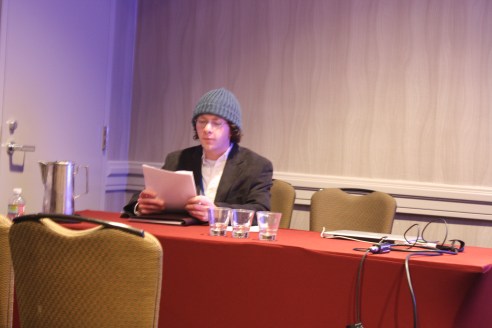
In other news, I read some poetry at a big fancy academic conference.

index

This week, scholars, musicians, writers, film critics, professors, fans of The Grateful Dead, zombie fanatics, pop culture critics and lovers (one in the same, here) flocked to Albuquerque, New Mexico, to discuss their ideas, share their theses, their creative works, their analysis of other people’s creative works, and generally enjoy the spirit of popular culture.

In one day alone, I’ve heard scholar/fans discuss the relationship between Rick and Morty in Rick and Morty, compare Jurassic World and the TV series Zoo, analyze countless horror movies (from Poltergeist to The Babadook), explore various media’s fixation with underage serial killers, give two different interpretations of David Cronenberg’s eXistenZ, explore the role of nature as a setting in The Walking Dead, critique consumer culture in prepper magazines and the capitalist frenzy to buy things before the coming apocalypse, and read a variety of poetry.

IMG_2210.JPG

Reading my own work for an audience was not entirely new to me; I’ve made use of open-mic nights and poetry slams now and again. This venue certainly was new to me, though, but I don’t want readers to assume that I think a conference is somehow better than a slam. Poetry is meant to be read out loud, and all venues are equally worthy and professional; poetry slams are just as important as big fancy academic conferences. But here, my audience differs, and the tone is more critical, more focused on poetry within popular culture rather than poetry alone. Where else can I backup a poem about the end of the world with information I’d heard half an hour before?

I’m centered in the academic world, and this is an academic pilgrimage that I’m honored to take. Reading in front of a live audience, of course, is terrifying, but also thrilling, and I hope to enjoy that thrill again soon.

There are still plenty of days left in the conference, and there is more to come.

-jk


Tales From the Thrift Store

ThriftyI can’t remember the last time I went shopping for clothes. I still wear most of the same things I had in high school and hoped that my minimal wardrobe would last forever when I moved to Lincoln. After losing forty-two buttons, an unfortunate mishap involving bleach, and then proceeding to lose a significant amount of weight in Lincoln by switching to a diet of mostly oxygen and hydrogen, I realized finally that I’m starting to look a little weird in my old clothes. So yesterday, I trekked through the aftermath of Nebraska’s most recent snowstorm to a row of thrift stores downtown, just to take a look around.
For environmental and humanitarian reasons, I will only ever purchase used clothes. The damage has already been done, slave labor already used, Jesus has already cried his usual tears of blood, and at least fourteen MORE elephants won’t be killed in order for me to possess a belt.

As I searched desperately for clothes to fit a short bony dude with a disproportionately big head (which is why I sometimes look like an extraterrestrial), I wondered about the donators. About the reasons for donating. There were stories behind every article of clothing I perused. Maybe a nasty divorce prompted a disappointed man to donate all the ties his ex-wife gave him; maybe a widow donated her husband’s shirts after he took a bullet in Afghanistan; maybe somebody decided he had too many jeans; maybe he gained weight or lost closet space. It’s easy to imprint little fictions onto these old items. It’s fun, even, to wonder about who owned this pair of pink sunglasses or that tacky gold and green parrot-covered sports jacket. I’m a part of the narrative too; everything I give and take changes the equation. I’m an actor in the saga of the exchange of used clothes, and therefore the exchange of unwritten mysteries.

Or so I’d like to think. There may be mysteries, but I’ll never solve them. I may never even figure out the premise. What really matters is that now I can read at a conference in a neon green sports jacket with gold leather sleeves and smiling parrots patterned across the whole thing.

-jk

A Public Apology From This Blog

FOE

It has come to my attention that there is a slight possibility that some readers of this blog might find my portrayal of writers to be unfair.

It was not my intention to portray writers as living in the excesses of caffeine, alcohol, or both, or as people who experiment with certain stimulants that some states have outlawed. I did not intend to give the impression that writers are difficult people who have trouble coping with rejection, or that they have limited social skills. I also had no intention of portraying writers as hyper-critical egomaniacs who write for revenge, and who publish unflattering stories about their friends and families when they feel resentful of their almost constant sense of rejection by publishers, friends, strangers, and that guy at the bookstore with the mustache.

Additionally, it was not my intention to portray writers as the kind of people who use creative writing workshops as a means to external validation by submitting work that has already been accepted for publication, to insist upon the value and merit of their submitted workshop material on the basis that it has been accepted for publication, while simultaneously engaging in pretentious, esoteric discussions of craft that have little, if anything, to do with the actual content of their peers’ work, leading their peers, instructors, loved ones, and Rick from the bookstore to question if they ever actually read their peers’ work and merely have a list of bland, useless comments that can easily apply to any written work, or as people who spend their time rubbing their toes on others’ property and rummaging through Rick’s medicine cabinet when he’s not looking, and who drunk text their lovers at 2:34 in the morning while standing outside Rick’s house and wondering why Marsha’s car is there, or as the sort of people who deliberately loan you their sunglasses when they have pinkeye and leave their beard shavings in your glove compartment.

It was not my intention to portray writers this way, but I can understand why some readers might think that I had such an agenda in mind.

While I’m at it, my lawyers inform me I should apologize for my portrayal of historians. Any interpretation of historians, based on this blog, as resentful, conceited, pretentious, hyper-liberal anti-social Harvard rejects who hate their countries and take pleasure in reducing anybody’s joy in holidays to a crime against humanity and who spend their free time burning copies of the U.S. Constitution in their backyards in their underwear in a massive green cloud of pot smoke, is merely a misunderstanding.

As always, I thank you for your concerns about my portrayal of people on this blog.

-jk

Coffee: A Steamy Love Affair

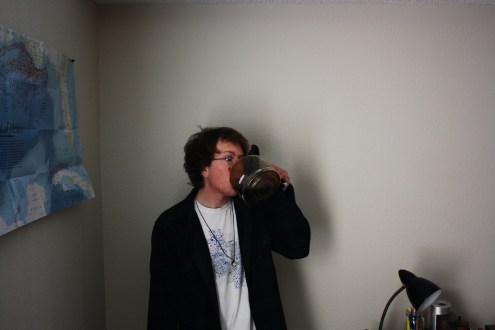
Coffee Poet.jpg

Those who know me know that I love coffee. Those who don’t know me can easily guess, thus far, that I have a moderate fondness for coffee. To be clear, I’m not picky; I like tea, cocoa, water, smoothies, milkshakes, juice. But coffee has a special place in my life.

I had my first cup in my high school cooking class. During one of the baking sessions, our teacher turned on the coffee pot near my station while our muffins were still in the oven. That’s when I had my first cup of caffeinated hot brown acidic water, filled with cream and sugar like most first-timers. After a while, I started drinking coffee whenever I cooked, then every morning, then every morning and afternoon, then several times a day. For a while, I got headaches when I didn’t consume any caffeine by 10:00 AM.

I’ve since become less addicted. I once considered giving it up for Lent but decided that not even Jesus would have gone that far. Nevertheless, I have cut back, and not just because I’ll probably have an ulcer by the age of twenty-six if I don’t.

There are coffee addicts and there are coffee lovers, and I want to be the latter. The difference between a violinist and someone with a violin is making every note a masterpiece. The difference between a chef and somebody who cooks every meal is mastering the kitchen’s tools and ingredients, and cooking with gusto rather than mere hunger. Anything can be an art, and the only way to become an artist is to inhabit a practice so fully that we infuse ourselves with it.

Everything about coffee is perfect to me, and if not I try to make it perfect. Espresso, lattes, dark roasts, light roasts, the smell of the beans, the feel of them in my fingers, the careful measurement of fresh grounds into the coffee pot, pouring the first cup, breathing in the scented steam before the first sip, and feeling it run down my throat hot and fresh, until it bounces around my stomach looking for a place to sit. I write with it; I read with it; I get to know people with it. It’s not for everyone, but it’s certainly for me, which is likely why I haven’t slept since 2015.

What practice or hobby or food do you love? Let me know in the comments!

-jk

P.S. If you thought the title was cheap, consider all the other possibilities I had to work with. Drip coffee was only a starting place.

After Gallipoli

ANZAC Soldiers on the Gallipoli Peninsula

ANZAC Soldiers on the Gallipoli Peninsula

Today marks an important moment in the First World War: the final evacuation of British and ANZAC (Australian and New Zealand Army Corpse) troops from the Gallipoli Peninsula, ending a disastrous months-long Allied campaign to gain control of a narrow a sea route to Russia, the Dardanelles, and to push troops through Anatolia (Turkey) to the Ottoman capitol Constantinople and knock the Ottoman Empire out of the war.

Allied Strategy for the Gallipoli Campaign. Keagan, John, The First World War.

Allied Strategy for the Gallipoli Campaign. Keegan, John, The First World War.

First Lord of the Admirality Winston Churchill schemed the invasion. Allied ships would sail through the Dardanelles accompanied by minesweepers and land thousands of troops onto the Gallipoli Peninsula, where they would secure the area and push on to Constantinople. The initial landing was on April 25, 1915, involving many soldiers from Australia, New Zealand, and Ireland.

The Allies were unprepared for the harsh environment on Gallipoli and the ferocity of Ottoman Turkish soldiers, led by the now famous commander Mustafa Kemal, who directed his troops in successfully defending the Peninsula. The Allied troops became entrenched on Gallipoli for a grueling eight months. Kemal proved his military prowess; Churchill’s plan, on the other hand, proved to be a quagmire. On this day one hundred years ago, the Gallipoli Campaign came to a close. The Ottomans had defeated the British Empire for the time being.

That victory was arguably the last great moment in Ottoman history, and the first in a long time. Earlier in 1915, Ottoman troops committed acts of genocide against Armenian civilians. The Ottoman Empire had been in decline for decades amid encroaching Russian and European empires, and would later suffer British and French diplomats carving it into colonial mandates after the end of World War One. Winston Churchill was involved in that process; he even said that he created the country of Jordan “with the stroke of a pen one Sunday afternoon.” When the War finally ended in 1918, the British and French saw the defeated Ottoman Empire as property to divide among them: Britain took Palestine, Jordan, and Iraq, while France seized Lebanon and Syria, divided artificially. Those artificial borders continue to create problems today in these countries, pitting groups together or dividing cultures along superficial lines.

The Ottoman Empire had practiced its own form of imperialism, and ruled over its Arab territories from its imperial center in Anatolia, just as the British Empire ruled India and South Africa from England. Just as the British and French are guilty of reprehensible war crimes to maintain imperial power, the Ottomans were guilty of the same, such as the Armenian Genocide. Despite the emphasis on self-determination that dominated discussions at the Treaty of Versailles, Arab, Kurdish, Armenian, and other groups were simply shifted from Ottoman rule to British and French rule with as much regard as plunder shifted between pirates.

The Allies also wanted to divide Anatolia, but the Young Turks, led by Mustafa Kemal, fought a war for Independence from 1919 to 1922, and formed a stable, secular, but complex democracy. The Greek minority in Anatolia fought its own smaller rebellion, leading to the eventual forced migration of thousands of Greeks from Anatolia and Turks from Greece in 1923. Kemal had nevertheless defended his homeland from the British, and would not allow the Allies to make property of it.

New nations were formed from the defeated Ottoman Empire, but Turkey may have been the only one to form itself on at least some of its citizens’ own terms. The rest were carved artificially by Churchill and his ilk, Similarly, many Irish soldiers returned to a British-controlled Ireland torn by rebellion in the 1916 Easter Uprising. April 25 is commemorated as Anzac Day in New Zealand and Australia. The Battle of Gallipoli brought British loyal subjects to the edge of the Ottoman imperial center; it was a devastating failure for the otherwise almost obnoxiously successful British, who continued to claim colony after colony across the globe. For the crumbling Ottoman Empire, it was one final act of defiance against the empires surrounding it. Two of the most complex figures of the twentieth century emerged from the battle with profoundly different scars: Mustafa Kemal won, and Winston Churchill lost. Both men went on to be war heroes and war criminal simultaneously, and their role in history will likely always be contentious. At least, both played crucial roles in the destruction and recreation of nations.

By January 9, 1916, about 265,000 Allied soldiers and 300,000 Ottoman soldiers died on Gallipoli. Many of the them were probably unconcerned with the survival or strengthening of empires. They were concerned, most likely, with fighting for something they were told, and genuinely believed, was bigger than them: nationhood. Many Irish joined the war thinking the British would reward them with independence. Australians and New Zealanders had an emerging sense of national identity separate from but loyal to the British. The Turks fought on their homeland against invading Europeans. Thousands died trying to make a nation of their world. Indeed, nations formed, but maybe those who fought created their own kind of temporarily autonomous nationhood of spaceless unity. Amid the destruction of empires, it may be tricky to honor that unity on both sides of Gallipoli equally, but we should strive to anyway. Nationhood is what we make of it, and despite what Churchill seems to have believed, sovereignty means more than a pen stroke.

-jk

John Keegan. The First world War. New York: Vintage Books, 2000.

Very Near the Last Best Place

“I’m in love with Montana. For other states I have admiration, respect, recognition, even some affection. But with Montana it is love. And it’s difficult to analyze love when you’re in it.” -John Steinbeck, Travels with Charley

Snowy Horseman

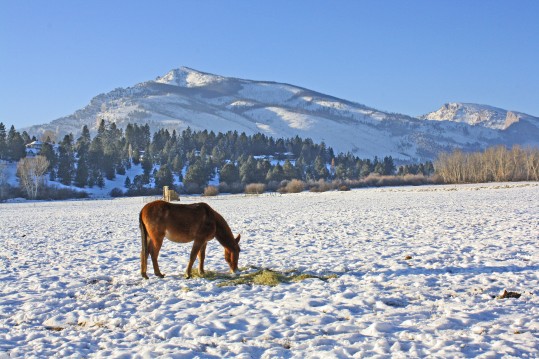
It’s been especially cold in the Bitterroot Valley this week. The air is fat with moisture, and below-freezing temperatures are typical. Still, there is clarity in the cold, standing at the center of the Valley’s balding head. The crown of mountains rolling up and down across the horizon like changing statistics are garnished with snow and the torn fabric of clouds. The trees carry tufts of it, the fields and sleepy barns hold sheets of it stretched thin into ice, and the sky lets down more, flake by perfect, God’s-eye flake.

River Icy

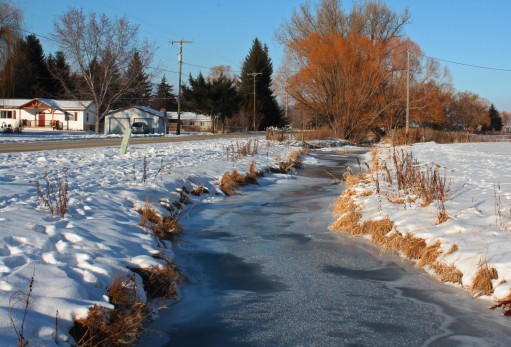
In the middle of the ring of mountains, I stand surrounded by the monumental totality, the jagged white-purple strips draped below a hazy, bitter blue sky, like skin left out in the cold too long.  My nose hairs freeze as I breathe in and look at the sunlit snowscape, a territory lost in cold dreams of something to bloom later, something better to come, something beautiful in the future. I find beauty in the waiting, or try to. The snow is a fixation for me. This frigid terrarium of agriculture and forestry is astounding.

Fence

Maybe there really is such a thing as timelessness. Maybe there’s a way to stop time, step out of it like out of a beater truck, and frame time within electrical confines. Keep it forever, or send the past into the future untarnished by change. But the snow will melt, and something gorgeous will replace it. Trees will philosophize, flowers will converse, and a listlessness of birdsong will fill the air.

Snow Mountain

I pull my camera from my bag, take my gloves off, and take a picture of the landscape. The snow is so lovely, and it melts so quickly when touched, so I try to hold it in another way. I can hardly use my fingers when I lower the camera. I didn’t notice how numb they’d gotten in the photographic thrill of momentlessness.

-jk

All photos copyrighted material of Lost Compass Photography, 2016. Donations, or else get-well-financially cards, are always welcome.


Reflections on a First Semester in Grad School

AcademyI’m twenty-five percent of the way finished with my Master’s Degree in English at the University of Nebraska-Lincoln. Most of what I’ve encountered is unsurprising: the workload is tough, the Midwest is flat. However, there are certain things I’ve learned, perhaps unique to my own situation, that I wish I’d known earlier this summer.

  1. Maturity is a state of mind. I’m the youngest person I’ve met in the creative writing segment of my department, and I’m often made to feel like a little kid, like I don’t quite belong, among the adults (at least among most of the writers I’ve met). Many are PhD students with an MFA or an MA. In truth, I don’t quite fit in with most of the other writers stylistically, humorously, or aesthetically. Both my writing and self are plain weird, and I’m surrounded by tradition and formality. I don’t want to sacrifice my identity to fit in, though. I’d rather be a transplanted weirdo in the Midwest than a converted Midwesterner. Growing up isn’t about leaving behind parts of myself that don’t meet others’ expectations; it’s about maintaining myself in increasingly diverse and challenging situations.
  2. Discussions of craft are not as important as craft itself. Every discussion of craft I’ve had so far consists of an extensive mythology of what other writers did to keep themselves writing, followed by the refrain, do what works for you; coffee, rum, fishing in the Missouri River, whatever will help crank out a daily three to four pages. My own method involves writing for those who inspire me, unhealthy amounts of caffeine, and hikes in nature (which I’ve yet to find near Lincoln).
  3. Nothing is more important than the writing. I came to graduate school to write, and to publish, and to understand literature and improve myself intellectually, but my primary goal is to crank out three to four pages a day, no matter what.
  4. Friendship is more important than the writing. Friends are increasingly hard to come by the higher I climb into academia. Allies are nice, but the few friends I’ve made are crucial to my survival. Without them, I’d have no support for my experimentation. Plus, writing can be lonely, and being cooped up all day is a good way to get cabin fever.
  5. Contradictions are okay (and inevitable). Graduate life, much like undergraduate life, is complex and full of numerous contradictions. Some are basic: a free ride still requires one thousand dollars of student fees per semester. Some are more complex: writing depends upon time and inspiration, but inspiration usually comes from things requiring time not spent writing (loved ones, caffeine, hiking). Fortunately, I now have the benefit of knowing exactly what I need to survive the next seventy-five percent of my degree: writing, friends, coffee, a place to hike, more confidence in my weirdness, and a few more publications would be tolerable, I suppose.

Look out, 2016, here I come.

-jk