

Tag Archives: criticism

Movement

A stature of Saint Louis in front of a building with stone columns and an American Flag. A garden with yellow flowers separates the statue and the building.

One of the last things I did in the Midwest before departing yet again to yet another part of the country was to visit local museums.

I don’t go to museums as often as I’d like. It’s a practice I know is intellectually and culturally valuable for me and whichever community I’m in, but it’s one I tend to put off for something more familiar, like hiking or watching weird movies.

Sianne Ngai writes that criticism, in the artistic and literary sense, is a “conceptual justification for feeling based judgment.” Criticism is a way of organizing, articulating, and perhaps quantifying an emotional reaction to a particular artifact. This definition is satisfying to me because it retains a basic fact about criticism, that it is, at its heart, a subjective and emotional response, but without treating that fact as if it minimizes the value of criticism. A “conceptual justification for feeling based judgment” is more complex than simply stating which artifacts give me joy or disgust or boredom because it structures my ability to articulate why similar works evoke different responses, or the other way around.

I’m not going to try my hand at formal criticism here. I might try to justify my judgements, or my feelings, in a conceptual way, but the concept on my mind lately is a single verb, to move, as in, what moved me, and to where?

Movement has a religious connotation, which is why it’s on my mind. The most spiritual experiences I have felt have been in the context of learning about history. I am moved by learning about how my life is similar to the lives of people in the past, in different regions, in different cultures, in different languages, why the same stories about humility or sacrifice that moved people two thousand years ago move us today.

I found it moving to learn recently that medieval communities in rural Eastern Europe planted trees on the bases of mountains to reduce the impact of avalanches. I found it moving to visit the oldest city in the United States, Cahokia, one of the mound-building civilizations from the Mississippian peoples, and to stand at the top of the tallest mound and see the Saint Louis Arch in the distance. I was moved in the opposite direction by the constant sawing of traffic on the highway. Sometimes I am moved toward revulsion at how different I am from people who share my history, language, and culture, at their shallowness and desire for a smaller, flatter world.

That same day, I went to the Saint Louis Art Museum, a circuitous and immense museum originally founded in 1879 and in a wider plot of land featuring an intricate park, the ideal third space for an industrial city where thousands of people that day alone came for a bit of nature, culture, and community.

The SLAM had a display of Roman art from the time of Emperor Trajan on one floor. A standing exhibition featured extensive world-spanning displays of religious and cultural art from every continent across multiple floors, including the Strait of Torres in northern Australia, Indigenous works from coastal Alaska, pottery from Safavid Persia, and baroque woodwork from eighteenth century Austria. I got lost in a display of modern interior design. I lingered in a too-small exhibit of Art Deco paintings of working-class Saint Louis.

A museum is curated by someone else. I don’t have the freedom to start and stop where I want. The circuitry that takes me from Persia to Papua New Guinea to expressionism is a movement built in someone else’s vision of patterns and deviations that I have to trust. A curated museum isn’t personalized, nor does it cater to specific interests. It’s my loss if I don’t accept the curator’s vision.

In this way, a museum is like an essay, more than a novel or play, because it is a curation of artifacts from the real world organized for the audience to navigate. The essayist makes a map of experience in which the space between artifacts imposes meaning, like the Kuleshov effect in film, and so maybe a museum is a much more collaborative version of that process. I’m a broken record on this, but curation, curiosity, and care all share the same etymological root.

All of this was deeply moving (conceptually, spiritually) because each work of art was carefully placed in relation to other works of art, bundled for meaning and laid out in a labyrinth for everyone to follow. Every reader brings their own insight to the page, and in the museum, perhaps pacing is where the curator’s role ends and the viewer’s begin, how long I spend contemplating the lives of the people who made a ritual mask or a helmet or a painting of wheat farmers.

Something that should have moved me but did not: the museum’s America 250 display. I think it’s partly exhaustion, partly that I know the story so well already, partly that the story itself is so reduced to a handful of events and people that it feels like a smashcut of the greatest hits played on loop over and over again. The display itself was thoughtful and insightful, of course, but it didn’t move me the way an Art Deco rendition of the city did.

This country is very good at being a commercial for itself, at treating itself as a product and its people as customers. There’s a compelling argument already made that the category of customer has replaced that of the citizen. When I witness something celebrating the revolution, no matter how earnest, I’ve lost trust that it isn’t anything other than a commercial for a product, that my participation in this empire is an exchange that someone else profits from. American Revolutionary imagery doesn’t evoke patriotism or inspiration in part, I think, because it’s designed to minimize curiosity.

Darren Aronofksy’s AI-generated series depicting the American Revolution is a good example of this: An artificial version of events built on decades of digital interpretations drawn from the work of actual historians who are now fully removed from the process of historical accounting. No records, no unresolved question, no actual conflict, just a cartoonish visualization of an encyclopedia entry turned into a commodity. A shiny palimpsest of a palimpsest.

My day at the SLAM was free. Likewise, visiting the Lincoln Boyhood Memorial in Indiana was free with my father’s National Parks pass. It was moving to witness so much art. It was moving to talk about Robert Caro’s monumental and ongoing biography of LBJ with my dad where Lincoln grew up, to engage with the actual process of history instead of its distillation into a digital trading card, a sameness that is the same as all the other samenesses.

Maybe it was the distinctions that made the Saint Louis Arm Museum so moving. Nothing was the same, and yet it was because of that exchange of differences that I felt a deeper connection to the people involved in the production, preservation, and curation of art and history. The exchange of experiences (like the World Cup or film festivals or shows about restaurants or museums curated by actual curators) is more moving than an artificial rendering of the same experience again and again. I think that’s what moves me this time of year the most, the possibilities for living in a larger and larger world, of finding myself smaller and smaller the farther away I zoom out.


Ngai, Sianne. Theory of the Gimmick: Aesthetic Judgment and the Capitalist Form. Belknap Press, 2022.

Genre, Nostalgia, and The Love Witch

I don’t normally do film reviews/analysis on this blog, but a recent viewing of The Love Witch with its “aggressive strangeness,” as a friend described it, warrants a a closer look.

witchAnna Biller’s 2016 The Love Witch begins as a parody of late 1960s/early ’70s sci-fi/fantasy sexploitation B movies such as Barbarella (1968) and A Touch of Satan (1971). Biller’s film establishes a concrete cinematic nostalgia that it then goes to great lengths to critique.

Spoilers and such: The main character, Elaine, is a witch utilizing her witchiness to seduce men in her supposedly endless search for love. After having killed her husband, Elaine quickly finds a new partner (Wayne) and uses her excessive witchitudes to convince him to take her to his getaway cabin. There, she gives him a “potion,” which causes him to “feel love” too intensely and die. (Audiences can recognize that taking beverages from strangers is also a possible way to die). Elaine attributes Wayne’s death to men being unable to cope with their emotions, and moves on from there, as we all should when someone feels emotions to death.

When Elaine finds  Griff, “the right one,” the film has veered from its established genre, becoming at different points a Hallmark romcom and a buddy cop drama. Disappointed that he fails to feel love for her (and also happens to be the cop who finds that she is guilty of “loving” people to death), Elaine stabs Griff in the chest. The film ends with a disturbingly quiet fantasy of Elaine marrying Griff in a Renaissance setting, interrupting the campy tone and ending with a serious meditation on the consequence’s of the film’s own logic.

The Love Witch exploits viewers’ nostalgia for a unique cultural moment that existed only after the emergence of birth control and before the HIV/AIDS epidemic, an era that felt like it was going places and might have were it not for the sudden death of hope that came with Reagan and the moral majority.

Elaine’s treatment of men is cynical and essentialist, and the film’s male characters buy into it just as much as she does. Audiences are meant to see her views as a product of her frustration with social expectations for happiness and monogamy, and she turns to witchliness to prevent further disappointment. Witchcraft here functions as a cult-like ideology: Elaine seeks improvement in relationships and cedes her agency to something beyond her (a program/product/cult), but as a result of that program/product/cult, she only ends up killing people (which, to no surprise, ends up hurting her relationships). Witchcraft is a stand-in for any commodified, pre-packaged self-help ideology, such as Sedona’s vortexes, Scientology, or the books of Rob Bell (all of which, I’m sure, have resulted in someone’s death).

Marriage appears most colorfully in a scene at a Renaissance fair, pulling back the curtain on Elaine’s personal investment in the program/product/cult. Elaine, like many Americans, is drawn to witchcraft simply for the nostalgia of a pre-globalized Europe, one without the intrusion of Christianity but all the aesthetics of a Pagan religion without the human sacrifice and patriarchy. All the fun without the historicity. Tolkien made even whiter and somehow less sexy. Halloween ruined by Medieval and Renaissance Studies majors. The list goes on. The film critiques the audience for participating in nostalgia for a style it portrays as commodified, pre-packaged, and self-consuming.

The Love Witch dissects the way many Americans imagine the sexual revolution, which existed between two periods of extreme repression, the 1950s and 1980s, and captures the strangeness of that moment of hope while simultaneously undermining it just as violently as it was subverted historically.

The film’s generic experimentation acts as a mechanism exploiting viewers’ nostalgia. The Love Witch tricks audiences the way time and politics often do, by taking its viewers on a trip they never signed up for but feel unable to step out of, forcing them to walk away with questions and pretentious blog post ideas about witch hunts and the 1970s or something.

-jk

Running Into Foucault at the Supermarket

cash stash

So there you are at the supermarket deciding whether or not it’s a macaroni and cheese week or more of a spaghetti week, and you turn a corner and there he is, Michel Foucault, judging wine in the wine section. You stare for a moment; his basket is mostly bread and wine and a pair of binoculars, and then he sees you, and it’s too late. He’s going to ask you if you’ve read his books yet. There’s no escaping it. You smile, he smiles. You ask him about the wine. He’s polite enough when you tell him no, not yet, but it’s in your reading list, you promise. You apologize, so he’s probably not hurt. Right?

It doesn’t help that Jacques Derrida is backing up the cash register with all his cheese cakes. He asks you how it’s going, but reads more into your answer of “fine” than you thought he would. You smile and ask him how Bourdieu is, but Derrida just keeps going on and on about how Foucault ruined his dinner party, and he’s throwing another one this evening with a book signing and everything, and you’re welcome to come of course, and you say no, so he guesses correctly that the subtext of “no” is actually “I’m so sorry but I still haven’t gotten to your work, please forgive me for being the skunk-flavored latte that I am.” You buy your spaghetti in silence.

You drop by the bank on your way home. While waiting in line you get bored, so you get on Tinder, and then there he is, Foucault, looking all smug in his first picture. Casually, you read his bio, which is the most Foucault you’ve actually read. “French writer and critic up for whatever. Let’s be visible together.” Your only common interest is wine; you swipe left after a moment’s hesitation.

You make it home, put away the spaghetti, and start working on your laundry. At the laundromat, you see Foucault again, leaning over a table with a pile of dark clothes, some of them folded. He is on his phone, his thumbs padding on the screen furiously. He doesn’t see you, thank God. You dump your clothes into a machine fast, cram in the quarters, and realize you’re one short. You turn around; Foucault is gone, clothes and all.

You should have said hello; he might have spared you a quarter. You begin crawling on the floor to look for a quarter someone might have dropped. You try, perhaps desperately, to remember where you left Foucault’s book on your shelf, with your unread Freud or your unread Butler. Sometime you’ll get to it all, but you are still short by a quarter. You think, “You will always be short a quarter,” but can’t remember if that’s existentialism or postmodernism or something else altogether. Either way, you are now covered in dust and you still don’t have a quarter. Like always.

-jk


Making Sense of the Things We Love

books 3

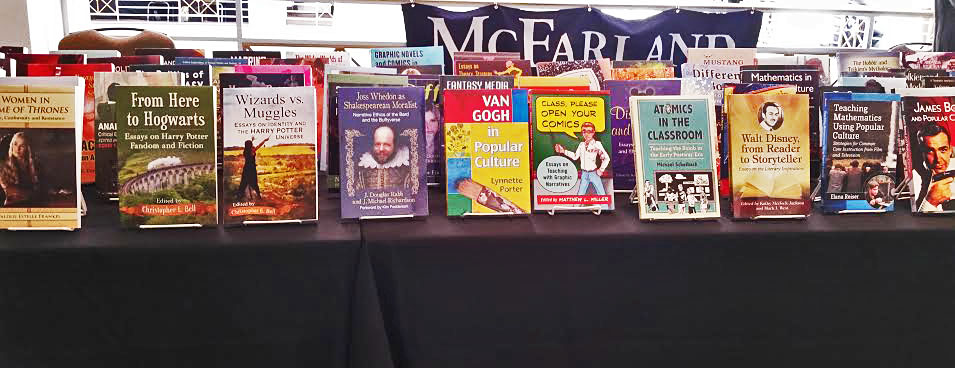
It’s early on a Saturday morning in Albuquerque, New Mexico, and scholars wander around with free coffee in their hands to one of a dozen panels in one of many sessions in the Southwest Popular/American Culture Association Conference. Topics range from The Grateful Dead to Motor Culture to Film and History. I attend one on Sci-Fi and Fantasy during this session.

The two papers presented are on Jim Henson’s fantasy films (such as Labyrinth, featuring David Bowie) and the television program Ancient Aliens. The second speaker states that he loves Ancient Aliens, and though he refrains from using the phrase “guilty pleasure,” it’s clear from his analysis that he agrees with none of the theories put forward on the program. Instead, he critiques the faulty logic and Euro-centric rhetoric while simultaneously praising the show for trying to subvert the idea that hard-fixed academia is the only source of knowledge. The speaker also points out that the show is outside his academic field. His paper is simply an attempt to make sense of something he loves, and that the whole conference is about people making sense of things they love.

I find that sentiment reassuring. It proves to me something I’d suspected, that pleasure and criticism are not mutually exclusive. Speakers stepped out of their fields of immediate interest to talk about their favorite movies, books, TV shows, music, and the pop culture they love, not to ridicule it but to analyze it.

Almost entirely absent from the conference is a kind of academic elitism that I’ve encountered more and more lately, a hierarchy placing scholars above fans. Obviously, scholars do not need to enjoy everything we analyze (I’m looking at you, James Fenimore Cooper), and maybe we do not need to analyze everything we enjoy (though for an academic, that is very hard to do). Nevertheless, there are many academics who believe that the ability to criticize makes them superior to others.

The conference proved fans and academics can inhabit the same space equally. There were very few moments when scholars looked down on anybody for enjoying pop culture. There was no status involved in the academia; it was communal, friendly, positive, constructive, and creative, qualities I’ve found myself missing in academia lately.

Being critical does not make me better than others. It may give me a more nuanced perspective, but more accurately, I think, it gives me a differently nuanced perspective. With few exceptions, nobody is better than anybody for anything; the rigid hierarchies I’ve encountered so often separating students from faculty, graduate from undergraduate, critic from fan, are unnecessary and unhealthy. I’m pleased to have found a space where fans and critics are on equal footing, where people can be both at the same time. I’m glad to find a place where the egotism that drives much of academia is suspended, and criticism and enjoyment work hand-in-hand.

-jk