Author Archives: keeneshort

Unknown's avatar

About keeneshort

I am a writer in Southern Indiana.

Running Into Foucault at the Supermarket

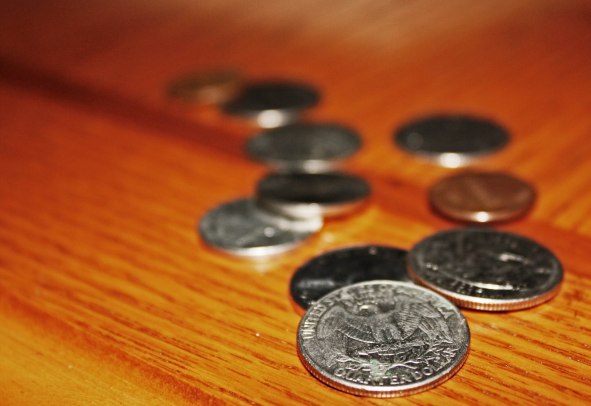
cash stash

So there you are at the supermarket deciding whether or not it’s a macaroni and cheese week or more of a spaghetti week, and you turn a corner and there he is, Michel Foucault, judging wine in the wine section. You stare for a moment; his basket is mostly bread and wine and a pair of binoculars, and then he sees you, and it’s too late. He’s going to ask you if you’ve read his books yet. There’s no escaping it. You smile, he smiles. You ask him about the wine. He’s polite enough when you tell him no, not yet, but it’s in your reading list, you promise. You apologize, so he’s probably not hurt. Right?

It doesn’t help that Jacques Derrida is backing up the cash register with all his cheese cakes. He asks you how it’s going, but reads more into your answer of “fine” than you thought he would. You smile and ask him how Bourdieu is, but Derrida just keeps going on and on about how Foucault ruined his dinner party, and he’s throwing another one this evening with a book signing and everything, and you’re welcome to come of course, and you say no, so he guesses correctly that the subtext of “no” is actually “I’m so sorry but I still haven’t gotten to your work, please forgive me for being the skunk-flavored latte that I am.” You buy your spaghetti in silence.

You drop by the bank on your way home. While waiting in line you get bored, so you get on Tinder, and then there he is, Foucault, looking all smug in his first picture. Casually, you read his bio, which is the most Foucault you’ve actually read. “French writer and critic up for whatever. Let’s be visible together.” Your only common interest is wine; you swipe left after a moment’s hesitation.

You make it home, put away the spaghetti, and start working on your laundry. At the laundromat, you see Foucault again, leaning over a table with a pile of dark clothes, some of them folded. He is on his phone, his thumbs padding on the screen furiously. He doesn’t see you, thank God. You dump your clothes into a machine fast, cram in the quarters, and realize you’re one short. You turn around; Foucault is gone, clothes and all.

You should have said hello; he might have spared you a quarter. You begin crawling on the floor to look for a quarter someone might have dropped. You try, perhaps desperately, to remember where you left Foucault’s book on your shelf, with your unread Freud or your unread Butler. Sometime you’ll get to it all, but you are still short by a quarter. You think, “You will always be short a quarter,” but can’t remember if that’s existentialism or postmodernism or something else altogether. Either way, you are now covered in dust and you still don’t have a quarter. Like always.

-jk


It’s in the Syllabus

Calander 2In a week, I’ll be teaching two sections of an introductory English class using a syllabus of my own design, for my graduate program. I can choose the readings, assignments, and discussion topics, all within reason, of course (I probably wouldn’t be allowed to teach my students math; lucky them). While I’ve been a TA and writing tutor before, I’ve never been in charge of a class for a full sixteen weeks. And now I’m charge of two classes.
For a while, I thought of syllabi as surreal artifacts that came from thin air, or maybe from elves living in the College of Business. Even until recently, I didn’t think too much about the amount of work that can go into a syllabus. Some good friends have given me advice, and while a few peers have suggested I improvise the whole thing, I’d much rather work with a script.

Drafting a syllabus felt like writing a script more than anything else. There are formal parts, class goals and policies on plagiarism, but most of it is a kind of script. I worry that I may not play the role of “teacher” well enough, but at least I’ll have a day-to-day plan to navigate my way through the semester.

As a student, it’s easy to jump to the most important parts of a syllabus, the due dates and assignment descriptions (so we can know which days we should study and which days we can party), but for a teacher the syllabus is more than a binding contract with students. It’s a way of making the act of teaching much less daunting. I can worry less about sixteen weeks when I see those weeks compartmentalized into individual blocks of time: here, a discussion about a short story; there, a brief note about logos, pathos, and ethos; after that, a short paper is due.

I look forward to teaching in a week, and I’m terrified of teaching in a week. By next Monday, I’ll know what to say one day at a time, and if I get stumped, I’ll know the answer is in the syllabus.

-jk


In the Tradition of Poems for Dogs

IMG_0128

Recently, I read Andre Alexis’s novel Fifteen Dogs. Among the many delightful things in the novel (that it starts with the gods Hermes and Apollo in a bar in modern-day Toronto, that the characters are mostly sentient dogs, that it’s filled with excellent descriptions and dog-drama) is that one of its main dog characters, Prince, becomes a poet who uses a unique poetic form intended to make sense to both humans and dogs.

The French poet Francois Caradec invented this form of poetry for dogs, and Alexis lends him credit for its invention. The form requires the sound of a dog’s name to be embedded in the poem. In this way, dogs will hear their name if the poem is read aloud, and respond in their dogly way by wagging their tails and analyzing the poem from a critical dog studies perspective.

An example from the novel, for the dog named Prince, is as follows:

“Longing to be sprayed (the green snake
writhing in his master’s hand),
back and forth into that stream–
jump, rinse: coat slick with soap” (Alexis 81)

The name Prince can be heard in the words “jump, rinse,” and supposedly a dog named Prince will hear it in the poem. The rest, apparently, will be the usual human nonsense Prince is used to hearing by now.

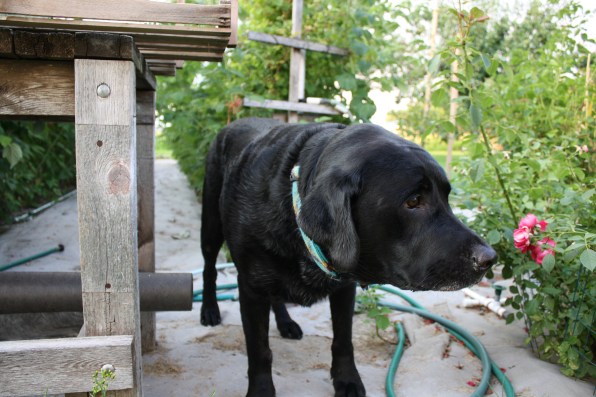
I wrote a poem in this form for my own dog, Pete, who has seasonal allergies and enjoys scratching his face on various surfaces, including people:

Rough carpet scratches
snatch up every face-itch
on the floor, sensations
to make easy sleep. Eat, sniff, dream
until the next itch, then scratch.

Do you have a dog? A pet? Write them a poem and see what they think.

-jk

Alexis, Andre. Fifteen Dogs. Toronto: Coach House Books, 2015

Graduate School, Season Two

teapotAmong the many things coming this Fall is the second season of me being in Graduate School. This next year looks promising, and I’m looking forward to the goofy Nebraska antics, the creative writing classes I’ll be taking, and finally teaching a class on my own.

I hope the next year of Graduate School corrects some of the mistakes of last season. For example, the protagonist last year came off as exceedingly pretentious, especially in his attitude toward the setting. The protagonist spent too much time complaining about the Midwest, and while the “missing home narrative” was compelling, it got old quickly. I for one hope the main character does more than sit around making bad jokes about the prairies.

The next season will most likely see more of the main character trying to get published, and the audience will enjoy the conflict between devotion to graduate studies versus the effort it takes to write, read, submit, and convince literary magazines to publish his work. Many of last season’s episodes focused on various low-stakes self-contained stories that take place in the protagonist’s apartment or the English department, which is why I hope Graduate School will venture out a little more this season. As a show with a whole city for a setting, it’s strange that so much of it uses only two interior buildings to shoot in.

The show has many strange components: the romance plots are all backstory, the drama is all internal, there’s very little dialogue, and the protagonist doesn’t seem to have changed in the first season, at least not in ways the audience would hope for. Where’s his arc?

The real question is whether or not Graduate School will go on for a third season, or if the show will wrap up with the protagonist just getting a Master’s Degree and stopping his college pursuits after that. Future years of Graduate School could be quite worthwhile, but without major character development, this could be Graduate School’s last year. In any case, I look forward to the season premier, and I hope the coming year will be, at the very least, entertaining.

-jk

Reading Terry Tempest Williams in Zion

Zion 2This week, I had the pleasure of joining one of my best friends for a trip through parts of southern Utah, starting in Moab and ending in Zion National Park. We went for the usual reasons (viewing nature, camping, hiking, burning a dictionary and cooking quesadillas over it). After hiking the Wildcat Canyon Trail (a good ten miles of limb-crunching views), we went to our campsite and read our selected book in the fading light, both collections of short pieces on the Southwest and West, Getting Over the Color Green and Northern Lights.

In Northern Lights, I stumbled upon an essay by Terry Tempest Williams, “The Clan of One-Breasted Women.” Williams grew up in Utah in the 1950s when fallout from nuclear testing in Nevada drifted beyond the test sites. As a result, many people downwind of the tests, including her family, suffered from radiation. Williams meditates in her essay on the many women (many in her family) downwind of the test sites who developed breast cancer from the radioactive fallout.


At the peak of the hike in Zion, I could see far, far out into the distance. I was surrounded by a place brimming with life; the whole area is a complexity of ecosystems overlapping, intertwined: red and tan oceans spotted green or lush with ponderosa and aspen or colored with sand and pale sunlight. Much of the Southwest doesn’t look alive to the untrained eye. Deserts play tricks on us by hiding their life, but life is always there. Overlooking Zion, I was overwhelmed and haunted by its history.

Zion

In the 1860s, Mormon pioneers founded a town near Zion, Springdale, and named the nearby canyon Zion. To Mormons, Zion refers to a gathering place for the faithful, and naming the canyon was an act of claiming the land for Mormon culture. But while pioneers were in the process of colonizing the area, the region was home to Southern Paiute communities pushed out by U.S. settlement. Like much of the Southwest, Zion is part of overlapping histories and state-sanctioned narrative revision.

The place was shaped by geologic hands, the fingers of rivers, a mind of clouds and rain, then engulfed with diverse flora and fauna, indigenous communities, overrun by Spanish colonization, Mexican statehood, Mormon expedition, and U.S. authority that ignored all previous layers by deeming the Southwest an absolute desert, a place so deserted they could safely test nuclear weapons there without harming anyone or anything worth mentioning. But Williams contests, as many do, that all of it is worth mentioning, worth respecting and preserving and revering.

After reading Williams’s essay, I stargazed with my friend in the desert where the stars are aggressively visible. The Southwest is misleading to those unfamiliar with it. The stars are brighter here, the air is heavier with scent, the land is rougher, and the going can be tough. Zion, a place of peace, a place of eternity, may be an apt name. The whole Southwest may be a kind of Zion, a refuge for wanderers and romantics. Its beauty is rare and atypical, taking on strange shapes and colors, rich sounds and haunting narratives. Its beauty is misfit and misleading, but in its presence it’s impossible to miss.

-jk

From Coffee Shops to Mountaintops

Macy's

For a too-short time this summer, I’m on a pilgrimage to my hometown of Flagstaff, Arizona. Here, I’ve been working on a collection of short stories that will become my Master’s Thesis in less than a year (no pressure), because I won’t have much time to write come Fall when I’ll take four graduate classes, teach two classes, hold office hours, and try to get published. Flagstaff is a nice place to be productive. It’s also a nice place to be useless.

This month, I’ve been scurrying from one Flagstaff coffee shop (many in gentrified neighborhoods, admittedly) to the next. Maybe sitting all day in Macy’s or Firecreek or Steep (technically a tea house) is a bit of a yuppee activity, but for many writers it’s an easy solution. Coffee shops induce productivity with comfortable spaces, lots of light, energetic music, and socially acceptable drugs like caffeine. They remove us from crammed apartments, English departments, and work places; they spark quiet, collective inspiration. I’ve also enjoyed the aggressively supportive environments that seem to define the West, where even complete strangers encourage you to keep going and pursue your dreams, even if they’re strange and uncomfortable. My writing has been very productive.

But there was another pilgrimage I needed. Yesterday, after writing and reading stories in Firecreek all morning, I took the afternoon to hike up Mount Elden. I did not take anything to write with, and although I’m a strong advocate for making art in the wilderness (alone or with friends), I wanted a more complete silence. I wanted the overwhelming smell of bark and dust and dew. When I return to Nebraska, I’ll have to find the same solitude in the prairies, out on the range.

Mountaintop

From the mountainside where I stopped to rest, the only thing I could hear were crickets and the distant whistle of a train. There was no traffic; there was no music; sometimes a bird chirped, or a deer fluttered through the forest below the steep cliff’s edge. I was not alone, but I was alone from people, and from myself.

It was windy, almost cold, but closer to the sun I felt warm. It was peaceful to be nobody for a while, to be free of the need to be someone. The pressure to be someone these days, the millennial fixation with making something of oneself, being a successful talented individual with a totally unique, self-owned identity, is sometimes too much.

Sometimes I’d rather sit on a mountaintop and be useless. No fast pace. No updates. No news. No one to impress. Just one more organism in an ecosystem finding, at last, its place therein: a lone and unimportant creature in a society of deer, coyote, foxes, crows, ponderosa, a cityscape of boulders and greenery.

-jk

The Tunnels

Brick wall triptych 1.jpg

The English department at my Alma mater, Northern Arizona University, has released a cool new student literary journal called The Tunnels, and I’m pleased to announce that I have two pieces published in its inaugural issue: a poem, “List of Lists,” and a creative nonfiction essay, “Between Brick Walls.” The first was written after a First Friday Art Walk; the second is about photography, forest fires, and climate change. Both pieces are part of my never-ending love affair with Flagstaff, AZ. However, I mostly want to advertise the journal as a whole.

Two wonderful and talented professors, one in creative writing and one in literature, are the journal’s editors and creators, but it is heavily student-run. Last year, I was a reader for its earlier iteration, JURCE. The Tunnels is an academic and literary journal, and features literary criticism as well. One of my friends has a paper on one of Isaac Asimov’s stories; another friend of mine has a paper on Luigi’s Mansion. The whole journal is an excellent collection of literature and criticism, and a lovely reminder of how many people from Flagstaff and NAU have inspired and continue to inspire me. It also makes me excited for future editions.

So feel free to take a gander at this hip new journal, and I hope you enjoy it!

-jk

P.S. I listened to “Paper Moon” by Chic Gamine while writing the poem and “She Got Lost in the Observatory” by Motionless while writing the essay, to get in the right writing mood.

One More Final Poem

In a blogging tradition going back to the early 1840s, every April 30th I post one of the poems I wrote in the preceding thirty days to mark the end of National Poetry Month. Unfortunately, because I’m a grad student, I had to spend most of my time writing research papers (all about Canada), and did not reach my goal of thirty poems. But I don’t want to skip this beloved tradition, so I wrote one more final poem this morning. It’s the first thing I’ve written in two weeks not about Canada.

GalwayAfter Galway Kinnell

“We lie close,
as if having waked
in bodies of glory.” -Galway Kinnell, “The Last River”

I ignore the news of floods and wind this morning
in favor of another kind of news, certainly not gospel
but written with another kind of good news,
this aged copy of Body Rags I haven’t read in years.

A more clinical approach to wandering bodies might be useful today;
I could take on a diagnostic demeanor to dissect
the way bodies fall in motion beyond my control,
spinning down a river with fickle rapids
knocking back and forth, back and forth,
away and towards a rumbling unknowing,
but Galway keeps winking at me from the page
to find the glory in the body. Maybe

that’s all there is to us: we are meandering
collages of bone, blood, stretched tissue

and bird-shy nerves emailing sensations to one another,
quietly demanding more sunlight on skin, more rivers to listen to,
more poetry to see in the clouds, all these furtive microselves

gossiping to each other the full extent of the body’s glories
back and forth, back and forth. How else does good news spread?

I hold onto this dying copy of Body Rags
tracing my fingers down the pages, like deep beaches
with thin blue streaks where a friend underlined her favorite lines.
Maybe there’s enough gloriousness to go on here,
some secret, hushed process of bliss that saturates
when I’m closer to the sunniest people I know,

but even my god-obsessed metaphors go overboard,
so here I stop to underline my own favorite line with blue ink,
adding one more river to the desert-tan pages
rocky with broken sentences.

-jk

Copyright, Keene Short 2016. Photo: I asked Lost Compass Photography for a photo of Galway Kinnell, but those dorks gave me a photo of Galway, Ireland, which is why the senior photographer isn’t getting his twenty bucks.


Writers and the Easter Rising

IMG_5610

Arbour Hill, Dublin, where Patrick Pearse and other leaders of the Easter Rising are buried.

One hundred years ago today in Dublin, an Irish writer named Patrick Pearse stood on the steps of the General Post Office and read aloud the Proclamation of the Irish Republic on behalf of the Irish Republican Brotherhood, while revolutionary groups like the IRB and the women’s nationalist organization Cumann na mBan occupied Dublin and other locations in Ireland. Many of the revolutionaries were intellectuals, socialists, writers, stemming from different backgrounds; Patrick Pearse was a playwright and poet. Their goals included workers’ rights and women’s rights, alongside concerns that Britain would implement a military draft in Ireland to supplement its effort in the First World War. In the following week, known as the Easter Rising, the British responded as they often have when a colony declares independence: with excessive military force, which devastated Dublin and the rising’s core membership.

In the wake of the Rising, the British rounded up, arrested, and executed many of the rebellion’s leaders. Within a few weeks, the British executed much of Ireland’s intellectual community. Remaining leaders, such as Eamon de Valera, would go on to lead a more conservative Ireland, almost erasing the role of women and workers in the Irish Revolution from Ireland’s historical memory.

Patrick Pearse was executed on May 3. He joined what he believed was a just cause, and saw his responsibility not in writing, but in direct action, alongside other Irish writers, including the poet Joseph Plunkett.

IMG_5981

Thoor Ballylee

The poet William Butler Yeats felt differently. He sympathized with the IRB, but distanced himself from it before the Easter Rising. Some time after the Rising, he purchased a castle called Thoor Ballylee in rural western Ireland, where he placed himself both literally and figuratively above what would become the Irish War for Independence, Partition, and Civil War.

James Joyce had already relocated to the Continent, leaving Ireland behind physically but not artistically. Sean O’Casey, an Irish playwright, did not participate in the Easter Rising but would continue to write plays through the revolutionary period. While not all who participated in the Rising were executed, Britain’s heavy-handed response resulted in the deaths of numerous Irish writers, leaders, and thinkers. Meanwhile, writers who refused to participate allowed themselves more years to write, and therefore critique and contribute.

What is the role of writers in social change? In social upheaval? The Easter Rising may be an extreme example, but so was the American Revolution. What is a writer’s responsibility to a cause? It requires humility to surrender oneself to an active political movement, and a vast ego to situate oneself above the fray. But direct involvement is risky, and with the loss of intelligentsia comes the kind of one-sided leadership de Valera seemed to emphasize in the 1940s and 1950s when he found himself in charge of Ireland. Many American thinkers today threaten to leave the country if this or that candidate is elected president, but doing so abandons those Americans who cannot afford to leave to potentially brutal leadership that is suddenly without domestic criticism.

I try to be an activist, but I’m the first to admit I’m not very good at it, and that’s mostly because I can easily stop. If I wanted to, I could afford to escape into a pleasant countryside and write from afar; or I could join an activist group on the streets. I wish I knew which I would choose. All I know is that I admire Patrick Pearse’s bravery and humility in putting writing on hold for what he saw as a more admirable calling.

-jk

The Nine Circles of Term Paper Writing

College students across the country are about to walk through hell, a hell of term papers and cramming and source-hunting. Many of you will not make it, but all of you can expect to pass through several of the dreaded Nine Circles of Term Paper Writing.

First is Limbo, otherwise known as procrastination. This is where most of you will die. Limbo is where you need fifteen cups of coffee before even looking at your sources, where you are forever logged into facebook no matter how hard you try to leave. It’s a place of endless scrolling, a place where the due date at the end of the tunnel is miles away. It takes a concentrated effort to work through this circle.

2

After sitting down to start, you will find yourself in Lust. Now you have a thesis that you want to prove, and it becomes an obsession. You really, really want to prove this wonderful thesis of yours. You want to prove it until the sun comes up. Maybe you want to write a postpostmodern analysis of the presidential race, or argue that Plato was just a whale’s intestine and Aristophanes actually wrote all his works. Whatever it is, it will consume you, no matter how ridiculous.

3

Moving on from Lust, you will find yourself in Gluttony. Here you will quench your desire to prove your thesis by binging on the various amenities college life offers: ramen noodles and your RA’s stash of confiscated alcohol. Gluttony tends to resurface throughout the rest of your journey.

4

Next comes Greed. Filled with calories and “inspired” by Rick the RA’s vodka, you will push yourself to secure more sources than needed. Your paper is on the American Revolution, but you will find a way to incorporate Mad Max into it. Or your paper is on Mad Max, and you just need the perfect Plato quote for the intro. If the sources and vodka don’t kill you, unless you revise extensively, your professors might.

5

Sobering up a bit, you will find yourself in Anger. In this circle, you are taunted by your computer screen showing that after three hours of work, you put your name as the title, misspelled the date, and have written nothing else. Filled with rage and sudden hunger, you will seek satisfaction by insulting your roommate who wrote his final papers last week like a total jerk.

6

Soon, you will find yourself passing through Heresy. Here, you begin to question things: the due date on the syllabus, the current day of the month, whether or not you need to pass this class. You even find yourself questioning petty things, like whether or not the nineteenth century even happened in the first place (it didn’t).

7

Failing to arrive at sufficient answers, you will move on to Violence. This circle will last only briefly, and if it doesn’t, your jerk roommate will bring Rick the RA in, and you’ll have to apologize and watch that jerk return to his video games while Rick cuts you off from the vodka like the dingo’s bladder he is.

8

Next comes Fraud. Seriously, run through this circle. Sprint through it. Fraud is perfectly acceptable in other circumstances, such as politics, banking, military spending, the EPA, trade regulations, local/state/federal elections, corporate taxes, government surveillance, international gambling rings, working as an RA in a dorm, and even important places like twitter, but it is not acceptable in an academic paper, so just move on to the next circle.

9

Finally, you will come to Treachery. By now you have a paragraph of rewritten thesis statements that somehow ended up in second-person plural. You remove every instance of “all ya’ll” from your intro and realize that your problems all started with procrastination. This is where you realize that you have betrayed yourself by putting off this paper for so long. Maybe you spent too much time blogging and taking stupid pictures of yourself for your blog. Who knows? Whatever the case, you have procrastinated yourself into a hole, and procrastination is a terrible way to climb back out. So you slap yourself in the face and focus all your attention on one valiant goal: a high C. After this, you vow to never procrastinate so much again, just like last semester. But this time it’s for real.

10

To my fellow academics, happy End of the Semester. Now stop wasting time reading this and get back to work.

-jk