
Tag Archives: Art

Movement

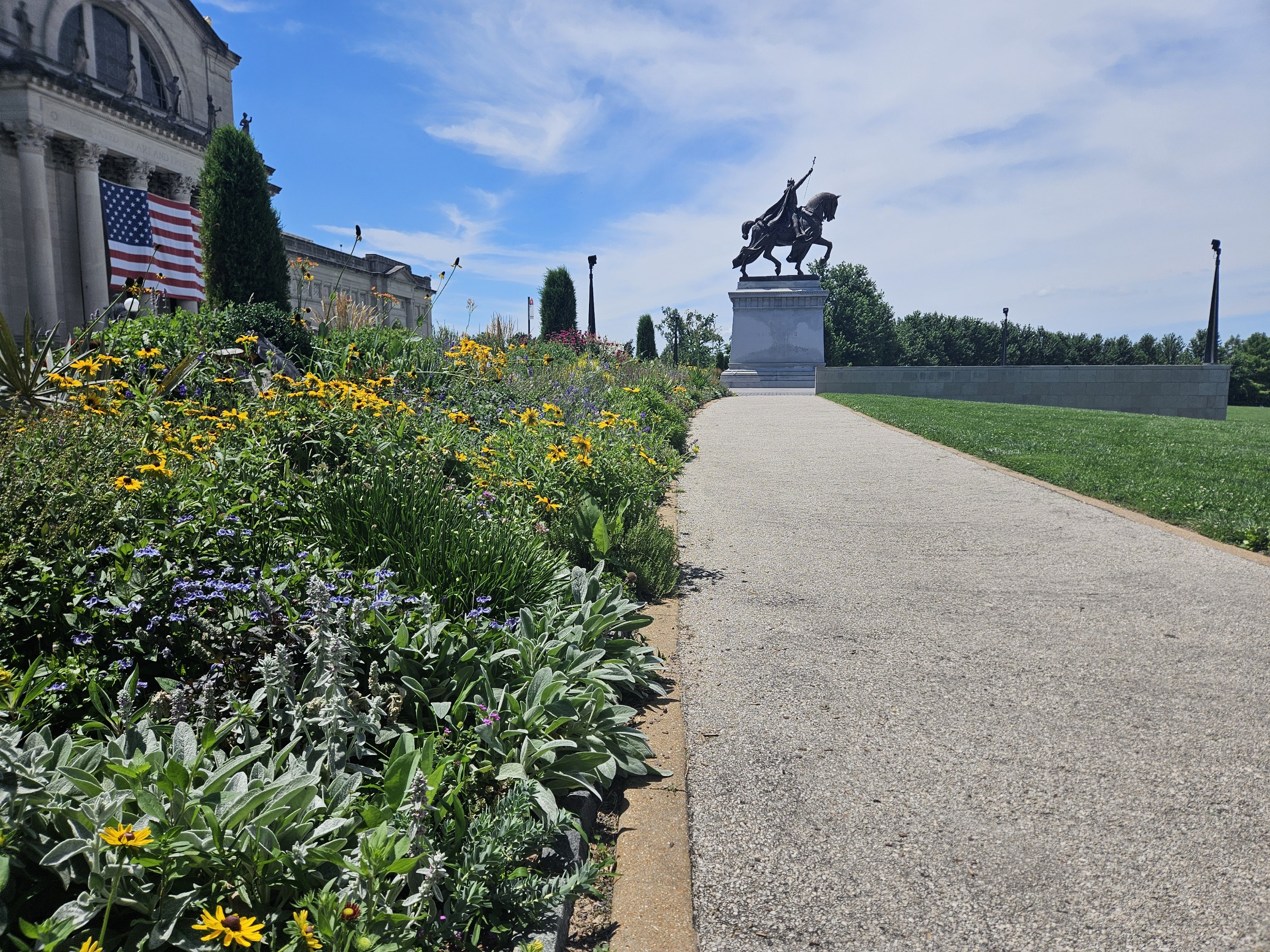
A stature of Saint Louis in front of a building with stone columns and an American Flag. A garden with yellow flowers separates the statue and the building.

One of the last things I did in the Midwest before departing yet again to yet another part of the country was to visit local museums.

I don’t go to museums as often as I’d like. It’s a practice I know is intellectually and culturally valuable for me and whichever community I’m in, but it’s one I tend to put off for something more familiar, like hiking or watching weird movies.

Sianne Ngai writes that criticism, in the artistic and literary sense, is a “conceptual justification for feeling based judgment.” Criticism is a way of organizing, articulating, and perhaps quantifying an emotional reaction to a particular artifact. This definition is satisfying to me because it retains a basic fact about criticism, that it is, at its heart, a subjective and emotional response, but without treating that fact as if it minimizes the value of criticism. A “conceptual justification for feeling based judgment” is more complex than simply stating which artifacts give me joy or disgust or boredom because it structures my ability to articulate why similar works evoke different responses, or the other way around.

I’m not going to try my hand at formal criticism here. I might try to justify my judgements, or my feelings, in a conceptual way, but the concept on my mind lately is a single verb, to move, as in, what moved me, and to where?

Movement has a religious connotation, which is why it’s on my mind. The most spiritual experiences I have felt have been in the context of learning about history. I am moved by learning about how my life is similar to the lives of people in the past, in different regions, in different cultures, in different languages, why the same stories about humility or sacrifice that moved people two thousand years ago move us today.

I found it moving to learn recently that medieval communities in rural Eastern Europe planted trees on the bases of mountains to reduce the impact of avalanches. I found it moving to visit the oldest city in the United States, Cahokia, one of the mound-building civilizations from the Mississippian peoples, and to stand at the top of the tallest mound and see the Saint Louis Arch in the distance. I was moved in the opposite direction by the constant sawing of traffic on the highway. Sometimes I am moved toward revulsion at how different I am from people who share my history, language, and culture, at their shallowness and desire for a smaller, flatter world.

That same day, I went to the Saint Louis Art Museum, a circuitous and immense museum originally founded in 1879 and in a wider plot of land featuring an intricate park, the ideal third space for an industrial city where thousands of people that day alone came for a bit of nature, culture, and community.

The SLAM had a display of Roman art from the time of Emperor Trajan on one floor. A standing exhibition featured extensive world-spanning displays of religious and cultural art from every continent across multiple floors, including the Strait of Torres in northern Australia, Indigenous works from coastal Alaska, pottery from Safavid Persia, and baroque woodwork from eighteenth century Austria. I got lost in a display of modern interior design. I lingered in a too-small exhibit of Art Deco paintings of working-class Saint Louis.

A museum is curated by someone else. I don’t have the freedom to start and stop where I want. The circuitry that takes me from Persia to Papua New Guinea to expressionism is a movement built in someone else’s vision of patterns and deviations that I have to trust. A curated museum isn’t personalized, nor does it cater to specific interests. It’s my loss if I don’t accept the curator’s vision.

In this way, a museum is like an essay, more than a novel or play, because it is a curation of artifacts from the real world organized for the audience to navigate. The essayist makes a map of experience in which the space between artifacts imposes meaning, like the Kuleshov effect in film, and so maybe a museum is a much more collaborative version of that process. I’m a broken record on this, but curation, curiosity, and care all share the same etymological root.

All of this was deeply moving (conceptually, spiritually) because each work of art was carefully placed in relation to other works of art, bundled for meaning and laid out in a labyrinth for everyone to follow. Every reader brings their own insight to the page, and in the museum, perhaps pacing is where the curator’s role ends and the viewer’s begin, how long I spend contemplating the lives of the people who made a ritual mask or a helmet or a painting of wheat farmers.

Something that should have moved me but did not: the museum’s America 250 display. I think it’s partly exhaustion, partly that I know the story so well already, partly that the story itself is so reduced to a handful of events and people that it feels like a smashcut of the greatest hits played on loop over and over again. The display itself was thoughtful and insightful, of course, but it didn’t move me the way an Art Deco rendition of the city did.

This country is very good at being a commercial for itself, at treating itself as a product and its people as customers. There’s a compelling argument already made that the category of customer has replaced that of the citizen. When I witness something celebrating the revolution, no matter how earnest, I’ve lost trust that it isn’t anything other than a commercial for a product, that my participation in this empire is an exchange that someone else profits from. American Revolutionary imagery doesn’t evoke patriotism or inspiration in part, I think, because it’s designed to minimize curiosity.

Darren Aronofksy’s AI-generated series depicting the American Revolution is a good example of this: An artificial version of events built on decades of digital interpretations drawn from the work of actual historians who are now fully removed from the process of historical accounting. No records, no unresolved question, no actual conflict, just a cartoonish visualization of an encyclopedia entry turned into a commodity. A shiny palimpsest of a palimpsest.

My day at the SLAM was free. Likewise, visiting the Lincoln Boyhood Memorial in Indiana was free with my father’s National Parks pass. It was moving to witness so much art. It was moving to talk about Robert Caro’s monumental and ongoing biography of LBJ with my dad where Lincoln grew up, to engage with the actual process of history instead of its distillation into a digital trading card, a sameness that is the same as all the other samenesses.

Maybe it was the distinctions that made the Saint Louis Arm Museum so moving. Nothing was the same, and yet it was because of that exchange of differences that I felt a deeper connection to the people involved in the production, preservation, and curation of art and history. The exchange of experiences (like the World Cup or film festivals or shows about restaurants or museums curated by actual curators) is more moving than an artificial rendering of the same experience again and again. I think that’s what moves me this time of year the most, the possibilities for living in a larger and larger world, of finding myself smaller and smaller the farther away I zoom out.
Ngai, Sianne. Theory of the Gimmick: Aesthetic Judgment and the Capitalist Form. Belknap Press, 2022.

Coffee: A Steamy Love Affair

Coffee Poet.jpg

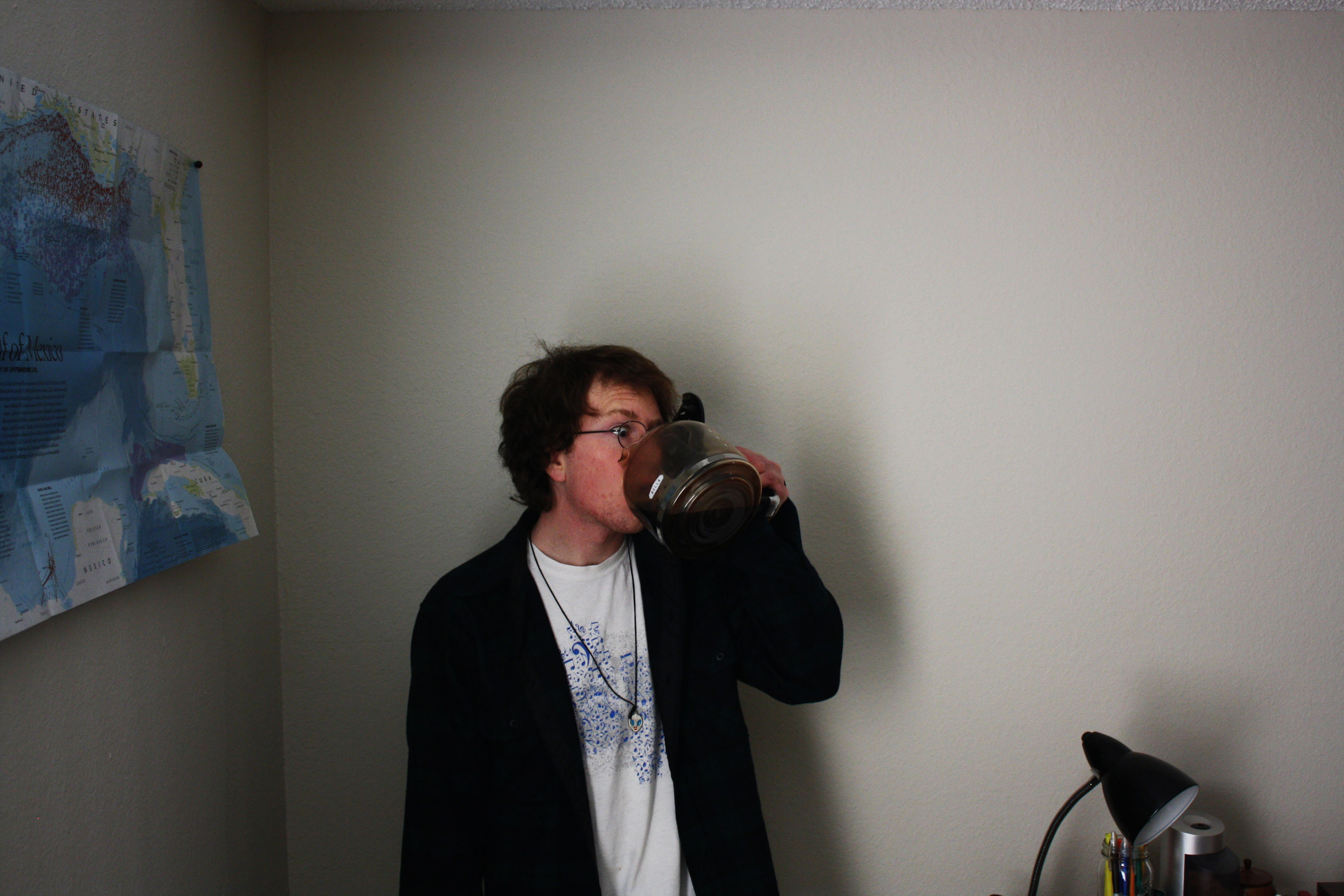
Those who know me know that I love coffee. Those who don’t know me can easily guess, thus far, that I have a moderate fondness for coffee. To be clear, I’m not picky; I like tea, cocoa, water, smoothies, milkshakes, juice. But coffee has a special place in my life.

I had my first cup in my high school cooking class. During one of the baking sessions, our teacher turned on the coffee pot near my station while our muffins were still in the oven. That’s when I had my first cup of caffeinated hot brown acidic water, filled with cream and sugar like most first-timers. After a while, I started drinking coffee whenever I cooked, then every morning, then every morning and afternoon, then several times a day. For a while, I got headaches when I didn’t consume any caffeine by 10:00 AM.

I’ve since become less addicted. I once considered giving it up for Lent but decided that not even Jesus would have gone that far. Nevertheless, I have cut back, and not just because I’ll probably have an ulcer by the age of twenty-six if I don’t.

There are coffee addicts and there are coffee lovers, and I want to be the latter. The difference between a violinist and someone with a violin is making every note a masterpiece. The difference between a chef and somebody who cooks every meal is mastering the kitchen’s tools and ingredients, and cooking with gusto rather than mere hunger. Anything can be an art, and the only way to become an artist is to inhabit a practice so fully that we infuse ourselves with it.

Everything about coffee is perfect to me, and if not I try to make it perfect. Espresso, lattes, dark roasts, light roasts, the smell of the beans, the feel of them in my fingers, the careful measurement of fresh grounds into the coffee pot, pouring the first cup, breathing in the scented steam before the first sip, and feeling it run down my throat hot and fresh, until it bounces around my stomach looking for a place to sit. I write with it; I read with it; I get to know people with it. It’s not for everyone, but it’s certainly for me, which is likely why I haven’t slept since 2015.

What practice or hobby or food do you love? Let me know in the comments!

-jk

P.S. If you thought the title was cheap, consider all the other possibilities I had to work with. Drip coffee was only a starting place.

When a Story Strikes

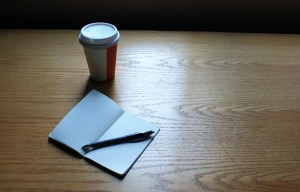
Blank PagesCreativity is sneaky; it can strike at the most inopportune moments, and writers need to be prepared. Writers can find inspiration while showering, cooking biscotti, giving back rubs, performing open heart surgery, or in my case all of the above simultaneously, and creative ideas can whither if not recorded quickly enough. Many writers, myself included, carry around small notebooks to salvage sudden ideas.
Sometimes, the best preparations fall short. While flying home this week, I was enjoying the on-flight complimentary burned coffee when something in my brain clicked, and an idea for a story crystallized.

Before I could pull out my notebook and pen, the plane began to shake. The pilot announced that we should remain seated through the turbulence, “even if you do like it shaken, not stirred.” My tray table lurched as I flipped to the next blank page and scribbled down every detail of my brilliant, wonderful story idea while it was still fresh.

Several hours later, as I waited for the shuttle to my hometown, I had a few spare moments to look back at the brilliant, wonderful, award-winning story idea. Instead, I found in my notebook a slim paragraph of what looked like ancient hieroglyphics. My handwriting is bad to begin with; add a jittery writing space and a lack of patience, and clarity is doomed. I could make out the words “old man” and “saucepan” amid the scribbles, but otherwise my brilliant, wonderful, paradigm-shifting story idea was illegible.

Rest in peace, story idea. I’m sure what I would have titled “The Old Man and the Saucepan” would have been excellent. In my rush to preserve it intact, I lost it entirely. As a writer, I should slow down sometimes. More importantly, I should learn to trust myself to utilize a half-formed idea. Even the best ideas I’ve recorded legibly have evolved. Art, after all, is a process of evolution, patient and sometimes careless. The key to producing good art is the ability to improvise. Now if you’ll excuse me, I have to clean biscotti dough out of my shower drain.

-jk

To Hear Hamlet (In a Cemetery)

Graveyard

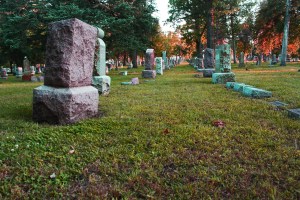
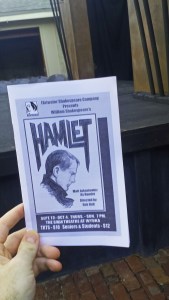
This weekend, I had the pleasure of seeing a live production of Hamlet by Lincoln’s Flatwater Shakespeare Company. The performance was held in the Swan Theater, which also happens to be in Lincoln’s historic Wyuka Cemetery. The show started at sunset; as the characters progressed into madness and scheming, the night grew darker and colder, and the full moon rose higher and higher. The experience was exhilarating.

Ham1As I’ve mentioned in previous posts, I love theater despite my minimal experience with it. Plays are not meant to be read, but seen, and heard. Words are powerful enough in print, but when given a voice, they have so much more power to move the audience. Some readers are familiar with how important voice is to me. I’m drawn to people with strong voices; to me, it’s the first part of attraction. I grew up caring about voice more than any other part of a person. Garrison Keillor’s rusty voice on the radio; the beautiful harmonies produced by folk singers, The Wailin’ Jennys or Peter, Paul, and Mary. Of course Renaissance theater isn’t for everyone; nothing is. But hearing Shakespeare’s words put to the instrumentation of a cast of strong voices makes it impossible for me not to enjoy those words.
But the experience of hearing Hamlet in a cemetery was even more gripping. When the ghost of Hamlet’s father appears, the audience is reminded that hundreds of ghosts are in the ground behind him. When Hamlet contemplates mortality, that undiscovered country, we are forced to remember that emigrants to that undiscovered country are just a few yards away. Finally, when a clown digs up a grave, tossing skulls out of the earth, we cannot help but think that an actual gravedigger is performing the same task, under the full moon. We are surrounded by actual skulls while Hamlet picks up Yorick’s skull; we are surrounded by actual corpses while Ophelia is placed in the grave.

The very ground the audience walks on to reach the stage is defined by mortality. The theatricality of undoing the grave’s permanence, of waking up the dead and gazing into their empty eye sockets, hits us uncomfortably close. The stage mocks the dead we struggle to leave hallowed; we depart from the performance facing the cemetery illuminated by a full moon wondering if our own skulls will be unburied, if a tragedy will be staged on the field we’re confined to.

In this case, the play’s the thing wherein the audience finds its own conscience, and as we all know, conscience does make cowards of us all. That’s the power of theater, and poetry, and art. It places mortality in our face and invites us to wonder. To look around. To investigate. To consider that soon we’ll be departing for an undiscovered country, and we can either go mad waiting in line for our plane ticket, or we can enjoy the graces the terminal has to offer. Thus conscience does make cowards of us all, unless we muster up the courage to laugh at all the skulls surrounding us. Why not laugh? Aye, there’s the rub.

-jk


A Novel That Sounds Like Bach

Typewriter musicStarting a new writing project can sometimes feel like latching onto an umbrella and jumping off a cliff, relying only on improvisation and plain luck to keep me from hitting the ground. The key difference is that, unlike jumping off a cliff, writing is a lot scarier.

The other day, I latched onto a good idea for a novel (lawyers, blogs, Texas). It’s since pulled me over the edge, and there’s no turning back. Fortunately, I have plenty to write about. I pull my inspiration from many sources, the authors I read, the people I talk with. One notion fueling this new novel is that I want it to read like the sonatas and partitas of J. S. Bach.

Of course prose and music are two different forms of art, but I’ve enjoyed listening to Bach for over ten years. I enjoy the deliberateness in his music. Nothing is superfluous, allowing the chord progressions to take center stage unhindered by a fixation with virtuosity, and I say this as a violinist who has personally dealt with the pretentiousness of virtuoso musicians and composers.

Instead, Bach patiently jogs along, sometimes as straight 8th notes for measure after measure. The emotions he conveys vary from movement to movement, but they always carry the same deliberate awareness, the same steady pace, putting focus on the chords rather than the structure. Similarly, I want to write prose that invites the reader to go on a run with it on an Autumn morning, that invites the reader to turn corners in an unfamiliar neighborhood but to keep running no matter what they encounter together. Ultimately, I hope to write something the reader can get along with easily, more a friend than a confusing professor. I admit that I am sometimes guilty of lecturing my readers in past stories.

I intend to listen to Bach’s sonatas and partitas while my fingers unravel this novel, but specifically I will listen to Chris Thile performing them on the mandolin. Bach wrote them for the violin, but I enjoy Thile’s rendition more. The timbre sounds more autumnal, more like raindrops or footsteps. And unless I get back to work writing, I may never see this idea to the end.

-jk

A Letter From Ludwig van Beethoven

Fiddle

On this day in 1827, Ludwig van Beethoven died at the age of 57. He completed nine symphonies, twelve concertos, numerous arrangements, sonatas, trios, and quartets. He was a prolific composer whose impact on the musical world and western art is immeasurable. He was young when be began to lose his hearing, and there was at least one distinct moment when he weighed the burden of his life against the value of his art. At that moment, Beethoven considered the possibility of ending his life.

In 1802, he moved to Heiligenstadt, a short distance from Vienna, to rest while facing the reality of his deafness. In October, he wrote a letter to his brothers Carl and Johann in which he expressed his grief and anguish over his loss of hearing, lamenting incidents when, for instance, a flute played but he could not hear it.  Of these incidents he wrote the following: “Little more and I would have put an end to my life –only art it was withheld me, as it seemed impossible to leave the world until I had produced all that I felt called upon me to produce.” He was twenty-eight years old when he wrote this letter, but kept it secret. It was only made public after his death.

I have always been fascinated and inspired by his reasoning to refrain from ending his life, that the world demanded he keep composing. I think of it as a humble and intellectually sophisticated approach to his struggle; he could not hear music, but his community could, and he felt he had an obligation to contribute. His life could continue so long as his ability to compose remained, even if he could only imagine the music he produced, the applause he received, and the praises of his family.

Although I find it inspiring that he allowed his art to take precedence over his misery, I wonder about other artists, musicians, and writers who chose to commit suicide. Could Ernest Hemingway have written one more novel? Was Sylvia Plath depleted of poems? What more would Vincent van Gogh have painted had he held out a few more years? I cannot speculate about most artists, but I know that if Beethoven had chosen to end his life when he seems to have considered it most seriously, we would not have his third symphony Eroica, his D Major violin concerto, or my favorite of his late string quartets.

I know too many people who contemplate suicide regularly. They are my close friends, loved ones, and colleagues. Today, I think, it is easy to romanticize Beethoven’s life and call him a tortured artist. In truth, there is nothing romantic about considering suicide. Most, if not all, writers who suffer from depression or bipolar disorder will tell you that it’s detrimental to creativity.  But despite the darkness that so many of us inhabit, I know many people for whom art is the only sustenance. I know poets, musicians, painters, and writers who contemplate suicide but feel joy and meaning in their creative outlets. For them, art is a necessity during the worst periods of depression, no matter how difficult creativity can become during those periods.

I don’t know if we can determine that Beethoven suffered depression by current medical standards, but I think more honestly we can say that he found himself questioning the value of life and decided that there existed something more important than, and yet at the same time dependent upon, his life. I think that this is a great paradox for artists: what sustains the artist is a product of the artist’s own efforts. It is a positive cycle. I know that when life no longer feels worth living, I can take comfort in Beethoven’s decision, and like him I can treat my life like the rough draft of a magnum opus.