Category Archives: Writing

“Don’t be a writer. Be writing.” -William Faulkner

Writers and the Easter Rising

IMG_5610

Arbour Hill, Dublin, where Patrick Pearse and other leaders of the Easter Rising are buried.

One hundred years ago today in Dublin, an Irish writer named Patrick Pearse stood on the steps of the General Post Office and read aloud the Proclamation of the Irish Republic on behalf of the Irish Republican Brotherhood, while revolutionary groups like the IRB and the women’s nationalist organization Cumann na mBan occupied Dublin and other locations in Ireland. Many of the revolutionaries were intellectuals, socialists, writers, stemming from different backgrounds; Patrick Pearse was a playwright and poet. Their goals included workers’ rights and women’s rights, alongside concerns that Britain would implement a military draft in Ireland to supplement its effort in the First World War. In the following week, known as the Easter Rising, the British responded as they often have when a colony declares independence: with excessive military force, which devastated Dublin and the rising’s core membership.

In the wake of the Rising, the British rounded up, arrested, and executed many of the rebellion’s leaders. Within a few weeks, the British executed much of Ireland’s intellectual community. Remaining leaders, such as Eamon de Valera, would go on to lead a more conservative Ireland, almost erasing the role of women and workers in the Irish Revolution from Ireland’s historical memory.

Patrick Pearse was executed on May 3. He joined what he believed was a just cause, and saw his responsibility not in writing, but in direct action, alongside other Irish writers, including the poet Joseph Plunkett.

IMG_5981

Thoor Ballylee

The poet William Butler Yeats felt differently. He sympathized with the IRB, but distanced himself from it before the Easter Rising. Some time after the Rising, he purchased a castle called Thoor Ballylee in rural western Ireland, where he placed himself both literally and figuratively above what would become the Irish War for Independence, Partition, and Civil War.

James Joyce had already relocated to the Continent, leaving Ireland behind physically but not artistically. Sean O’Casey, an Irish playwright, did not participate in the Easter Rising but would continue to write plays through the revolutionary period. While not all who participated in the Rising were executed, Britain’s heavy-handed response resulted in the deaths of numerous Irish writers, leaders, and thinkers. Meanwhile, writers who refused to participate allowed themselves more years to write, and therefore critique and contribute.

What is the role of writers in social change? In social upheaval? The Easter Rising may be an extreme example, but so was the American Revolution. What is a writer’s responsibility to a cause? It requires humility to surrender oneself to an active political movement, and a vast ego to situate oneself above the fray. But direct involvement is risky, and with the loss of intelligentsia comes the kind of one-sided leadership de Valera seemed to emphasize in the 1940s and 1950s when he found himself in charge of Ireland. Many American thinkers today threaten to leave the country if this or that candidate is elected president, but doing so abandons those Americans who cannot afford to leave to potentially brutal leadership that is suddenly without domestic criticism.

I try to be an activist, but I’m the first to admit I’m not very good at it, and that’s mostly because I can easily stop. If I wanted to, I could afford to escape into a pleasant countryside and write from afar; or I could join an activist group on the streets. I wish I knew which I would choose. All I know is that I admire Patrick Pearse’s bravery and humility in putting writing on hold for what he saw as a more admirable calling.

-jk
The Nine Circles of Term Paper Writing

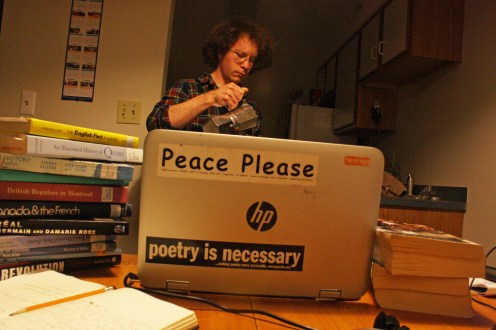
College students across the country are about to walk through hell, a hell of term papers and cramming and source-hunting. Many of you will not make it, but all of you can expect to pass through several of the dreaded Nine Circles of Term Paper Writing.

First is Limbo, otherwise known as procrastination. This is where most of you will die. Limbo is where you need fifteen cups of coffee before even looking at your sources, where you are forever logged into facebook no matter how hard you try to leave. It’s a place of endless scrolling, a place where the due date at the end of the tunnel is miles away. It takes a concentrated effort to work through this circle.

2

After sitting down to start, you will find yourself in Lust. Now you have a thesis that you want to prove, and it becomes an obsession. You really, really want to prove this wonderful thesis of yours. You want to prove it until the sun comes up. Maybe you want to write a postpostmodern analysis of the presidential race, or argue that Plato was just a whale’s intestine and Aristophanes actually wrote all his works. Whatever it is, it will consume you, no matter how ridiculous.

3

Moving on from Lust, you will find yourself in Gluttony. Here you will quench your desire to prove your thesis by binging on the various amenities college life offers: ramen noodles and your RA’s stash of confiscated alcohol. Gluttony tends to resurface throughout the rest of your journey.

4

Next comes Greed. Filled with calories and “inspired” by Rick the RA’s vodka, you will push yourself to secure more sources than needed. Your paper is on the American Revolution, but you will find a way to incorporate Mad Max into it. Or your paper is on Mad Max, and you just need the perfect Plato quote for the intro. If the sources and vodka don’t kill you, unless you revise extensively, your professors might.

5

Sobering up a bit, you will find yourself in Anger. In this circle, you are taunted by your computer screen showing that after three hours of work, you put your name as the title, misspelled the date, and have written nothing else. Filled with rage and sudden hunger, you will seek satisfaction by insulting your roommate who wrote his final papers last week like a total jerk.

6

Soon, you will find yourself passing through Heresy. Here, you begin to question things: the due date on the syllabus, the current day of the month, whether or not you need to pass this class. You even find yourself questioning petty things, like whether or not the nineteenth century even happened in the first place (it didn’t).

7

Failing to arrive at sufficient answers, you will move on to Violence. This circle will last only briefly, and if it doesn’t, your jerk roommate will bring Rick the RA in, and you’ll have to apologize and watch that jerk return to his video games while Rick cuts you off from the vodka like the dingo’s bladder he is.

8

Next comes Fraud. Seriously, run through this circle. Sprint through it. Fraud is perfectly acceptable in other circumstances, such as politics, banking, military spending, the EPA, trade regulations, local/state/federal elections, corporate taxes, government surveillance, international gambling rings, working as an RA in a dorm, and even important places like twitter, but it is not acceptable in an academic paper, so just move on to the next circle.

9

Finally, you will come to Treachery. By now you have a paragraph of rewritten thesis statements that somehow ended up in second-person plural. You remove every instance of “all ya’ll” from your intro and realize that your problems all started with procrastination. This is where you realize that you have betrayed yourself by putting off this paper for so long. Maybe you spent too much time blogging and taking stupid pictures of yourself for your blog. Who knows? Whatever the case, you have procrastinated yourself into a hole, and procrastination is a terrible way to climb back out. So you slap yourself in the face and focus all your attention on one valiant goal: a high C. After this, you vow to never procrastinate so much again, just like last semester. But this time it’s for real.

10

To my fellow academics, happy End of the Semester. Now stop wasting time reading this and get back to work.

-jk

Some Kind of Blogging Award

sunshine-blogger-awardI’m honored that fellow blogger Charles French has recognized me for the Sunshine Blogger Award (even though it’s completely overcast and raining in Lincoln right now). Nevertheless, I’m very thankful for the recognition! I’ve never actually received one of these blogging awards I’ve heard so much about, but from what I gather, they are ways to recognize other bloggers for doing cool things (or tasty or artsy or sciencey things, depending on context).

The Rules for the award:

1. Thank the person that nominated you.

2. Answer the 11 questions from your nominator.

3. Nominate and notify 11 bloggers.

4. Give them 11 questions to answer.

The questions I was given, and my answers, are as follows:

1.) If you could visit any country that you have never been to, where would you go? I’ve always wanted to visit Afghanistan.

2.) What is your favorite book? Impossible to name just one, so I’ll split it between fiction (Sum by David Eagleman), poetry (The Iraqi Nights by Dunya Mikhail), and drama (Wit by Margaret Edson).

3.) Coffee or tea? While I enjoy both, I strongly prefer coffee.

4.) What is your favorite meal of the day? Breakfast. It combines waffles, coffee, syrup, coffee, and powdered sugar, in my coffee.

5.) What do you think is the most pressing issue of the day? I think climate change is the most pressing issue of the day, which is why I’m voting for Treebeard of the Ent Party this election, on a platform of reforestation and smashing society with large boulders. #feeltheboulders

6.) Are you a day or night person? I’m a morning person, until only a few weeks are left in the semester, at which point I stay awake day and night cramming.

7.) What is your favorite snack? Cheese quesadilla with diced bell peppers (plus coffee).

8.) What is the time period for which you have the most interest? I’m most interested in the period immediately after the Second World War and the beginning of the Cold War, but the inter-war period (1918-1939) is a close second.

9.) Movie or live theater? I’ve come to enjoy live theater more and more in recent years.

10.) What is your favorite season? I love winter, and I’m not sure if that’s because I’m a romantic introvert or just like it when everything is cold and dead. I’ll say the first one.

11.) Dog or cat? Again, while I enjoy both, dogs are obviously superior to cats in every way and fill me with immeasurable joy.

Now I need to nominate more bloggers. I’m choosing blogs I always look forward to reading, ones I find delightful and thoughtful. My list is as follows:

Hanna McCall at https://proofreaderhannah.com/

The Twenty Something Social Recluse

Annamarie Carlson at https://annamarieabroad.wordpress.com/

Lois Elsden

Robert Okaji at O At the Edges

Hummings

Simon Bowler at https://simonbowlerphotos.wordpress.com/

M Weaver at https://sorrysongbird.wordpress.com/

J. W. Eberle at https://jweberle.com/

Chris Helzer at The Prairie Ecologist

Lizzy Nichols at The Lizzysaurus

My questions, if you choose to accept, are as follows:

  1. What book are you reading now, or are eager to start?
  2. What music do you listen to while working (if anything)?
  3. What is the most useful tool for your work or hobbies?
  4. The Grim Reaper rings your doorbell; you challenge the Reaper to a board game, and if you win you won’t be taken to Hades; what board game do you choose?
  5. What is your ideal pet (apart from a domesticated Grim Reaper)?
  6. Is there a past (or future) decade for which you are nostalgic? If so, what and why?
  7. What is your best method for coping with stress? (I swear I’m not asking because I’m stressed. I swear).
  8. How do you celebrate a major achievement or accomplishment?
  9. What is your preferred mode of transportation (bike, plane, feet, racing team of twelve congresspeople tied to a sled, etc.)?
  10. Where do you do most of your work (home, office, school department, coffee shop, in a sled pulled by twelve congresspeople)?
  11. And lastly, how much wood could a woodchuck chuck if a woodchuck could get a law degree from Harvard and join a lobby group on behalf of small locally owned and operated woodchucking facilities and successfully bring down Big Wood and their death grip on the international woodchucking industry?

Peace and happy blogging,

-jk


Short Story Published in Circa

sparks upI’m pleased to announce that my short story “The End of Akrotiri” has been published in Circa, an excellent online journal of historical fiction. The story is about life in a historical Bronze Age Aegean site called Akrotiri before it was destroyed during the eruption of Thera in the 1600s BCE. I would be honored if you took a gander at it, and please check out the other stories I have the privilege of sharing this volume with.
This story is also a taste of what I intend to be my Master’s Thesis: a collection of short historical fiction stories set in different moments of cataclysm and transition. I want to explore varying forms of intimacy between people and places as ways of transcending climactic turmoil. But these are all details for my committee. For now, just enjoy a gentle, loving story about a volcanic eruption that killed everyone everywhere.

-jk

P.S. I listened to “All Used Up” by the wonderful Utah Phillips and “Funtimes in Babylon by Father John Misty while writing and revising this story. Neither of these songs have anything to do with ancient Greek volcanoes, but they did put me in the right mood for writing about the end of the world.

Broken Strings

Today is World Poetry Day, and by tradition on this blog (after having done it once), I’ll celebrate by posting an original poem. But today isn’t just about writing poetry; it’s about reading it. Currently, I’m enjoying Brandon Som’s The Tribute Horse. Let me know in the comments what poetry you’re reading, and I hope you enjoy my own contribution. If not, I have others.

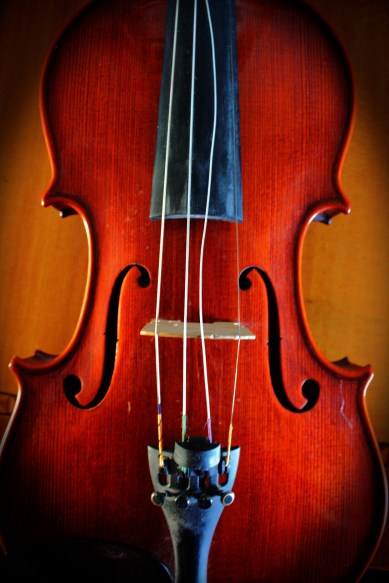
Fiddle

Violins are such distraught instruments,
attention-hungry, stage-front and fraught with stage fright
as they demand burning strings with match-striking speed,
snapping bow hairs. When violinists listen
they can hear the glue dry on the tuning pegs,
can hear the instrument creak under the pressure
of a perfect performance, and still audiences almost never see
the violin at home. The smallest things do the worst damage;
a change in weather alone can pop a string. In silence
they release the pressure; tuning pegs unwind
letting out the strings, freeing them from the chipped bridge.
Violinists anthropomorphized these tools, naming them with anatomy,
the neck and body, not for the romance of it
but to transplant their body’s torment onto an instrument,
to make it suffer with them.
How frail the off-stage violin can be,
letting small things gnaw at it from the inside out,
allowing snowflake-sized details to warp its wood, melt its glue.
But these things are easy to fix. I can tune a violin
but what of the violinist? What of the audience? The streets?
Can we fine tune the weather to make the planet ripe again?
It doesn’t take a petition to tune an instrument
or social media campaigns to rosin a bow.
I can fix a broken string, but there my skills end
in the wake of so many other broken things,
cities, hearts, correspondences, futures. I can mend an instrument
held together and torn apart again by chance,
but for all the brokenness I can only marvel
at musicians with stage presence and their perfect instruments
that never need tweaking, never gather yellow layers of rosin dust,
never slide out of tune with the changing seasons
the way mine always seems to these days.

Copyright Keene Short, 2016.


Comfort in a Cookie

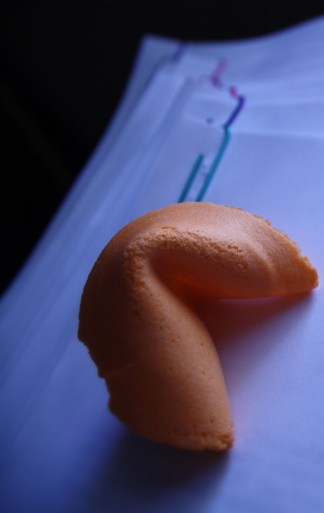
You Are Not What You EatFor an exercise in my fiction workshop, each student was given a fortune cookie and asked to interact with it. We interacted: we broke them, read the fortunes, nibbled on the cookie chunks or chomped them down in one bite. The exercise was about magical thinking in our own lives and our readers’ lives, and how stories so often rely upon the magic of symbols, the mystical confluence of coincidences. Despite of our capacity for logic, we often attach special meaning to mundane things.

I wanted to resist that superstitious behavior. I am, after all, a pretentious English Major, cold and unfeeling, so I instinctively dismiss all fortunes found in cookies, or any other bourgeois baked goods.

In this class, we have also discussed publication (and lack thereof) at great length. “Writing is an industry of rejection,” the instructor has pointed out. While we try to have thick skin, rejections pile up and start to hurt. So when I read my fortune, I will admit that for a moment I gave into magical thinking:

You will soon be receiving some good written news.

It could have been written just for me. Why not? Why can’t I find a little comfort in a cookie? Most writers know to take rejections in stride, but it’s difficult to take for so long, so why not admit that I wanted some factory-produced strip of paper to let me know that if I wait just a moment longer, I’ll get a big publication in a well-known journal?

After class yesterday, I checked my email, and was surprised to find a response from a literary journal I’d sent a collection of environmental poems to back in December. My heart skipped a beat as I read the email quickly, and to my utter amazement, the journal rejected the poems.

Maybe you thought for a moment that I got a big publication. I’d hoped so, too. Maybe I’ve just demonstrated how easily I can connect an arbitrary object (a fortune cookie) with the right combination of values and aspirations lurking in you, the reader. Or maybe not. Perhaps I’ve manipulated your own experience with rejection, especially if you’re a writer. This is an industry of rejection, and good fortune doesn’t correlate with publication. I’ll keep submitting, and I’ll keep writing and revising, and every now and then I’ll allow myself the comfort of dreaming that maybe, just maybe, I’ll get some good written news.

Fellow writers, how do you cope with rejections? Or have you fortuitously gotten any publications lately? Let me know in the comments, and spread the writerly love.

-jk

Making Sense of the Things We Love

books 3

It’s early on a Saturday morning in Albuquerque, New Mexico, and scholars wander around with free coffee in their hands to one of a dozen panels in one of many sessions in the Southwest Popular/American Culture Association Conference. Topics range from The Grateful Dead to Motor Culture to Film and History. I attend one on Sci-Fi and Fantasy during this session.

The two papers presented are on Jim Henson’s fantasy films (such as Labyrinth, featuring David Bowie) and the television program Ancient Aliens. The second speaker states that he loves Ancient Aliens, and though he refrains from using the phrase “guilty pleasure,” it’s clear from his analysis that he agrees with none of the theories put forward on the program. Instead, he critiques the faulty logic and Euro-centric rhetoric while simultaneously praising the show for trying to subvert the idea that hard-fixed academia is the only source of knowledge. The speaker also points out that the show is outside his academic field. His paper is simply an attempt to make sense of something he loves, and that the whole conference is about people making sense of things they love.

I find that sentiment reassuring. It proves to me something I’d suspected, that pleasure and criticism are not mutually exclusive. Speakers stepped out of their fields of immediate interest to talk about their favorite movies, books, TV shows, music, and the pop culture they love, not to ridicule it but to analyze it.

Almost entirely absent from the conference is a kind of academic elitism that I’ve encountered more and more lately, a hierarchy placing scholars above fans. Obviously, scholars do not need to enjoy everything we analyze (I’m looking at you, James Fenimore Cooper), and maybe we do not need to analyze everything we enjoy (though for an academic, that is very hard to do). Nevertheless, there are many academics who believe that the ability to criticize makes them superior to others.

The conference proved fans and academics can inhabit the same space equally. There were very few moments when scholars looked down on anybody for enjoying pop culture. There was no status involved in the academia; it was communal, friendly, positive, constructive, and creative, qualities I’ve found myself missing in academia lately.

Being critical does not make me better than others. It may give me a more nuanced perspective, but more accurately, I think, it gives me a differently nuanced perspective. With few exceptions, nobody is better than anybody for anything; the rigid hierarchies I’ve encountered so often separating students from faculty, graduate from undergraduate, critic from fan, are unnecessary and unhealthy. I’m pleased to have found a space where fans and critics are on equal footing, where people can be both at the same time. I’m glad to find a place where the egotism that drives much of academia is suspended, and criticism and enjoyment work hand-in-hand.

-jk

Reading at the Southwest Popular/American Culture Association Conference

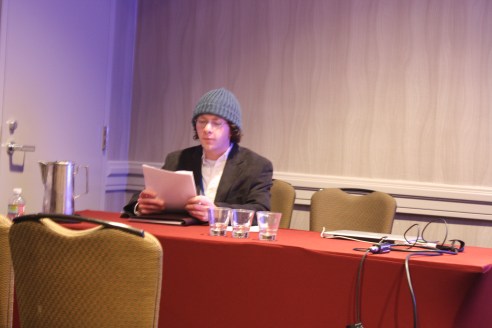
In other news, I read some poetry at a big fancy academic conference.

index

This week, scholars, musicians, writers, film critics, professors, fans of The Grateful Dead, zombie fanatics, pop culture critics and lovers (one in the same, here) flocked to Albuquerque, New Mexico, to discuss their ideas, share their theses, their creative works, their analysis of other people’s creative works, and generally enjoy the spirit of popular culture.

In one day alone, I’ve heard scholar/fans discuss the relationship between Rick and Morty in Rick and Morty, compare Jurassic World and the TV series Zoo, analyze countless horror movies (from Poltergeist to The Babadook), explore various media’s fixation with underage serial killers, give two different interpretations of David Cronenberg’s eXistenZ, explore the role of nature as a setting in The Walking Dead, critique consumer culture in prepper magazines and the capitalist frenzy to buy things before the coming apocalypse, and read a variety of poetry.

IMG_2210.JPG

Reading my own work for an audience was not entirely new to me; I’ve made use of open-mic nights and poetry slams now and again. This venue certainly was new to me, though, but I don’t want readers to assume that I think a conference is somehow better than a slam. Poetry is meant to be read out loud, and all venues are equally worthy and professional; poetry slams are just as important as big fancy academic conferences. But here, my audience differs, and the tone is more critical, more focused on poetry within popular culture rather than poetry alone. Where else can I backup a poem about the end of the world with information I’d heard half an hour before?

I’m centered in the academic world, and this is an academic pilgrimage that I’m honored to take. Reading in front of a live audience, of course, is terrifying, but also thrilling, and I hope to enjoy that thrill again soon.

There are still plenty of days left in the conference, and there is more to come.

-jk


Tales From the Thrift Store

ThriftyI can’t remember the last time I went shopping for clothes. I still wear most of the same things I had in high school and hoped that my minimal wardrobe would last forever when I moved to Lincoln. After losing forty-two buttons, an unfortunate mishap involving bleach, and then proceeding to lose a significant amount of weight in Lincoln by switching to a diet of mostly oxygen and hydrogen, I realized finally that I’m starting to look a little weird in my old clothes. So yesterday, I trekked through the aftermath of Nebraska’s most recent snowstorm to a row of thrift stores downtown, just to take a look around.
For environmental and humanitarian reasons, I will only ever purchase used clothes. The damage has already been done, slave labor already used, Jesus has already cried his usual tears of blood, and at least fourteen MORE elephants won’t be killed in order for me to possess a belt.

As I searched desperately for clothes to fit a short bony dude with a disproportionately big head (which is why I sometimes look like an extraterrestrial), I wondered about the donators. About the reasons for donating. There were stories behind every article of clothing I perused. Maybe a nasty divorce prompted a disappointed man to donate all the ties his ex-wife gave him; maybe a widow donated her husband’s shirts after he took a bullet in Afghanistan; maybe somebody decided he had too many jeans; maybe he gained weight or lost closet space. It’s easy to imprint little fictions onto these old items. It’s fun, even, to wonder about who owned this pair of pink sunglasses or that tacky gold and green parrot-covered sports jacket. I’m a part of the narrative too; everything I give and take changes the equation. I’m an actor in the saga of the exchange of used clothes, and therefore the exchange of unwritten mysteries.

Or so I’d like to think. There may be mysteries, but I’ll never solve them. I may never even figure out the premise. What really matters is that now I can read at a conference in a neon green sports jacket with gold leather sleeves and smiling parrots patterned across the whole thing.

-jk

A Public Apology From This Blog

FOE

It has come to my attention that there is a slight possibility that some readers of this blog might find my portrayal of writers to be unfair.

It was not my intention to portray writers as living in the excesses of caffeine, alcohol, or both, or as people who experiment with certain stimulants that some states have outlawed. I did not intend to give the impression that writers are difficult people who have trouble coping with rejection, or that they have limited social skills. I also had no intention of portraying writers as hyper-critical egomaniacs who write for revenge, and who publish unflattering stories about their friends and families when they feel resentful of their almost constant sense of rejection by publishers, friends, strangers, and that guy at the bookstore with the mustache.

Additionally, it was not my intention to portray writers as the kind of people who use creative writing workshops as a means to external validation by submitting work that has already been accepted for publication, to insist upon the value and merit of their submitted workshop material on the basis that it has been accepted for publication, while simultaneously engaging in pretentious, esoteric discussions of craft that have little, if anything, to do with the actual content of their peers’ work, leading their peers, instructors, loved ones, and Rick from the bookstore to question if they ever actually read their peers’ work and merely have a list of bland, useless comments that can easily apply to any written work, or as people who spend their time rubbing their toes on others’ property and rummaging through Rick’s medicine cabinet when he’s not looking, and who drunk text their lovers at 2:34 in the morning while standing outside Rick’s house and wondering why Marsha’s car is there, or as the sort of people who deliberately loan you their sunglasses when they have pinkeye and leave their beard shavings in your glove compartment.

It was not my intention to portray writers this way, but I can understand why some readers might think that I had such an agenda in mind.

While I’m at it, my lawyers inform me I should apologize for my portrayal of historians. Any interpretation of historians, based on this blog, as resentful, conceited, pretentious, hyper-liberal anti-social Harvard rejects who hate their countries and take pleasure in reducing anybody’s joy in holidays to a crime against humanity and who spend their free time burning copies of the U.S. Constitution in their backyards in their underwear in a massive green cloud of pot smoke, is merely a misunderstanding.

As always, I thank you for your concerns about my portrayal of people on this blog.

-jk