Author Archives: keeneshort

Unknown's avatar

About keeneshort

I am a writer in Southern Indiana.

Once Upon a Time, Graduation Meant Something

Empty It finally happened. I graduated. I shook hands with the Dean of Arts and Letters and some of my favorite literature professors, and was handed a fancy diploma case for after the real one arrives in the mail. I went through the whole ritual, but when I left the Skydome amidst Flagstaff’s annual early-May snowstorm, I felt about as empty as the diploma case they gave me.

Most of my friends and family expect graduation to be a time of great joy, relief, sadness, and memory. I reflected on many things, but I tend to be reflective in general. For me, graduation offered no profundity. It was a mess of finding the right place, shaking the right hands, and enduring vague speeches about the future. Walking onto stage, having my name (and other information) announced, and receiving a diploma case should have been meaningful experiences, but I couldn’t keep myself from thinking that it was all a show.

Commencement was a self-congratulatory performance for the university, and the profiteering involved in the current education system was not only evident but ever-present. All students were required to have a cap and gown to participate in commencement, and the only way to obtain them, short of cheating and borrowing them from a friend, is to purchase them from a company; I was among those who cheated. After receiving an empty diploma case, students were ushered into two photo shoots. I was literally pulled into position, but I cannot get any of the photos taken unless I spend more money to purchase them. The commencement speeches had nothing to do with any of our own problems, our crippling student debts, an unnavigable job market, a scary world with an even scarier future. Instead, the speeches were about the university’s accomplishments, its growth and benefits, all at our expense.

College is no longer about advancing art and science and law; it’s become a business for the corporations benefiting from the on-campus dining, the corporations who make and sell caps and gowns, the construction companies profiting on new buildings the school can’t afford without cutting valuable tutoring and learning initiative programs. Education is one of the most important assets of the modern world, but the education system has become a method of exploitation.

All through commencement, I felt exploited. That’s not to suggest I did not receive an adequate education. Indeed, my professors exceeded my expectations, and they’ve changed me immeasurably. But college, as a system, profits regardless of anybody’s intellectual, scientific, artistic, political, technical, or social improvement. Instead, it encourages us to bankrupt ourselves so it can grow. In the end, NAU’s leaders do not care whether or not I graduate; they care about getting my money, and that realization hurts. I’m fortunate to have worked with professors who sincerely value their students’ collective improvement, to the point that they run themselves into the ground physically and emotionally by the end of each semester just to help us. But NAU, and the modern college-industrial complex, has done little, if anything, to contribute to its students’ intellectual improvements. I owe nothing to my university, but I do not blame it. This is a national pattern, and all of us are caught up in it. How long will it last? How long can it last before students realize that they are on a conveyer belt for the profit of private firms with no investment in literature, law, environmental science, political science, understanding globalization, or the development of compassion?

And now I’m going to pursue a graduate degree at the University of Nebraska-Lincoln. Now I’m plunging myself back into the factory.

Am I wrong about all this? Is it not the case that my friends have been placed on a conveyer belt for the past four years? For the next fifteen? Will the education system ever be returned to the hands of the educators and not the businesses? In a perfect world, the students gain more from a four-year program than the university they attend; we’ll never make it to a perfect world, but I think we deserve more than we’ve been given. We are more than crops with full pockets to harvest from. We are more than fruit to be drained and dried. We are scared, we are angry, we are curious, and we seek understanding. We are passionate and seek the means to express. We are knowledgeable and seek to use our knowledge. We deserve to be treated honestly about what we’ve been given, what we can do, and where we are going. Although I’m disappointed in my graduation, my university, and my country for voting the universities into such positions, I’m far from disheartened. Behind the curtain and the profiteering are professors who still work hard to teach and improve us. It is because of these professors that I have the means to express my discontent, and it is only through these means that I see any possibility for change.

-jk

A Brief Note About the Best Weekend of the Year*

*or, That Time I Went to the Association of Writers and Writing Programs 2015 Conference in Minneapolis

Conference 1

“Listen to the language you start with in the first paragraphs. That will shape the rest of the story more than you are aware.” –Pamela Painter on first drafts.

Every year, thousands of writing programs, small presses and literary magazines, publishing companies, writers new and old, writing teachers, and students flock together to share their books, writing programs, new releases, and innovations in the literary community. Thanks to the NAU Honors Program, I joined several friends in attending the conference, and it was one of the most beneficial experiences of my academic life.

“The MFA program is useful because it’s a break from the capitalist shitstorm. It lets you work without giving you black lung, and lets you focus on writing. The problem is that it doesn’t prepare you for life back in the capitalist shitstorm after it’s over.” –Claire Vaye Watkins.

Conference 2

Despite our travel plans going wrong, we made it. Because Arizona does not acknowledge daylight savings time  (but Greyhound does), we missed our bus by an hour. We decided to take a shuttle to Phoenix and ended up taking two different shuttles an hour apart, but eventually gathered in Sky Harbor with enough time to bankrupt ourselves from airport food. By late afternoon and with much applause, we landed in Minneapolis, Minnesota, amidst rain and snow.

“One of the hardest things for an Arab to accomplish is to live apolitically.” –Hayan Charara on whether or not writing should be political.

The conference has two features, an exhaustive list of panels and a colossal book fair. I spent most of my time in the less popular conferences, and tried to explore as rich and diverse a selection of topics as possible:

conference swagLiterature from communities in diaspora, featuring Vietnamese-, Korean-, and Arab-American writers; a reading of flash fiction, from six-word memoirs to 1,000-word short-shorts; a reading from Cuban poet Víctor Rodríguez Núñez and a signing of his newest collection With a Strange Scent of World; a set of memoir readings from U.S. veterans of the wars in Iraq and Afghanistan; a discussion on translating Brazilian minority poets; a lengthy discussion from MFA teachers about the usefulness of seeking an MFA in Creative Writing in the first place; a panel on the usefulness of historical fiction and the rules one can break with it; a beautiful poetry reading from Iranian Farzaneh Milani, Syrian Mohja Khaf, and Iraqi Dunya Mikhail plus a list of historical women poets in the Arab-speaking world; a panel on writing as advocacy; and a reading of creative nonfiction about the value of speculation in nonfiction works.

“The ‘other’ for the writer is simply everyone.” –Elizabeth Kadetsky on the relationship between writers and the world.

The conference reinvigorated my love of writing, but unmasked a great many myths and expectations upon which I had previously built my understanding of the writing life. I now understand that the MFA racket is not all it’s cracked up to be; though certainly useful if applied correctly, MFAs are neither necessary nor financially sustainable if one wants to be a writer. I now have a greater appreciation for the need for good translators, and how deeply politicized translations can become when meaning and identity are at stake crossing the thresholds between languages. Flash fiction is more than an exercise in economizing language but a growing form of art itself.

Lastly, and most importantly, being a lone writer, while romantic, is terrible; good writing can only ever come from the experiences a writer internalizes and interprets, so I must accumulate as many experiences as possible, good, unpleasant, awkward, funny, humiliating, beautiful, terrifying, or calming. Time is not what I need as a writer; a community of friends, loved ones, people who inspire me, are what I really need. This trip generated more ideas for stories than anything I’ve done inside a classroom, and it is to my friends that I owe my ability to write, if I can say I possess such an ability in the first place.

friends

-jk

The Case of the Empty Inbox

The Vast Unknown In December, I submitted five short stories to small literary presses and journals for potential publication. One sent me a rejection within a week, but the rest took their time. Four months later, I had received one new rejection, leaving three still looking over my work or letting it rust in a fat stack of emails from countless other writers.

Curious about the long wait, I looked up each remaining journal to check the reading periods, see if they posted information about a delay, or (I vainly hoped) had published my work and simply forgot to tell me. I remembered that one journal had not sent a confirmation email, and I discovered that it was no longer active, and indeed no longer available. Their links on databases for writers only took me to empty Could Not Be Found pages. Information about it existed on other sites, blogs, and five-year-old lists of calls for submissions, but the journal itself was simply gone. I know it was up and running in December when I sat at a cold kitchen table adjusting my cover letter and drinking Christmas-gift coffee. It’s not surprising that small online journals struggle, even stop publishing, but what would prompt it to vanish from the face of the Internet?

Somewhere in the foggy bays of the web sits an email containing a short story, a cover letter, and my name at the bottom. Is it still drifting along in the electronic waves, lost forever? Did it find itself to the inbox before the editors abandoned their little island? Did anybody bother to unpack the document in its cargo? Did other emails not make it in time and drift away into the darkness? I once read a sample of short stories and poems from this journal, not only defunct but scuttled and drowned, without proof that anybody once perused its archives, and it’s a bit spooky. I will probably never know why the little journal disappeared. The mystery may go unsolved forever.

-jk

Muhammad ‘Abduh and Egyptian Islamic Reform

Note: I was offered the opportunity to present a paper at the Middle Eastern and North African Studies Undergraduate Conference at the University of Arizona, but have had numerous cases of the flu since December and the worst case yet hit the day before the conference. As such, I cancelled my presentation, to my immense regret and disappointment, but have decided to post a much briefer version here. Thank you for reading.

Contemporary western discourse on Islam often impose a liberal-conservative, moderate-extremist dichotomy on the Muslim world, ignoring local, idiosyncratic contexts. For instance, such discourse labels the Muslim Brotherhood as a conservative organization, and the Egyptian theologian Muhammad ‘Abduh as a liberal counterexample. The measuring stick western media use, however, is how willing Muslims are to accommodate western influence. ‘Abduh is often seen as sympathetic to western influence, but his political and religious goals were effectively those of the Muslim Brotherhood–to bring the community of believers back to a more authentic practice of Islam because the community has strayed and allowed unlawful innovation.
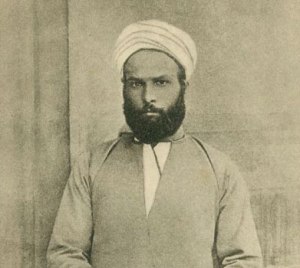
Abduh

Muhammad ‘Abduh

The youngest child of a rural farmer, ‘Abduh was born in 1849 in a village called Mahallat Nasr, on the Egyptian Nile Delta, into a middle-class family. Egypt was under a series of economic reforms first initiated by Muhammad Ali, a military leader who wanted to industrialize Egypt like Europe. His economic reforms benefited peasants, including ‘Abduh’s father, and those benefits allowed ‘Abduh to leave his rural home to become an Islamic scholar, or ‘alim. ‘Abduh showed much potential; he reportedly memorized the Qur’an at the age of ten. At thirteen, he went to study at the Ahmadi Mosque at Tanta, and later the University of al-Azhar in Cairo. However, ‘Abduh’s experience with the traditional education system was disappointing. The outdated practice of having students memorize centuries-old commentaries on the Qur’an and Hadith frustrated him to the point that he ran away from school multiple times, returning only when his father forced him back.

In addition to his formal education, ‘Abduh received an informal education with his uncle Shaykh Darwish, whom he visited when he was not in school. Darwish had a profound influence on ‘Abduh. He was a Sufi mystic familiar with several North African Sufi Brotherhoods, such as the Sanusiyya and the Tajiniyya, which emphasized an important concept in Islamic discourse, ijtihad, or independent reasoning. Ijtihad allows scholars to rely upon their own reasoning to answer questions. It departs from the method employed at al-Azhar at the time, called taqlid, or reliance upon set precedence, which requires scholars to defer to previously established commentaries, most of which came from the medieval period. While not opposites, ijtihad and taqlid differ greatly from one another, but ‘Abduh learned both simultaneously.

‘Abduh’s two educations coincided. While he continued to tolerate the outdated methods at al-Azhar, he learned from his Sufi uncle who taught mysticism, asceticism, and individual reasoning. These two educations showed ‘Abduh two extremes, the dilapidated structure of Islamic learning in a weakened Egypt trying to imitate Europe, and the informal, thoughtful, and intimate education of Sufi Brotherhoods.
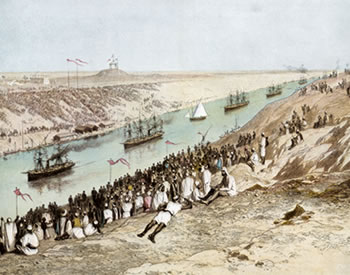
Suez Canal

Painting of the Suez Canal

Meanwhile, Egypt fell into an economic crisis. The Khedive, Isma’il Pasha, turned to European investors to help with the expensive construction of the Suez Canal. These investors, mostly British and French, took an increasingly demanding role in all of Egypt’s economic affairs after the Canal’s 1869 opening. The British exerted more and more control over the Egyptian state, at a time when European powers imposed colonial administration over much of the Islamic world. Many Muslim scholars turned their attention to the threat of Europeanization (taghrib). These scholars traveled, wrote, and publicly spoke about religious reform against colonial authority. One well-established scholar, Jamal al-Din al-Afghani, met ‘Abduh while he was still a student at al-Azhar. In their meeting, they discussed Qur’anic exegesis and theology, and ‘Abduh became one of al-Afghani’s most devoted students.

As the political situation in Egypt worsened, ‘Abduh turned to the press and became politically active. Eventually becoming the chief editor of the Egyptian Official Gazette (Al-Waqai al-Misriya), ‘Abduh published numerous articles critical of what he saw as the most damaging facet of Egypt and the Islamic world: unchecked deference to authority. Taqlid and Europeanization were equally dangerous; ‘Abduh criticized the local ‘ulema for their “obsolete and rambling” denouncements of rubbing alcohol while the British exerted control over Egypt’s finances. Both parties, he argued, were responsible for Egypt’s problems.

Battle of Tel El Kebir 1882

The Battle of Tel-El-Kebir, 1882, leading to the British defeat of the Urabis

‘Abduh and al-Afghani were part of a nationalist movement in Egypt in the 1870s, which culminated in a militant revolt against the British authorities in 1879. Led by Ahmed Urabi, the revolt briefly established a new government in Egypt. ‘Abduh criticized the revolt but nevertheless offered his support through the press in the hopes that all Egyptians would unite under a movement to throw off British control. The Urabi Government, however, ended in 1882 when the British invaded, installed a colonial regime, and exiled of the revolt’s supporters, including ‘Abduh.

al-Afghani

Jamal al-Din al-Afghani

While in exile, ‘Abduh and al-Afghani worked together, mostly in Paris, publishing articles on Islamic reform and European rhetoric that painted Islam as backwards by the standards of post-Enlightenment liberalism. Their writing emphasized criticism, but not blind dismissal, of European influence. He applied ijtihad to European as well as Islamic ideas. For example, a broad-based European education was useful, but the British authority on the grounds of racial and historical superiority was useless and inaccurate.

After his return to Egypt, ‘Abduh was named Grand Mufti of Egypt by the colonial administrators, and he used the opportunity to reform al-Azhar. He expanded the curriculum, adding western subjects such as political science, history, geography, and mathematics. At the same time, he overturned the outdated, taqlid-based system and instead required students to pass tests on their knowledge of both religious and secular subjects. Not only did ‘Abduh hope to produce morally upstanding students, but he also wanted intellectually sophisticated students with an understanding of economics, politics, military science, math, and natural sciences.

If previous generations would have had such education, Egypt might not have fallen into debt. A moral nation-state would not have felt the need to compete with Europe or would not have wanted such an expensive opening of the Suez Canal. An educated Egypt would have had a sufficient background to combat European rhetoric and influence.

‘Abduh once wrote that “life takes precedence over religion in Islam,” meaning that Islam is meant to improve the quality of life for all its subjects. An Islamic Egypt did not entail imitating the precedence of medieval societies, nor did it mean modernizing Islam to fit contemporary standards. Instead, it meant meeting contemporary challenges and constructing a modern nation-state as devoted, thoughtful, well-reasoned Muslims who continually developed along with the ebb and flow of a globalized world while retaining their identity, faith, and authenticity.
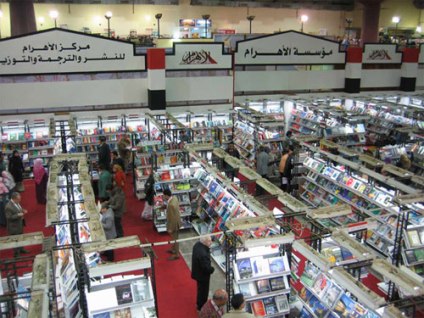
Cairo Book Fair

2015 Cairo International Book Fair

‘Abduh was named person of the year at the 2015 Cairo International Book Fair for his reformist discourse. His conceptualization of orthodoxy was a counterexample to numerous forces in his time, the outdated methods of his fellow ‘ulema, khedives trying to compete with the West, and European powers carving the Muslim world into colonies and protectorates. That the Cairo Book Fair would name ‘Abduh their person of the year shows a belief in the continued relevance of his theology. He defied the imperialist rhetoric imposed upon the Muslim world; he still defies the liberal-conservative dichotomy western forces use today to justify forced assimilation of Islamic societies with the West.  ‘Abduh was instead one voice in the diverse scholarly discourse of Islam, a diversity that western media ignore and powerful forces like the Saudi regime and terrorist organizations want to crush.

As such, allowing ‘Abduh to exist in his own context, a reformer trying to implement a more authentic Islam, is an exercise in understanding the intellectual diversity of the Muslim world as a whole, an understanding that over one billion people cannot be reduced to a largely fictional duality.

The Snow, the Writer, the Time

Campus Snow Day

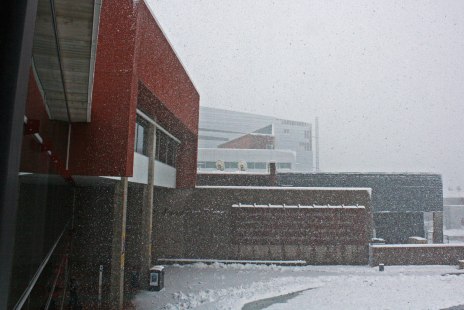
Yesterday started so safely. It was overcast and raining, but the roads were clear. By 11:00 AM, though, the city of Flagstaff was covered in snow and slush. Ponds sprouted in road dips and parking lots became marshes. Northern Arizona University cancelled all classes after 2:00 PM, after everybody was already on campus and desperate to get home. Students, faculty, and staff were told to leave before it got worse.

Com Building

I opted to stay on campus and not wait in the snow swamps amid dozens of tense drivers. I chose not to risk driving down Milton or Butler to get home, not wanting to wait ninety minutes because some inevitably bad drivers congested traffic after skiing their cars into each other. Instead, I found a warm corner on campus and set up shop with everything I needed: my computer, hot chocolate, a lengthy playlist of folk music, and a window giving me an unmitigated view of the snowfall.

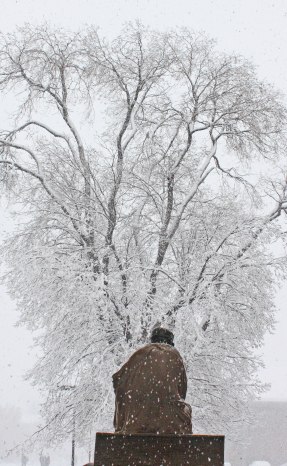
Cline and Tree

I not-so-secretly harbor an obsession with snow. It’s often a subject in my writing. I’ve written many poems about snow alone, how it feels against my skin and glows under streetlamps. I’ve set numerous short stories in a mountain town in December, a Russian field in January, a Montanan cabin in February, or Flagstaff in March. Snow delights me immeasurably, and imposes an opportunity to sit back and do what I have so little time to even contemplate. When it snows so monstrously, I refuse to let the cold and darkness drag me down. Instead, I accept them as unexpected gifts. I don’t think sitting in front of a cold window improves my writing, but it often gives me direction and motivation. Yesterday, it forced isolation upon me, and isolation prompts writing. I’m grateful for being ushered indoors sometimes. Otherwise, I might never begin sewing the words together.

-jk

Flash Fiction: Train Tracks

I’m attempting to do forty creative things (stories, poems, music, art, photography) for Lent. Here is one of them, a short short story.

Train TracksThe chainlink fence delicately rattles. There is nothing in the distance, but the rattling persists like a stick dragged through broken glass. Then, in the distance, we hear it, the horn calling from the right. It’s coming. The fence shakes violently. At last, it spills into view, the bright lights on the front forming a trio of eyes glaring at us as we scurry up the gravel slope to the tracks. The train soars closer.
The all-consuming noise enthralls us. We dig in our backpacks for the ritual sacrifices: an action figure, a light bulb, a marble chess piece, and a platoon of plastic army men. We assemble them facing the train, the unstoppable bringer of death. We line them up on the bright steel tracks, then scramble back down the hill to watch the storm, the explosion, the apocalypse. The train blares its horn once more as we shiver in delight at our violation of the rules. We have been rebelling like this ever since we first discovered how easy it is to get away with it.
Moments before impact, one of us asks whose action figure we used. For a moment nobody speaks, but soon we realize it does not belong to any of us but to one of our old brothers. We look at one another, then take the hill once again, prepared to ambush the rumbling tracks like soldiers emerging from their trench. Amidst one last blast from the horn, an air raid siren before the bombs fall, we stop two feet in front of the train as it eviscerates the entire army we set up. It crumbles the chess piece, it pops the light bulb, it mows down the platoon of army men, and flattens the action figure. We do not turn our attention away, even after the last traces of our sacrifice have vanished. We stand and watch wheel after wheel glide past us where the toys had been.
After the train passes, we stand sullenly around the hallowed battlefield. An atomic bomb has just been dropped. A tornado has just hit. There is not a trace of the army men. We find some glass fragments from the light bulb and a single arm of the action figure. We pick it up and stare at it in horror. Just one severed red arm gnarled at the shoulder. What more can we say? We bury it and begin working on a good lie.

-jk

Photo and story copyrighted work of Keene Short, 2015.

In Search of the Perfect Beer Milkshake

Beer Shake

“If a man ordered a beer milk shake, he thought, he’d better do it in a town where he wasn’t known. But then, a man with a beard, ordering a beer milk shake in a town where he wasn’t known–they might call the police.” -John Steinbeck in Cannery Row.

My favorite author, John Steinbeck, is known for his epic novels about the lives of the working poor like The Grapes of Wrath. While I love his longer works, the Steinbeck novel that has had the most influence on me is Cannery Row, more a collection of interconnected stories than a novel. I first discovered it four years ago, and I have reread it every fall to rediscover the magic of Steinbeck’s Cannery Row in Montery, California, which he calls “a poem, a stink, a grating noise, a quality of light, a tone, a habit, a nostalgia, a dream.”

In one story, the main character Doc remembers somebody commenting that he loves beer so much, “someday [he’ll] go in and order a beer milk shake.” Because he is safely out of town, he takes the bet and orders one, providing the following recipe: “Put in some milk, and add half a bottle of beer. Give me the other half in a glass–no sugar in the milk shake.” Because Doc is one of my favorite literary characters, I attempted to make a beer milkshake following Doc’s specifications.

It turned out dreadfully, so I worked on changing the recipe. Because several restaurants have already experimented with beer milkshakes, one can probably find several recipes online, but here, I offer my own.

1 bottle of beer (preferably a flavorful ale or stout)

3 scoops vanilla ice cream

1/4 cup milk

1 tablespoon sugar

2-3 icecubes

Beer Shake

Combine all ingredients in a blender and serve fresh and cold.

Beer Shake I tested numerous variations of the beer milkshake. With dark beers, I tried adding chocolate sauce. With ales, I tried using only ice cream and beer, nothing else. I don’t know what Steinbeck was thinking when he wrote about Doc’s excursions into the world of beer milkshakes; he wrote that “it wasn’t so bad–it just tasted like stale beer and milk.” I may have taken Steinbeck fandom to an extreme, but his work is dear to my heart. For now, I’m content to read my favorite writer, take his jokes too seriously, and remember his reflections on the world:

Cannery Row’s “inhabitants are, as the man once said, ‘whores, pimps, gamblers, and sons of bitches,’ by which he meant Everybody. Had the man looked through another peephole he might have said, ‘Saints and angels and martyrs and holy men,’ and he would have meant the same thing.”

World War One: The Unpopular Prequel to World War Two

World War One BooksThis semester I’m taking a senior seminar on World War One, for many different reasons: it’s an important event that changed the shape of the world in the twentieth century, I want to know more about it, it’s the hundredth anniversary. I’m also frequently disappointed by how often popular media ignore World War One.

European military history appears in popular arts on a regular basis. We have numerous video games, movies, and documentaries about World War Two. The History Channel has a long list of Hitler-fetish programs (Hitler and the Occult, Hitler’s Henchmen, Hitler’s Women), and in the U.S., WWII movies often come out on or near Christmas Day (Schindler’s List, Valkyrie, and most recently Unbroken, because there’s no better way to celebrate Christmas than by watching portrayals of crimes against humanity). I was excited this past summer when the History Channel announced a six-hour special on both World Wars, but was disappointed when it ignored much of World War One in favor of yet another biography of Hitler; I jokingly called the series Hitler: Origins. Complete with historical inaccuracies, it was effectively a Hollywood trilogy.

Nevertheless, there are some very good portrayals of history in popular media, such as the documentaries of Ken Burns and the BBC series Foyle’s War. These and others pay close attention to detail and often avoid simplifying history. The problem with so many popular depictions is that they present a simple Good Guy/Bad Guy narrative, to the point that World War Two is often reduced to a standard action movie format: bad guys do bad things to good people, good guys intervene, and there’s a happy ending. On the other hand, World War One resists this narrative completely: morally ambiguous empires kept promises to invade each other, millions died without significant progress, and nobody was happy about how it ended.

Popular arts can be useful if treated with the proper attention, and understanding World War One, I think, is sometimes more important than understanding its wildly popular sequel. The problem is that history never translates easily into narrative. It’s not a study of plot and characters, it’s a study of variable circumstance and decision-making without foresight, which can be messy, scary, and uncomfortable. It almost never works out the way we expect or want. Nevertheless, I long for better popular depictions of history. If the History Channel and Hollywood will not grant this wish, then I’ll simply have to do my part as a writer and contribute better, more accurate stories to the canon.

-jk

Where Has All the Introspection Gone?

Aran Islands Coast

However, the self, every instant it exists, is in the process of becoming, for the self does not actually exist; it is only that which it is to become.” Søren Kierkegaard, The Sickness Unto Death.

I may not be a depressed Danish philosopher, but I still appreciate the above quote whenever I try to examine my life. The problem, however, is that I have not actually examined my life for several months.

This past semester was one of the most challenging I’ve had. Apart from school, I applied to eight graduate programs, balanced a new job with my old one, and dove into numerous extracurricular activities. Every date on my calendar was a deadline, so I kept going and going, nonstop, without a moment’s rest. Now that I have a break between semesters, I can pause, breathe, and look at myself in the mirror.

But for the past several months, I have not had a single moment of introspection. I confined my thoughts to academia and packed all my energy into other projects, research assignments, and work. I spent so much time looking out that I’ve nearly lost my ability to look in. Now, I find it difficult and even painful to examine my own life, to place my actions under a microscope and investigate the mechanisms of my identity.

Introspection is at the heart of my ambitions, artistic, intellectual, spiritual, and social. I need to examine and reexamine how I treat others, criticize myself before criticizing others, and spend more time watching my self become what it is constantly becoming. I agree with Kierkegaard; I think our identities are always changing, like water traveling from the ocean to the clouds, from the clouds to the land, and from the land back to the oceans. I cannot resist that change, but maybe self-examination can let me influence the direction.

-jk

The 1914 Christmas Truce

December 24, 1914

Memorial for the 1914 Christmas Truce in Flanders, Belgium, where soldiers may have played soccer.

Memorial for the Truce in Flanders, Belgium, where soldiers may have played soccer.

“About five o’clock on Christmas Eve the Germans started lighting up Christmas trees in their trenches. We took no notice of them until they began to sing. Then we began to cheer them and to talk to one another as we are only about 80 yards apart.” -Rifleman C. Ernest Furneaux, British Rifle Brigade, January 4, 1915.

Along the Western Front in France and Belgium, soldiers waited in their trenches on Christmas Eve. British troops enjoyed puddings and cigarettes from home. Across the fields, sometimes only yards apart, German troops decorated small Christmas trees with candles. Both sides had started singing carols, and could hear their sworn enemies singing familiar tunes. French and British soldiers peered out of their trenches and saw hundreds of lights across the fields when curiosity took hold of them. Despite the language barriers and the months-long war, soldiers crawled out of their trenches, walked into the open air, traded gifts, and sang together. Some even played soccer, with a reported German victory of 3-2. They drank, sang, and celebrated Christmas on the battlefield. Later, many soldiers wrote about these events in letters to their friends and families.

“At dawn the Germans displayed a placard over the trenches, on which was written Happy Christmas, and then leaving their trenches unarmed they advanced towards us singing and shouting ‘comrades!’ No one fired.” -Unknown Belgian soldier, January 4, 1915.

The Great War began in August, 1914, and was expected to end before Christmas. By December, it was clear the war would drag on. Soldiers found themselves in appalling conditions. Sanitation was poor, food was scarce, and enemy gunfire was frequent. So, far away from home, threatened with death and disease, cold, hungry, and probably confused, many German, French, and British soldiers decided to stop fighting.

“The British burst into a song with a carol, to which we replied with ‘Stille Nacht, heilige Nacht.’ It was a very moving moment, hated and embittered enemies singing carols around the Christmas tree. All my life I will never forget that sight.” -Josef Wendl, German soldier, January 1915.

In some places, the Truce lasted until Christmas morning. In others, it lasted until New Year’s Day. Soldiers shared whatever food and drink they had, took the opportunity to bury their own dead, and befriended the men they were expected to kill. Some even joined together in a Christmas Mass on the battlefield. Suddenly, the Germans were no longer monsters trying to dismantle civilization; suddenly the French and British were not the greatest threat Europe had ever known.

“Friend and foe stood side by side, bare-headed, watching the tall, grave figure of the padre outlined against the frosty landscape as he blessed the poor broken bodies at his feet. Then with more formal salutes we turned and made our way back to our respective ruts.” -Unknown British soldier, January 15, 1915.

The ceasefire was spontaneous, informal, and technically illegal. Soldiers were forbidden from fraternizing with the enemy, which was relatively easy when trenches were so close, and such interactions sparked sympathy. Though common then, such fraternization is rare today.

In contemporary wars, it is easier to dehumanize the enemy because there are broader cultural differences. American troops during the Korean and Vietnam wars were told they alone prevented the spread of communism, and those Americans who celebrate Christmas now find it difficult to share that holiday with the mostly Sunni Muslim communities of Iraq and Afghanistan. Propaganda dehumanized communists as the negation of American values and contemporary media frequently call Muslim societies the antithesis of western culture.

“Further, they agreed that if by any mischance a single shot were fired, it was not to be taken as an act of war, and an apology would be accepted; also that firing would not be opened without due warning on both sides.” -Unknown Irish soldier, January 2, 1915.

But dehumanization is only a process of denial. No matter how well we deny it, everybody in the crosshairs is a human being. They all have families; they are all lost and confused and angry and shaken. It’s easy to deny the humanity of an Iraqi or a Korean whose language and culture we do not understand. But just like all Americans, they work like us; they make music like us; they bleed and yearn and gasp for one last breath like us.

The trenches were hell on Earth. Nevertheless, people chose to celebrate Christmas in hell. They chose to recognize their mutual humanity and stop their mechanized slaughter. We can learn from the Truce that peace is actually quite simple. All we have to do is realize that, no matter who we’re fighting, all we really want is good food, good music, and good company. If we all stopped listening to the propaganda and acknowledged how much we long for home, maybe we can stop the nonsensical industry of warfare. It may sound preposterous, but the letters prove that such an act, however brief, has a historical precedence. Who’s to say it can’t happen again?

Joyeux Noël.

Schöne Weihnachten.

Happy Christmas.