Author Archives: keeneshort

Unknown's avatar

About keeneshort

I am a writer in Southern Indiana.

My Last Letter to Flagstaff

Dear Flagstaff,

autumn forest

There’s no easy way to say this, but I have to say goodbye.

Northern Arizona University

It’s not that I don’t like you. On the contrary, you’re the finest community I’ll ever know. Never mind that you’re the only community I’ve ever known. Having lived in Flagstaff for twenty years and with no actual memories of my life in Pocatello, Idaho, before moving to you, it might be unfair to future communities, but I mean it, Flagstaff. Where else can I see a herd of deer pass in front of my car just uphill from my high school? Where else can I have a mountain for a backyard? Where else will I be an hour from the Grand Canyon and Sedona?

Flagstaff

You’ve been great to me, Flagstaff, but it would be naive to say it was all fountains of chocolate. I mean, you are in Arizona, after all. The snow was nice, but driving downhill on an icy road to a stop light was a little scary. I appreciated the dog food factory, but the smell was a little overwhelming sometimes.

Macy's

Everything good and bad that has ever happened to me, with a few exceptions (Ireland, Montana, Minneapolis), has happened to me in Flagstaff: failed orchestra concerts, a broken arm, publication, falling in love for the first time, crippling self-doubt, hangovers in church, learning to play the violin, becoming an Eagle Scout, rejections from journals, writing my first good poem, writing my first bad poem, saying goodbye at the train station to the woman I loved. I’ve had colds and stage fright, I’ve had frog dissections and marching band performances, I’ve had reader’s theater and photography gigs. I lurched through high school and college in Flagstaff. Spending two decades in a place allows for the accumulation of immeasurable joy and bitterness, and leaving you, Flagstaff, is a tough decision, perhaps the toughest I’ll ever have to make. Sticking around is quite tempting.

Train Station Bench

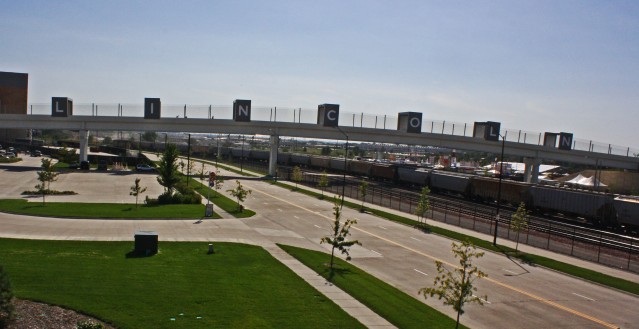
But I need to see other cities, other states, other countries. I need to travel. I need to study and write and learn. I’ll start by going to graduate school in Lincoln, Nebraska. Lincoln may be the opposite of you, Flagstaff, but everything is packed, and I’ll be out the door by the time you read this. After graduate school, I’ll traverse shores yet untarnished by my footprints.

Duck Pond

Even if I fall for Lincoln, I’ll always miss you, Flagstaff. You were the rough draft of a misshapen side character dropped into the world; you were a place of enlightenment in the saints’ cult of writers; you were the architect of this backpack stuffed with art and questions that I am honored to call my soul.

Christmas in Flagstaff

I owe you more than I’ve given, and you’ve given me more than I deserve, Flagstaff. Perhaps I’ll come back to you someday. I would like to see you at least once more before I die. If I do make it back, I hope you have not changed except to become more beautiful, but I cannot, for the life of me, imagine a more beautiful city.

Pipeline Trail

I’ll miss the hippies and cowboys and geriatric motorcyclists. I’ll miss the perpetual smell of pine trees and incense and dog food. My memories of Flagstaff are like photographs in a gallery hung at random. No real structure binds these moments, and it’s more breathtaking that way. With that, I say goodbye Flagstaff. Wish me luck.

Appalachia

Sincerely,

jk

Midwest by Northeast

The Map

For someone who grew up safe in the Southwest, the idea of the Midwest is just a scary story, no more real than werewolves or zombies or werezombies. But soon, all the stories may be proven true. I may wake up one day no longer a Southwesterner but a Midwesterner.

We’ve all heard tales of the Midwest. We’ve seen them in movies like A Christmas Story, Field of Dreams, even children’s movies like Fargo. We’ve heard Garrison Keillor’s weekly horror stories about allegedly growing up in the Midwest. I myself didn’t believe the stories, but soon I’ll immerse myself in the region, in the cornfields and endless piles of Lutherans.

I’ll have to disguise myself to fit in. I’m already quiet, so maybe they won’t recognize that I’m an Arizonan. I’ll have to start eating German and Scandinavian food instead of Mexican. But will I really become one of them? One of those smiling, dry-humor-loving, flat-land-roaming, hotdish-cooking huskers? I’m a fully-fledged American Westerner. My ancestors traversed the Rocky Mountains, settled in the potato fields of Idaho and the great Bitterroot Valley. I have family scattered across Arizona, Utah, Idaho, California, Oregon, Washington, and Montana. Will I transmute into a Midwesterner? Or will I be like the lone survivor of a zombie apocalypse, wandering the fields among the throngs of polka-dancing tundra folk?

I’m sure I’ll end up enjoying life in the Midwest, even if resistance is futile and I start eating hotdish and corn. Or I’ll discover that the Midwest and Southwest aren’t that different, and I’ll fit in just fine, because as important as regional identity is, we should dismantle every wall we allow it to build between us. We’re all in this sinking ship together, after all, and life’s too short to let our differences confine us.

In any case, I’ve lived in Arizona for twenty years: Arizona is a dystopian oligarchy whose capital city, which is a violation of basic human rights by its very existence, is run by a deranged sheriff, and about thirty percent of the population qualifies as a heavily armed militia that wants to improve upon the concept of walls with barbed wire and snipers. If I can survive in Arizona, I can survive anywhere.

-jk

Play Wins Contest, Writer Absent

stage fright

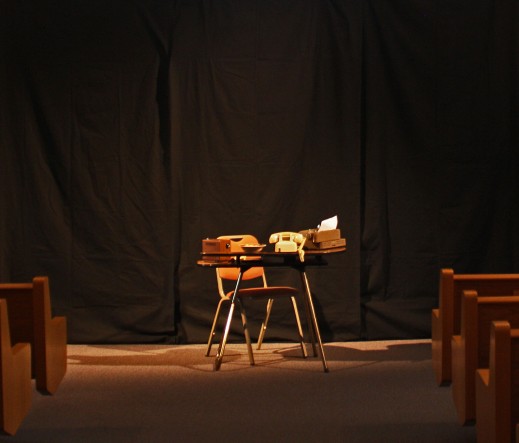
I’m pleased to announce that my ten-minute play “The Real Deal” is one of seven winning plays in this year’s Northern Arizona Playwriting Showcase. The seven short plays will be given a staged reading on August 28, 29, and 30. I’ve submitted to the contest before, under the guidance of various NAU Creative Writing faculty. Last year, I volunteered to be a reader for NAPS 2014, and was typecast to read for “Morons,” by William Baer. This year I’m honored the judges selected one of my plays, and I hope my Flagstaff friends will be able to attend. However, I will be absent, as I will be starting graduate school in Lincoln, Nebraska. It’s a two-day drive back to Flagstaff, and plane tickets are expensive.

The few times I’ve dabbled in theater have been rewarding, as well as painful. I’ve written, directed, and acted for fundraiser plays, and my experiences taught me that volunteer theater is a collectively-driven form of indentured servitude. The drama you see on stage is nothing like the drama behind the curtain. As a moron for NAPS 2014, I discovered the difficulty in holding a script while using props on stage. As with all volunteer activities, there is the challenge of people committing but dropping out at crucial moments.

Although I’ll be several states away from the stage, I’m still proud of my little play. Perhaps I’ll find similar contests in Lincoln; perhaps I’ll even see a full-length play of mine performed. Of course, that will never happen unless I keep writing.

Time to break a leg.

-jk

Out of the Frying Pan, Into Graduate School

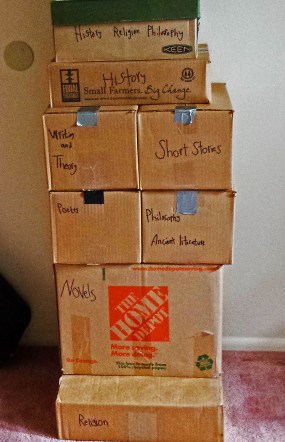
book boxes A few months ago, I attended the AWP Conference where eager representatives from MA and MFA programs stuffed fliers into my hands. They all offered the same possibility: a few years in paradise with nothing to do but write, read, workshop, and inevitably publish. I was drawn into the illusion that ignored the work, the expenses, the debt, and the difficulty in getting anything published.

While preparing for life after NAU, I knew that graduate school was not the only way to become a writer. I could serve overpriced coffee to people in suits, slipping them poems on their receipts to show them my talent, or I could work as a governess for a rich man with gigantic muttonchops who helps me publish my sad story. Or I could take the realistic approach and work, write, and submit short pieces to journals, like most writers I know, gradually building up a longer and longer list of published works.

After I returned from the conference, I received an email from the University of Nebraska-Lincoln. I had applied to eight schools last fall, and all rejected me but UNL; late in April they informed me they would offer me full funding and a stipend through a research assistantship. It was a lucky break, and I took the offer, not because I believed it was the only path I could take, but because I believed it was the best path for me at the moment. It’s the opportunity to get a Master’s Degree in English without any debt, which is just short of a fantasy these days. I don’t believe I deserve such an opportunity over other applicants, but because I have the opportunity now, it’s my responsibility to make the best of it that I can.

I’m not going just to improve my writing, though of course my emphasis will be in creative writing, and of course I intend to come out of it a better writer. But I also hope to become a more scholarly reader, a better student, a more disciplined person.  I was born into academia, and I can handle it a few more years without losing my mind. I am immensely grateful for the opportunity. So I’ll buckle down, pack up my four thousand books and my no. 2 pencils, and plunge into the fire.

-jk

In Which the Pen Name, Nickname, and Legal Name Meet Each Other

Who? More authors than I can count have used a pen name at one point. Dean Koontz has used Aaron Wolfe; Charlotte Bronte used Currer Bell; Daniel Foe, being the creative genius that he was, used Daniel Defoe, not to conceal his identity but to convince his readers he was more gentlemanly. My favorite is Daniel Handler’s pseudonym Lemony Snicket, because Snicket becomes a character in Handler’s Series of Unfortunate Events, one who navigates the reader through the troubling plots. I’ve never imagined myself using a pen name, until I realized how many names I’ve gone by.

For most of my life, I’ve gone by my middle name Keene. In middle school, I got tired of correcting people who thought I said Ken or Keenan or Keith, and I also wanted a name requiring no spelling correction. Not Keen, not Keane, not Frank, but Keene! I tried my first name Jeffery, but even then most people misplaced the R, spelling it Jeffrey. So I shortened it to Jeff. This was also around the time I started writing, and I wrote my earliest stories as Jeff Short. But Jeff was not a very pleasant person, nor a very good writer. He was obnoxiously political, and was competitive in music, writing, and grades.

Along the way, I decided that I liked Keene better. Keene Short. It’s a good name for a writer, and frankly I like Keene as a person more than Jeff. Whereas Jeff was picky, Keene embraced just about everything. He had a better sense of humor than Jeff. Most importantly, he gave up competitiveness. Keene wasn’t concerned with being superior with distinction, but with enjoying the show. Jeff slowly diminished into a forgotten nickname.

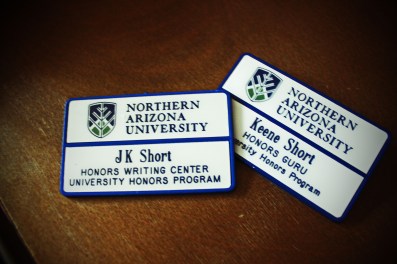
In the last years of college, I adopted another name: JK. The nickname originated in the place I worked, the NAU Honors Writing Center, which I can only describe as a mythical realm where the drawers are stuffed with candy and sarcasm flows freely from the tutors. My boss began calling me JK, and soon I started signing emails, letters, and even blog posts as JK. Keene now blogs as JK, who can withhold his sarcasm and be somber when the time calls for it but prefers to be lighthearted. You do not know everything about Keene; you don’t need to and I don’t want you to, which is why JK is here as a literary filter.

But I will always be Keene Short, even in publication. JK is a nice nickname, but I can’t see critics taking Collected Stories of JK very seriously. Maybe JK is just the fictionalized version of Keene, and I’m content with that. I don’t think of Keene Short as a pen name because Jeffery Short, to me, isn’t a real person. I’d be lying if I published under Jeffery or Jeff, both strangers to me. I am simply Keene Short.

-jk

Srebrenica and Why I Still Study Genocide

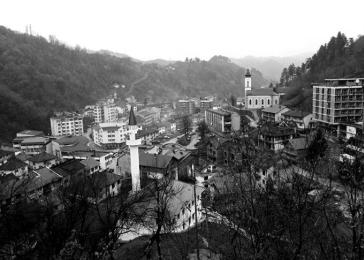
Photo of Srebrenica City, 2002, from the United States Holocaust Memorial Museum.

Photo of Srebrenica City, 2002, borrowed from the United States Holocaust Memorial Museum.

I should begin with a brief clarification about why I post so often about war and genocide. It affects me deeply, and I often have trouble bringing myself to read about it any more. As a result of the professors I’ve worked with, I find myself compelled to study and write about violent conflict in history. I do not find any satisfaction in studying it, and I feel the need to mention this because I know from experience that some people do find satisfaction in reading about genocides, especially the Holocaust; too often, I’ve heard people refer to it as ‘fascinating’ or ‘intriguing.’ I suppose I cannot dispute the value of somebody’s motivation, but I do not believe one should explore the industrialized slaughter of civilians because it arouses fascination. It should disgust, it should repulse, but I do not think it should invite intrigue. My motive for studying it is not rooted in a sick fixation with the gruesome details, which often keep me up at night; I do not believe enjoyment should be my sole motive, however. I feel compelled to study it in part because I have no power to change it.

I admit that the more I delve into historical traumas, the more guilt I feel, and I don’t think there is necessarily a problem with that. A guiltless being is a soulless one, and a belief that one is free of guilt, that guilt will never inflict legal or psychological damage, might be a common trait of the perpetrators. I think there is merit in a little collective guilt. History’s ghosts haunt us, all of us, if we stop and listen. The thing about history is that it persists, it continues into the present, and the battles are still going on.

I can distance myself from the details enough to write about them, just enough to maybe offer a brief commentary. The exception, however, is the Srebrenica Genocide. Today marks twenty years after the start of the massacre, and I have wanted to write about it. Anniversaries can be convenient opportunities to engage moments in the past, though they are also quite arbitrary: historical traumas are not relevant every ten years, but continually.

Though I have tried to write about the Srebrenica Genocide, I find it almost impossible. What happened in Srebrenica affects me more than other genocides. When I read about the details, I feel chest pressure and panic, and have to turn away from the research.

The region of Bosnia-Herzegovina, where Srebrenica is located, was solidified in the former Yugoslavia during the Cold War under the dictatorship of Josip Broz Tito, who took power after World War Two. Prior to that, the region had a brief period of independence after being ruled by the Austro-Hungarian Empire, and before that the Ottoman Empire. By the twentieth century, Bosnia was religiously and ethnically diverse, and the two are often conflated: With Catholic Croats, Orthodox Serbs, and Muslim Bosniaks, the region had few moments of independence despite strong nationalist movements, such as Young Bosnia. Gavrilo Princip, one of Young Bosnia’s members, assassinated the Austrian Archduke Ferdinand and his wife in Sarajevo in 1914, sparking the First World War.

While Yugoslavia collapsed in the early 1990s alongside the Soviet Union, Bosnia declared its independence. Serbian nationalists attempting to solidify the region again under the new Republic of Srpska, rejected the declaration of independence, invaded the region, and began a campaign to cleanse it of its Muslim population. This event is similar to how the Irish War for Independence and Civil War broke out, devolving into sectarian violence between Catholic Republicans and Unionist Protestants after the Republicans declared a kind of independence; this event is also similar to what is currently going on in Iraq, where a right-wing Sunni organization has the apparently unquestioning loyalty of many of Iraq’s Sunnis who felt oppressed by a Shi’i-led, and US-backed, government. Ireland did not witness a genocide against the island’s Protestants, though sectarian violence continued well into the 1980s and beyond. In contrast, Iraq and Syria may be witnessing a genocide now, despite the almost universal condemnation of ISIS and its tactics.

That is precisely the situation Bosnia was in, starting in 1992. The United Nations, appalled at the Serb nationalists’ tactics, intervened in the war (at least in theory) and declared the town of Srebrenica one of several safe zones. UN peace-keeping soldiers were placed on the ground, world powers condemned the violence, but nobody wanted to intervene directly. Instead, the United Nations designed a system that effectively blocked any nation from direct confrontation with combatants.

This is where I find it difficult to go on reading, sometimes. In 1995, Serbian nationalists, under the presence and observation of the UN, took Muslim men and boys from Srebrenica at gunpoint, ushered them into the surrounding woods, and slaughtered them. They buried them in mas graves, often with the intention of preventing the bodies from ever being found, proof that they were aware that the world would look upon them as criminals, proof that they wanted to hide the evidence of their crimes. But there is something wholly corrupt about a system that prevents peace-keeping soldiers from intervening in the slaughter of 8,000 men and boys.

Some UN soldiers express guilt, shame, and even sought treatment for PTSD afterwards. I should also note that this is not the only crime against humanity committed during the Bosnian War. The perpetrators also implemented a campaign of systematic rape against women and girls, a crime that victims report ISIS has committed in recent months (trigger warning if you open the link). But I have not been able to bring myself to read about these crimes beyond broad overviews. I simply can’t, unless I choose to tolerate the inevitable anxiety I feel from researching it.

Historical trauma does not continue only in a communal sense. Russia recently rejected a UN resolution to classify the Srebrenica Genocide as genocide, and right-wing Serbian organizations threatened to disrupt commemoration events. Many Serbs deny that Muslim casualties were as high as reported, and several mass graves remain yet to be uncovered and documented. The trauma persists daily; many perpetrators still walk among the victims’ families, and collective denial of the genocide, which is strong in many circles, is an active assault on the Muslim community in Bosnia.

Maybe, in some ways, I feel like one of those UN soldiers, unable to intervene but forced to watch. I feel helpless when I read about these and other crimes, and guilt can be overwhelming. It should not be debilitating, though I often let it become too much to handle. There is more that I can be doing.  There is more that I should be doing. But I will continue to engage these traumas as best I can, even if I leave historical research behind academically. It will haunt me no matter what I do, and I can invite the ghosts in or close the door on them. I’d rather leave the door open, because I believe that history’s ghosts have something to say, and it’s our responsibility to listen. Will these blog posts make a difference? Probably not. But I’d rather not be silent when the past is so loud.

Boots on the Ground

Civil War Soldiers

Statue Commemorating Civil War Veterans

Some of the best advice I received about historical research is that oftentimes the surest way to find sources is to have boots on the ground and look for sources in person. This usually involves going into public archives or getting access to private ones, but I’ve heard tales of finding rare documents forgotten in the trunk of a car or simply on display in a book fair. This week, while visiting family in Appleton, Wisconsin, I decided to experiment with boots-on-the-ground-history.

March to SocialismI discovered that historical research is more than just skimming through a few letters. It’s detective work, a methodological investigation, and I did not rise to the challenge. As I prepare to go to graduate school to study creative writing, I worry that I may leave history behind. History is close to my heart, but requires a patient diligence.
McCarthy

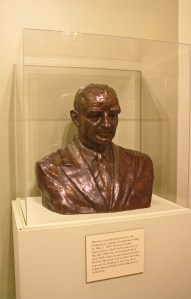
Statue of Senator Joseph McCarthy

The challenge of in-person research yielded a few interesting results. Appleton’s public history emphasizes its positive qualities, such as the fact that magician Harry Houdini claimed it as his hometown, though he was born in Hungary. There is a museum with an entire floor devoted to Houdini’s life and work. However, another famous man claimed Appleton as his hometown, Senator Joseph McCarthy, who engaged in congressional witch hunts during the early 1950s to remove suspected communists. Popular opinion has since turned against McCarthy, but as journalist Edward R. Murrow said in an open challenge to the Senator’s unethical methods, “He did not create this situation of fear, he merely exploited it.” Now that Red SpiesMcCarthy is remembered as an aggressive demagogue, his hometown has taken a statue of him that once stood in public view and placed it in a museum’s bottom floor, under the stairs.

Apart from some obscure anti-communist propaganda, one from 1950 and the other from 1967, a World War One Dough Boy memorial statue and a Civil War memorial statue, I could not find any major historical documents in Appleton’s history, simply because I did not look that hard. It is not surprising that they hide McCarthy’s image and highlight a still-popular celebrity. Any research on the Cold War in Wisconsin daily life would require interviews with those who remember it, access to radio and news archives, local newspapers, and other hidden sources. Perhaps I might be able to dig up a few rare pieces of propaganda if I looked deeper, or uncover a story of Cold War espionage, but such research requires more time and energy than I can offer. I’m not a specialist, or a driven detective. I am, for the time being, only an interested amateur.

Patriotic WWI Statue

Doughboy Statue Commemorating World War One Veterans

Perhaps I can one day conduct better historical research. Perhaps I will one day dare to dig deeper, open doors that should not be opened, find people who have answers. I was inspired by a year-old article about Amor Masovic, who has been looking for burial sites from the Srebrenica massacre in Bosnia-Herzegovina, in 1995. That massacre, part of the Bosnian Genocide, was the first act of genocide on European soil since the Holocaust, and one that the world ignored for years. Today, the perpetrators still live side-by-side with the families of the victims, and reconciliation is a great challenge. But Masovic pursues burial grounds, is still looking for the missing victims to piece together the community of Bosniak Muslims that existed before the massacre. He’s been working for nearly twenty years and there are still bodies unaccounted for.

Will I ever be such a researcher? Will I ever contribute to as admirable an effort as Masovic? It’s unlikely, but I do not want to leave history behind. I’m too compelled and too haunted by its ghosts to allow myself to give it up completely. History truly is obsessive, and maybe the only way to make a difference is to simply embrace that obsession, dig my boots into the ground, and dig as deep as the past will allow.

-jk


The Great Summer Reading List

books

The Summer Reading List is a staple of summer vacations. Like beaches, fireworks, and barbecues, books are a necessity for good summers. I’m sure countless psychologists, anthropologists, literary scholars, and social scientists have devoted hour after hour to calculating the best equation for a summer reading list. It should be filled with books one has meant to read but hasn’t had time to yet. It should be diverse in genre, not just balancing poetry, novels, and plays, but adventure, drama, comedy, romance, or any combination of the reader’s personal preferences. Often they have new releases paired with classics. My summer reading list is hefty; it has books I’ve been meaning to get around to for over five years, as well as books I just discovered months ago. Some come recommended by friends, others I picked up off the shelf on a whim. However, it is most important for a summer reading list to be leisurely and enjoyable. I’ve certainly enjoyed my list so far, and have no intention of slowing my reading until I have to get back to work in the Fall.

My list is as follows:

The Iraqi Nights by Dunya Mikhail (Iraqi poetry)

A Dog About Town by J. F. Englert (murder mystery narrated by a dog)

The Long and Short of It by Pamela Painter (short stories)

The Theory and Practice of Rivers by Jim Harrison (poetry)

With a Strange Scent of World by Víctor Rodríguez Núñez (Cuban poetry)

The Propheteers by Max Apple (historical fiction novel)

Of Mice and Men by John Steinbeck (novel)

The Penguin Book of Modern African Poetry

Literature from the ‘Axis of Evil’ by various authors (anthology of works from Iraq, Iran, North Korea, Cuba, Libya, Sudan, and Syria)

The Penguin Book of First World War Poetry 

Fall 2014 edition of Cardinal Sins (literary journal)

Book of Grass by J. V. Brummels (Midwestern poetry)

They Came to Jerome by Herbert Young (Arizona History)

Salt by Earl Lovelace (Trinidadian novel)

Our Father Who Wasn’t There by David Carlin (Australian memoir)

Death and the King’s Horseman by Wole Soyinka (Nigerian play)

Volume 35, No. 1 of Mid-American Review (literary journal)

Healing Earthquakes by Jimmy Santiago Baca (poetry)

Aimless Love by Billy Collins (poetry)

Waiting for the Barbarians by J. M. Coetzee (South African novel)

The Blizzard Voices by Ted Kooser (Midwestern poetry)

All Quiet on the Western Front by Erich Remarque (WWI novel)

The Wayward Bus by John Steinbeck (novel)

The Business of Fancydancing by Sherman Alexie (poetry and short stories)

Emails from Scheherazad by Mohja Khaf (Syrian-American poetry)

What books are on your summer reading list? Any favorites? Leave a comment and let me know what you’ve been reading.

-jk

If Napoleon Had Won

View of Paris from the Louvre, by Lost Compass Photography

View of Paris from the Louvre, by Lost Compass Photography

Today, as we mark the two hundredth anniversary of Napoleon’s defeat at Waterloo and a definite end to his conquest of Europe, I wonder what would have happened if he’d won. If the French had defeated the British-led coalition, France would still have faced Britain across the English Channel, Prussia (part of modern-day Germany) to the east, and Russia even further to the east. In other words, Napoleon would have faced a potential war on two fronts, the same situation Germany faced in both World Wars. French forces were already stretched thin, particularly from colossal defeats in Russia, so it seems unlikely that the French would win a two-front war.

Perhaps Napoleon would turn to diplomacy. Britain historically fears a continental empire, preferring a divided and contentious Europe. If Spain, France, Prussia, Russia, and the Netherlands cannot work together, England can keep them from uniting against the island Kingdom. Napoleon would be wise, then, to turn to Prussia and make a political pact against Britain. Such treaties were common during the nineteenth century, eventually creating a complex alliance system that some blame World War One on. So, to avoid a military defeat, Napoleon turns to Prussia and promises to work with them if Britain or Russia ever turn against their interests.

What would certainly be known as the Franco-Prussian Alliance creates a strong central-European power. Napoleon dies decades later of stomach cancer, but in this universe he dies a hero. Statues are built to him, poems in French and German are composed, and peace settles now that Imperial France has secured its assets abroad. A Franco-Prussian alliance changes the shape of Europe completely. German unification never happens, but Franco-Prussia probably allies with Austro-Hungary anyway. As a result, the First World War pits central European powers against Britain and Russia rather than France and Britain against Germany and Austria. However, the combined strength of France and Prussia, along with France’s imperial allies of Italy, Spain, Portugal, Romania, and probably the Ottoman Empire, manage to defeat Russia and Britain. The U.S. never involves itself regardless of the outcome, and France gains all of Britain’s colonies. As a result, French becomes the dominant language in the world, no fascist dictators come to power, and the U.S. keeps to itself and Latin America.

Of course, this is not an objective speculation. Counterfactual history is subject to individual decisions as well, namely those of the historian. My own bias against fascism motivates me to see a possible way out of it. There’s no indisputable likelihood that there would be no World Wars if Napoleon had won a single battle. There may have been a worse war, there may have been no more wars, but there’s no way of knowing for certain. As such, counterfactual history can sometimes show more about the historian’s own bias than about history itself. In any case, thousands died at Waterloo, and millions have died in combat since. Speculating about how we could have avoided past conflicts, while intriguing, can be a distraction from how to avoid conflicts now.

-jk


Modern Turkey and a History of the Word Genocide

Photo of the Armenian Genocide Memorial Complex

Photo of the Armenian Genocide Memorial Complex

Earlier this week, an important but under-reported incident occurred in international politics. Brazil’s government passed a resolution to recognize atrocities committed against the Ottoman Empire’s Armenian population in 1915 as genocide, which dozens of countries and most historians already recognize. As a response, the Turkish Foreign Ministry responded by condemning the resolution, saying that it “distorts reality.”

This year marks the hundredth anniversary of the Armenian Genocide. One hundred years later, the use of the term genocide is still contentious. Historical truths can be malleable. In Brazil, what happened in 1915 is genocide; in Turkey, it is only a tragic conflict. The use of one word to describe an event might seem like a pointless semantic argument to some, but language is crucial when discussing history, and it’s important enough to spark discomfort between nations.

Part of the problem is that the Armenian Genocide occurred decades before the term genocide came into use. In 1915, the Ottoman Empire joined Germany and Austro-Hungary against Britain, France, and Russia in World War One; the Ottoman military, after a disastrous failed invasion of southern Russia, attacked civilian Armenian Christians through forced deportations, mass imprisonment, confiscation of property, death marches, and massacres. The total death toll is still in dispute, but a common estimate is 1.5 million Armenians. Some Ottoman officials thought the Armenians were a pro-Russian threat, and such an argument was used to justify the atrocities. After the war, the Allies carved up the Ottoman Empire, but an independent Turkey emerged after revolutionary forces took control of Anatolia. The revolution was partly led by Mustafa Kemal, a talented Ottoman military leader who defended the Gallipoli Peninsula during the War. Becoming the first president of Turkey, Kemal rewrote history to make the new Turkey a heroic nation. Taking control of national education, Kemal erased the Armenian Genocide from his new country’s textbooks and public discourse, and this pattern continues in Turkey today.

Despite a wealth of archival evidence, Turkey’s national investment in keeping the term genocide out of its history is wrapped up in the complicated nature of the word itself. Raphael Lemkin coined the term to describe Nazi atrocities during World War Two. Lemkin’s activism began much earlier; a Jewish migrant from Poland, he had heard many stories about Ottoman atrocities as well as pogroms against Jews. In 1948, the United Nations recognized genocide as an international crime in its Convention on the Prevention and Punishment of the Crime of Genocide, referring to it as requiring “the intent to destroy, in whole or in part, a national, ethnical, racial, or religious group.” Consequently, forced deportations and ethnic cleansing (the attempt to remove a group of people from a designated geographic area but not the group entirely) do not necessarily count as genocide (though they often lead to genocide, historically). Like most criminal matters, recognizing the Armenian Genocide, at least in a legal sense, requires proof that the perpetrators intended to erase the Armenian population from Anatolia through their physical and cultural destruction.

But for Armenians today, as well as countless activists and historians, genocide is not always a legal matter, but a matter of identity and truth. In Armenian collective memory, what the Ottoman military did goes beyond specific legal parameters; it was an assault against an entire culture resulting in the death of over one million people on the basis of a shared ethnic-religious identity. Its historical scars are still visible for many Armenians, but history is more than just past crimes; history is a living, evolving beast. Turkey’s refusal to recognize the Armenian Genocide is a direct attack on Armenians today. Such a refusal wipes away the validity and dignity of those Armenians the Empire slaughtered and the generations who are around today, the descendants of the survivors. Brazil’s resolution is a positive step, but real progress will come only when the Turkish government comes to grips with its predecessor’s crimes and its own complicity in the denial of those crimes.

-jk