
In other news, I read some poetry at a big fancy academic conference.

This week, scholars, musicians, writers, film critics, professors, fans of The Grateful Dead, zombie fanatics, pop culture critics and lovers (one in the same, here) flocked to Albuquerque, New Mexico, to discuss their ideas, share their theses, their creative works, their analysis of other people’s creative works, and generally enjoy the spirit of popular culture.
In one day alone, I’ve heard scholar/fans discuss the relationship between Rick and Morty in Rick and Morty, compare Jurassic World and the TV series Zoo, analyze countless horror movies (from Poltergeist to The Babadook), explore various media’s fixation with underage serial killers, give two different interpretations of David Cronenberg’s eXistenZ, explore the role of nature as a setting in The Walking Dead, critique consumer culture in prepper magazines and the capitalist frenzy to buy things before the coming apocalypse, and read a variety of poetry.
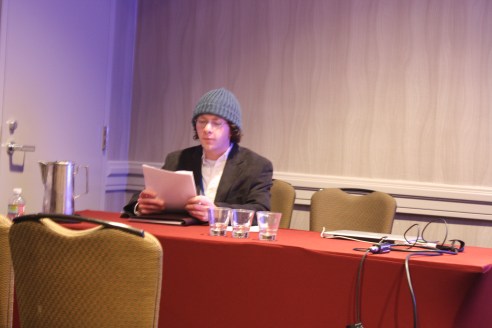
Reading my own work for an audience was not entirely new to me; I’ve made use of open-mic nights and poetry slams now and again. This venue certainly was new to me, though, but I don’t want readers to assume that I think a conference is somehow better than a slam. Poetry is meant to be read out loud, and all venues are equally worthy and professional; poetry slams are just as important as big fancy academic conferences. But here, my audience differs, and the tone is more critical, more focused on poetry within popular culture rather than poetry alone. Where else can I backup a poem about the end of the world with information I’d heard half an hour before?
I’m centered in the academic world, and this is an academic pilgrimage that I’m honored to take. Reading in front of a live audience, of course, is terrifying, but also thrilling, and I hope to enjoy that thrill again soon.
There are still plenty of days left in the conference, and there is more to come.
-jk
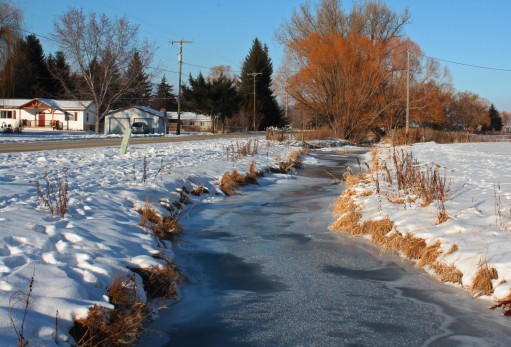
 I can’t remember the last time I went shopping for clothes. I still wear most of the same things I had in high school and hoped that my minimal wardrobe would last forever when I moved to Lincoln. After losing forty-two buttons, an unfortunate mishap involving bleach, and then proceeding to lose a significant amount of weight in Lincoln by switching to a diet of mostly oxygen and hydrogen, I realized finally that I’m starting to look a little weird in my old clothes. So yesterday, I trekked through the aftermath of Nebraska’s most recent snowstorm to a row of thrift stores downtown, just to take a look around.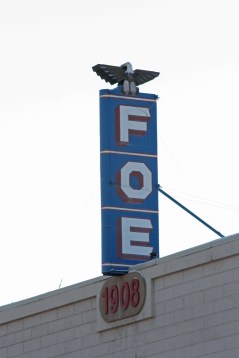
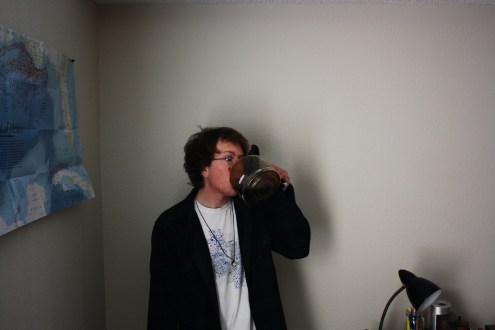


 I’m twenty-five percent of the way finished with my Master’s Degree in English at the University of Nebraska-Lincoln. Most of what I’ve encountered is unsurprising: the workload is tough, the Midwest is flat. However, there are certain things I’ve learned, perhaps unique to my own situation, that I wish I’d known earlier this summer.
 Yesterday afternoon, I crawled off the California Zephyr after spending sixteen hours next to a window watching snowy mountains go by as I sat alone with a good book (Chang-Rae Lee’s Native Speaker), some new music on my iPod (Bombay Bicycle Club), and laptop to write short stories (Sci-Fi and Cli-Fi, with very little Wi-Fi). I was completely alone, standing up only to stretch and get coffee from the service car. It was spectacular.
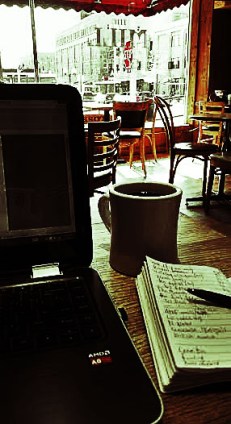
 Creativity is sneaky; it can strike at the most inopportune moments, and writers need to be prepared. Writers can find inspiration while showering, cooking biscotti, giving back rubs, performing open heart surgery, or in my case all of the above simultaneously, and creative ideas can whither if not recorded quickly enough. Many writers, myself included, carry around small notebooks to salvage sudden ideas.
 It’s another game day in Lincoln, Nebraska. The city is dripping with redshirts (not the kind from Star Trek, but closer than you’d think) and people asking for tickets. It’s hot, dry, loud, and alive. There is energy and consumerism in Lincoln today. Parking here, fifty dollars! Hot dogs, popcorn, soda, beer! Families move through the streets as the day builds toward the big game. Parties, I’m certain, are in planning, if not already in mid-construction.
 I’m pleased to announce that two poems of mine,