Tag Archives: Reflection

Coffee: A Steamy Love Affair

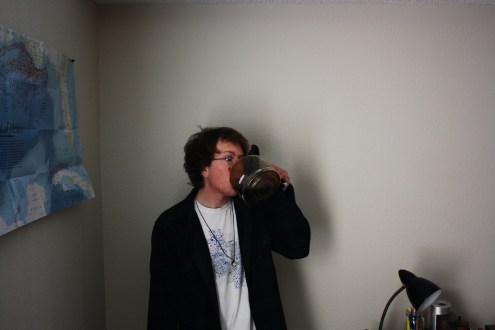
Coffee Poet.jpg

Those who know me know that I love coffee. Those who don’t know me can easily guess, thus far, that I have a moderate fondness for coffee. To be clear, I’m not picky; I like tea, cocoa, water, smoothies, milkshakes, juice. But coffee has a special place in my life.

I had my first cup in my high school cooking class. During one of the baking sessions, our teacher turned on the coffee pot near my station while our muffins were still in the oven. That’s when I had my first cup of caffeinated hot brown acidic water, filled with cream and sugar like most first-timers. After a while, I started drinking coffee whenever I cooked, then every morning, then every morning and afternoon, then several times a day. For a while, I got headaches when I didn’t consume any caffeine by 10:00 AM.

I’ve since become less addicted. I once considered giving it up for Lent but decided that not even Jesus would have gone that far. Nevertheless, I have cut back, and not just because I’ll probably have an ulcer by the age of twenty-six if I don’t.

There are coffee addicts and there are coffee lovers, and I want to be the latter. The difference between a violinist and someone with a violin is making every note a masterpiece. The difference between a chef and somebody who cooks every meal is mastering the kitchen’s tools and ingredients, and cooking with gusto rather than mere hunger. Anything can be an art, and the only way to become an artist is to inhabit a practice so fully that we infuse ourselves with it.

Everything about coffee is perfect to me, and if not I try to make it perfect. Espresso, lattes, dark roasts, light roasts, the smell of the beans, the feel of them in my fingers, the careful measurement of fresh grounds into the coffee pot, pouring the first cup, breathing in the scented steam before the first sip, and feeling it run down my throat hot and fresh, until it bounces around my stomach looking for a place to sit. I write with it; I read with it; I get to know people with it. It’s not for everyone, but it’s certainly for me, which is likely why I haven’t slept since 2015.

What practice or hobby or food do you love? Let me know in the comments!

-jk

P.S. If you thought the title was cheap, consider all the other possibilities I had to work with. Drip coffee was only a starting place.

Reflections on a First Semester in Grad School

AcademyI’m twenty-five percent of the way finished with my Master’s Degree in English at the University of Nebraska-Lincoln. Most of what I’ve encountered is unsurprising: the workload is tough, the Midwest is flat. However, there are certain things I’ve learned, perhaps unique to my own situation, that I wish I’d known earlier this summer.

  1. Maturity is a state of mind. I’m the youngest person I’ve met in the creative writing segment of my department, and I’m often made to feel like a little kid, like I don’t quite belong, among the adults (at least among most of the writers I’ve met). Many are PhD students with an MFA or an MA. In truth, I don’t quite fit in with most of the other writers stylistically, humorously, or aesthetically. Both my writing and self are plain weird, and I’m surrounded by tradition and formality. I don’t want to sacrifice my identity to fit in, though. I’d rather be a transplanted weirdo in the Midwest than a converted Midwesterner. Growing up isn’t about leaving behind parts of myself that don’t meet others’ expectations; it’s about maintaining myself in increasingly diverse and challenging situations.
  2. Discussions of craft are not as important as craft itself. Every discussion of craft I’ve had so far consists of an extensive mythology of what other writers did to keep themselves writing, followed by the refrain, do what works for you; coffee, rum, fishing in the Missouri River, whatever will help crank out a daily three to four pages. My own method involves writing for those who inspire me, unhealthy amounts of caffeine, and hikes in nature (which I’ve yet to find near Lincoln).
  3. Nothing is more important than the writing. I came to graduate school to write, and to publish, and to understand literature and improve myself intellectually, but my primary goal is to crank out three to four pages a day, no matter what.
  4. Friendship is more important than the writing. Friends are increasingly hard to come by the higher I climb into academia. Allies are nice, but the few friends I’ve made are crucial to my survival. Without them, I’d have no support for my experimentation. Plus, writing can be lonely, and being cooped up all day is a good way to get cabin fever.
  5. Contradictions are okay (and inevitable). Graduate life, much like undergraduate life, is complex and full of numerous contradictions. Some are basic: a free ride still requires one thousand dollars of student fees per semester. Some are more complex: writing depends upon time and inspiration, but inspiration usually comes from things requiring time not spent writing (loved ones, caffeine, hiking). Fortunately, I now have the benefit of knowing exactly what I need to survive the next seventy-five percent of my degree: writing, friends, coffee, a place to hike, more confidence in my weirdness, and a few more publications would be tolerable, I suppose.

Look out, 2016, here I come.

-jk

In the Company of Roses

Flower Last week, a man told me a parable about a lump of clay and some roses. He cited it as a Persian parable, but I did some research and found that it actually comes from the thirteenth century Persian poet Abū-Muhammad Muslih al-Dīn bin Abdallāh Shīrāzī, commonly known as Sa’di. He is one of the most influential poets in Islamic and Asian literature. In Iran, April 21 is celebrated as Sa’di Day.

While Europeans were busy killing each other in the medieval period, which they eventually termed the Dark Ages like a bad sequel to the Roman Empire, most of Western and Central Asia witnessed an artistic, philosophical, and scientific renaissance. Sa’di was only a part of this unique cultural era.

The poem I heard comes from the “Adoration and Preamble” section of Gulistan, or “the rose garden,” one of Sa’di’s most famous works. It reads something like this:

“I held in my bath a per­fumed piece of clay
that came to me from a beloved’s hand.
I asked it, ‘Are you musk or amber­gris?
Like fine wine, your smell intox­i­cates me.’

Till some­one set me down beside a rose,’
it said, ‘I was a loath­some lump of clay.
My companion’s scent seeped into me.
Oth­er­wise, I am only the earth that I am.'”

Apart from talking lumps of clay, I love this poem because it reminds me that I am defined by my proximity to others more than I realize.

Artistically, I am the product of the writers and poets I read: Billy Collins, Sylvia Plath, Douglas Adams, John Steinbeck, Dunya Mikhail, Jamaica Kincaid, and Pablo Neruda have made me the writer I am. Aesthetically, the Southwest made me an experimental, avant-garde magical realist. Socially, I am shaped by my friends, family, lovers, mentors, and the two or three enemies I keep around for good measure. Professionally, I’m a workaholic, being the son of professors who know education is a religious devotion serving the many at the expense of the few, the happy few.

I’m honored to live in the company of roses. I surround myself with those who inspire me. It took me a while to figure out how miserable one can get surrounded by those who are negative, over-critical, dishonest, manipulative, and toxic. I don’t mean I’m in the company of the perfect; all roses have their thorns. But for what it’s worth, I’m glad to let my friends rub off on me. It makes me a better person (and apparently more appealing to bathe with) to walk with roses.

-jk

Big League Academia

New WriterTwo months into my first year of graduate school, I think I’ve finally started to settle in. The workload is not beyond my management (I somehow function better with less sleep), the faculty are just as thoughtful and thought-provoking, and my descent deeper into the cult of academia is going smoothly; soon, I’m told, I’ll be a card-carrying postmodernist. The support my writing receives is frequent, and the possibility of a writing career is even starting to take shape.

For example, this past week I had the opportunity to meet with two agents and two editors, to have them critique a section of my novel-in-progress and discuss the publishing industry. They told me what they liked about the short section, offered insights, made revision suggestions, and allowed me to see the project in grander terms. I learned that when I eventually get an agent and editor, publishing becomes a collaborative effort, a group project. They offered to stay in contact when I have a polished draft. Suddenly, the fantasy of publication no longer feels so impossible.

Is this it? Is this the next step for my writing? Or is this just the next phase in my hike up the ranks into academia? I ask myself this question because I’m surrounded by people who have it figured out already. I’m surrounded by serious academics, doctoral students devoting years to studying, students fulfilling long-term plans. Many of them took a break after college to figure out the rest of their lives, get married, travel, go on adventures, experience things they can then write about. And here I am, fresh out of my undergraduate career.

Am I here because I want to be a writer, or because I want to be an academic? I feel like a kid who doesn’t yet know what he wants to be when he grows up, and time is running out. Do I teach? Get a PhD? Another MA? An MFA? Is there life after publication? Or should I let my ambitions dictate my future? Tired of studying tragedy but never taking that study out of the classroom, I still want to join a charity, volunteer in a hospital in Palestine or Afghanistan or Jordan, or work on an organic farm in Chile or Brazil. I want to see the world, because I know if I stay in the confines of an English Department, I’ll run out of things to write about.

I’m still just a kid, academically speaking, and I’m surrounded by intellectual adults. I can’t count the number of times I’ve been asked about my PhD, as if that’s the only end in sight, and I can’t count the number of times I’ve silently shrugged and changed the subject. I only have until next fall to figure it out, though. Do I become a career academic? Teach? Work? Let me know in the comments your own thoughts or plans.

-jk

My Last Letter to Flagstaff

Dear Flagstaff,

autumn forest

There’s no easy way to say this, but I have to say goodbye.

Northern Arizona University

It’s not that I don’t like you. On the contrary, you’re the finest community I’ll ever know. Never mind that you’re the only community I’ve ever known. Having lived in Flagstaff for twenty years and with no actual memories of my life in Pocatello, Idaho, before moving to you, it might be unfair to future communities, but I mean it, Flagstaff. Where else can I see a herd of deer pass in front of my car just uphill from my high school? Where else can I have a mountain for a backyard? Where else will I be an hour from the Grand Canyon and Sedona?

Flagstaff

You’ve been great to me, Flagstaff, but it would be naive to say it was all fountains of chocolate. I mean, you are in Arizona, after all. The snow was nice, but driving downhill on an icy road to a stop light was a little scary. I appreciated the dog food factory, but the smell was a little overwhelming sometimes.

Macy's

Everything good and bad that has ever happened to me, with a few exceptions (Ireland, Montana, Minneapolis), has happened to me in Flagstaff: failed orchestra concerts, a broken arm, publication, falling in love for the first time, crippling self-doubt, hangovers in church, learning to play the violin, becoming an Eagle Scout, rejections from journals, writing my first good poem, writing my first bad poem, saying goodbye at the train station to the woman I loved. I’ve had colds and stage fright, I’ve had frog dissections and marching band performances, I’ve had reader’s theater and photography gigs. I lurched through high school and college in Flagstaff. Spending two decades in a place allows for the accumulation of immeasurable joy and bitterness, and leaving you, Flagstaff, is a tough decision, perhaps the toughest I’ll ever have to make. Sticking around is quite tempting.

Train Station Bench

But I need to see other cities, other states, other countries. I need to travel. I need to study and write and learn. I’ll start by going to graduate school in Lincoln, Nebraska. Lincoln may be the opposite of you, Flagstaff, but everything is packed, and I’ll be out the door by the time you read this. After graduate school, I’ll traverse shores yet untarnished by my footprints.

Duck Pond

Even if I fall for Lincoln, I’ll always miss you, Flagstaff. You were the rough draft of a misshapen side character dropped into the world; you were a place of enlightenment in the saints’ cult of writers; you were the architect of this backpack stuffed with art and questions that I am honored to call my soul.

Christmas in Flagstaff

I owe you more than I’ve given, and you’ve given me more than I deserve, Flagstaff. Perhaps I’ll come back to you someday. I would like to see you at least once more before I die. If I do make it back, I hope you have not changed except to become more beautiful, but I cannot, for the life of me, imagine a more beautiful city.

Pipeline Trail

I’ll miss the hippies and cowboys and geriatric motorcyclists. I’ll miss the perpetual smell of pine trees and incense and dog food. My memories of Flagstaff are like photographs in a gallery hung at random. No real structure binds these moments, and it’s more breathtaking that way. With that, I say goodbye Flagstaff. Wish me luck.

Appalachia

Sincerely,

jk

To Whom It May Concern

Yesterday, while wandering the streets of Galway around the river, I found myself in front of a Catholic church built in the 1800s. I stepped inside, eager to explore a tradition with which I was unfamiliar. I had been in Catholic churches before, but only on guided tours with a camera in my hands and a ball cap on my head. This was different. This was an opportunity to find a new experience.

Church

I was alone inside the old church, and the silence was overwhelming in a city that otherwise was suffocated by the noise of traffic, crowds, and the river. I walked past a statue of St. Francis of Assisi, turned toward an organ, and made my way up the church to the front pew. There, I sat down in silence and looked around the bright room, engulfed in its old and magnificent imagery. The silence was almost alarming, as I had hardly a moment of solitude since my arrival in Ireland. I worried that somebody might come in and tell me I was in the wrong place, or ask me how I got past the Swiss Guard. After a while, though, I closed my eyes and listened to nothing, and managed to stop thinking for a few soft moments.

After a while, I opened my eyes, took out my notebook, and wrote a simple, one-page poem. I wrote it slowly, deliberately, one word at a time. I rarely take such care when writing. It was a brief poem entitled “To Whom It May Concern.” I tore it from my notebook, rose quietly from my seat, and placed it on the altar. After that, I left quickly, afraid that I would be caught.

I do not remember the contents of the poem. After I left it on the altar, it no longer belonged to me. It was a gift to the first person to find it. All I remember about it is that I felt satisfied when I finished it, that it was about light, that it ended with the line “Dona Nobis Pacem,” and I signed it “jk.” Perhaps they will think I was joking, or maybe it’ll be thrown away, or maybe it will be read aloud at Sunday Mass by a curious priest. For me, it was out of the ordinary, but I felt peaceful when I placed the paper on the sunlit altar. I’ll never know what happened to that little poem; all I know is that it set sail for uncharted territory just as I did two weeks ago.

-jk