
 On behalf of Satan and his minions and CEOs and several charitable people who donated buildings to us, we would like to welcome you, personally, to the University of Hell.
You’ll find your freshman orientation packets in your complimentary tote bag, along with two coupons for two free meals in the Hell Union. The cost of the tote bag and coupons will be included in your student fees, which will be calculated in total for you at the beginning of Finals Week. You will also find information about parking, which will become much easier with our new Henry Kissinger Bill Gates Memorial Super Tennis Parking Lot, located on south-east campus near the Ninth Circle Dorm. This year, parking passes are $786, which will also be included in your student fees. For those who don’t have a car, you’ll be glad to help pay for the parking passes of your fellow peers, or else.
The University of Hell is honored to serve our new students. Our Beelzebub Administration Center is located in the middle of campus, at the suggestion of UH graduate Jeremy Bentham, and our administrators are always open for questions, suggestions, and even concerns during their office hours from 3:00 AM to 3:15 AM every fifth Tuesday of the month. Feel free to direct all questions regarding student fees, parking, jobs, recreation, and housing to one of our 4,000 departmental administration management directors (we call them the DAMD for short). You’ll be paying for their salaries and Satan’s swimming pool of virgins’ blood with your student fees, so don’t be afraid to take advantage of their time.
Please feel free to tour our new Adam Smith Institute for Pharmaceutical Studies, or the recently constructed Brett Favre School of English Literature and Mass Entertainment, or our Walt Disney School of Criminal Justice and Gender Studies located next to the Pit of Eternal Fire, where football practice is held.
If any of our guests today find a lack of toilet paper, please do not be alarmed. We are working on a new system in which students pay for the necessary quantity of toilet paper with their student ID cards, and their student accounts are then charged for the toilet paper they use on the spot. If students lose their ID card for any reason and are unable to pay for toilet paper, they will be reminded that it is useful to carry their class syllabi with them at all times in the event of an emergency.
The University of Hell values you. Ever since its founding by Satan, who received his Hotel and Restaurant Management degree from Yale, UH has prided itself in the quantity of its students. We are here to help you help us, and we want to help you in doing so.
From all of us here at Hell, welcome to higher education.
-jk
 I’m writing a novel this summer, or at least until the semester starts. Without divulging too much, it’s a crime novel, which is a return to my literary roots. I grew up reading detective fiction by Rex Stout, Agatha Christie, Colin Dexter, and others. The novel is (unsurprisingly) set in Flagstaff, Arizona, and mixes fictional and historic criminal cases.
 “I suppose our capacity for self-delusion is boundless. I knew very well that I rarely make notes, and if I do I either lose them or can’t read them. I also knew from thirty years of my profession that I cannot write hot on an event. It has to ferment.” –John Steinbeck, Travels With Charlie
 In a
In a  April is
  Is there a place for soft-spoken introverts in the competitive fast-paced aggressively limited-time-offer college-industrial complex? The short answer is no. The long answer is no, thank goodness.
 In 1902 on February 27, John Steinbeck was born, kicking off a wonderful century of war and economic strife. To celebrate his birthday, you can either have a disgusting beer milkshake or delicious mush or even a glass of extremely fresh milk. Or you can be sensible about the whole thing and make peach upside-down cake.
 The young short story begins with a bang as the author manages to write six thousand words in several non-continuous sittings over the course of two weeks, though the author will later describe it in workshop as a single moment of creative pure truth. The short story matures with each passing workshop, experiencing growing pains, expanding and then suddenly being cut by a thousand words repeatedly, and not just because Rick from workshop said it “felt a little novelish.”
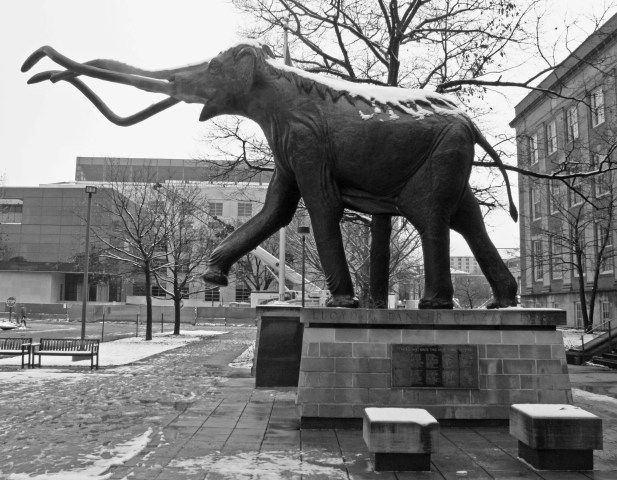
 This weekend, an ice storm fluttered over eastern Nebraska, coating Lincoln in thin layers of slick ice and making it difficult to drive or walk. It has warmed up today, but UNL cancelled classes. I left my apartment only once this weekend for the sacred ritual of movies and food. Otherwise I’ve been inside my apartment avoiding the weather’s risks.