Category Archives: Writing

“Don’t be a writer. Be writing.” -William Faulkner

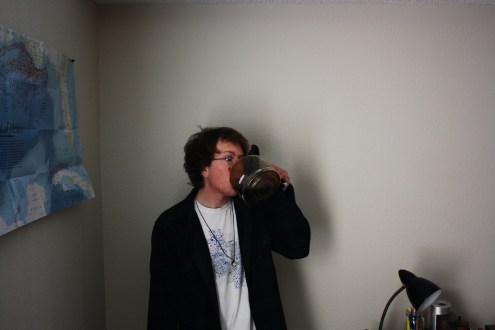
Coffee: A Steamy Love Affair

Coffee Poet.jpg

Those who know me know that I love coffee. Those who don’t know me can easily guess, thus far, that I have a moderate fondness for coffee. To be clear, I’m not picky; I like tea, cocoa, water, smoothies, milkshakes, juice. But coffee has a special place in my life.

I had my first cup in my high school cooking class. During one of the baking sessions, our teacher turned on the coffee pot near my station while our muffins were still in the oven. That’s when I had my first cup of caffeinated hot brown acidic water, filled with cream and sugar like most first-timers. After a while, I started drinking coffee whenever I cooked, then every morning, then every morning and afternoon, then several times a day. For a while, I got headaches when I didn’t consume any caffeine by 10:00 AM.

I’ve since become less addicted. I once considered giving it up for Lent but decided that not even Jesus would have gone that far. Nevertheless, I have cut back, and not just because I’ll probably have an ulcer by the age of twenty-six if I don’t.

There are coffee addicts and there are coffee lovers, and I want to be the latter. The difference between a violinist and someone with a violin is making every note a masterpiece. The difference between a chef and somebody who cooks every meal is mastering the kitchen’s tools and ingredients, and cooking with gusto rather than mere hunger. Anything can be an art, and the only way to become an artist is to inhabit a practice so fully that we infuse ourselves with it.

Everything about coffee is perfect to me, and if not I try to make it perfect. Espresso, lattes, dark roasts, light roasts, the smell of the beans, the feel of them in my fingers, the careful measurement of fresh grounds into the coffee pot, pouring the first cup, breathing in the scented steam before the first sip, and feeling it run down my throat hot and fresh, until it bounces around my stomach looking for a place to sit. I write with it; I read with it; I get to know people with it. It’s not for everyone, but it’s certainly for me, which is likely why I haven’t slept since 2015.

What practice or hobby or food do you love? Let me know in the comments!

-jk

P.S. If you thought the title was cheap, consider all the other possibilities I had to work with. Drip coffee was only a starting place.

After Gallipoli

ANZAC Soldiers on the Gallipoli Peninsula

ANZAC Soldiers on the Gallipoli Peninsula

Today marks an important moment in the First World War: the final evacuation of British and ANZAC (Australian and New Zealand Army Corpse) troops from the Gallipoli Peninsula, ending a disastrous months-long Allied campaign to gain control of a narrow a sea route to Russia, the Dardanelles, and to push troops through Anatolia (Turkey) to the Ottoman capitol Constantinople and knock the Ottoman Empire out of the war.

Allied Strategy for the Gallipoli Campaign. Keagan, John, The First World War.

Allied Strategy for the Gallipoli Campaign. Keegan, John, The First World War.

First Lord of the Admirality Winston Churchill schemed the invasion. Allied ships would sail through the Dardanelles accompanied by minesweepers and land thousands of troops onto the Gallipoli Peninsula, where they would secure the area and push on to Constantinople. The initial landing was on April 25, 1915, involving many soldiers from Australia, New Zealand, and Ireland.

The Allies were unprepared for the harsh environment on Gallipoli and the ferocity of Ottoman Turkish soldiers, led by the now famous commander Mustafa Kemal, who directed his troops in successfully defending the Peninsula. The Allied troops became entrenched on Gallipoli for a grueling eight months. Kemal proved his military prowess; Churchill’s plan, on the other hand, proved to be a quagmire. On this day one hundred years ago, the Gallipoli Campaign came to a close. The Ottomans had defeated the British Empire for the time being.

That victory was arguably the last great moment in Ottoman history, and the first in a long time. Earlier in 1915, Ottoman troops committed acts of genocide against Armenian civilians. The Ottoman Empire had been in decline for decades amid encroaching Russian and European empires, and would later suffer British and French diplomats carving it into colonial mandates after the end of World War One. Winston Churchill was involved in that process; he even said that he created the country of Jordan “with the stroke of a pen one Sunday afternoon.” When the War finally ended in 1918, the British and French saw the defeated Ottoman Empire as property to divide among them: Britain took Palestine, Jordan, and Iraq, while France seized Lebanon and Syria, divided artificially. Those artificial borders continue to create problems today in these countries, pitting groups together or dividing cultures along superficial lines.

The Ottoman Empire had practiced its own form of imperialism, and ruled over its Arab territories from its imperial center in Anatolia, just as the British Empire ruled India and South Africa from England. Just as the British and French are guilty of reprehensible war crimes to maintain imperial power, the Ottomans were guilty of the same, such as the Armenian Genocide. Despite the emphasis on self-determination that dominated discussions at the Treaty of Versailles, Arab, Kurdish, Armenian, and other groups were simply shifted from Ottoman rule to British and French rule with as much regard as plunder shifted between pirates.

The Allies also wanted to divide Anatolia, but the Young Turks, led by Mustafa Kemal, fought a war for Independence from 1919 to 1922, and formed a stable, secular, but complex democracy. The Greek minority in Anatolia fought its own smaller rebellion, leading to the eventual forced migration of thousands of Greeks from Anatolia and Turks from Greece in 1923. Kemal had nevertheless defended his homeland from the British, and would not allow the Allies to make property of it.

New nations were formed from the defeated Ottoman Empire, but Turkey may have been the only one to form itself on at least some of its citizens’ own terms. The rest were carved artificially by Churchill and his ilk, Similarly, many Irish soldiers returned to a British-controlled Ireland torn by rebellion in the 1916 Easter Uprising. April 25 is commemorated as Anzac Day in New Zealand and Australia. The Battle of Gallipoli brought British loyal subjects to the edge of the Ottoman imperial center; it was a devastating failure for the otherwise almost obnoxiously successful British, who continued to claim colony after colony across the globe. For the crumbling Ottoman Empire, it was one final act of defiance against the empires surrounding it. Two of the most complex figures of the twentieth century emerged from the battle with profoundly different scars: Mustafa Kemal won, and Winston Churchill lost. Both men went on to be war heroes and war criminal simultaneously, and their role in history will likely always be contentious. At least, both played crucial roles in the destruction and recreation of nations.

By January 9, 1916, about 265,000 Allied soldiers and 300,000 Ottoman soldiers died on Gallipoli. Many of the them were probably unconcerned with the survival or strengthening of empires. They were concerned, most likely, with fighting for something they were told, and genuinely believed, was bigger than them: nationhood. Many Irish joined the war thinking the British would reward them with independence. Australians and New Zealanders had an emerging sense of national identity separate from but loyal to the British. The Turks fought on their homeland against invading Europeans. Thousands died trying to make a nation of their world. Indeed, nations formed, but maybe those who fought created their own kind of temporarily autonomous nationhood of spaceless unity. Amid the destruction of empires, it may be tricky to honor that unity on both sides of Gallipoli equally, but we should strive to anyway. Nationhood is what we make of it, and despite what Churchill seems to have believed, sovereignty means more than a pen stroke.

-jk

John Keegan. The First world War. New York: Vintage Books, 2000.

Very Near the Last Best Place

“I’m in love with Montana. For other states I have admiration, respect, recognition, even some affection. But with Montana it is love. And it’s difficult to analyze love when you’re in it.” -John Steinbeck, Travels with Charley

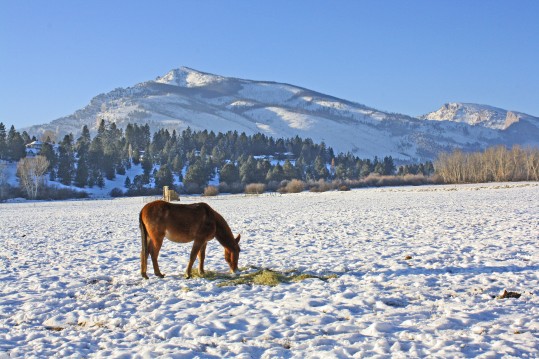
Snowy Horseman

It’s been especially cold in the Bitterroot Valley this week. The air is fat with moisture, and below-freezing temperatures are typical. Still, there is clarity in the cold, standing at the center of the Valley’s balding head. The crown of mountains rolling up and down across the horizon like changing statistics are garnished with snow and the torn fabric of clouds. The trees carry tufts of it, the fields and sleepy barns hold sheets of it stretched thin into ice, and the sky lets down more, flake by perfect, God’s-eye flake.

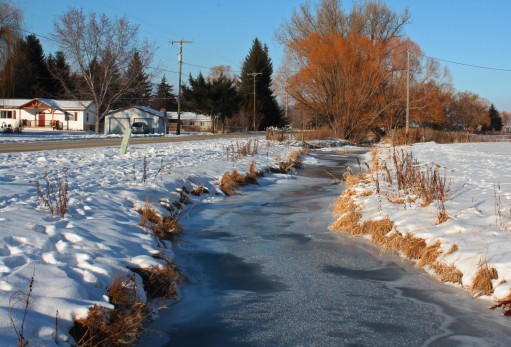
River Icy

In the middle of the ring of mountains, I stand surrounded by the monumental totality, the jagged white-purple strips draped below a hazy, bitter blue sky, like skin left out in the cold too long.  My nose hairs freeze as I breathe in and look at the sunlit snowscape, a territory lost in cold dreams of something to bloom later, something better to come, something beautiful in the future. I find beauty in the waiting, or try to. The snow is a fixation for me. This frigid terrarium of agriculture and forestry is astounding.

Fence

Maybe there really is such a thing as timelessness. Maybe there’s a way to stop time, step out of it like out of a beater truck, and frame time within electrical confines. Keep it forever, or send the past into the future untarnished by change. But the snow will melt, and something gorgeous will replace it. Trees will philosophize, flowers will converse, and a listlessness of birdsong will fill the air.

Snow Mountain

I pull my camera from my bag, take my gloves off, and take a picture of the landscape. The snow is so lovely, and it melts so quickly when touched, so I try to hold it in another way. I can hardly use my fingers when I lower the camera. I didn’t notice how numb they’d gotten in the photographic thrill of momentlessness.

-jk

All photos copyrighted material of Lost Compass Photography, 2016. Donations, or else get-well-financially cards, are always welcome.


Reflections on a First Semester in Grad School

AcademyI’m twenty-five percent of the way finished with my Master’s Degree in English at the University of Nebraska-Lincoln. Most of what I’ve encountered is unsurprising: the workload is tough, the Midwest is flat. However, there are certain things I’ve learned, perhaps unique to my own situation, that I wish I’d known earlier this summer.

  1. Maturity is a state of mind. I’m the youngest person I’ve met in the creative writing segment of my department, and I’m often made to feel like a little kid, like I don’t quite belong, among the adults (at least among most of the writers I’ve met). Many are PhD students with an MFA or an MA. In truth, I don’t quite fit in with most of the other writers stylistically, humorously, or aesthetically. Both my writing and self are plain weird, and I’m surrounded by tradition and formality. I don’t want to sacrifice my identity to fit in, though. I’d rather be a transplanted weirdo in the Midwest than a converted Midwesterner. Growing up isn’t about leaving behind parts of myself that don’t meet others’ expectations; it’s about maintaining myself in increasingly diverse and challenging situations.
  2. Discussions of craft are not as important as craft itself. Every discussion of craft I’ve had so far consists of an extensive mythology of what other writers did to keep themselves writing, followed by the refrain, do what works for you; coffee, rum, fishing in the Missouri River, whatever will help crank out a daily three to four pages. My own method involves writing for those who inspire me, unhealthy amounts of caffeine, and hikes in nature (which I’ve yet to find near Lincoln).
  3. Nothing is more important than the writing. I came to graduate school to write, and to publish, and to understand literature and improve myself intellectually, but my primary goal is to crank out three to four pages a day, no matter what.
  4. Friendship is more important than the writing. Friends are increasingly hard to come by the higher I climb into academia. Allies are nice, but the few friends I’ve made are crucial to my survival. Without them, I’d have no support for my experimentation. Plus, writing can be lonely, and being cooped up all day is a good way to get cabin fever.
  5. Contradictions are okay (and inevitable). Graduate life, much like undergraduate life, is complex and full of numerous contradictions. Some are basic: a free ride still requires one thousand dollars of student fees per semester. Some are more complex: writing depends upon time and inspiration, but inspiration usually comes from things requiring time not spent writing (loved ones, caffeine, hiking). Fortunately, I now have the benefit of knowing exactly what I need to survive the next seventy-five percent of my degree: writing, friends, coffee, a place to hike, more confidence in my weirdness, and a few more publications would be tolerable, I suppose.

Look out, 2016, here I come.

-jk

Midnight Train to Colorado

LocomotiveYesterday afternoon, I crawled off the California Zephyr after spending sixteen hours next to a window watching snowy mountains go by as I sat alone with a good book (Chang-Rae Lee’s Native Speaker), some new music on my iPod (Bombay Bicycle Club), and laptop to write short stories (Sci-Fi and Cli-Fi, with very little Wi-Fi). I was completely alone, standing up only to stretch and get coffee from the service car. It was spectacular.

A century ago, trains propelled people into expanses of uncertainty. They helped us contract time and space, a theme I regularly wrestle with. Trains pushed Europe into Asia, and solidified New England. They stapled towns together across the American Midwest like a string of Christmas lights, one after another after another, bringing them to the foot of the Rockies and knitting cross-communal quilts in the process. The railroad changed history entirely.

Today, trains are far from the fastest form of transportation. I could have gone home by plane in a fifth of the time it took by train. But for a historian and writer, trains are the perfect form of travel. Being able to slow down, lean back, and reflect on the past semester was just what I needed.

Midnight Train to Colorado

It’s difficult for me not to be reflective this time of year. Winter break imposes introspection. In one year, I’ve changed more than I thought possible. I almost wrote a novel but completed a poetry manuscript, and saw the publication of two poems, an essay, a story, and a ten-minute play. In the past year, I found more of my voice than I had in ten years prior. I also moved to a new home and school, leaving behind everything familiar. I raced through the last semester too fast to enjoy it, propelled by a locomotive of too much ambition.

These days, trains are a way of retracting time and space, and after running through the semester at full speed, slowing down to watch the nightscapes and frosted mountains go by was a healthy step back, a way to manage the introspection overwhelming me after a year of so many wonderful, terrifying changes.

-jk

When a Story Strikes

Blank PagesCreativity is sneaky; it can strike at the most inopportune moments, and writers need to be prepared. Writers can find inspiration while showering, cooking biscotti, giving back rubs, performing open heart surgery, or in my case all of the above simultaneously, and creative ideas can whither if not recorded quickly enough. Many writers, myself included, carry around small notebooks to salvage sudden ideas.
Sometimes, the best preparations fall short. While flying home this week, I was enjoying the on-flight complimentary burned coffee when something in my brain clicked, and an idea for a story crystallized.

Before I could pull out my notebook and pen, the plane began to shake. The pilot announced that we should remain seated through the turbulence, “even if you do like it shaken, not stirred.” My tray table lurched as I flipped to the next blank page and scribbled down every detail of my brilliant, wonderful story idea while it was still fresh.

Several hours later, as I waited for the shuttle to my hometown, I had a few spare moments to look back at the brilliant, wonderful, award-winning story idea. Instead, I found in my notebook a slim paragraph of what looked like ancient hieroglyphics. My handwriting is bad to begin with; add a jittery writing space and a lack of patience, and clarity is doomed. I could make out the words “old man” and “saucepan” amid the scribbles, but otherwise my brilliant, wonderful, paradigm-shifting story idea was illegible.

Rest in peace, story idea. I’m sure what I would have titled “The Old Man and the Saucepan” would have been excellent. In my rush to preserve it intact, I lost it entirely. As a writer, I should slow down sometimes. More importantly, I should learn to trust myself to utilize a half-formed idea. Even the best ideas I’ve recorded legibly have evolved. Art, after all, is a process of evolution, patient and sometimes careless. The key to producing good art is the ability to improvise. Now if you’ll excuse me, I have to clean biscotti dough out of my shower drain.

-jk

Writing on Game Day

The Mill It’s another game day in Lincoln, Nebraska. The city is dripping with redshirts (not the kind from Star Trek, but closer than you’d think) and people asking for tickets. It’s hot, dry, loud, and alive. There is energy and consumerism in Lincoln today. Parking here, fifty dollars! Hot dogs, popcorn, soda, beer! Families move through the streets as the day builds toward the big game. Parties, I’m certain, are in planning, if not already in mid-construction.

Currently I am not involved in the game day activities. It’s nothing personal, Nebraska, but I have work to do. I have a novel to write, several novels to read, essays to research, critiques to work on, and Renaissance comedies to struggle through. I have work for my research assistantship on top of my graduate classes, plus my ongoing attempts to write and publish.

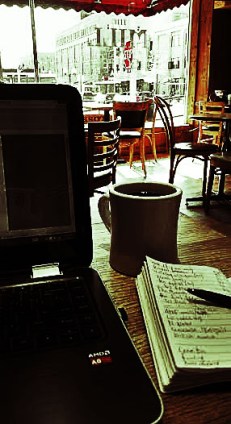
I’ve tucked myself into a corner coffee shop downtown to caffeinate and induce sleeping problems. I’m going to spend the whole of game day here, watching the red sea of fans part against the street corner while rushing to complete the next section of my novel for workshop on Monday, then finish the 4,501 other projects I have (blogging notwithstanding, of course). I can’t afford to see a game, anyway. Four dollars for a cup of coffee and a scone is better than fifty for a ticket. Even if I watched the game, I wouldn’t particularly care who won. I’m told we’re having a bad season, but I couldn’t tell you a single score. It’s nothing personal, Lincoln; fandom just doesn’t suit me.

-jk

After Two Years of Blogging, Your Guess is Still as Good as Mine

toastWordPress reminded me that today is my two-year blogiversary. I missed last year’s for the obvious reasons (grad school applications, Macbeth, mud wrestling, etc.). Today, though, I slide two years into the past when I was surrounded by the mess of my education: Beloved, essays on the Holocaust, a textbook on linguistics, The Outlaw Bible of American Poetry, and drafts of my own poetry. The liberal arts defined my life, but lacked definition; in a confused fervor I wrote my first blog post asking simply, why get a liberal education in the first place?

Two years have gone by. I created this blog to explore the liberal arts generally, the life of a wannabe writer specifically. At varying times, it has served as an open journal, editorial, bully pulpit, and archive of my writing. I started out posting short vignettes satirizing myself as a freshman, but moved on to better creative writing, philosophy, travelogues, history, and humor. If my blog feels eclectic, it’s only because my brain is eclectic. I move rapidly from Steinbeck to colonial Egypt to writing a short story. This blog is one part journal, one part art, and one part scholarship, with three extra parts marked “miscellaneous.” I strive to make sure no two posts are alike, which may be a bad idea when blogging is supposed to be about consistency and ritual, two qualities I lack.

I’ve explored numerous moments in my life on this blog: I mourned Pete Seeger, challenged myself to write a poem every day each April, founded a photography business, announced publications, had breakfast in Ireland, lunch in Jerome, dinner in Wisconsin, went to my first big fancy writing conference, broke up with my hometown of twenty years for graduate school in Nebraska.

For the most part, though, I’ve read, and written about what I read, and read what others wrote about what I wrote about what I read. An endless reading list is the bedrock of any good liberal education.

Liberal Education

On this blog, I’ve also reached many half-baked conclusions, but one thing has remained clear post after post: a good liberal education is worthless if it stays inside the classroom. Sitting around reading and writing is no way to be a writer, if it’s all I do. I have to experiment with baking or acting, work for a charity, travel, read for a literary journal. I should traverse the gridlock of cities, the innards of bars, the vast organs of campsites. My blog may be ineffectively unconventional; the only binding theme is the continual mess of my lifelong education and my desire to be a writer. But I know blogging has made me a better writer, a more considerate reader, a more confident thinker. It’s been an eclectic two years. I hope the next two will be even more eclectic.

jk

Why a liberal education? Your guess is as good as mine, and I mean that. If you’re engaged in the liberal arts, especially outside of academia, let me know in the comments what you study or write or create, and why.

-jk

In the Company of Roses

Flower Last week, a man told me a parable about a lump of clay and some roses. He cited it as a Persian parable, but I did some research and found that it actually comes from the thirteenth century Persian poet Abū-Muhammad Muslih al-Dīn bin Abdallāh Shīrāzī, commonly known as Sa’di. He is one of the most influential poets in Islamic and Asian literature. In Iran, April 21 is celebrated as Sa’di Day.

While Europeans were busy killing each other in the medieval period, which they eventually termed the Dark Ages like a bad sequel to the Roman Empire, most of Western and Central Asia witnessed an artistic, philosophical, and scientific renaissance. Sa’di was only a part of this unique cultural era.

The poem I heard comes from the “Adoration and Preamble” section of Gulistan, or “the rose garden,” one of Sa’di’s most famous works. It reads something like this:

“I held in my bath a per­fumed piece of clay
that came to me from a beloved’s hand.
I asked it, ‘Are you musk or amber­gris?
Like fine wine, your smell intox­i­cates me.’

Till some­one set me down beside a rose,’
it said, ‘I was a loath­some lump of clay.
My companion’s scent seeped into me.
Oth­er­wise, I am only the earth that I am.'”

Apart from talking lumps of clay, I love this poem because it reminds me that I am defined by my proximity to others more than I realize.

Artistically, I am the product of the writers and poets I read: Billy Collins, Sylvia Plath, Douglas Adams, John Steinbeck, Dunya Mikhail, Jamaica Kincaid, and Pablo Neruda have made me the writer I am. Aesthetically, the Southwest made me an experimental, avant-garde magical realist. Socially, I am shaped by my friends, family, lovers, mentors, and the two or three enemies I keep around for good measure. Professionally, I’m a workaholic, being the son of professors who know education is a religious devotion serving the many at the expense of the few, the happy few.

I’m honored to live in the company of roses. I surround myself with those who inspire me. It took me a while to figure out how miserable one can get surrounded by those who are negative, over-critical, dishonest, manipulative, and toxic. I don’t mean I’m in the company of the perfect; all roses have their thorns. But for what it’s worth, I’m glad to let my friends rub off on me. It makes me a better person (and apparently more appealing to bathe with) to walk with roses.

-jk

Writer Seeks Characters

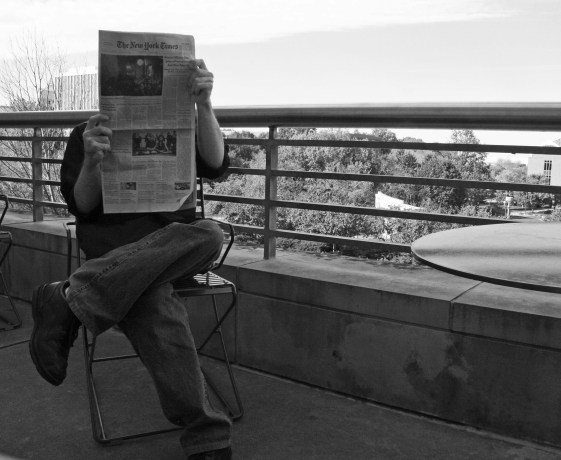
newspaper

March 3: Aspiring writer seeks three to four characters for minor literary endeavor, entitled Untitled Novel. Characters must be diverse, original, and snappy. Villains always appreciated.

March 9: Writer seeks one to two sympathetic protagonists to balance the fourteen unsympathetic villains who answered prior ad. One must be fluent in Russian. Quirks and comic relief are highly valued.

March 10: Fourteen unused unsympathetic villains seek good writer. Willing to die violently; highly skilled in diabolical laughter, fear, surprise, ruthless efficiency, etc.

March 15: Lonely protagonist seeks sidekick and/or love interest. Must have agency, thorough backstory, and moderate comic relief. Static characters strictly prohibited.

March 22: Writer seeks spare subplot involving a gun. Alternative subplots acceptable, but must end in the death of an unexpected love interest the writer doesn’t know what else to do with.

March 25: Postmodern short story seeks ironic resolution for a plot involving fourteen unsympathetic villains. Violent deaths are acceptable, but must be meaningless.

March 29: Writer has unused Chekhovian subplot available, after finding a stray Deus Ex Machina in the shed.

April 9: Hastily killed-off love interest seeks new story, preferably one with a less obviously Freudian subtext and better dialogue.

April 11: Writer has unused Freudian subtext available. Writer also requests to be given a break, Marsha, the dialogue wasn’t that bad.

April 15: Postmodernist writer seeks editor and agent for polished fourteen-villain ironic story.

April18: Protagonist seeks new writer who doesn’t kill off characters just to fill a few chapters.

April 20: Struggling writer seeks copyright lawyer for advice on a recently run-away protagonist.

April 25: Escaped protagonist looking for work, has experience with romantic subplots but prefers complex internal conflict.

April 30: Aspiring writer seeks runaway protagonist. Please come back, Harold.

May 1: Postmodernist writer seeks complex internal conflict for new protagonist.

May 16: Writer seeks runaway protagonist, promises to try harder this time, really he will.

May 18: Seriously, Harold, I created you. What am I supposed to do now?

May 23: Postmodernist writer seeks good journal for a metafictional buddy/love story entitled “Marsha, Harold, and the Writer.”

May 30: Writer seeks three to four characters to collaborate on revising an old plot; is willing to work with characters closely; is willing to let the characters move the plot along.

June 2: Unused plot devices, tropes, and schemes available, no charge.

-jk