
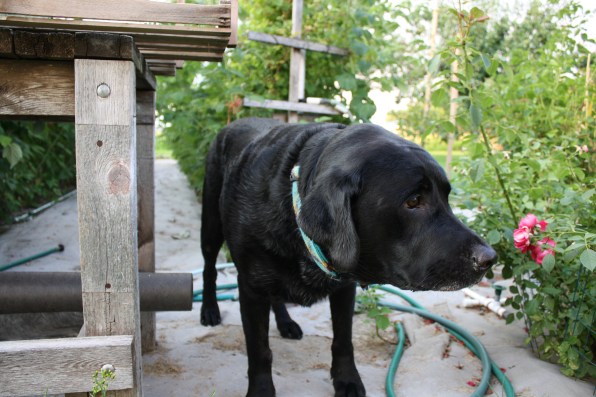
Recently, I read Andre Alexis’s novel Fifteen Dogs. Among the many delightful things in the novel (that it starts with the gods Hermes and Apollo in a bar in modern-day Toronto, that the characters are mostly sentient dogs, that it’s filled with excellent descriptions and dog-drama) is that one of its main dog characters, Prince, becomes a poet who uses a unique poetic form intended to make sense to both humans and dogs.
The French poet Francois Caradec invented this form of poetry for dogs, and Alexis lends him credit for its invention. The form requires the sound of a dog’s name to be embedded in the poem. In this way, dogs will hear their name if the poem is read aloud, and respond in their dogly way by wagging their tails and analyzing the poem from a critical dog studies perspective.
An example from the novel, for the dog named Prince, is as follows:
“Longing to be sprayed (the green snake
writhing in his master’s hand),
back and forth into that stream–
jump, rinse: coat slick with soap” (Alexis 81)
The name Prince can be heard in the words “jump, rinse,” and supposedly a dog named Prince will hear it in the poem. The rest, apparently, will be the usual human nonsense Prince is used to hearing by now.
I wrote a poem in this form for my own dog, Pete, who has seasonal allergies and enjoys scratching his face on various surfaces, including people:
Rough carpet scratches
snatch up every face-itch
on the floor, sensations
to make easy sleep. Eat, sniff, dream
until the next itch, then scratch.
Do you have a dog? A pet? Write them a poem and see what they think.
-jk
Alexis, Andre. Fifteen Dogs. Toronto: Coach House Books, 2015

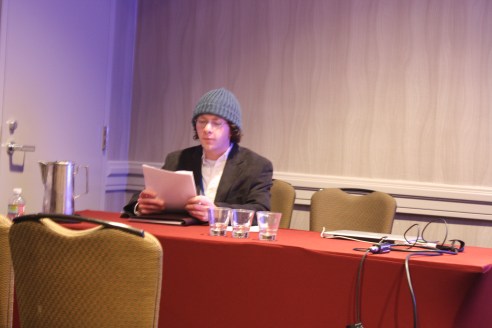
 I’m twenty-five percent of the way finished with my Master’s Degree in English at the University of Nebraska-Lincoln. Most of what I’ve encountered is unsurprising: the workload is tough, the Midwest is flat. However, there are certain things I’ve learned, perhaps unique to my own situation, that I wish I’d known earlier this summer.
 WordPress reminded me that today is my two-year blogiversary. I missed last year’s for the obvious reasons (grad school applications, Macbeth, mud wrestling, etc.). Today, though, I slide two years into the past when I was surrounded by the mess of my education: Beloved, essays on the Holocaust, a textbook on linguistics, The Outlaw Bible of American Poetry, and drafts of my own poetry. The liberal arts defined my life, but lacked definition; in a confused fervor I wrote


 Two months into my first year of graduate school, I think I’ve finally started to settle in. The workload is not beyond my management (I somehow function better with less sleep), the faculty are just as thoughtful and thought-provoking, and my descent deeper into the cult of academia is going smoothly; soon, I’m told, I’ll be a card-carrying postmodernist. The support my writing receives is frequent, and the possibility of a writing career is even starting to take shape.
 Starting a new writing project can sometimes feel like latching onto an umbrella and jumping off a cliff, relying only on improvisation and plain luck to keep me from hitting the ground. The key difference is that, unlike jumping off a cliff, writing is a lot scarier.
 A few months ago,
  More authors than I can count have used a pen name at one point. Dean Koontz has used Aaron Wolfe; Charlotte Bronte used Currer Bell; Daniel Foe, being the creative genius that he was, used Daniel Defoe, not to conceal his identity but to convince his readers he was more gentlemanly. My favorite is Daniel Handler’s pseudonym Lemony Snicket, because Snicket becomes a character in Handler’s Series of Unfortunate Events, one who navigates the reader through the troubling plots. I’ve never imagined myself using a pen name, until I realized how many names I’ve gone by.
 Keene Short