
 WordPress reminded me that today is my two-year blogiversary. I missed last year’s for the obvious reasons (grad school applications, Macbeth, mud wrestling, etc.). Today, though, I slide two years into the past when I was surrounded by the mess of my education: Beloved, essays on the Holocaust, a textbook on linguistics, The Outlaw Bible of American Poetry, and drafts of my own poetry. The liberal arts defined my life, but lacked definition; in a confused fervor I wrote my first blog post asking simply, why get a liberal education in the first place?
Two years have gone by. I created this blog to explore the liberal arts generally, the life of a wannabe writer specifically. At varying times, it has served as an open journal, editorial, bully pulpit, and archive of my writing. I started out posting short vignettes satirizing myself as a freshman, but moved on to better creative writing, philosophy, travelogues, history, and humor. If my blog feels eclectic, it’s only because my brain is eclectic. I move rapidly from Steinbeck to colonial Egypt to writing a short story. This blog is one part journal, one part art, and one part scholarship, with three extra parts marked “miscellaneous.” I strive to make sure no two posts are alike, which may be a bad idea when blogging is supposed to be about consistency and ritual, two qualities I lack.
I’ve explored numerous moments in my life on this blog: I mourned Pete Seeger, challenged myself to write a poem every day each April, founded a photography business, announced publications, had breakfast in Ireland, lunch in Jerome, dinner in Wisconsin, went to my first big fancy writing conference, broke up with my hometown of twenty years for graduate school in Nebraska.
For the most part, though, I’ve read, and written about what I read, and read what others wrote about what I wrote about what I read. An endless reading list is the bedrock of any good liberal education.

On this blog, I’ve also reached many half-baked conclusions, but one thing has remained clear post after post: a good liberal education is worthless if it stays inside the classroom. Sitting around reading and writing is no way to be a writer, if it’s all I do. I have to experiment with baking or acting, work for a charity, travel, read for a literary journal. I should traverse the gridlock of cities, the innards of bars, the vast organs of campsites. My blog may be ineffectively unconventional; the only binding theme is the continual mess of my lifelong education and my desire to be a writer. But I know blogging has made me a better writer, a more considerate reader, a more confident thinker. It’s been an eclectic two years. I hope the next two will be even more eclectic.

Why a liberal education? Your guess is as good as mine, and I mean that. If you’re engaged in the liberal arts, especially outside of academia, let me know in the comments what you study or write or create, and why.
-jk

 Two months into my first year of graduate school, I think I’ve finally started to settle in. The workload is not beyond my management (I somehow function better with less sleep), the faculty are just as thoughtful and thought-provoking, and my descent deeper into the cult of academia is going smoothly; soon, I’m told, I’ll be a card-carrying postmodernist. The support my writing receives is frequent, and the possibility of a writing career is even starting to take shape.





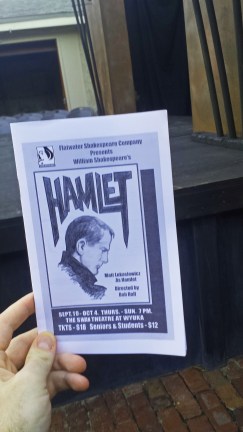 As I’ve mentioned in previous posts, I love theater despite my minimal experience with it. Plays are not meant to be read, but seen, and heard. Words are powerful enough in print, but when given a voice, they have so much more power to move the audience. Some readers are familiar with how important voice is to me. I’m drawn to people with strong voices; to me, it’s the first part of attraction. I grew up caring about voice more than any other part of a person. Garrison Keillor’s rusty voice on the radio; the beautiful harmonies produced by folk singers, The Wailin’ Jennys or Peter, Paul, and Mary. Of course Renaissance theater isn’t for everyone; nothing is. But hearing Shakespeare’s words put to the instrumentation of a cast of strong voices makes it impossible for me not to enjoy those words.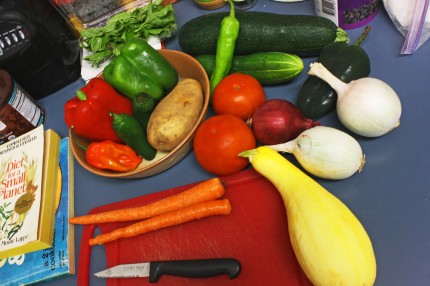


 Let the chili simmer the way the working class simmers before the coming revolution, for two or three hours. Feel free to freeze it for the future or emergency pot lucks. Because your vegetarian Marxist postcolonial chili will be as spicy as your attitude (on tumblr), serve with lots of bread, or over rice. This chili is not for the faint of tongue.

 Starting a new writing project can sometimes feel like latching onto an umbrella and jumping off a cliff, relying only on improvisation and plain luck to keep me from hitting the ground. The key difference is that, unlike jumping off a cliff, writing is a lot scarier.