Author Archives: keeneshort

Unknown's avatar

About keeneshort

I am a writer in Southern Indiana.

Irish Goodbyes

treeI have a bad habit of leaving places without saying goodbye first. I recognize that many consider it rude, but I know I’m not alone in this habit. We have multiple terms for it: the Irish goodbye, the French leave, ghosting. I promise I’m not being rude. This social practice is more common than you’d think.

Ghosting suggests a kind of permanence, because it implies death. It might be a complement to accuse someone of ghosting, a backhanded way of telling someone you value their presence by suggesting that person’s absence feels in some ways tragic. But ghosting doesn’t make sense, as a word for leaving without announcing so. Ghosts spend their energy trying to be known. They knock on doors and haunt people at night. When I leave early, duck out into the snow past the smokers huddled together, I’m not leaving forever. I’m not going to the afterlife, just back home for the night.

Supposedly the French leave was a practice among wealthy French elites at dinner parties, but the Irish goodbye came from impoverished women and men leaving Ireland for America during the Famine. The Irish goodbye is more permanent in this sense, but the drama of leaving a starved nation is a bit much to describe leaving a party early. The French leave is more accurate.

It’s disconcerting how often shyness is interpreted as rudeness, how often presence accompanies the expectation that I need to remind people that I’m there. Will I be forgotten if I don’t? Will I be made to feel like a ghost if I’m not quiet? I don’t like to interrupt, or be interrupted. My silent departures are a way of saving you time, a way of not interrupting you. Your time is precious, and I don’t want to shave off sections of it for myself to announce my leave.

I’m not a ghost, so far I know, but if I were that would be an unsurprising plot twist. I’m not French, or rich, or starved, or Irish. I’m not running away from you, or even running away. I just need to breathe for a bit, get a good night sleep, a long breakfast, maybe spend the weekend on an armchair reading so I can catch my breath.

I promise it’s not personal. I really do enjoy your company; that’s why I listen so much to those around me. I want to listen to everything because I’m afraid I’ll interrupt a brilliant insight or a kind attitude, because I’m surrounded by brilliant and kind people every day whose thoughts are so regularly cut off or never even asked for in the first place. I want to hear from you without interruption. I want to know where you’ll arrive with your thinking, to understand how it works and where it goes. I promise I’m not being rude. I’m just a little shy.

-jk

The 1796 Treaty of Peace and Friendship

By Gardner Weld Allen (1856-1944) - Our Navy and the Barbary_Corsairs_1904

Decatur’s Squadron Off Algiers, by Gardner Allen Weld, 1905.

On June 7, 1797, the US Senate ratified a treaty with Tripoli, which President John Adams signed into law three days later. This Treaty of Peace and Friendship of 1796 was one of four maritime agreement between the infantile United States and the Maghrib States (Tripoli, Algiers, Morocco, and Tunis), known in the west as the Barbary Coast. These treaties were meant to protect American ships in the Mediterranean from pirates operating in the region.

The treaties soon failed, largely because of the toll of payments owed to the Maghrib States and the pirates’ continued ransoming of American sailors. President Adams opted to pay the ransoms and tributes, but his slave-owning Southern successor Thomas Jefferson refused to pay the North African states, sparking a war during the first year of Jefferson’s presidency, the first of two conflicts known as the Barbary Wars.

Late during the Obama Administration, several commentators on both the left and right compared Obama’s foreign policies to the Barbary Wars. An article in The Atlantic called US involvement in the 2011 Libyan Civil War “The Third Barbary War.” Others compared the Barbary pirates to ISIS, while those on the far right erroneously claimed that Jefferson went to war with Islamic terrorists.

Both camps miss the point: as usual, those on the right conflate terrorists with literally every other state-with-Muslims-in-it in history, while liberal commentators misrepresent Barbary piracy as comparable to religious terrorism. Historian Max Boot notes that both the US and Britain utilized piracy in the same ways, noting that “the corsairs of North Africa were no more–and no less–piratical than Sir Francis Drake or Sir John Hawkins. . . both of whom operated as privateers” and that “the US government was so attached to this practice that it refused to sign the 1856 Declaration of Paris outlawing privateering as a weapon of war” (8).

Furthermore, twenty-first century US Middle-Eastern policy differs ideologically from Jefferson’s. Edward Said points out that in the US, unlike Britain and France during this period, “there was no deeply invested tradition of Orientalism. . . the imaginative investment [in the Orient] was never made either, perhaps because the American frontier, the one that counted, was the westward one” (290). The US was interested in controlling the narrative, and therefore the economic value, of the American West (e.g. the Louisiana Purchase) rather than North Africa, which is perhaps the opposite of the Bush/Obama/Trump era.

While the Barbary Wars are easy to exploit for ideological op-eds, the pre-war treaties are more instructive. Specifically, the 1796 Treaty demonstrates that the early US conceptualized itself on equal footing with other seafaring powers, and was willing to alter the national identity it presented to that end.

Consisting of twelve articles, the 1796 Treaty proclaims first that there “is a firm and perpetual Peace and friendship between the United States of America and the Bey and subjects of Tripoli of Barbary” (Article I) and that the two states should avoid naval conflicts with one another. As such, the Treaty states that trade “is on the same footing with those of the most favoured nations respectively (Article IX).

Article XI is now controversial for its implications, and is worth quoting at length: “As the government of the United States of America is not in any sense founded on the Christian Religion,-as it has in itself no character of enmity against the laws, religion or tranquility of [Muslims],-and as the said States never have entered into any war or act of hostility against any [Islamic] nation, it is declared by the parties that no pretext arising from religious opinions shall ever produce an interruption of the harmony existing between the two countries.”

Here, the US emphasizes at length that it does not have a bias against the Maghrib States on religious grounds. Yet Article XI is still out-of-place. In a strictly economic treaty, the US stresses religious difference, or its indifference to religion. Despite Article XI’s clear message, there is overwhelming evidence of a legalized bias against non-Christians after Independence. Gaustad and Schmidt write that “Delaware’s 1776 constitution required all public officials to swear their belief ‘in God the Father, in Jesus Christ His only Son, and in the Holy Ghost.’. . Pennsylvania in 1790 vowed to deny state offices to any atheist as well as to anyone who did not believe in ‘a future state of awards and punishments.’ Only Protestants could be elected in New Hampshire, Massachusetts, New Jersey, South Carolina, and Georgia–according to their constitutions” (131).

And yet, in the 1796 Treaty, the US publicly reshaped its cultural identity in order to make the treaty more appealing. American culture warriors insist that national identity is non-negotiable, but Article XI contradicts this at an international level. In contrast, the US crafted its national identity as an open slate, not just for states but as a union. From the beginning, malleability was intentional, not a growing list of exceptions to the rule. Malleability was the whole point of America.

I want to argue here that the US had a global consciousness from its inception, and not just when it entered World War One. Instead, it built its global consciousness on the trading and military strategies of Britain and France, as well as its own perception of itself as a frontier space, as a blank chalkboard upon which its leaders could draw and erase American identity.  Like the imagined Frontier, America was made to sustain multiple contradictions in what it was. A savage but easily conquered wilderness, a piratical state against piracy, not built on Christianity but where only Christians can be elected.

The land-owning businessmen who created America self-consciously crafted a flexible state that was easy to change as needed. The problem is that the mechanisms of change, of political dynamics, are still in the hands of economic elites.

The Barbary Treaties demonstrate a deliberate American flexibility, an exchange of identity for financial expansion. If this flexibility is more openly acknowledged, even utilized–if we finally recognized America’s founding blankness–then more people might be able to survive and even thrive in America. Until then, the nation is a chalkboard ruled by people who only know how to use the erasers.


Boot, Max. The Savage Wars of Peace. Basic Books, 2002.

Gaustad, Edward S. & Leigh E. Schmidt. The Religious History of America. Harper Collins, 2002.

Said, Edward. Orientalism. Vintage Books, 1994.


Recipes for Grad Students: The Office Hour Banana Smoothie in a Used Salsa Jar

smoothieLet’s say you’re a grad student who teaches in the morning and takes classes at night. What do you do for lunch between those times? You have grading to do and office hours to keep and assignments to write. Going home for lunch is an option, for those who have time or enjoy skipping homework assignments. A useful alternative is a smoothie: easy to make, easy to eat, and usually easy to digest, all in the relative comfort of a small graduate office while you work on job applications during your office hours.

The recipe is simple:

1 banana

1/4 cup milk

1/4 cup yogurt

2-3 Tablespoons peanut butter

1/4 cup granola

1 Tablespoon honey

A dash of cinnamon

Mix all ingredients in a blender or mash them in a bowl with a potato masher if your blender is broken again or as stress relief. Make sure to blend thoroughly, as the peanut butter will make the smoothie more pudding-like in texture.

Presentation matters; just watch any show on the Food Network for five minutes. If you find yourself in need of a stylish smoothie container, just remember that, as a grad student, chances are you have an empty salsa jar somewhere in the back of you fridge (just admit it, you know you do). It’s trendy to put cocktails in Mason jars, but a smoothie in a salsa jar is ahead of its time. The plus is that nobody will think to steal your lunch from the grad lounge refrigerator, especially not when they open a salsa jar to the smell of bananas.

If your students catch you drinking from a salsa jar, they might think twice about asking for an extension, so really, this recipe is a win-win, assuming that phrase means two wins for you and you alone. Enjoy your smoothie, and enjoy your office hours.

-jk

On Writing as a Profession (But Not as a Career)

IMG_4605For me, writing is a practice. More than a hobby, writing is a profession, though I’ve never been paid for it. Writing is work that I enjoy, but it’s not labor. It’s production, but not a job.

My job is to teach on an organized schedule broken into lesson plans, weeks, units, semesters, and academic calendars. I know roughly what I’ll be doing on May 10 (grading final papers) and I know what I’ll be doing on January 10 (introducing a syllabus). Between those dates, I have a little more room for spontaneity, but not much. This is a job, for better or worse: reliably predictable and strictly regimented.

As such, I cannot call writing a job or a career. The point isn’t to make money by providing a unique service, but to make stories and essays, some of which I publish on this blog and others I submit to journals with a broader readership, almost always operating on minuscule budgets. But I can call writing a profession.

I want to completely separate the word profession from its frequent association with economics and careerism. The Oxford English Dictionary traces the word profession to Anglo-Norman and Old French. The OED cites one of the earliest uses of the word to a thirteenth century text called the Ancrene Wisse, meaning “manual for anchoresses.” Authored by an unknown medieval priest, possibly in Wales, the Ancrene Wisse was a religious manual addressed to three sisters to instruct their code of spiritual, monastic conduct. This text, like most early uses of profession, aligns with the OED‘s first definition of the word: “The declaration, promise, or vow made by a person entering a religious order. . . Any solemn declaration, promise, or vow.”

Writing may not be a religious order (though graduate school certainly feels monastic at times), but writing is a profession in its oldest sense, a solemn declaration, a promise. When I write, I profess what I am capable of knowing at the time, and I do so for the creative and intellectual benefit of my readers (first) and myself (second). More importantly I read the writing of others, to benefit from my fellow cloistered writers. Writing is a profession of what I know and want to know, a profession of the questions I have.

Not everything needs to be monetized. I don’t want to market my writing as an asset, and I certainly don’t want to think of writing as an extension of my own commodification. If I do one day get paid to write, I’ll be grateful. If not, I’ll be happy for the stories I’ve had published online for the world to view for free. That my professions can be made public is what matters.

-jk

Nobody Plans to Stay in Spokane

SpokaneMy plan for the break was to take a bus from Spokane to Missoula, and get a ride from there to Hamilton, Montana, to visit my grandparents, then travel to Arizona with my parents. To make a short story shorter, the bus was delayed, and now I’m stuck in Spokane for the night. I will depart in the morning, I hope.

My aunt was kind enough to give me a ride to Spokane from Moscow, on her birthday no less. In her profound generosity, she booked a hotel room for me in Spokane after learning the bus was delayed twelve hours. She then joined a friend for per-arranged birthday plans, hurrying because apparently there was an active shooter in downtown Spokane. She told me that her well-traveled husband has only ever been afraid of Spokane. Moscow, Russia? Fine. Dubai? Sure. But not Spokane. Anything but Spokane at night.

Of course 2017 would draw to a close with me stuck in a hotel room in Spokane where there’s an active shooter on the last day of the semester, listening to “Pale Green Things” by The Mountain Goats on repeat. There are worse endings.

The last time I was in Spokane, I was with the only other nonfiction first-year student in my department. He was picking up a friend from New York at the same Greyhound station I will (hopefully) depart from. He and I wandered the town at night, what my well-traveled uncle would strongly advise against. We found cool bars, he visited a dispensary, and we waited for his friend’s bus in his car listening to Utah Philips sing “Solidarity Forever” on repeat, talking about the possibility of unionizing grad students to protect ourselves from the multitude of organizations attacking higher education.

A month later, he had to leave. His story is not mine to tell, but I know that a graduate student union might have been able to help him stay. A better healthcare system, or even expanded medicaid, would also have helped, and stricter environmental regulations would have spared his health from the start. But, as with so many things this year, it’s too late now.

I didn’t expect to be in Spokane tonight. I expected to explain again to my grandparents what a vegetarian diet involves and sleeping in a comfortable old house in the Bitterroot Valley. Instead, tonight I can see the spot my friend and I parked and shared our insecurities from the view of this hotel. What an unexpected gift, to remember the people who have helped me survive this semester. I needed this reminder of the many people who unintentionally hold me together at the seams just by being themselves. At the end of a dreadful year, what an unexpected gift.

-jk

1917: All Quiet on the Eastern Front

Eastern Front 1914

Russian troops on the Eastern Front, 1914.

On December 17, 1917 (December 4 in the Old Russian calendar), an armistice between the Central Powers and the Bolshevik government in Russia began, temporarily ending a long and bloody German advance and initiating peace negotiations between Russia and the Central Powers. Though official peace through the Treaty of Brest-Litovsk would not take effect for another three months, Russia was essentially out of the Great War, almost a year after anti-war protests in Petrograd led to the February Revolution. Meanwhile, the ill-reported Russian Civil War between the Red Army and the White Army was only just beginning. Out of the frying pan, into the fire.

The conflict was a civil war as well as a proxy war. The Reds constituted the Bolsheviks and their allies. The Whites were an amalgamation of pro-monarchists, proto-fascists hoping to establish a military dictatorship, moderate leftists opposed to communism, and troops from the Allied Powers, all of whom wanted to prevent a socialist regime from succeeding. Months earlier, the Allies had praised the Tsar’s abdication, and the US had been the first to recognize the post-Tsarist government. Now, as the revolution pushed Russia out of the war, the Allies directed their praise elsewhere.

The Bolsheviks, meanwhile, found themselves isolated, their new government shaky, threatened by violence from all sides. The Civil War lasted from late 1917 (or 1918, depending upon which historiography one chooses) to 1922, ending just two years before Lenin’s death. Trotsky’s 1920 book Terrorism and Communism offers an instructive perspective into this period. In Chapter Four, Trotsky examines the American Civil War as an example of state-sanctioned terrorism from both sides, including Lincoln’s suspension of habeas corpus and the repressive violence in the Confederacy against pro-Union sentiments. Trotsky describes Confederate vigilantes running a campaign of terror against those in the Southern States who were seen as disloyal to the South, which he compares to the terror employed by the White Army, writing that the situation in the South was “extremely reminiscent of the scenes which day by day took place in the camps of Denikin, Kolchak, Yudenich, and the other heroes of Anglo-Franco-American ‘democracy'” (Trotsky).

One figure he lists, Alexander Kolchak, is notable for his temporary military dictatorship in Siberia, the Civil War’s Eastern Front. Kolchak was a former admiral in the Russian Navy who, shortly after the October Revolution, joined the White faction in Siberia known as the “directory.” As the White Army became more authoritarian, Kolchak’s supporters overthrew the directory and established a military dictatorship on November 18, 1918, seven days after the armistice in Europe. Kolchak appointed himself “supreme ruler and commander-in-chief” of a White faction in Omsk, Siberia, creating the kind of regime Kornilov failed to make in August, 1917. Under Kolchak, political opponents were imprisoned, peasants were exploited, and unarmed civilians were shot by the hundreds, all to support the White Army. David Fogelsong points out the degree to which the US supported such leaders, writing that with “support from the State Department, the Treasury Department, and the White House, the Russian embassy was able to send millions of dollars of supplies to White forces in the Russian Civil War, particularly those in Siberia” (Fogelsong 69).

The state of Russia between 1918 and 1922 was disconnected and malleable. Mark Steinberg’s description is particularly useful: “But the civil war was a more complex and varied experience than this simple binary of Red versus White suggests. The history of the civil war included terrorism and armed struggle by Socialist Revolutionaries, anarchists, and socialists opposed to both Bolshevik ‘dictatorship’ and the return of right-wing dictatorship that the Whites seemed to represent; ‘Green’ armies of peasants who fought against both Reds and Whites, mainly depending on who presented the greater immediate threat to their autonomy” were among those involved (97). The Russian Civil War more closely resembled Balkanization between ideologically opposed factions funded by competing stakeholders, comparable to Iraq and Syria today. The Reds met counter-revolutionary violence with pro-revolutionary terror in their effort to hold the country together, to prevent disintegration.Trotsky’s comparison to the American Civil War is justified, then, as well as instructive: the successful regime employed violence in much the same way the defeated faction did, ending life to preserve it.

Giorgio Agamben writes that the First World War “coincided with a permanent state of exception in the majority of warring countries” (12), so much so that he describes the period following the War as “a laboratory for testing and honing the mechanisms and apparatuses of the state of exception as a paradigm of government” (6) in which governments utilize “states of emergency” to exert tightly-crafted control over populations so that, gradually, the defense of state ideologies from external or internal threats can only succeed with the suspension of the institutions of those ideology. Trotsky’s description of the American Civil War, and of political terror in general, is stunningly close to Agamben’s analysis of the same conflict.

Continuing in Terrorism and Communism, Trotsky writes that the “degree of ferocity of the struggle depends on a series of internal and international circumstances. The more ferocious and dangerous is the resistance of the class enemy who have been overthrown, the more inevitably does the system of repression take the form of a system of terror” (Trotsky). He justifies state-sanctioned terror because it matches and counters the terror of the White Army, evident in Kolchak and others. In this sense, the shift from the older Soviet calls for bread, peace, and land to Lenin’s policies of “war communism” is similar to Agamben’s articulation of the state of exception as the suspension of democracy in defense of democracy. In the early USSR, this can be understood as the suspension of peace in defense of peace. Given the violence of the White Army, it is difficult to imagine what an alternative response could have looked like.

It is tragic, then, that the majority of people who sided with the Bolsheviks wanted an end to the violence of the Great War and were met, instead, with the brutal violence of the Russian Civil War in the reactionary violence of the White Army and the violence used to country those reactionaries on all fronts and for many years. This is not to suggest indulging in counter-factual fantasies of a Soviet Union not scarred by conflict, but to consider instead the consequences of supporting proxy violence today.

The Treaty of Brest-Litovsk was overshadowed by the fragmentation of Russia and its territories to the south. For a moment, though, there was a temporary peace, or at least the hope for something longer lasting than an armistice. A peaceful world is unlikely to emerge by next year’s hundredth anniversary of the end of the War to End All Wars. But what do we actually gain by giving up and giving into cynicism? Peace is elusive and unsustainable, a moving target. What, then, should we do with our centuries of target practice?


Agamben, Giorgio. State of Exception. University of Chicago Press, 2005.

Fogelsong, David. America’s Secret War Against Bolshevism. University of North Carolina Press, 1995.

Steinberg, Mark D. The Russian Revolution, 1905-1921. Oxford University Press, 2017.

Teacher Sweat Solutions, Ltd.

shirt stainIf you’re a first-time college instructor, you may have heard this piece of encouraging advice on your first day: “Don’t sweat it!” Well, studies have shown that this is physiologically impossible. In fact, the classroom setting is designed specifically to create more sweat among teachers through a combination of lights, stress, and projectors to overheat the exact spot a teacher teaches in, and nowhere else. As a result, within minutes of teaching, teachers are inevitably drenched in a thin layer of sweat they know their students can see, even those students who spend entire classes with their eyes directed into their phone screens.

We here at Teacher Sweat Solutions, Ltd., would like to offer you, a first-time sweaty teacher, a variety of solutions to alleviate what scientists and Rick who always shows up late to meetings have dubbed “frequent sweating issues.”

  1. To reduce the visibility of FSI, consider wearing only black clothes. This will make sweat stains visible only to the first two rows of students.
  2. Strategically reduce the heat in the classroom. Recent studies cited offhandedly by Rick that might have come from NPR but he can’t remember where suggest that body temperature increases the more teachers realize just how many of their students are judging them for mumbling or for saying “um” or for being a humanities professor who sometimes uses critical thinking. Consider turning down the heat and cranking up the AC. Your students can cope with it.
  3. Be careful with your layers. Wear a really tight undershirt and a really loose top over that, so that your undershirt can become a towel that almost never comes into contact with the rest of your clothes. No sweat stains! However, this solution only works if you do not move during the entire class period.
  4. Head sweat is a growing concern these days. Just ask Rick, who pointed out to you in the meeting he was late to that you look uncomfortably sweaty and offered you a tissue. Consider wearing a beanie or a bandana while teaching to mop up the sweat. Longer hair can also catch sweat, but be sure to wash it regularly.
  5. If all else fails, teach online classes only. This will make it impossible for your students to see the sweat you produce typing emails explaining to them that the answers to their questions are in the syllabus.

Teaching is a risky career fraught with pitfalls and existential anxiety, and not just because tuition waivers are about to be taxed pointlessly while professors are scrutinized by petty, ideologically driven politicians. We can’t help with that, but we can at least help you reduce the visibility of your sweat while you anxiously watch the news unfold during your in-class free writes. We can’t reduce your stress, but we can help you deny that it’s there, like you do with the rest of your problems, Rick.

-jk

Surrendering a Pocket Knife

IMG_4603There wasn’t much going on at the Spokane International Airport. Its two runways did not seem busy yesterday as I navigated the rigid airport security system. I diligently took off my shoes, placed my laptop in its own plastic tub, and placed my sparsely packed backpack in another tub. Shoeless, coatless, without my glasses and a little sleepy, I went through security. Past the body scan, I then waited as a TSA agent rummaged through my backpack.

“It looks like there’s a knife in here,” he said to me, casually.

Of course. My air travel backpack is the same as my camping backpack. Before packing, I had emptied my backpack of all my camping equipment, and even emptied it of pens and pencils, just in case. It seems I had missed a pocketknife, which took the agent a few minutes to locate after it slipped into one of my backpack’s many pockets. Only an X-ray could detect it. He held the knife in front of me, saying I had three options. I could have it delivered somewhere from the airport, put it in my car (I didn’t drive there), or, as he put it, I could “surrender it and let it go to knife heaven.”

I paused for a second. My flight would begin boarding in thirty minutes, and I probably had enough time to have it mailed back to my apartment and then go through security again, even though the knife was the only issue. But the line behind me and the agent’s calm patience made me feel embarrassed, even ashamed, at not doing my civic duties and preparing my backpack for Thanksgiving travel thoroughly enough. I chose to surrender the knife.

During my flight, I mulled over the word surrender. There are so many other ways of putting it: confiscate, disavow, give up. Instead, the situation looked like this: a TSA agent held my knife at me and told me to surrender.

It occurred to me that I felt safer at an airport than I do in my own classroom. I cannot take a knife on a plane (fair enough), but if I wanted to, I could bring a concealed handgun into my classroom while teaching. Idaho’s laws are finicky, and concealed-carry gun-owners, while on campus, are not allowed to reveal their weapons, but I still have the option to have one, and so do my students.

The argument is that the only thing stopping a bad guy with a gun is a good guy with a gun, and yet we don’t apply this logic to airplanes. On the plane, we cannot trust anyone with a pocket knife, or scissors, or toothpaste, so we regulate these things, or at least we collectively agree to embrace the cognitive dissonance required to believe that the good guy/bad guy hypothetical situation works everywhere except a plane. Nobody is trusted on a plane, but we have to trust that good guys will be everywhere else.

While teaching my last class before the holiday break, a man walked into my classroom, abrasively opening the door and marching toward me. He was older, balding, and looked frantic. Before I could panic, before I could beg him not to shoot me, he pointed to the lectern at which I stood and said, “I need to get a flash drive.” Then, in a few quick moves, he unplugged a flash drive from the computer. Evidently, he was another professor who had previously used the same classroom, and had left his equipment there. He apologized for the inconvenience and walked out. My students didn’t seem bothered. Maybe they’re all just good guys.

As my plane landed, I thought about something Charles Olson wrote in his 1947 literary criticism Call Me Ishmael: “I take SPACE to be the central fact to man born in America, from Folsom cave to now. I spell it large because it comes large here. Large, and without mercy.” I’m skeptical that there is one central fact of America, but after the twin incidents in the classroom and airport, I’m inclined to think the central fact of America might be surrendering. This might be the case for every nation-state, but I cannot speak to other countries, but it seems more widespread in America: If I were not white, I can’t imagine what the TSA agents would have done to me after discovering a pocket knife in my backpack.

The word surrender has another, more sinister layer. Only combatants can surrender to another authority, lesser or greater in force. Soldiers surrender in war, and criminals surrender to cops. It suggests a more equal power dynamic than what is actually recorded in history. Native Americans surrendered land and life, Afghan children surrender security under drones, politicians surrender principles and we surrender to them our votes and our privacy, the working poor surrender their labor. What the state calls surrender is more like seizure because those who are asked to surrender are made to feel responsible for their defeat, as if it was their choice to enter into a conflict with America, large and without mercy.

And what was I ashamed of? That I was caught not remembering the state of terror we live in? I think, in truth, I was ashamed that the first time I relaxed this semester was walking into an airport, that I felt safer in a security complex designed to reinforce fear than I do in a classroom designed for comfort and an easy pace, and that I’m made to feel responsible because I’m not a good guy with a gun. Instead, I walk into a classroom with pens, pencils, markers, books, and slideshows, but none of those things, it seems, are enough to make me good.

-jk

1917: Into the Dustbin of History

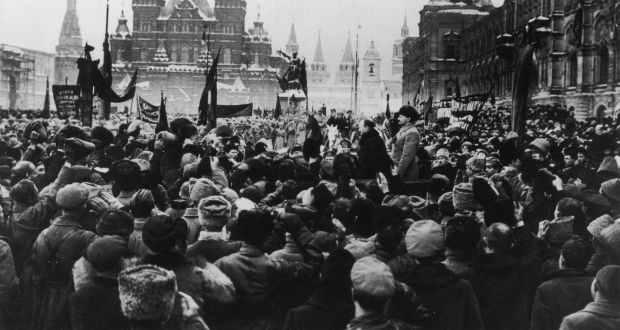
Trotsky speaking in Red Square

Leon Trotsky speaking before a crowd in Petrograd, October, 1917.

“I am certainly not radical enough. One can never be radical enough; that is, one must always try to be as radical as reality itself.” -Vladimir Lenin, in conversation with Valeriu Marcu while exiled in Switzerland.

On this day, one hundred years ago, the October Revolution began. In the Gregorian Calendar, the Revolution started on November 7, but in the old Russian Julian calendar, it was October 25. In memory, it marked the beginning of the state that would become the Soviet Union. For those involved, it was something more important: the end of the Provisional Government and its de facto lack of leadership.

The problem with the Provisional Government that formed after February, 1917, was not that it was explicitly authoritarian. The problem, from its inception, was that it was a balancing act between traditional hierarchies and the growing desire for the end of those hierarchies. Alexander Kerensky came to control the Provisional Government, sharing power with the soviets while trying to maintain the war.  What Trotsky called “dual power” between Kerensky’s Provisional Government and the Petrograd Soviet (representing workers, peasants, and soldiers), Lenin called “Bonapartism,” in reference to Napoleon Bonaparte. In mid-1917, Lenin wrote that Kerensky was maneuvering “state power, which leans on the military clique (on the worst elements of the army) for support, between two hostile classes and forces which more or less balance each other out.” Lenin was not alone in criticizing the Provisional Government, which was a primary point of contention among Russia’s revolutionaries.

Apart from Kerensky’s perpetuation of the war effort, he was shown to be an unhelpful leader in August, during what became known as the Kornilov Affair. Lavr Kornilov was a general who, in August, attempted to overthrow the Provisional Government and install a right-wing military dictatorship, a proto-fascist regime that would have undermined the February Revolution and reinstated a new Tsarism. As China Mieville writes of the affair, “. . . there was more than one conspiracy simmering away on the right. Various shadowy groups–the Union of Officers, the Republican Centre and Military League–were meeting to discuss plans for martial law” (213). Add to these the threat of the antisemitic Black Hundreds, responsible for mass murders and pogroms across Russia, as well as counterrevolutionary efforts to win the war, the bleak regime Kornilov almost created would have been as oppressive, if not more so, than the regime of Tsar Nicholas II. But the coup failed because Kerensky managed to work alongside the Petrograd Soviet in time to stop Kornilov’s renegades from invading the capitol.

There was leadership, then, but no ruler. Christopher Read writes that one consequence of the Kornilov Affair was “a sort of reverse of the July Days,” that the “right had discredited itself and restored the ascendancy of the left.” He also writes that there were consequences for Kerensky, too, who “made an agreement with the Petrograd Soviet, armed it, withdrew the ban on its members, primarily the Bolsheviks, and released Soviet prisoners from jail. . . But it was not enough. Kerensky was seen to have cultivated Kornilov in the first place, not least in appointing him C-in-C” (Read 92-93). Indeed, Kerensky was seen as having worked with Kornilov, and many believed that he was sympathetic to an authoritarian coup that would relieve him of his duties. If nothing else, the affair proved that the Provisional Government had become dysfunctional, barely clinging to life.

In the months that followed, popular support for the Bolsheviks rose while support for Kerensky plummeted. It is important to note that the goal of most on the far left, including some Mensheviks, was to pass power to the soviets completely, and end the power of the Provisional Government. As early as September, “eighty soviets in large and medium towns backed the call for a soviet government. In towns such as Tsaritsyn, Narva, Krasnoiarsk, and Kostroma soviet power was already a reality” (Smith 147). During this time, the Bolsheviks were actively campaigning from the ground up, organizing factories, speaking in public, and stoking public support for a soviet antithesis to the Provisional Government. It was around this time that Lenin suggested that the Bolsheviks, “‘having obtained a majority in the soviets of workers’ and soldiers’ deputies in both capitols, can and must take state power into their own hands‘” (Mieville 246), and should make no compromise with the Provisional Government by simply walking away from it.

Here, Lenin believed that the time was ripe for the soviets to lead the soviets in taking power. Earlier, he had encouraged the Bolsheviks to refrain from leaving the Provisional Government in July because they were not popularly supported, and it was important for him to recognize that the support of the workers, peasants, and soldiers was more important than overthrowing a weak Provisional Government. It had to be done for the soviets and all they represented. Now that it was clear the Bolsheviks were going to gain popular recognition in an upcoming pre-parliament session (which would begin October 7), the Bolsheviks would declare their legitimacy among the soviets and then walk out.

The Bolshevik Alexandra Kollontai, who helped exiled leaders like Lenin correspond with the party and without whom the revolution would not have succeeded, articulated the main argument against working with the Provisional Government in her text “Why the Bolsheviks Must Win.” She wrote that the “February revolution could remove none of the factors which caused it, namely war, rising prices, famine and privation. At the same time, the Russian bourgeoisie calmly continued their rule” (Kollontai). In other words, the horrors that motivated widespread protests across Russia continued to inflict damage, and needed to be addressed with different means. For many Bolsheviks, this meant an armed insurrection to precipitate the transfer of power to the soviets.

After walking out on the pre-parliament, the Bolshevik Central Committee met in secret on October 10 to vote on whether or not to implement an insurrection. By ten to two, after numerous speeches from numerous members, they voted in favor of insurrection. They were now popular representatives of the peasants and workers, and the time had come for another, more radical change necessitated by the moment’s urgency. For the Central Committee members, waiting for more elections would result only in more casualties as the German army approached and increase the chance of another Kornilov-inspired coup. If they waited any longer, the comatose Provisional Government might be toppled and a military dictator might be installed.

The insurrection began on October 25. Fittingly, this was also Trotsky’s birthday.

That day, Trotsky spoke to an “emergency session of the Petrograd Soviet” and announced, “‘On behalf of the Military Revolutionary Committee, I declare that the Provisional Government no longer exists‘” (Mieville 289). The Second Congress of Soviets opened to debate a new soviet-led government. Meanwhile, Red Guards (a paramilitary branch of the Bolsheviks), seized key areas of Petrograd, including bridges, train stations, the post office, and eventually the Winter Palace, where they arrested the remaining members of the Provisional Government, who surrendered peacefully. All except Kerensky, who had long since fled the city.

A number of elected officials who opposed the insurrection walked out of the Second Congress of Soviets, while Trotsky pontificated on the legitimacy of the move he and the Bolsheviks made: “A rising of the masses of the people requires no justification. What has happened is an insurrection, and not a conspiracy.” While those who dissented walked up and left, just as the Bolsheviks had at the pre-parliament weeks before, Trotsky denounced them, shouting, “you are miserable bankrupts, your role is played out. Go where you ought to go: to the dustbin of history” (298-299). On those words, the opposition left the Congress to continue debating a new regime, one without monarchy, oligarchy, or hierarchy.

By early morning on October 26, after tense nightlong debates, the Second Congress of Soviets passed a resolution drafted by Lenin to build a soviet-exclusive government, end the war, grant self-determination to nations Russia had subjugated, and transfer land to the peasants (303-304), thus creating an all-soviet state.

The October Revolution occurred without a single loss of life. It was armed, but bloodless. A ship controlled by the Red Guards, the Aurora, fired a blank shot, and some shots were fired periodically during the arrest of the Provisional Government, but nobody died in the October Revolution, partly because of how well organized the Red Guards were, but mostly because the government in place was apathetic to its own demise. It did not resist arrest and cancellation, which suggests that the October Revolution was not a coup, as some historians contest. As S. A. Smith puts it, “. . . a coup implies the seizure of a functioning state machine. Arguably, Russia had not had this since February” (43).

It is telling that the document announcing the insurrection’s success, titled “To the Citizens of Russia,” begins not by declaring a new soviet regime but by iterating that “The Provisional Government has been deposed” (Lenin). A bottom-up regime change was important, but it was more important to end what was in place, a doomed, if not failed, attempt to sustain a fraction of the old guard through the exhausted imitation of the old guard’s strategies. It was not a state of anarchy the way contemporary anarchists would have preferred. Kerensky held together a stitched-up government of poorly balanced provisions and hierarchy beyond its health. He was not a competent ruler, but he still ruled, and as such, he presided over a kind of anarchy by leaving the Provisional Government open to coups that favored hierarchy, which would have been a return to pre-revolutionary Russia.

The October Revolution was an attempt to replace the lasting remains of the Tsarist regime with something new, something untried, something that could create a state without hierarchy. It was a somewhat democratic effort to reaffirm the rule of the soviets, to make every worker, peasant, and soldier free of status. It seems that in the moment, the only other option was a cynical return to military dictatorship, well-known to those many who survived it before. The Bolsheviks wanted to give the Congress an alternative, however strange and frightening it may have been, to what Russians had spent decades suffering through. After the bloody Civil War, Lenin’s too-soon passing, and Stalin’s hijacking of the state, the Second Congress is easily obscured in its long, cold aftermath.

One step forward, one step back.

Trotsky condemned those who refused to try for an alternative to hierarchy to the “dustbin of history,” where, now that Russia is under a new brand of right-wing authoritarianism, the entire Soviet Union now rests, sometimes even in peace.


Mieville, China. October. Verso, 2017.

Read, Christopher. War and Revolution in Russia, 1914-1922. Palgrave Macmillan, 2013.

Smith, S. A. Russia in Revolution. Oxford University Press, 2017.

Smith, S. A. The Russian Revolution. Sterling, 2011.

Having Blogged for Four Years

Arboretum

Photo taken at the University of Idaho Arboretum and Botanical Garden

. . . I wonder if this is the only anniversary in my life that matters. I started this blog four years ago. Hopefully, the quality of posts has improved just as the quality of the world has diminished.

I’m knee-deep in the first semester in my third college program, this time an MFA in creative nonfiction. Since October 27, 2016, I have started a blog series about the Russian Revolution, had one essay published and one short story published, finished my Master’s degree in English, and moved from Nebraska to Idaho. I’ve also started writing for the Idaho MFA blog, reading nonfiction submissions for Fugue, and volunteering as an editorial assistant for Western American Literature. My literary life has expanded substantially in a year, and yet I’m still ambitious. I have writing and reading to finish, journals to curate, places to visit, sweeping political generalizations to make.

This has been a rough year for the country and the planet. Regardless, I will blog away into oblivion. Here’s to another year.

-jk