Author Archives: keeneshort

Unknown's avatar

About keeneshort

I am a writer in Southern Indiana.

1917: All Quiet on the Eastern Front

Eastern Front 1914

Russian troops on the Eastern Front, 1914.

On December 17, 1917 (December 4 in the Old Russian calendar), an armistice between the Central Powers and the Bolshevik government in Russia began, temporarily ending a long and bloody German advance and initiating peace negotiations between Russia and the Central Powers. Though official peace through the Treaty of Brest-Litovsk would not take effect for another three months, Russia was essentially out of the Great War, almost a year after anti-war protests in Petrograd led to the February Revolution. Meanwhile, the ill-reported Russian Civil War between the Red Army and the White Army was only just beginning. Out of the frying pan, into the fire.

The conflict was a civil war as well as a proxy war. The Reds constituted the Bolsheviks and their allies. The Whites were an amalgamation of pro-monarchists, proto-fascists hoping to establish a military dictatorship, moderate leftists opposed to communism, and troops from the Allied Powers, all of whom wanted to prevent a socialist regime from succeeding. Months earlier, the Allies had praised the Tsar’s abdication, and the US had been the first to recognize the post-Tsarist government. Now, as the revolution pushed Russia out of the war, the Allies directed their praise elsewhere.

The Bolsheviks, meanwhile, found themselves isolated, their new government shaky, threatened by violence from all sides. The Civil War lasted from late 1917 (or 1918, depending upon which historiography one chooses) to 1922, ending just two years before Lenin’s death. Trotsky’s 1920 book Terrorism and Communism offers an instructive perspective into this period. In Chapter Four, Trotsky examines the American Civil War as an example of state-sanctioned terrorism from both sides, including Lincoln’s suspension of habeas corpus and the repressive violence in the Confederacy against pro-Union sentiments. Trotsky describes Confederate vigilantes running a campaign of terror against those in the Southern States who were seen as disloyal to the South, which he compares to the terror employed by the White Army, writing that the situation in the South was “extremely reminiscent of the scenes which day by day took place in the camps of Denikin, Kolchak, Yudenich, and the other heroes of Anglo-Franco-American ‘democracy'” (Trotsky).

One figure he lists, Alexander Kolchak, is notable for his temporary military dictatorship in Siberia, the Civil War’s Eastern Front. Kolchak was a former admiral in the Russian Navy who, shortly after the October Revolution, joined the White faction in Siberia known as the “directory.” As the White Army became more authoritarian, Kolchak’s supporters overthrew the directory and established a military dictatorship on November 18, 1918, seven days after the armistice in Europe. Kolchak appointed himself “supreme ruler and commander-in-chief” of a White faction in Omsk, Siberia, creating the kind of regime Kornilov failed to make in August, 1917. Under Kolchak, political opponents were imprisoned, peasants were exploited, and unarmed civilians were shot by the hundreds, all to support the White Army. David Fogelsong points out the degree to which the US supported such leaders, writing that with “support from the State Department, the Treasury Department, and the White House, the Russian embassy was able to send millions of dollars of supplies to White forces in the Russian Civil War, particularly those in Siberia” (Fogelsong 69).

The state of Russia between 1918 and 1922 was disconnected and malleable. Mark Steinberg’s description is particularly useful: “But the civil war was a more complex and varied experience than this simple binary of Red versus White suggests. The history of the civil war included terrorism and armed struggle by Socialist Revolutionaries, anarchists, and socialists opposed to both Bolshevik ‘dictatorship’ and the return of right-wing dictatorship that the Whites seemed to represent; ‘Green’ armies of peasants who fought against both Reds and Whites, mainly depending on who presented the greater immediate threat to their autonomy” were among those involved (97). The Russian Civil War more closely resembled Balkanization between ideologically opposed factions funded by competing stakeholders, comparable to Iraq and Syria today. The Reds met counter-revolutionary violence with pro-revolutionary terror in their effort to hold the country together, to prevent disintegration.Trotsky’s comparison to the American Civil War is justified, then, as well as instructive: the successful regime employed violence in much the same way the defeated faction did, ending life to preserve it.

Giorgio Agamben writes that the First World War “coincided with a permanent state of exception in the majority of warring countries” (12), so much so that he describes the period following the War as “a laboratory for testing and honing the mechanisms and apparatuses of the state of exception as a paradigm of government” (6) in which governments utilize “states of emergency” to exert tightly-crafted control over populations so that, gradually, the defense of state ideologies from external or internal threats can only succeed with the suspension of the institutions of those ideology. Trotsky’s description of the American Civil War, and of political terror in general, is stunningly close to Agamben’s analysis of the same conflict.

Continuing in Terrorism and Communism, Trotsky writes that the “degree of ferocity of the struggle depends on a series of internal and international circumstances. The more ferocious and dangerous is the resistance of the class enemy who have been overthrown, the more inevitably does the system of repression take the form of a system of terror” (Trotsky). He justifies state-sanctioned terror because it matches and counters the terror of the White Army, evident in Kolchak and others. In this sense, the shift from the older Soviet calls for bread, peace, and land to Lenin’s policies of “war communism” is similar to Agamben’s articulation of the state of exception as the suspension of democracy in defense of democracy. In the early USSR, this can be understood as the suspension of peace in defense of peace. Given the violence of the White Army, it is difficult to imagine what an alternative response could have looked like.

It is tragic, then, that the majority of people who sided with the Bolsheviks wanted an end to the violence of the Great War and were met, instead, with the brutal violence of the Russian Civil War in the reactionary violence of the White Army and the violence used to country those reactionaries on all fronts and for many years. This is not to suggest indulging in counter-factual fantasies of a Soviet Union not scarred by conflict, but to consider instead the consequences of supporting proxy violence today.

The Treaty of Brest-Litovsk was overshadowed by the fragmentation of Russia and its territories to the south. For a moment, though, there was a temporary peace, or at least the hope for something longer lasting than an armistice. A peaceful world is unlikely to emerge by next year’s hundredth anniversary of the end of the War to End All Wars. But what do we actually gain by giving up and giving into cynicism? Peace is elusive and unsustainable, a moving target. What, then, should we do with our centuries of target practice?


Agamben, Giorgio. State of Exception. University of Chicago Press, 2005.

Fogelsong, David. America’s Secret War Against Bolshevism. University of North Carolina Press, 1995.

Steinberg, Mark D. The Russian Revolution, 1905-1921. Oxford University Press, 2017.

Teacher Sweat Solutions, Ltd.

shirt stainIf you’re a first-time college instructor, you may have heard this piece of encouraging advice on your first day: “Don’t sweat it!” Well, studies have shown that this is physiologically impossible. In fact, the classroom setting is designed specifically to create more sweat among teachers through a combination of lights, stress, and projectors to overheat the exact spot a teacher teaches in, and nowhere else. As a result, within minutes of teaching, teachers are inevitably drenched in a thin layer of sweat they know their students can see, even those students who spend entire classes with their eyes directed into their phone screens.

We here at Teacher Sweat Solutions, Ltd., would like to offer you, a first-time sweaty teacher, a variety of solutions to alleviate what scientists and Rick who always shows up late to meetings have dubbed “frequent sweating issues.”

  1. To reduce the visibility of FSI, consider wearing only black clothes. This will make sweat stains visible only to the first two rows of students.
  2. Strategically reduce the heat in the classroom. Recent studies cited offhandedly by Rick that might have come from NPR but he can’t remember where suggest that body temperature increases the more teachers realize just how many of their students are judging them for mumbling or for saying “um” or for being a humanities professor who sometimes uses critical thinking. Consider turning down the heat and cranking up the AC. Your students can cope with it.
  3. Be careful with your layers. Wear a really tight undershirt and a really loose top over that, so that your undershirt can become a towel that almost never comes into contact with the rest of your clothes. No sweat stains! However, this solution only works if you do not move during the entire class period.
  4. Head sweat is a growing concern these days. Just ask Rick, who pointed out to you in the meeting he was late to that you look uncomfortably sweaty and offered you a tissue. Consider wearing a beanie or a bandana while teaching to mop up the sweat. Longer hair can also catch sweat, but be sure to wash it regularly.
  5. If all else fails, teach online classes only. This will make it impossible for your students to see the sweat you produce typing emails explaining to them that the answers to their questions are in the syllabus.

Teaching is a risky career fraught with pitfalls and existential anxiety, and not just because tuition waivers are about to be taxed pointlessly while professors are scrutinized by petty, ideologically driven politicians. We can’t help with that, but we can at least help you reduce the visibility of your sweat while you anxiously watch the news unfold during your in-class free writes. We can’t reduce your stress, but we can help you deny that it’s there, like you do with the rest of your problems, Rick.

-jk

Surrendering a Pocket Knife

IMG_4603There wasn’t much going on at the Spokane International Airport. Its two runways did not seem busy yesterday as I navigated the rigid airport security system. I diligently took off my shoes, placed my laptop in its own plastic tub, and placed my sparsely packed backpack in another tub. Shoeless, coatless, without my glasses and a little sleepy, I went through security. Past the body scan, I then waited as a TSA agent rummaged through my backpack.

“It looks like there’s a knife in here,” he said to me, casually.

Of course. My air travel backpack is the same as my camping backpack. Before packing, I had emptied my backpack of all my camping equipment, and even emptied it of pens and pencils, just in case. It seems I had missed a pocketknife, which took the agent a few minutes to locate after it slipped into one of my backpack’s many pockets. Only an X-ray could detect it. He held the knife in front of me, saying I had three options. I could have it delivered somewhere from the airport, put it in my car (I didn’t drive there), or, as he put it, I could “surrender it and let it go to knife heaven.”

I paused for a second. My flight would begin boarding in thirty minutes, and I probably had enough time to have it mailed back to my apartment and then go through security again, even though the knife was the only issue. But the line behind me and the agent’s calm patience made me feel embarrassed, even ashamed, at not doing my civic duties and preparing my backpack for Thanksgiving travel thoroughly enough. I chose to surrender the knife.

During my flight, I mulled over the word surrender. There are so many other ways of putting it: confiscate, disavow, give up. Instead, the situation looked like this: a TSA agent held my knife at me and told me to surrender.

It occurred to me that I felt safer at an airport than I do in my own classroom. I cannot take a knife on a plane (fair enough), but if I wanted to, I could bring a concealed handgun into my classroom while teaching. Idaho’s laws are finicky, and concealed-carry gun-owners, while on campus, are not allowed to reveal their weapons, but I still have the option to have one, and so do my students.

The argument is that the only thing stopping a bad guy with a gun is a good guy with a gun, and yet we don’t apply this logic to airplanes. On the plane, we cannot trust anyone with a pocket knife, or scissors, or toothpaste, so we regulate these things, or at least we collectively agree to embrace the cognitive dissonance required to believe that the good guy/bad guy hypothetical situation works everywhere except a plane. Nobody is trusted on a plane, but we have to trust that good guys will be everywhere else.

While teaching my last class before the holiday break, a man walked into my classroom, abrasively opening the door and marching toward me. He was older, balding, and looked frantic. Before I could panic, before I could beg him not to shoot me, he pointed to the lectern at which I stood and said, “I need to get a flash drive.” Then, in a few quick moves, he unplugged a flash drive from the computer. Evidently, he was another professor who had previously used the same classroom, and had left his equipment there. He apologized for the inconvenience and walked out. My students didn’t seem bothered. Maybe they’re all just good guys.

As my plane landed, I thought about something Charles Olson wrote in his 1947 literary criticism Call Me Ishmael: “I take SPACE to be the central fact to man born in America, from Folsom cave to now. I spell it large because it comes large here. Large, and without mercy.” I’m skeptical that there is one central fact of America, but after the twin incidents in the classroom and airport, I’m inclined to think the central fact of America might be surrendering. This might be the case for every nation-state, but I cannot speak to other countries, but it seems more widespread in America: If I were not white, I can’t imagine what the TSA agents would have done to me after discovering a pocket knife in my backpack.

The word surrender has another, more sinister layer. Only combatants can surrender to another authority, lesser or greater in force. Soldiers surrender in war, and criminals surrender to cops. It suggests a more equal power dynamic than what is actually recorded in history. Native Americans surrendered land and life, Afghan children surrender security under drones, politicians surrender principles and we surrender to them our votes and our privacy, the working poor surrender their labor. What the state calls surrender is more like seizure because those who are asked to surrender are made to feel responsible for their defeat, as if it was their choice to enter into a conflict with America, large and without mercy.

And what was I ashamed of? That I was caught not remembering the state of terror we live in? I think, in truth, I was ashamed that the first time I relaxed this semester was walking into an airport, that I felt safer in a security complex designed to reinforce fear than I do in a classroom designed for comfort and an easy pace, and that I’m made to feel responsible because I’m not a good guy with a gun. Instead, I walk into a classroom with pens, pencils, markers, books, and slideshows, but none of those things, it seems, are enough to make me good.

-jk

1917: Into the Dustbin of History

Trotsky speaking in Red Square

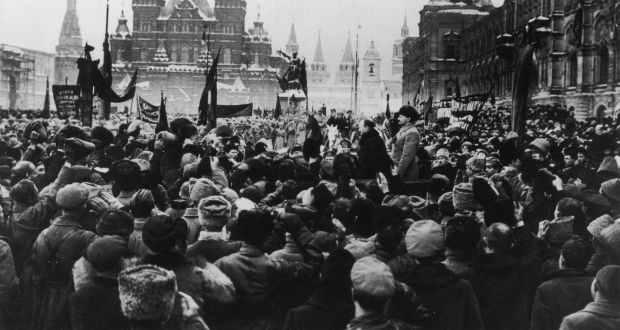
Leon Trotsky speaking before a crowd in Petrograd, October, 1917.

“I am certainly not radical enough. One can never be radical enough; that is, one must always try to be as radical as reality itself.” -Vladimir Lenin, in conversation with Valeriu Marcu while exiled in Switzerland.

On this day, one hundred years ago, the October Revolution began. In the Gregorian Calendar, the Revolution started on November 7, but in the old Russian Julian calendar, it was October 25. In memory, it marked the beginning of the state that would become the Soviet Union. For those involved, it was something more important: the end of the Provisional Government and its de facto lack of leadership.

The problem with the Provisional Government that formed after February, 1917, was not that it was explicitly authoritarian. The problem, from its inception, was that it was a balancing act between traditional hierarchies and the growing desire for the end of those hierarchies. Alexander Kerensky came to control the Provisional Government, sharing power with the soviets while trying to maintain the war.  What Trotsky called “dual power” between Kerensky’s Provisional Government and the Petrograd Soviet (representing workers, peasants, and soldiers), Lenin called “Bonapartism,” in reference to Napoleon Bonaparte. In mid-1917, Lenin wrote that Kerensky was maneuvering “state power, which leans on the military clique (on the worst elements of the army) for support, between two hostile classes and forces which more or less balance each other out.” Lenin was not alone in criticizing the Provisional Government, which was a primary point of contention among Russia’s revolutionaries.

Apart from Kerensky’s perpetuation of the war effort, he was shown to be an unhelpful leader in August, during what became known as the Kornilov Affair. Lavr Kornilov was a general who, in August, attempted to overthrow the Provisional Government and install a right-wing military dictatorship, a proto-fascist regime that would have undermined the February Revolution and reinstated a new Tsarism. As China Mieville writes of the affair, “. . . there was more than one conspiracy simmering away on the right. Various shadowy groups–the Union of Officers, the Republican Centre and Military League–were meeting to discuss plans for martial law” (213). Add to these the threat of the antisemitic Black Hundreds, responsible for mass murders and pogroms across Russia, as well as counterrevolutionary efforts to win the war, the bleak regime Kornilov almost created would have been as oppressive, if not more so, than the regime of Tsar Nicholas II. But the coup failed because Kerensky managed to work alongside the Petrograd Soviet in time to stop Kornilov’s renegades from invading the capitol.

There was leadership, then, but no ruler. Christopher Read writes that one consequence of the Kornilov Affair was “a sort of reverse of the July Days,” that the “right had discredited itself and restored the ascendancy of the left.” He also writes that there were consequences for Kerensky, too, who “made an agreement with the Petrograd Soviet, armed it, withdrew the ban on its members, primarily the Bolsheviks, and released Soviet prisoners from jail. . . But it was not enough. Kerensky was seen to have cultivated Kornilov in the first place, not least in appointing him C-in-C” (Read 92-93). Indeed, Kerensky was seen as having worked with Kornilov, and many believed that he was sympathetic to an authoritarian coup that would relieve him of his duties. If nothing else, the affair proved that the Provisional Government had become dysfunctional, barely clinging to life.

In the months that followed, popular support for the Bolsheviks rose while support for Kerensky plummeted. It is important to note that the goal of most on the far left, including some Mensheviks, was to pass power to the soviets completely, and end the power of the Provisional Government. As early as September, “eighty soviets in large and medium towns backed the call for a soviet government. In towns such as Tsaritsyn, Narva, Krasnoiarsk, and Kostroma soviet power was already a reality” (Smith 147). During this time, the Bolsheviks were actively campaigning from the ground up, organizing factories, speaking in public, and stoking public support for a soviet antithesis to the Provisional Government. It was around this time that Lenin suggested that the Bolsheviks, “‘having obtained a majority in the soviets of workers’ and soldiers’ deputies in both capitols, can and must take state power into their own hands‘” (Mieville 246), and should make no compromise with the Provisional Government by simply walking away from it.

Here, Lenin believed that the time was ripe for the soviets to lead the soviets in taking power. Earlier, he had encouraged the Bolsheviks to refrain from leaving the Provisional Government in July because they were not popularly supported, and it was important for him to recognize that the support of the workers, peasants, and soldiers was more important than overthrowing a weak Provisional Government. It had to be done for the soviets and all they represented. Now that it was clear the Bolsheviks were going to gain popular recognition in an upcoming pre-parliament session (which would begin October 7), the Bolsheviks would declare their legitimacy among the soviets and then walk out.

The Bolshevik Alexandra Kollontai, who helped exiled leaders like Lenin correspond with the party and without whom the revolution would not have succeeded, articulated the main argument against working with the Provisional Government in her text “Why the Bolsheviks Must Win.” She wrote that the “February revolution could remove none of the factors which caused it, namely war, rising prices, famine and privation. At the same time, the Russian bourgeoisie calmly continued their rule” (Kollontai). In other words, the horrors that motivated widespread protests across Russia continued to inflict damage, and needed to be addressed with different means. For many Bolsheviks, this meant an armed insurrection to precipitate the transfer of power to the soviets.

After walking out on the pre-parliament, the Bolshevik Central Committee met in secret on October 10 to vote on whether or not to implement an insurrection. By ten to two, after numerous speeches from numerous members, they voted in favor of insurrection. They were now popular representatives of the peasants and workers, and the time had come for another, more radical change necessitated by the moment’s urgency. For the Central Committee members, waiting for more elections would result only in more casualties as the German army approached and increase the chance of another Kornilov-inspired coup. If they waited any longer, the comatose Provisional Government might be toppled and a military dictator might be installed.

The insurrection began on October 25. Fittingly, this was also Trotsky’s birthday.

That day, Trotsky spoke to an “emergency session of the Petrograd Soviet” and announced, “‘On behalf of the Military Revolutionary Committee, I declare that the Provisional Government no longer exists‘” (Mieville 289). The Second Congress of Soviets opened to debate a new soviet-led government. Meanwhile, Red Guards (a paramilitary branch of the Bolsheviks), seized key areas of Petrograd, including bridges, train stations, the post office, and eventually the Winter Palace, where they arrested the remaining members of the Provisional Government, who surrendered peacefully. All except Kerensky, who had long since fled the city.

A number of elected officials who opposed the insurrection walked out of the Second Congress of Soviets, while Trotsky pontificated on the legitimacy of the move he and the Bolsheviks made: “A rising of the masses of the people requires no justification. What has happened is an insurrection, and not a conspiracy.” While those who dissented walked up and left, just as the Bolsheviks had at the pre-parliament weeks before, Trotsky denounced them, shouting, “you are miserable bankrupts, your role is played out. Go where you ought to go: to the dustbin of history” (298-299). On those words, the opposition left the Congress to continue debating a new regime, one without monarchy, oligarchy, or hierarchy.

By early morning on October 26, after tense nightlong debates, the Second Congress of Soviets passed a resolution drafted by Lenin to build a soviet-exclusive government, end the war, grant self-determination to nations Russia had subjugated, and transfer land to the peasants (303-304), thus creating an all-soviet state.

The October Revolution occurred without a single loss of life. It was armed, but bloodless. A ship controlled by the Red Guards, the Aurora, fired a blank shot, and some shots were fired periodically during the arrest of the Provisional Government, but nobody died in the October Revolution, partly because of how well organized the Red Guards were, but mostly because the government in place was apathetic to its own demise. It did not resist arrest and cancellation, which suggests that the October Revolution was not a coup, as some historians contest. As S. A. Smith puts it, “. . . a coup implies the seizure of a functioning state machine. Arguably, Russia had not had this since February” (43).

It is telling that the document announcing the insurrection’s success, titled “To the Citizens of Russia,” begins not by declaring a new soviet regime but by iterating that “The Provisional Government has been deposed” (Lenin). A bottom-up regime change was important, but it was more important to end what was in place, a doomed, if not failed, attempt to sustain a fraction of the old guard through the exhausted imitation of the old guard’s strategies. It was not a state of anarchy the way contemporary anarchists would have preferred. Kerensky held together a stitched-up government of poorly balanced provisions and hierarchy beyond its health. He was not a competent ruler, but he still ruled, and as such, he presided over a kind of anarchy by leaving the Provisional Government open to coups that favored hierarchy, which would have been a return to pre-revolutionary Russia.

The October Revolution was an attempt to replace the lasting remains of the Tsarist regime with something new, something untried, something that could create a state without hierarchy. It was a somewhat democratic effort to reaffirm the rule of the soviets, to make every worker, peasant, and soldier free of status. It seems that in the moment, the only other option was a cynical return to military dictatorship, well-known to those many who survived it before. The Bolsheviks wanted to give the Congress an alternative, however strange and frightening it may have been, to what Russians had spent decades suffering through. After the bloody Civil War, Lenin’s too-soon passing, and Stalin’s hijacking of the state, the Second Congress is easily obscured in its long, cold aftermath.

One step forward, one step back.

Trotsky condemned those who refused to try for an alternative to hierarchy to the “dustbin of history,” where, now that Russia is under a new brand of right-wing authoritarianism, the entire Soviet Union now rests, sometimes even in peace.


Mieville, China. October. Verso, 2017.

Read, Christopher. War and Revolution in Russia, 1914-1922. Palgrave Macmillan, 2013.

Smith, S. A. Russia in Revolution. Oxford University Press, 2017.

Smith, S. A. The Russian Revolution. Sterling, 2011.
Having Blogged for Four Years

Arboretum

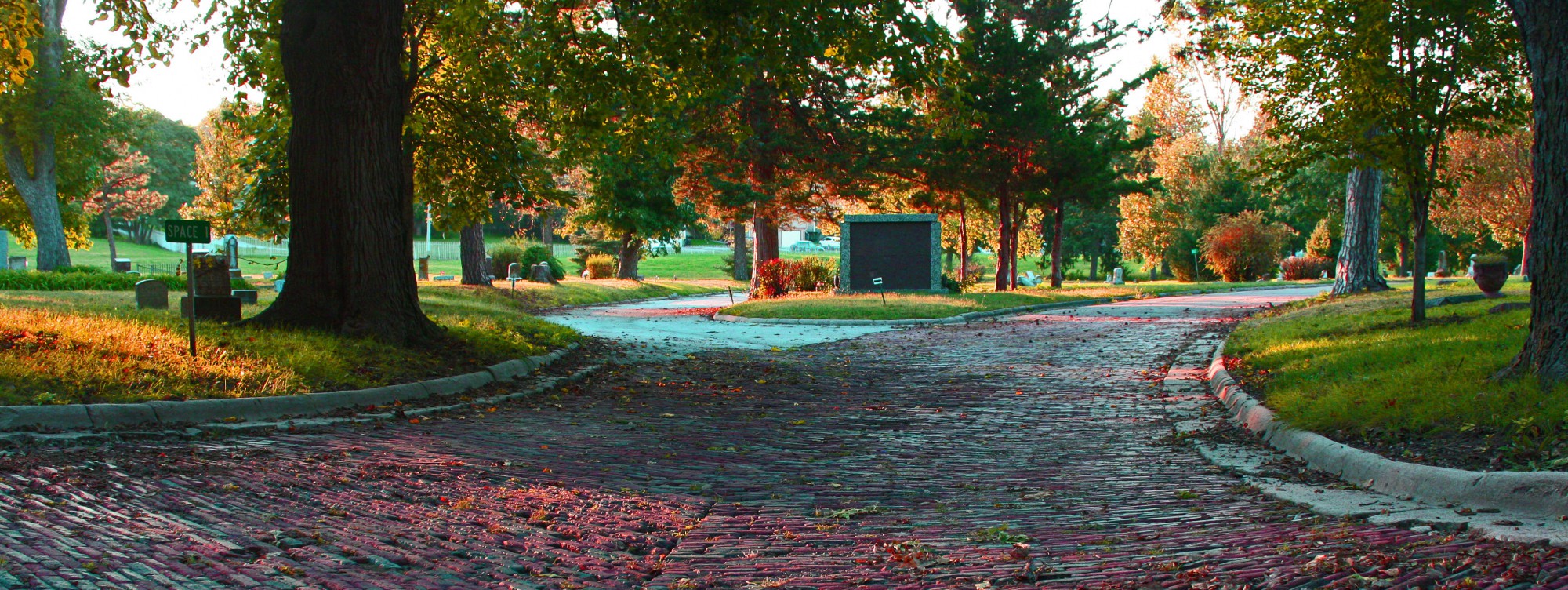
Photo taken at the University of Idaho Arboretum and Botanical Garden

. . . I wonder if this is the only anniversary in my life that matters. I started this blog four years ago. Hopefully, the quality of posts has improved just as the quality of the world has diminished.

I’m knee-deep in the first semester in my third college program, this time an MFA in creative nonfiction. Since October 27, 2016, I have started a blog series about the Russian Revolution, had one essay published and one short story published, finished my Master’s degree in English, and moved from Nebraska to Idaho. I’ve also started writing for the Idaho MFA blog, reading nonfiction submissions for Fugue, and volunteering as an editorial assistant for Western American Literature. My literary life has expanded substantially in a year, and yet I’m still ambitious. I have writing and reading to finish, journals to curate, places to visit, sweeping political generalizations to make.

This has been a rough year for the country and the planet. Regardless, I will blog away into oblivion. Here’s to another year.

-jk

Writing Lamentation, Writing Celebration

Close Acorn“I dote on myself, there is that lot of me and all so luscious,/Each moment and whatever happens thrills me with joy,/I cannot tell how my ankles bend, nor whence the cause of my faintest wish,/Nor the cause of the friendship I emit, nor the cause of the friendship I take again.” -Walt Whitman, “Song of Myself,” Leaves of Grass

Recently, one of my nonfiction professors mentioned that, if the tone and texture of writing can be divided into either writing of lamentation or writing of celebration, my writing style tends toward lamentation. She said, unlike Whitman’s celebratory exaltation, my writing texture is more like Emerson’s, brooding and internal.

To me, this makes sense: my writing broods. Maybe that’s why my stand-up comedy special The Writer of Lamentations has done so poorly on Netflix. It’s not that I avoid celebration. I try (and often fail) to celebrate others. I try to support my friends and praise their successes as much as possible, but this celebration rarely enters my writing. Instead, my writing fixates on losses.

More and more, I write about the environment, the west, and disparate interests like history and music, and I think my essays do, in fact, have a sense of lamentation: for places that will soon no longer be, for talents I used to have, for wars that I never fought in, and for friends who have shaped and continue to shape me, even in their absence. Despite my best efforts, friends come and go. I lament being unable to continue being shaped by them, and departure starts to feel normal and they have their lives. Thank goodness they have their lives. And still, I brood.

And what does it mean to celebrate? A friend and colleague of mine shared a poem by Abu al-Qasim al-Shabi called “The Will of Life” about embracing “the love of life,” an active, rather than passive, task. Even in the midst of what is worth lamenting, there is room for celebration. This makes me think of Prior in Angels in America refusing to be a prophet, telling the angels he wants more life: “We can’t just stop. We’re not rocks. Progress, migration, motion is modernity, it’s animate. It’s what living things do. We desire. Even if all we desire is stillness, it’s still desire for. . . . It’s so much not enough. It’s so inadequate. But still: Bless me anyway. I want more life.”

It’s been almost a year since I saw Angels in America with friends whom I miss dearly. I will admit that I desire, and I often desire stillness. I don’t want to celebrate myself the way Whitman does, but lamentation requires life in memory, the shadow of what was and could be. It is an act of wanting, but it is always active, not passive. To lament is to recognize that life, friendship, love, the burning world will never be enough, will always be inadequate, but to want to celebrate it anyway. Can there be lamentation without celebration, even in possibility? I write for the past while stuck in the present, constantly spiraling headlong into whatever disaster the future holds, one after another.

I want more life, and I want to mourn life for all that it is, all that it isn’t, all that it used to be. Someone should. Life requires lamentation as much as celebration, but the opposite holds true. To lament is to want, but to want without striving toward celebration misses the point completely.

-jk

Short Story Published in Waxwing

on-the-roadI’m honored to have my short story “Scouting Locations” published in Issue XIII of Waxwing, one of my favorite literary journals. It’s one of several historical fiction stories that made up my MA thesis at UNL. It’s about old Hollywood, among other things. But before you read it, you should read the other excellent work featured in Waxwing.

-jk

Fall in Another City

Campus 2.jpgI’m still getting to know Moscow, Idaho. I’ve only been here since August, but it takes me a while to reconfigure myself to new surroundings. I adapt slowly and cling to what is familiar: campus aesthetics, coffee shops, quiet mornings for writing.

The last time I moved, I went from Flagstaff, Arizona, to Lincoln, Nebraska, and it took me about a year to adjust. It took me a year to feel grounded in the place, in the people, like I wasn’t a transplant from the Southwest to the Midwest. Now that I live in the Pacific Northwest, I feel like a double transplant in yet another variation on the west, a west that I want to write down in the long, laborious tradition of writing about places. Do I need to be a tourist or a resident? I’ve gone from deserts to plains to this stranger place called the Palouse, a valley of vast wheat fields and pine trees.

I am not, yet, a tumbleweed, a person with “roaming proclivities.” But I still feel detached from so many places, so up-in-the-air right now. I wish I had spent more than two years with my friends in Nebraska before uprooting myself again. I wonder how long I’ll be in Idaho before I’m again uprooted.

I am still very much a westerner, but after only two moves, I feel scattered. I vote in Arizona, I made strong connections in Nebraska, and now I’m a writer in Idaho. The one constant has been the university as a setting, like a monastic system in which I orient myself toward the library, the English building, and the nearest coffee shop. Campuses are large and sometimes quiet. This is true of Flagstaff, Lincoln, and now Moscow. I like old campuses, brick buildings, planned and structured squares of nature for viewing purposes. In other words, the constant for me is finding places to work, the one thing I hope I am never uprooted from. If and when I move again, I hope there is a quiet campus wherever I go.


-jk


1917: To Free Russia

Four Horseman of the Apocalypse

Four Horseman of the Apocalypse, Viktor Vasnetsov, 1887.

The American journalist and socialist John Reed, who went to Russia to cover the revolution, interviewed Alexander Kerensky in late 1917, though the interview was published in The Liberator in 1918, after the October Revolution, which may have shaped its publication. Kerensky’s role as the de facto of the Provisional Government, a political body formed to stabilize the country in the wake of the February Revolution. Kerensky took power in spring, survived a coup and military defeats in summer, and by autumn he had come to embody the political and economic stagnation that led many Russians to revolt against Tsar Nicholas II in the first place. Kerensky continued the war effort (with disastrous results), censored critics by shutting down newspaper presses, exiled Bolsheviks whom he then appealed to for help after the failed Kornilov coup, and devoted most of his energy to sustaining his government at the cost of reforms and peace.

Reed writes of the interview that, as of its writing on “October 23, Kerensky is alone. . . In the midst of the class-struggle, which deepens and grows bitterer and bitterer every day, his place becomes more and more precarious” (Reed). Noting that Kerensky has become a symbol of the revolution’s failure for the working classes and a symbol of the failed war effort for the Allies, Reed adds grimly that “Kerensky will fall, and his fall will be the signal for civil war.”

It is interesting to note Reed’s carefully sympathetic treatment of Kerensky, presenting him as optimistic but naive. At one point in the interview, he asks Kerensky what he thinks his “purpose” is in the Provisional Government, to which he responds, “Just to free Russia.” This statement contrasts his continued, if not obsessive, involvement in World War One as well as his stagnant approach to Russia’s colonies, from Ukraine to Chechnya, from Scandinavia to Central Asia, vying for autonomy after centuries of Tsarist control.

Russia’s colonies fared variously, if not disproportionately, between February and October under the Provisional Government. Treadgold and Ellison note that historically, the “tsars had recognized no such entity as Ukraine. During the nineteenth century Ukrainian intellectuals had gathered to work for the cause of their new nationalism” (Treadgold & Ellison 108), and that the Provisional Government halfheartedly recognized but questioned an autonomous Ukraine. Central Asian communities pushed for greater autonomy as well. In May, 1917, an all-Russian Muslim Congress organized and met in Moscow, where they “proclaimed the emancipation of Muslim women, and established a religious administration independent of state control for all Russian Islam” (110), viewing the revolution as an opportunity to reevaluate and reaffirm post-Tsarist identities.

Historically, the Tsarist regime exercised a frontier settler colonialism, comparable to the settler colonialism the US exerted over Native American land, with similar tensions. In 1916, an “anti-Russian uprising took place” between Kazakhs in modern-day Kazakhstan and Russian colonists, “which the Russian tsarist military suppressed brutally, forcing some 300,000 Kazakhs to flee” into China (Peimani 124). While this kind of behavior was typical of imperial Russia, Kerensky’s hesitation to grant full autonomy was perceived by many Kazakhs, among others, as a continuation of the old guard. The bloodletting between Russian settlers and Kazakhs returning from China continued well into 1917, long after Kerensky stepped in to free Russia.

Russia’s southern colonies were not at the forefront of revolutionary discussions. Even the Bolsheviks did not explicitly prioritize the autonomy of Central Asian territories. In his 1916 essay “The Socialist Revolution and the Right of Nations to Self-Determination,” Lenin writes that “Russian Socialists who fail to demand freedom of secession for Finland, Poland, the Ukraine, etc. etc.–are behaving like chauvinists, like lackeys of the blood-and-mud-stained monarchies and the imperial bourgeoisie” (Lenin), and though Kazakhs, Chechans, Tartars, and other Central Asian groups might be included in Lenin’s use of “etc. etc.,” and though their freedom is logically consistent with Lenin’s argument from the same essay that “Imperialism is the highest stage of development of capitalism,” their absence is disappointingly consistent with the attitude of most Russian revolutionaries at the time.

It is certainly consistent with the attitude Kerensky had toward Russia’s colonial borders, who were not wholly unrepresented in the Soviets, but their calls for autonomy were overridden and often ignored. Kerensky’s Provisional Government was intended to restore order, which for starving urban workers was at least briefly productive. But for displaced, colonized peoples, restored order meant a reinstatement of the colonial status quo. And the bloodletting, much like the war, continued.

John Reed writes that Kerensky called himself a “doomed man” in late October, while simultaneously claiming his role was to free Russia. To free Russia from what? Himself? The stalled change he oversaw? The war he perpetuated? If Reed’s portrayal is accurate, Kerensky became a variation of his own stagnation, able to recognize that he, like his regime, was temporary, even doomed. That his fall would precipitate the Russian Civil War, which it eventually did.

Did Kerensky know he would fall? Did he think he could sustain the Russia he presided over? Did he believe he could save Russia by remaining in power, or did he believe that he could save it by finally beginning to dismantle the state’s violence after three years of war and three centuries of imperialism? What does it take to show political leaders that they are poisonous to the countries they oversee? Kerensky, like most inept, corrupt, or failed leaders, chose to stay in power, and the ensuing frustration with what was perceived as his cryptic neo-tsarism precipitated the October Revolution, not an act of taking power but recreating it where it was stalled, stored, rendered useless beyond repair.


Peimani, Hooman. Conflict and Security in Central Asia and the Caucuses. ABC-CLIO, LLC, 2009.

Treadgold, Donald W., Herbert J. Ellison. Twentieth Century Russia. Westview Press, 2000

Relearning to Teach in a Windowless Room

ClassroomMy second year of teaching, now in my second Master’s degree, is keeping me busy. Last fall, I took a class on pedagogy and read selections on composition and rhetoric theory by Peter Elbow, David Bartholomae, Janice Lauer, and Paulo Freire. Mostly, though, I learned how to teach by rapidly switching from my role as an instructor to my role as a student, wearing several hats several times a day. This fall, I’m in a similar pedagogy class and teaching similar composition courses, and I find myself learning the basics all over again, with perhaps a better sense of how to fail with grace.

But until now, I have never taught in a windowless room. One of the composition courses I’m teaching and the pedagogy class I’m taking are both in windowless rooms, lit from the ceiling alone with white incandescence, the kind of electricity I can hear when the room is silent, which is often the case when I teach. Even the basement classes I taught last year had basement windows, sometimes covered in snow but letting in shades of morning year-round.

A class on rhetoric should, I think, require windows. How can I teach rhetoric in a room that tries to block out the world? Rhetorical composition is an interior process that requires thoughtful contemplation of the overlapping layers of the world in which we find ourselves. When I assigned an article on the cost of fighting wildfires, I could not point out the window to the thick clouds of smoke that sunk over the Palouse from fires in Montana to demonstrate the concept of exigence.

Composition is introspective, and introspection is improved by a window students can stare out of. Without a window, where will my students glance wistfully? Where will they look when they finish a free write? White boards are only so interesting.

Maybe I’m overthinking this. In fact, I’m fairly sure I am. Personally, I feel uncomfortable as a student in a windowless room, but it’s unfair to assume my students are the same. To do so robs them of their own context. Do they prefer windowless rooms? Do they even care? The problem, then, is that I have trouble seeing beyond the limits of my comfort zone, just as my students have trouble seeing beyond the limits of their comfort zones when I ask them to think critically about the arguments they make. Nevertheless, it feels like an imposed form of denial about the world to teach rhetoric in a room with no windows, as if education is an un-real space that cannot be infiltrated by the external, “real” world. As if college should be so sterile.

To wear many hats, to be a student and a teacher, is to recognize that I am still learning how to teach, and maybe this is true every semester for every teacher. As a student, I walk into each new class to be surprised at how different instructors and groups of peers change the way discussions and my own writing develop. Likewise, I’m sure my approach to teaching (lots of high pitched squeaking about context and self-deprecating humor and self-referential meta-lectures) differs from the teaching styles of my students’ other professors, so much so that they have to relearn how to learn in my class just as I need to relearn how to teach them on some discovered common ground. I should learn that my students might not have windows where they learn, and they will hopefully learn the value of glancing up at the world while writing.

-jk