Author Archives: keeneshort

Unknown's avatar

About keeneshort

I am a writer in Southern Indiana.

Midnight Train to Colorado

LocomotiveYesterday afternoon, I crawled off the California Zephyr after spending sixteen hours next to a window watching snowy mountains go by as I sat alone with a good book (Chang-Rae Lee’s Native Speaker), some new music on my iPod (Bombay Bicycle Club), and laptop to write short stories (Sci-Fi and Cli-Fi, with very little Wi-Fi). I was completely alone, standing up only to stretch and get coffee from the service car. It was spectacular.

A century ago, trains propelled people into expanses of uncertainty. They helped us contract time and space, a theme I regularly wrestle with. Trains pushed Europe into Asia, and solidified New England. They stapled towns together across the American Midwest like a string of Christmas lights, one after another after another, bringing them to the foot of the Rockies and knitting cross-communal quilts in the process. The railroad changed history entirely.

Today, trains are far from the fastest form of transportation. I could have gone home by plane in a fifth of the time it took by train. But for a historian and writer, trains are the perfect form of travel. Being able to slow down, lean back, and reflect on the past semester was just what I needed.

Midnight Train to Colorado

It’s difficult for me not to be reflective this time of year. Winter break imposes introspection. In one year, I’ve changed more than I thought possible. I almost wrote a novel but completed a poetry manuscript, and saw the publication of two poems, an essay, a story, and a ten-minute play. In the past year, I found more of my voice than I had in ten years prior. I also moved to a new home and school, leaving behind everything familiar. I raced through the last semester too fast to enjoy it, propelled by a locomotive of too much ambition.

These days, trains are a way of retracting time and space, and after running through the semester at full speed, slowing down to watch the nightscapes and frosted mountains go by was a healthy step back, a way to manage the introspection overwhelming me after a year of so many wonderful, terrifying changes.

-jk

When a Story Strikes

Blank PagesCreativity is sneaky; it can strike at the most inopportune moments, and writers need to be prepared. Writers can find inspiration while showering, cooking biscotti, giving back rubs, performing open heart surgery, or in my case all of the above simultaneously, and creative ideas can whither if not recorded quickly enough. Many writers, myself included, carry around small notebooks to salvage sudden ideas.
Sometimes, the best preparations fall short. While flying home this week, I was enjoying the on-flight complimentary burned coffee when something in my brain clicked, and an idea for a story crystallized.

Before I could pull out my notebook and pen, the plane began to shake. The pilot announced that we should remain seated through the turbulence, “even if you do like it shaken, not stirred.” My tray table lurched as I flipped to the next blank page and scribbled down every detail of my brilliant, wonderful story idea while it was still fresh.

Several hours later, as I waited for the shuttle to my hometown, I had a few spare moments to look back at the brilliant, wonderful, award-winning story idea. Instead, I found in my notebook a slim paragraph of what looked like ancient hieroglyphics. My handwriting is bad to begin with; add a jittery writing space and a lack of patience, and clarity is doomed. I could make out the words “old man” and “saucepan” amid the scribbles, but otherwise my brilliant, wonderful, paradigm-shifting story idea was illegible.

Rest in peace, story idea. I’m sure what I would have titled “The Old Man and the Saucepan” would have been excellent. In my rush to preserve it intact, I lost it entirely. As a writer, I should slow down sometimes. More importantly, I should learn to trust myself to utilize a half-formed idea. Even the best ideas I’ve recorded legibly have evolved. Art, after all, is a process of evolution, patient and sometimes careless. The key to producing good art is the ability to improvise. Now if you’ll excuse me, I have to clean biscotti dough out of my shower drain.

-jk

Writing on Game Day

The Mill It’s another game day in Lincoln, Nebraska. The city is dripping with redshirts (not the kind from Star Trek, but closer than you’d think) and people asking for tickets. It’s hot, dry, loud, and alive. There is energy and consumerism in Lincoln today. Parking here, fifty dollars! Hot dogs, popcorn, soda, beer! Families move through the streets as the day builds toward the big game. Parties, I’m certain, are in planning, if not already in mid-construction.

Currently I am not involved in the game day activities. It’s nothing personal, Nebraska, but I have work to do. I have a novel to write, several novels to read, essays to research, critiques to work on, and Renaissance comedies to struggle through. I have work for my research assistantship on top of my graduate classes, plus my ongoing attempts to write and publish.

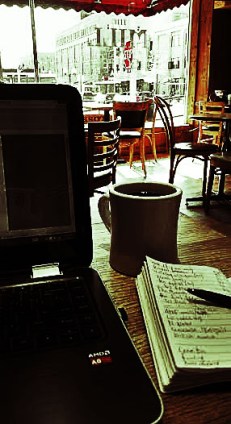
I’ve tucked myself into a corner coffee shop downtown to caffeinate and induce sleeping problems. I’m going to spend the whole of game day here, watching the red sea of fans part against the street corner while rushing to complete the next section of my novel for workshop on Monday, then finish the 4,501 other projects I have (blogging notwithstanding, of course). I can’t afford to see a game, anyway. Four dollars for a cup of coffee and a scone is better than fifty for a ticket. Even if I watched the game, I wouldn’t particularly care who won. I’m told we’re having a bad season, but I couldn’t tell you a single score. It’s nothing personal, Lincoln; fandom just doesn’t suit me.

-jk

Two Poems Published in NEAT

Portrait of the City as FatherhoodI’m pleased to announce that two poems of mine, “Portrait of the City as a Love Story” and “Fatherhood,” have been published in Issue 9 of NEAT, a lovely online journal showcasing Midwestern writers, and the edition is up for viewing now. I’d be honored if any and all read them, and the other excellent work in this edition of NEAT. There’s obviously only one adjective to describe this: cool.

While the city in this picture is Lincoln, the first poem was actually written in Minneapolis.

-jk

P.S. I listened to “Tristesse Suspendue” by Chic Gamine and “Far From Any Road” by The Handsome Family wile writing and revising these two poems, respectively. The songs should demonstrate the drastically different moods I was in while writing them.

After Two Years of Blogging, Your Guess is Still as Good as Mine

toastWordPress reminded me that today is my two-year blogiversary. I missed last year’s for the obvious reasons (grad school applications, Macbeth, mud wrestling, etc.). Today, though, I slide two years into the past when I was surrounded by the mess of my education: Beloved, essays on the Holocaust, a textbook on linguistics, The Outlaw Bible of American Poetry, and drafts of my own poetry. The liberal arts defined my life, but lacked definition; in a confused fervor I wrote my first blog post asking simply, why get a liberal education in the first place?

Two years have gone by. I created this blog to explore the liberal arts generally, the life of a wannabe writer specifically. At varying times, it has served as an open journal, editorial, bully pulpit, and archive of my writing. I started out posting short vignettes satirizing myself as a freshman, but moved on to better creative writing, philosophy, travelogues, history, and humor. If my blog feels eclectic, it’s only because my brain is eclectic. I move rapidly from Steinbeck to colonial Egypt to writing a short story. This blog is one part journal, one part art, and one part scholarship, with three extra parts marked “miscellaneous.” I strive to make sure no two posts are alike, which may be a bad idea when blogging is supposed to be about consistency and ritual, two qualities I lack.

I’ve explored numerous moments in my life on this blog: I mourned Pete Seeger, challenged myself to write a poem every day each April, founded a photography business, announced publications, had breakfast in Ireland, lunch in Jerome, dinner in Wisconsin, went to my first big fancy writing conference, broke up with my hometown of twenty years for graduate school in Nebraska.

For the most part, though, I’ve read, and written about what I read, and read what others wrote about what I wrote about what I read. An endless reading list is the bedrock of any good liberal education.

Liberal Education

On this blog, I’ve also reached many half-baked conclusions, but one thing has remained clear post after post: a good liberal education is worthless if it stays inside the classroom. Sitting around reading and writing is no way to be a writer, if it’s all I do. I have to experiment with baking or acting, work for a charity, travel, read for a literary journal. I should traverse the gridlock of cities, the innards of bars, the vast organs of campsites. My blog may be ineffectively unconventional; the only binding theme is the continual mess of my lifelong education and my desire to be a writer. But I know blogging has made me a better writer, a more considerate reader, a more confident thinker. It’s been an eclectic two years. I hope the next two will be even more eclectic.

jk

Why a liberal education? Your guess is as good as mine, and I mean that. If you’re engaged in the liberal arts, especially outside of academia, let me know in the comments what you study or write or create, and why.

-jk

In the Company of Roses

Flower Last week, a man told me a parable about a lump of clay and some roses. He cited it as a Persian parable, but I did some research and found that it actually comes from the thirteenth century Persian poet Abū-Muhammad Muslih al-Dīn bin Abdallāh Shīrāzī, commonly known as Sa’di. He is one of the most influential poets in Islamic and Asian literature. In Iran, April 21 is celebrated as Sa’di Day.

While Europeans were busy killing each other in the medieval period, which they eventually termed the Dark Ages like a bad sequel to the Roman Empire, most of Western and Central Asia witnessed an artistic, philosophical, and scientific renaissance. Sa’di was only a part of this unique cultural era.

The poem I heard comes from the “Adoration and Preamble” section of Gulistan, or “the rose garden,” one of Sa’di’s most famous works. It reads something like this:

“I held in my bath a per­fumed piece of clay
that came to me from a beloved’s hand.
I asked it, ‘Are you musk or amber­gris?
Like fine wine, your smell intox­i­cates me.’

Till some­one set me down beside a rose,’
it said, ‘I was a loath­some lump of clay.
My companion’s scent seeped into me.
Oth­er­wise, I am only the earth that I am.'”

Apart from talking lumps of clay, I love this poem because it reminds me that I am defined by my proximity to others more than I realize.

Artistically, I am the product of the writers and poets I read: Billy Collins, Sylvia Plath, Douglas Adams, John Steinbeck, Dunya Mikhail, Jamaica Kincaid, and Pablo Neruda have made me the writer I am. Aesthetically, the Southwest made me an experimental, avant-garde magical realist. Socially, I am shaped by my friends, family, lovers, mentors, and the two or three enemies I keep around for good measure. Professionally, I’m a workaholic, being the son of professors who know education is a religious devotion serving the many at the expense of the few, the happy few.

I’m honored to live in the company of roses. I surround myself with those who inspire me. It took me a while to figure out how miserable one can get surrounded by those who are negative, over-critical, dishonest, manipulative, and toxic. I don’t mean I’m in the company of the perfect; all roses have their thorns. But for what it’s worth, I’m glad to let my friends rub off on me. It makes me a better person (and apparently more appealing to bathe with) to walk with roses.

-jk

Writer Seeks Characters

newspaper

March 3: Aspiring writer seeks three to four characters for minor literary endeavor, entitled Untitled Novel. Characters must be diverse, original, and snappy. Villains always appreciated.

March 9: Writer seeks one to two sympathetic protagonists to balance the fourteen unsympathetic villains who answered prior ad. One must be fluent in Russian. Quirks and comic relief are highly valued.

March 10: Fourteen unused unsympathetic villains seek good writer. Willing to die violently; highly skilled in diabolical laughter, fear, surprise, ruthless efficiency, etc.

March 15: Lonely protagonist seeks sidekick and/or love interest. Must have agency, thorough backstory, and moderate comic relief. Static characters strictly prohibited.

March 22: Writer seeks spare subplot involving a gun. Alternative subplots acceptable, but must end in the death of an unexpected love interest the writer doesn’t know what else to do with.

March 25: Postmodern short story seeks ironic resolution for a plot involving fourteen unsympathetic villains. Violent deaths are acceptable, but must be meaningless.

March 29: Writer has unused Chekhovian subplot available, after finding a stray Deus Ex Machina in the shed.

April 9: Hastily killed-off love interest seeks new story, preferably one with a less obviously Freudian subtext and better dialogue.

April 11: Writer has unused Freudian subtext available. Writer also requests to be given a break, Marsha, the dialogue wasn’t that bad.

April 15: Postmodernist writer seeks editor and agent for polished fourteen-villain ironic story.

April18: Protagonist seeks new writer who doesn’t kill off characters just to fill a few chapters.

April 20: Struggling writer seeks copyright lawyer for advice on a recently run-away protagonist.

April 25: Escaped protagonist looking for work, has experience with romantic subplots but prefers complex internal conflict.

April 30: Aspiring writer seeks runaway protagonist. Please come back, Harold.

May 1: Postmodernist writer seeks complex internal conflict for new protagonist.

May 16: Writer seeks runaway protagonist, promises to try harder this time, really he will.

May 18: Seriously, Harold, I created you. What am I supposed to do now?

May 23: Postmodernist writer seeks good journal for a metafictional buddy/love story entitled “Marsha, Harold, and the Writer.”

May 30: Writer seeks three to four characters to collaborate on revising an old plot; is willing to work with characters closely; is willing to let the characters move the plot along.

June 2: Unused plot devices, tropes, and schemes available, no charge.

-jk

Big League Academia

New WriterTwo months into my first year of graduate school, I think I’ve finally started to settle in. The workload is not beyond my management (I somehow function better with less sleep), the faculty are just as thoughtful and thought-provoking, and my descent deeper into the cult of academia is going smoothly; soon, I’m told, I’ll be a card-carrying postmodernist. The support my writing receives is frequent, and the possibility of a writing career is even starting to take shape.
For example, this past week I had the opportunity to meet with two agents and two editors, to have them critique a section of my novel-in-progress and discuss the publishing industry. They told me what they liked about the short section, offered insights, made revision suggestions, and allowed me to see the project in grander terms. I learned that when I eventually get an agent and editor, publishing becomes a collaborative effort, a group project. They offered to stay in contact when I have a polished draft. Suddenly, the fantasy of publication no longer feels so impossible.

Is this it? Is this the next step for my writing? Or is this just the next phase in my hike up the ranks into academia? I ask myself this question because I’m surrounded by people who have it figured out already. I’m surrounded by serious academics, doctoral students devoting years to studying, students fulfilling long-term plans. Many of them took a break after college to figure out the rest of their lives, get married, travel, go on adventures, experience things they can then write about. And here I am, fresh out of my undergraduate career.

Am I here because I want to be a writer, or because I want to be an academic? I feel like a kid who doesn’t yet know what he wants to be when he grows up, and time is running out. Do I teach? Get a PhD? Another MA? An MFA? Is there life after publication? Or should I let my ambitions dictate my future? Tired of studying tragedy but never taking that study out of the classroom, I still want to join a charity, volunteer in a hospital in Palestine or Afghanistan or Jordan, or work on an organic farm in Chile or Brazil. I want to see the world, because I know if I stay in the confines of an English Department, I’ll run out of things to write about.

I’m still just a kid, academically speaking, and I’m surrounded by intellectual adults. I can’t count the number of times I’ve been asked about my PhD, as if that’s the only end in sight, and I can’t count the number of times I’ve silently shrugged and changed the subject. I only have until next fall to figure it out, though. Do I become a career academic? Teach? Work? Let me know in the comments your own thoughts or plans.

-jk

I Bought a Pumpkin. Now What?

Orange

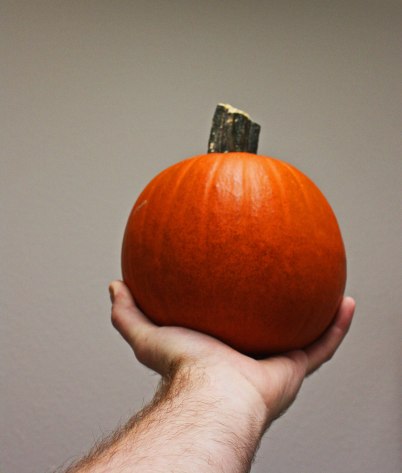
Leaves are changing colors, candy is getting cheaper and oranger, and the farmer’s market is filled with freshly harvested pumpkins. Resisting temptation is hard; now I have a pumpkin. What does one even do with a pumpkin?

Orange Triptych

The first thing to do is get to know the pumpkin. Give it a cute name, something like Fred. Spend a few nights drinking with Fred. Really get to know him. From there, it’ll be easier to figure out what you want to do with Fred. In my case, I wanted to make Fred into a pie.

Fred 1

Give Fred a good bath, remove Fred’s stem, and slice Fred laterally with a large cutting knife. This might upset Fred, but he’ll just have to learn to live with it. Using a large spoon or ice cream scoop, remove all of Fred’s insides, scraping against the flesh to get all the strands and seeds out. It goes without saying you can save Fred’s inside for later consumption. Dash a little salt onto Fred’s flesh, place his two halves flesh-side down on a covered cookie sheet, and bake at 400 degrees Fahrenheit for about thirty minutes, or until Fred is nice and mushy, like he always gets after a few beers.

Fred 2

Again, using an ice cream scoop or large spoon, scrape out Fred’s flesh, which should come out easily after baking Fred. He may be confused at this point, but just remind him it’s for a good cause. Mash (or blend in a food processor) Fred’s flesh, until it’s nice and smooth. You can store some of Fred’s flesh in the freezer for future endeavors. For example, you can make muffins out of Fred, too.

Toss 1 cup of Fred’s pureed flesh into a sauce pan and cook until it simmers. Add 1 cup milk, 1 teaspoon nutmeg, 1 teaspoon ginger, 1/2 teaspoon cinnamon, and 1/4 teaspoon ground cloves. Feel free to adjust the spices to make Fred as spicy as you like. Fred, of course, prefers to be very spicy, if his sass didn’t tell you anything. Mix well and let simmer.

Fred 5

In a separate bowl, combine two eggs and 1 cup of brown sugar. Add this to Fred’s simmering remains and stir to combine.

Fred 4

Once the eggs, sugar, cream, and Fred are thoroughly combined, pour into a pie dish with a prepared crust. You can make your own crust (like I did, in a completely unpretentious way), or buy a premade crust. Place the pie dish on a cleaned cookie sheet and bake Fred at 350 degrees for forty to fifty minutes. Fred will be very disappointed, but delicious. You can make it up to Fred by covering him in whipped cream and serving him with hot beverages. Like all gingers, Fred loves whipped cream and hot beverages.

Fred 6

-jk

To Hear Hamlet (In a Cemetery)

Graveyard

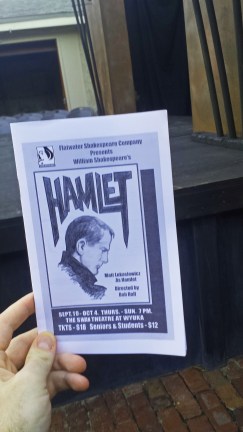
This weekend, I had the pleasure of seeing a live production of Hamlet by Lincoln’s Flatwater Shakespeare Company. The performance was held in the Swan Theater, which also happens to be in Lincoln’s historic Wyuka Cemetery. The show started at sunset; as the characters progressed into madness and scheming, the night grew darker and colder, and the full moon rose higher and higher. The experience was exhilarating.

Ham1As I’ve mentioned in previous posts, I love theater despite my minimal experience with it. Plays are not meant to be read, but seen, and heard. Words are powerful enough in print, but when given a voice, they have so much more power to move the audience. Some readers are familiar with how important voice is to me. I’m drawn to people with strong voices; to me, it’s the first part of attraction. I grew up caring about voice more than any other part of a person. Garrison Keillor’s rusty voice on the radio; the beautiful harmonies produced by folk singers, The Wailin’ Jennys or Peter, Paul, and Mary. Of course Renaissance theater isn’t for everyone; nothing is. But hearing Shakespeare’s words put to the instrumentation of a cast of strong voices makes it impossible for me not to enjoy those words.

But the experience of hearing Hamlet in a cemetery was even more gripping. When the ghost of Hamlet’s father appears, the audience is reminded that hundreds of ghosts are in the ground behind him. When Hamlet contemplates mortality, that undiscovered country, we are forced to remember that emigrants to that undiscovered country are just a few yards away. Finally, when a clown digs up a grave, tossing skulls out of the earth, we cannot help but think that an actual gravedigger is performing the same task, under the full moon. We are surrounded by actual skulls while Hamlet picks up Yorick’s skull; we are surrounded by actual corpses while Ophelia is placed in the grave.

The very ground the audience walks on to reach the stage is defined by mortality. The theatricality of undoing the grave’s permanence, of waking up the dead and gazing into their empty eye sockets, hits us uncomfortably close. The stage mocks the dead we struggle to leave hallowed; we depart from the performance facing the cemetery illuminated by a full moon wondering if our own skulls will be unburied, if a tragedy will be staged on the field we’re confined to.

In this case, the play’s the thing wherein the audience finds its own conscience, and as we all know, conscience does make cowards of us all. That’s the power of theater, and poetry, and art. It places mortality in our face and invites us to wonder. To look around. To investigate. To consider that soon we’ll be departing for an undiscovered country, and we can either go mad waiting in line for our plane ticket, or we can enjoy the graces the terminal has to offer. Thus conscience does make cowards of us all, unless we muster up the courage to laugh at all the skulls surrounding us. Why not laugh? Aye, there’s the rub.

-jk