Author Archives: keeneshort

Unknown's avatar

About keeneshort

I am a writer in Southern Indiana.

In the Company of Roses

Flower Last week, a man told me a parable about a lump of clay and some roses. He cited it as a Persian parable, but I did some research and found that it actually comes from the thirteenth century Persian poet Abū-Muhammad Muslih al-Dīn bin Abdallāh Shīrāzī, commonly known as Sa’di. He is one of the most influential poets in Islamic and Asian literature. In Iran, April 21 is celebrated as Sa’di Day.

While Europeans were busy killing each other in the medieval period, which they eventually termed the Dark Ages like a bad sequel to the Roman Empire, most of Western and Central Asia witnessed an artistic, philosophical, and scientific renaissance. Sa’di was only a part of this unique cultural era.

The poem I heard comes from the “Adoration and Preamble” section of Gulistan, or “the rose garden,” one of Sa’di’s most famous works. It reads something like this:

“I held in my bath a per­fumed piece of clay
that came to me from a beloved’s hand.
I asked it, ‘Are you musk or amber­gris?
Like fine wine, your smell intox­i­cates me.’

Till some­one set me down beside a rose,’
it said, ‘I was a loath­some lump of clay.
My companion’s scent seeped into me.
Oth­er­wise, I am only the earth that I am.'”

Apart from talking lumps of clay, I love this poem because it reminds me that I am defined by my proximity to others more than I realize.

Artistically, I am the product of the writers and poets I read: Billy Collins, Sylvia Plath, Douglas Adams, John Steinbeck, Dunya Mikhail, Jamaica Kincaid, and Pablo Neruda have made me the writer I am. Aesthetically, the Southwest made me an experimental, avant-garde magical realist. Socially, I am shaped by my friends, family, lovers, mentors, and the two or three enemies I keep around for good measure. Professionally, I’m a workaholic, being the son of professors who know education is a religious devotion serving the many at the expense of the few, the happy few.

I’m honored to live in the company of roses. I surround myself with those who inspire me. It took me a while to figure out how miserable one can get surrounded by those who are negative, over-critical, dishonest, manipulative, and toxic. I don’t mean I’m in the company of the perfect; all roses have their thorns. But for what it’s worth, I’m glad to let my friends rub off on me. It makes me a better person (and apparently more appealing to bathe with) to walk with roses.

-jk

Writer Seeks Characters

newspaper

March 3: Aspiring writer seeks three to four characters for minor literary endeavor, entitled Untitled Novel. Characters must be diverse, original, and snappy. Villains always appreciated.

March 9: Writer seeks one to two sympathetic protagonists to balance the fourteen unsympathetic villains who answered prior ad. One must be fluent in Russian. Quirks and comic relief are highly valued.

March 10: Fourteen unused unsympathetic villains seek good writer. Willing to die violently; highly skilled in diabolical laughter, fear, surprise, ruthless efficiency, etc.

March 15: Lonely protagonist seeks sidekick and/or love interest. Must have agency, thorough backstory, and moderate comic relief. Static characters strictly prohibited.

March 22: Writer seeks spare subplot involving a gun. Alternative subplots acceptable, but must end in the death of an unexpected love interest the writer doesn’t know what else to do with.

March 25: Postmodern short story seeks ironic resolution for a plot involving fourteen unsympathetic villains. Violent deaths are acceptable, but must be meaningless.

March 29: Writer has unused Chekhovian subplot available, after finding a stray Deus Ex Machina in the shed.

April 9: Hastily killed-off love interest seeks new story, preferably one with a less obviously Freudian subtext and better dialogue.

April 11: Writer has unused Freudian subtext available. Writer also requests to be given a break, Marsha, the dialogue wasn’t that bad.

April 15: Postmodernist writer seeks editor and agent for polished fourteen-villain ironic story.

April18: Protagonist seeks new writer who doesn’t kill off characters just to fill a few chapters.

April 20: Struggling writer seeks copyright lawyer for advice on a recently run-away protagonist.

April 25: Escaped protagonist looking for work, has experience with romantic subplots but prefers complex internal conflict.

April 30: Aspiring writer seeks runaway protagonist. Please come back, Harold.

May 1: Postmodernist writer seeks complex internal conflict for new protagonist.

May 16: Writer seeks runaway protagonist, promises to try harder this time, really he will.

May 18: Seriously, Harold, I created you. What am I supposed to do now?

May 23: Postmodernist writer seeks good journal for a metafictional buddy/love story entitled “Marsha, Harold, and the Writer.”

May 30: Writer seeks three to four characters to collaborate on revising an old plot; is willing to work with characters closely; is willing to let the characters move the plot along.

June 2: Unused plot devices, tropes, and schemes available, no charge.

-jk

Big League Academia

New WriterTwo months into my first year of graduate school, I think I’ve finally started to settle in. The workload is not beyond my management (I somehow function better with less sleep), the faculty are just as thoughtful and thought-provoking, and my descent deeper into the cult of academia is going smoothly; soon, I’m told, I’ll be a card-carrying postmodernist. The support my writing receives is frequent, and the possibility of a writing career is even starting to take shape.

For example, this past week I had the opportunity to meet with two agents and two editors, to have them critique a section of my novel-in-progress and discuss the publishing industry. They told me what they liked about the short section, offered insights, made revision suggestions, and allowed me to see the project in grander terms. I learned that when I eventually get an agent and editor, publishing becomes a collaborative effort, a group project. They offered to stay in contact when I have a polished draft. Suddenly, the fantasy of publication no longer feels so impossible.

Is this it? Is this the next step for my writing? Or is this just the next phase in my hike up the ranks into academia? I ask myself this question because I’m surrounded by people who have it figured out already. I’m surrounded by serious academics, doctoral students devoting years to studying, students fulfilling long-term plans. Many of them took a break after college to figure out the rest of their lives, get married, travel, go on adventures, experience things they can then write about. And here I am, fresh out of my undergraduate career.

Am I here because I want to be a writer, or because I want to be an academic? I feel like a kid who doesn’t yet know what he wants to be when he grows up, and time is running out. Do I teach? Get a PhD? Another MA? An MFA? Is there life after publication? Or should I let my ambitions dictate my future? Tired of studying tragedy but never taking that study out of the classroom, I still want to join a charity, volunteer in a hospital in Palestine or Afghanistan or Jordan, or work on an organic farm in Chile or Brazil. I want to see the world, because I know if I stay in the confines of an English Department, I’ll run out of things to write about.

I’m still just a kid, academically speaking, and I’m surrounded by intellectual adults. I can’t count the number of times I’ve been asked about my PhD, as if that’s the only end in sight, and I can’t count the number of times I’ve silently shrugged and changed the subject. I only have until next fall to figure it out, though. Do I become a career academic? Teach? Work? Let me know in the comments your own thoughts or plans.

-jk

I Bought a Pumpkin. Now What?

Orange

Leaves are changing colors, candy is getting cheaper and oranger, and the farmer’s market is filled with freshly harvested pumpkins. Resisting temptation is hard; now I have a pumpkin. What does one even do with a pumpkin?

Orange Triptych

The first thing to do is get to know the pumpkin. Give it a cute name, something like Fred. Spend a few nights drinking with Fred. Really get to know him. From there, it’ll be easier to figure out what you want to do with Fred. In my case, I wanted to make Fred into a pie.

Fred 1

Give Fred a good bath, remove Fred’s stem, and slice Fred laterally with a large cutting knife. This might upset Fred, but he’ll just have to learn to live with it. Using a large spoon or ice cream scoop, remove all of Fred’s insides, scraping against the flesh to get all the strands and seeds out. It goes without saying you can save Fred’s inside for later consumption. Dash a little salt onto Fred’s flesh, place his two halves flesh-side down on a covered cookie sheet, and bake at 400 degrees Fahrenheit for about thirty minutes, or until Fred is nice and mushy, like he always gets after a few beers.

Fred 2

Again, using an ice cream scoop or large spoon, scrape out Fred’s flesh, which should come out easily after baking Fred. He may be confused at this point, but just remind him it’s for a good cause. Mash (or blend in a food processor) Fred’s flesh, until it’s nice and smooth. You can store some of Fred’s flesh in the freezer for future endeavors. For example, you can make muffins out of Fred, too.

Toss 1 cup of Fred’s pureed flesh into a sauce pan and cook until it simmers. Add 1 cup milk, 1 teaspoon nutmeg, 1 teaspoon ginger, 1/2 teaspoon cinnamon, and 1/4 teaspoon ground cloves. Feel free to adjust the spices to make Fred as spicy as you like. Fred, of course, prefers to be very spicy, if his sass didn’t tell you anything. Mix well and let simmer.

Fred 5

In a separate bowl, combine two eggs and 1 cup of brown sugar. Add this to Fred’s simmering remains and stir to combine.

Fred 4

Once the eggs, sugar, cream, and Fred are thoroughly combined, pour into a pie dish with a prepared crust. You can make your own crust (like I did, in a completely unpretentious way), or buy a premade crust. Place the pie dish on a cleaned cookie sheet and bake Fred at 350 degrees for forty to fifty minutes. Fred will be very disappointed, but delicious. You can make it up to Fred by covering him in whipped cream and serving him with hot beverages. Like all gingers, Fred loves whipped cream and hot beverages.

Fred 6

-jk

To Hear Hamlet (In a Cemetery)

Graveyard

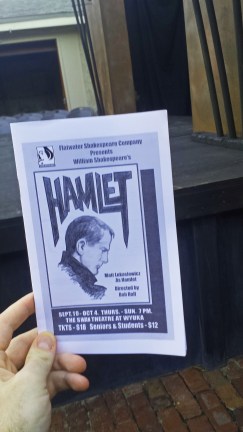
This weekend, I had the pleasure of seeing a live production of Hamlet by Lincoln’s Flatwater Shakespeare Company. The performance was held in the Swan Theater, which also happens to be in Lincoln’s historic Wyuka Cemetery. The show started at sunset; as the characters progressed into madness and scheming, the night grew darker and colder, and the full moon rose higher and higher. The experience was exhilarating.

Ham1As I’ve mentioned in previous posts, I love theater despite my minimal experience with it. Plays are not meant to be read, but seen, and heard. Words are powerful enough in print, but when given a voice, they have so much more power to move the audience. Some readers are familiar with how important voice is to me. I’m drawn to people with strong voices; to me, it’s the first part of attraction. I grew up caring about voice more than any other part of a person. Garrison Keillor’s rusty voice on the radio; the beautiful harmonies produced by folk singers, The Wailin’ Jennys or Peter, Paul, and Mary. Of course Renaissance theater isn’t for everyone; nothing is. But hearing Shakespeare’s words put to the instrumentation of a cast of strong voices makes it impossible for me not to enjoy those words.
But the experience of hearing Hamlet in a cemetery was even more gripping. When the ghost of Hamlet’s father appears, the audience is reminded that hundreds of ghosts are in the ground behind him. When Hamlet contemplates mortality, that undiscovered country, we are forced to remember that emigrants to that undiscovered country are just a few yards away. Finally, when a clown digs up a grave, tossing skulls out of the earth, we cannot help but think that an actual gravedigger is performing the same task, under the full moon. We are surrounded by actual skulls while Hamlet picks up Yorick’s skull; we are surrounded by actual corpses while Ophelia is placed in the grave.

The very ground the audience walks on to reach the stage is defined by mortality. The theatricality of undoing the grave’s permanence, of waking up the dead and gazing into their empty eye sockets, hits us uncomfortably close. The stage mocks the dead we struggle to leave hallowed; we depart from the performance facing the cemetery illuminated by a full moon wondering if our own skulls will be unburied, if a tragedy will be staged on the field we’re confined to.

In this case, the play’s the thing wherein the audience finds its own conscience, and as we all know, conscience does make cowards of us all. That’s the power of theater, and poetry, and art. It places mortality in our face and invites us to wonder. To look around. To investigate. To consider that soon we’ll be departing for an undiscovered country, and we can either go mad waiting in line for our plane ticket, or we can enjoy the graces the terminal has to offer. Thus conscience does make cowards of us all, unless we muster up the courage to laugh at all the skulls surrounding us. Why not laugh? Aye, there’s the rub.

-jk


Leftist Vegetarian Chili

Let’s say you want to make chili for the autumn season, something you can bring to a pot luck at a moment’s notice. If you’re anything like me (an English Major), any pot luck you get invited to will be filled with vegetarians who bring gallons of humus and pita chips by the crate. Here’s an easy recipe for a healthy chili to satisfy any English Major’s left-leaning, postmodernist palate.

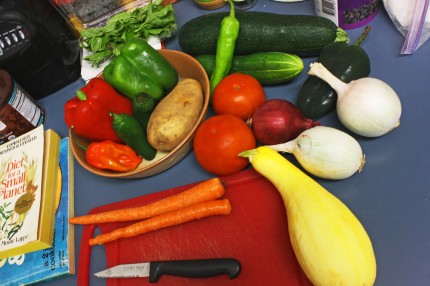
The first step is to go to the local farmer’s market to obtain the best locally grown organic non-GMO socialist ingredients. Obtain the following items:

4 or 5 tomatoes1
1 red onion
1 sweet onion
2-3 carrots
2 bell peppers
2 jalapeno peppers
1 green chili pepper
1 habanero pepper
1 yellow summer squash
1 potato
1 copy of Das Kapital
2 cans of black beans

Optional: two bowls of marijuana, but only if you’re serving at a gathering of poets. If the chili is for a faculty meeting, two to three liters of rum (as a side dish) should be provided.

Various seasonings (salt, pepper, cumin, cloves, cinnamon, ginger, turmeric, grassroots activism) should be added to your own taste (which should be excellent because you’re an English Major).

First, lay out the ingredients and tell them that cuisine is a social construct. Then chop up the onions and dump them into a cooking pot with an inch of oil. Stir them enough to keep them from burning, and add salt and pepper. The onions should be strong enough to make you cry, if you aren’t already crying about the TPP.

2

Next, chop up the tomatoes. Add a can of tomato sauce if you really want to give money to the 1 percent, you terrible monster.

Add the cans of beans, ignoring the fact that Big Canning got your hard-earned money. In a vegetarian chili, you need protein, and the beans will provide enough protein to help you resist the man.

Chop up the vegetables; carve them the way you’d carve up Wall Street, and redistribute their wealth in the pot. Season liberally with spices.

4

Next, chop up the peppers. Be careful to protect your hands, otherwise your fingers will burn the way the Christian right wants you to burn in hell. Be especially careful chopping the habanero, which will provide the amount of spiciness needed to smash the patriarchy. You can also add smashed patriarchy to the chili, but don’t add too much; patriarchy has very little nutritional value, because it’s mostly fatty acids and blood.

5

Stir all ingredients and continue to season as you see fit, because you are a creative and unique individual and however you season it will be an expression of your individuality in the rising tide of fascism. However, don’t add too much cinnamon or ginger; if you wanted a pumpkin spice latte, you’d go to a coffee shop with your Mac and write a screenplay in the corner.

6Let the chili simmer the way the working class simmers before the coming revolution, for two or three hours. Feel free to freeze it for the future or emergency pot lucks. Because your vegetarian Marxist postcolonial chili will be as spicy as your attitude (on tumblr), serve with lots of bread, or over rice. This chili is not for the faint of tongue.

Feel free, even, to serve it to your conservative friends. It may be meatless, but that’s no reason to be afraid of it. Take it to a tailgate party, or an NRA meeting. Use it to bring people together. What we eat may be politically driven, but sharing a meal is universal. At least that’s what the shoeless hippies who sold me the onions said.

-jk

Europe’s Refugee Crisis of 1492

Expulsion of Spanish Jews Universal History Archive

The Alhambra Decree. Credit: Universal History Archive/Getty Images

1492 marks an important moment in world history, not just because it’s the year Columbus landed in the Caribbean, along with smallpox, mercantilism, and other European diseases. It is also an important year in Spanish, Ottoman, and Jewish history. As European powers were slowly consolidating into modern nation-states, King Ferdinand and Queen Isabella of Spain passed a decree, the Alhambra Decree of 1492, that required all Jews to be expelled from Spain, or else convert to Christianity. This pattern of expulsion began with the centuries-long Reconquista, ending with the 1491 fall of the Emirate of Granada. The Spanish monarchs wanted not just a larger nation-state, but a religiously pure one. Thus, they expelled any Jew who refused to convert. Many crossed the border into Portugal; a few years later, the Portuguese crown declared the same policy, but directed its efforts at forced conversion rather than expulsion. The Spanish Inquisition played a crucial role in these events, as well.

Thousands of Jewish and Muslim refugees were left without a home as a result. The next month, after hearing about the expulsion, the Ottoman Sultan Bayezid II, issued decrees of his own allowing any and all Jewish refugees to resettle in Ottoman territories. He sent the massive Ottoman navy to Spain, under the famous admiral Kemal Reis, to help Jews, as well as Muslims, flee religious persecution in the Iberian Peninsula, known as Al-Andalus to the Ottomans. The refugees settled throughout the Ottoman Empire, often in large urban centers such as Cairo, Jerusalem, and Damascus. Today, Sephardic Jewish communities still hold a presence in Turkey.

The Ottoman Empire was at its height in the fifteenth and sixteenth centuries. It enjoyed economic influence over its surrounding polities, had a strong military, and was known for its extreme religious tolerance. A diverse empire to begin with, encompassing Turks, Arabs, Greeks, Kurds, and Armenians, the Sultanate practiced tolerance for all religious traditions inside the empire, including Sunni and Shi’i Islam, Eastern Orthodox Christianity, long-standing Judaism, and at its edge Catholic and later Protestant Christianity. In many ways, the Ottoman Sultan was the leader of the free world at the time.

I’ve never believed history repeats itself. I don’t want history to repeat itself. It’s often hideous and unfair. But maybe the western world should take a lesson from the Ottoman Empire and open its borders to Syrian and Iraqi refugees fleeing many of the same places Europe’s refugees resettled in the 1490s. Maybe this is one of the few moments in history that should be repeated. European nations cannot reverse the policies of Assad and ISIS, just as the Ottoman Sultan could not reverse the equally barbarous policies of King Ferdinand (yes, ISIS and the Spanish Monarchy are equally evil). But Europe and the U.S., as much as the Ottomans, can commit to an act of compassion in the face of unmitigated brutality. After all, it’s clearly been done before.

-jk

Jewish History Sourcebook: The Expulsion from Spain, 1492 CE

Lapidus, Ira. A History of Islamic Societies. New York: Cambridge University Press, 2002.

A Step-By-Step Guide to Not Writing a Novel

Coffee Flip

  1. Get an idea for a novel, something that challenges the status quo, too radical for your parents to read. Something like Cormac McCarthy’s work. Drink three cappuccinos and write two pages of exposition, then call it a day.
  2. Make concise, attainable writing goals the next day, but you should wake up late because the caffeine kept you from sleep. Create a reward system: one glass of wine for every ten pages you write. Proceed to crank out sixty pages of character description. Print it out the next day after the hangover wears off, read it over, and flush all sixty pages down the toilet because it sounds like a high school student trying to imitate Cormac McCarthy.
  3. Walk to the store for more wine and a plunger after the first draft of your radical novel clogged the toilet. Make small talk with the cashier. When she asks what kind of stories you write, look at the ceiling, shrug, and say, “Whatever comes to mind,” realizing that after the first three glasses of wine you forgot what you wanted to write about in the first place. Walk out of the store with the bottle of wine in one hand and the plunger in the other, like all writers do at some point.
  4. Rewrite your visionary, stupendous novel in a new voice. Shift the paradigms so radically that you end up with one hundred pages of a different novel entirely. Print it out, read through it, and this time flush the same sixty pages, keeping forty pages of unnecessary but extremely well-written exposition. Blame writer’s block and pour another glass of wine.
  5. Spiral into a deep depression because you can’t seem to write a novel. Spend the weekend drinking wine and reading Cormac McCarthy novels while sitting in front of your word processor. Manage to write another page of exposition, then go to a bar where writers are most likely to congregate, to ask them for help with your insurmountable writer’s block.
  6. Choose a swank hipster brew pub in a highly gentrified neighborhood. Stumble in and identify four or five writers sitting in a corner; you know they are writers because they have ordered wine in a brew pub and have brought their plungers with them. You order wine too and spend the next five hours pretending to listen to their advice but, like them, you spend much of the time updating your status about the loser Cormac McCarthy wannabes surrounding you.
  7. The next morning, email Cormac McCarthy. By now, your plot and character names should be thoroughly forgotten. You decide that you cannot write without his prophetic advice, so do not even attempt writing until you a receive a reply from Cormac McCarthy’s agent, a terse email containing the titles of several self-help books that Cormac McCarthy has written to counteract the rise of depressed writers trying to imitate him. You purchase one such book, entitled It’s Called Trying, Doofus. It features McCarthy on the cover holding a plunger.
  8. Spend the next three months perusing the Internet for cures to writer’s block and trying each one until it becomes boring. Start with the obvious (writing), then move on to the more exciting suggestions, like boxing Irish dairy farmers or having an affair with the prince of Liechtenstein. Try living on a diet of onions and peaches, or preach the gospel to alligators. All writers have their quirks, right?
  9. Try to be a writer; do everything you can to be a writer, because we all know being a writer is a lot easier than actually writing. The act of writing is difficult, often lonely work, requiring dangerous amounts of time alone with one’s thoughts resulting in alienation and poor social skills. Although the benefits of writing (completing a draft with a satisfied sigh, seeing the delight in the faces of those you share a polished draft with, seducing people, and such) are truly worth the effort in the end, the work that goes into writing is emotionally exhausting. If it were easy, there would be a lot more people writing than sitting around being writers.
  10. If writing were easy, it wouldn’t be worth it. Scars can be beneficial sometimes.

-jk

A Novel That Sounds Like Bach

Typewriter musicStarting a new writing project can sometimes feel like latching onto an umbrella and jumping off a cliff, relying only on improvisation and plain luck to keep me from hitting the ground. The key difference is that, unlike jumping off a cliff, writing is a lot scarier.

The other day, I latched onto a good idea for a novel (lawyers, blogs, Texas). It’s since pulled me over the edge, and there’s no turning back. Fortunately, I have plenty to write about. I pull my inspiration from many sources, the authors I read, the people I talk with. One notion fueling this new novel is that I want it to read like the sonatas and partitas of J. S. Bach.

Of course prose and music are two different forms of art, but I’ve enjoyed listening to Bach for over ten years. I enjoy the deliberateness in his music. Nothing is superfluous, allowing the chord progressions to take center stage unhindered by a fixation with virtuosity, and I say this as a violinist who has personally dealt with the pretentiousness of virtuoso musicians and composers.

Instead, Bach patiently jogs along, sometimes as straight 8th notes for measure after measure. The emotions he conveys vary from movement to movement, but they always carry the same deliberate awareness, the same steady pace, putting focus on the chords rather than the structure. Similarly, I want to write prose that invites the reader to go on a run with it on an Autumn morning, that invites the reader to turn corners in an unfamiliar neighborhood but to keep running no matter what they encounter together. Ultimately, I hope to write something the reader can get along with easily, more a friend than a confusing professor. I admit that I am sometimes guilty of lecturing my readers in past stories.

I intend to listen to Bach’s sonatas and partitas while my fingers unravel this novel, but specifically I will listen to Chris Thile performing them on the mandolin. Bach wrote them for the violin, but I enjoy Thile’s rendition more. The timbre sounds more autumnal, more like raindrops or footsteps. And unless I get back to work writing, I may never see this idea to the end.

-jk

Like a Writer in a Candy Store

Lincoln

My books are on my shelves, my violin is tuned, and my spice rack is full. I’ve finally settled into Lincoln, Nebraska, with a few weeks before I start my first semester of graduate school. I spent yesterday exploring the city on foot, and a few sunburns and several hours later I returned to my apartment exhausted but satisfied.

Wandering alone in a big city is a new experience for me. I knew my former home of Flagstaff was relatively small, but getting lost in Lincoln proved to me that I am only one brick in the world’s framework. In my exploration, every corner I turned showed me a new organ in Lincoln’s body. I flew through decades into the Midwest’s past, into rustic red brick buildings, some dating back to the 1870s. I perused this place’s history, its survival on the plains, and those strange intersections where the past meets the present in the connective tissue of reinvigorated neighborhoods and gentrification.

River

Although being in a big city should be overwhelming, for a writer it’s like being a kid in a candy store. I can use any one of a dozen metaphors to describe my place in the city, a cell in a body or a brick in a building, and all of them describe how I feel. They all express my belief that individuality is overrun by community, and I’m sure that Lincoln will organically change me as a person regardless of whether or not I want it to. But for a writer, a city is just one big candy store because it’s not made of bricks or cells, but of stories. There is street art, there is sewage, there are coffee shops, there are dimly lit bars, and right now all of it is new to me.

UNL

One day of exploration has already transformed me. Today, I’ll find a few good places to write on campus and around town, all of which are within walking distance of my apartment. But for the moment, I am still freefalling through Lincoln’s grid of stories, hardly able to contain my excitement.

-jk

P.S. A surprisingly fitting song to have stuck in one’s head while wandering around lost in a new city is H.S.K.T by Sylvan Esso. I also find it suitable for writing about cities.