Author Archives: keeneshort

Unknown's avatar

About keeneshort

I am a writer in Southern Indiana.

1917: Tsar Nicholas II, Celebrity Autocrat

nicholas-ii-huntingNicholas II was crowned Tsar at the age of twenty-six in 1894, following the sudden death of Tsar Alexander III. Nicholas inherited a relatively stable regime that he was determined to sustain without change. He grew up believing he had been born simply to preserve the institution of God-granted Russian royalty, to maintain the status quo. Alexander, thinking he would live longer, had not trained Nicholas in diplomacy or politics. Living like a king was all Nicholas knew how to do.

His central policy was autocracy. Nicholas rigidly adhered to a particular image of Russia as ordered beneath and for him, and attacked anything that contradicted his sense of that order. He placed himself in the public eye regularly, but only filtered through artificial expressions of his status. This was clear in the 1913 Romanov Tercentenary, a national celebration of the Romanov dynasty. Virginia Rounding points out that “as many as one and a half million commemorative rubles were issued on the occasion of the tercentenary,” and that Nicholas appeared on numerous stamps and in over a hundred film reels (9-10). The monarchy also granted permission “for the production of scarves bearing a portrait of the Tsar, but only with the proviso that the scarves should not be of the right size to be used as handkerchiefs” (10), because Nicholas did not want anybody blowing their noses on images of him. He viewed himself in religious terms, and treated even petty disrespect as sacrilege.

The Romanov Tercentenary was an elaborate publicity stunt scheduled after numerous disasters under Nicholas’s rein. The Russo-Japanese War of 1904-1905 ended with an absolute Japanese victory, and was considered an unprecedented humiliation for Imperial Russia. In 1905, Russia’s political and economic problems proved that Nicholas II was not the carefree celebrity he wanted the world to believe he was. That year, strikes and protests formed in the capital amid widespread unrest. Nicholas responded to protestors by ordering police to fire on them on January 22, 1905, now known as Bloody Sunday. The Revolution of 1905 put enough pressure on the Tsar to allow for modest state reforms, including the formation of the Duma as a legislative body and the Russian Constitution of 1906. Nevertheless, Nicholas continued to rule as an authoritarian, dissolving the first Duma and manipulating the second. Entering he Great War in 1914 was just one more disastrous move.

The elaborate publicity displays were what Nicholas wanted the world to see of his empire. Instead, he met countless challenges to his authority, to which he responded with oppression or dismissal, sometimes removing ministers who disagreed with him and distrusting many others. By September of 1915, he had taken complete control of the military, leaving the capitol for the front. By 1916, unrest among soldiers had grown such that in April, “orders were issued forbidding free and open exchange between enlisted men and aid workers unless specifically allowed by the military leaders”  (Sanborn 170).

Nicholas was untrained for leadership and unwilling to admit his shortcomings. He took more interest in sports and his family than in political reforms, which he viewed as a threat to his sovereign, divine authority. He had been raised to live as a ruler, but not to rule, and he began ruling at a time when many Russians grew tired of aristocrats flaunting their inherited God-given wealth and silencing anyone who pointed out the problems in the system. When he abdicated the throne on March 15, 1917, Imperial Russia was a lost cause. With his extravagance and sweeping political abuses and abrasive leadership, Nicholas II exhausted Russian statehood to the breaking point.


Rounding, Virgina. Alix and Nicky, St, Martin’s Press, 2011.

Sanborn, Joshua. Imperial Apocalypse, Oxford University Press, 2014.


My Heroes Have Always Been Teachers

archivesAs a child, I wanted to be a scientist. Astronomy called to me, but so did biology, zoology, ecology, geology, and entomology. The world was colossal, and to a youngshysmallguy, science was a way to make it less scary. Diseases, meteors, and volcanoes didn’t have to be terrifying as long as someone could show me how to figure out how and why they worked.

Scientists were my heroes because their superpowers (analysis, facts, cool lab coats) were all things I could acquire without being bitten by radioactive nerds or being born on another planet. They used logic and knowledge to solve problems, and I wanted to do the same. The world was colossally scary, and knowledge made it more comfortable to live in.

When I realized that my existential angst about politics and terrorism could be alleviated the same way, I started to study history, religion, geopolitics, literature, and somehow wandered into writing. I left behind old heroes for new ones, but my heroes were still teachers helping me make sense of the world.

This country is brutal to those who teach literature and art, but it is just as brutal to science teachers, who face an ugly twofold set of challenges: First, American traditional values that scrutinize and punish teachers for discussing science that disrupts the status quo, from evolution (contrary to religious conservatism) to climate change (a threat to capitalism). Secondly, there is the marketplace that teachers must prepare science students for, and competition for jobs and grants can be limiting. Humanities teachers face the same set of challenges, but they have enough irony and bitterness to make themselves feel better about it.

Obviously, education systems are far from perfect. Many public schools are underfunded, and university faculty face scrutiny from students, voters, and states. Even under ideal circumstances, teaching requires long, draining hours, and my own experiences with teaching so far attest to that workload. Individual teachers must work against these forces and use what intellectual energy they have left to assure students that the world, as horrifying as it is, can make sense. Teaching requires profound courage in the face of limited resources coupled with deliberate opposition. The best teachers  I had possessed a superpower, and only now do I realize that their superpower was the strength to keep teaching through the cacophony of discouraging voices.

It’s a power I may not possess myself. The new administration is making education even harder with its intentions to cut funding for the humanities and restrict scientists from making scientific facts public. Trump’s pick for Secretary of Education is a tangible threat to public school teachers, given the likelihood that she will push for cutting funds to public education while supporting education’s privatization, which potentially allows leaders in the private sector to control the education of their workforce.

And yet dedicated teachers push forward to understand the increasingly ugly world. I gave up science for writing, but they cannot be separated. Science meets politics and history, and we meet them back with art and social science and language. Teachers now face the full power of the state and its worst citizens, and it now requires even greater moral courage than before to teach science and literature. We need social studies teachers unafraid to tell students what their rights are, biology teachers who are not attacked for discussing climate change,  and history teachers who are not punished for pointing out this country’s hideous past and present of slavery and internment and anti-immigration policies. This country is a furnace of anti-intellectual interests, and it takes strength to teach despite those interests.

I draw my own courage from the quiet heroism of educators I’ve been lucky enough to know, the ones who brought me to this point, uncertain and bitter but not confused. Afraid, but not afraid to know more, to pull back the curtain and look for how and why and what now.

-jk

Invite List of the Men’s March

tax-the-tea

Protestors in Flagstaff, AZ, Winter of 2009, who just so totally accepted (without complaint or whiny over-dramatic public display) the election of Obama, courtesy of Lost Compass Photography.

To begin with, organizers would disagree about who to invite. Percolating through social media spontaneity, the Men’s March would draw folks who (apparently unable to cope with the emotions they felt at the sight of women moving forward in a linear direction expressing a desire to not be assaulted) would want to band together and reclaim their long-lost manhood.

Robert Bly would be there of course, but because Manly Men © have been defunding the humanities for so long, nobody would actually know who he was, and he would sit in a corner shirtless beating a drum, alone.

There would be a substantial debate about inviting women. Sarah Palin, Kellyanne Conway, Michelle Bachman, and other female meninist allies would show up, but would be accused by a few marchers of preventing men from enjoying their bro-friendly safe spaces.

Glenn Beck would show up and, within ten minutes, begin crying. Even though his tears would be patriotic and cowboy-like, a few hardliners would dismiss him. Attempting to recover their lost ideal manly hair-sweat manhood, organizers would publicly invite Nick Offerman, only to realize that he attended the Women’s March, thus disqualifying him. Organizers would desperately tag alt-righters with questions about which men they would invite to help recover America’s manly bearded manhood.

Ernest Hemingway? dead. Evel Knievel? dead. Charlton Heston? dead. John Wayne? dead. David Foster Wallace? dead. Elvis Presley? probably dead. George Washington? very dead. Freddie Mercury? queer and dead. Muhammad Ali? Muslim pacifist and dead. Johnny Cash? advocated for Native Americans too often and dead. Roger Goodell? too many penalties. Nick Offerman? feminist. Robert Bly? poet. Clint Eastwood? old Hollywood elite. JFK? dead cuck. John McCain? living cuck. Mike McCarthy? did you even see the Falcons game? All the oldschool manly male beer-stained men would be either dead or somehow disqualified. Organizers would realize this too late, but could easily tweet photos of the Women’s March and call it the Men’s March as a convenient alternative.

In the end, the number of men fitting the standard would be thirty-seven. Those in attendance would chant about being persecuted by society’s trends, like all the feminists not in congress, not passing laws requiring men to father children even if they don’t want to. They would complain about the woman who is not President and who was never recorded bragging about grabbing men by the purifier. Marchers would lament their dead sense of manhood in a prolonged circle-jerk of one another’s angst (but not in a fun way).

There would be many issues marchers would not discuss. Mike Pence would not mention mental illness among men or alcoholism or drug abuse. Franklin Graham would not mention institutional poverty or suicide rates among men, boys, and gay youths in particular. Piers Morgan would not bring up the consequences of concussions for football players or the fact that male rape victims tend not to be taken seriously. From the start organizers would be unconcerned with men as a totality. They would not care enough to lobby for men who are gay, foreign, disabled, or suffering a mental illness. Instead, they would see only themselves reflected in a wilderness of mirrors as they marched, self-consciously alone.

-jk

The Workaholic Catches Cabin Fever

author-pic-5This weekend, an ice storm fluttered over eastern Nebraska, coating Lincoln in thin layers of slick ice and making it difficult to drive or walk. It has warmed up today, but UNL cancelled classes. I left my apartment only once this weekend for the sacred ritual of movies and food. Otherwise I’ve been inside my apartment avoiding the weather’s risks.

Granted, Lincoln is usually dangerous because the sidewalks are coated in football players’ sweat and the ejaculatory spittle of Governor Pete Ricketts as he laughs at Nebraskan voters from the golden tower overlooking the city, but this weekend it was especially dangerous.

Regular readers of this blog know that I partly enjoy bad weather, especially if it involves snow. It allows me to stay inside, drink coffee, write, and read. I freely admit that I’m a workaholic. I maintain a strict work ethic, in part because it nags me to have unfinished tasks. Knowing I have a deadline coming up feels like hot, smelly breath on my neck, which is also the sensation I have when I look at the face of P. Ricketts. I work hard in order to avoid having things gnaw at me.

This weekend, though, I had few deadlines that I could meet from home. I have yet to receive papers for grading or major assignments to begin. I forced myself to plunge back into the habit of writing regularly, which I had lost over winter break, and what writing I did was weak and unsatisfying.

For once, I wasn’t productive, though society doesn’t normally benefit from my labor. The hours I put into writing, revising, submitting, and making fun of politicians usually go unnoticed, especially by politicians named Pricketts. I’m a workaholic, but I realized this weekend that I’m not a productive workaholic.

I realized that I deal in temporary moments. When I produce, it’s usually particular instances, things that dissipate into the air. As a teacher, I produce lessons, rather than capital. As a writer, I produce reactions and responses, usually from my loyal readership of five people, my dog, and maybe even Pricketts the Farmer of Nebraskan Tears. I’d like to think I produce moments of companionship, like the hairy dog I’m quickly becoming. What I obsessively create doesn’t last. Lessons, reactions, and responses always melt, one way or another, but I still enjoy producing them. Nobody gains capital as a result, but maybe they gain affirmation, if I work hard enough.

I could do very little affirming from my apartment while sheets of ice formed in the freezing rainfall. I still prefer the snowy weather, but I’m glad to be out and about writing, wandering, and listening.

-jk

1917: Rasputin and the Great War

anna_theodora_krarup_portrait_of_rasputin_1916

Portrait of Rasputin by Anna Theodora Karup, December 1916.

“Dear friend, I will say again a menacing cloud is over Russia lots of sorrow and grief it is dark and there is no lightning to be seen. A sea of tears immeasurable and as to blood? What can I say? There are no words the horror of it is indescribable. . . they will conquer Germany and what about Russia? If one thinks verily there has not been a greater sufferer since the beginning of time she is all drowned in blood. Terrible is the destruction and without end the grief.” -Grigorii Rasputin, in a letter to Tsar Nicholas II, summer, 1914

In late December in 1916, the Russian mystic Grigorii Rasputin was assassinated, two and a half years into the Great War, two and a half months before the Russian Revolution took shape. Aristocrats in the Empire, notably Prince Felix Yusupov, who had grown to hate the holy man invited him to dinner in Moika Palace in Petrograd, now Saint Petersburg. For years, the Tsar had placed Rasputin closer to his family, or Rasputin inserted himself into the family by influence. In 1907, the Romanovs invited Rasputin to visit the royal family and heal Alexei, heir to the throne and ill with inherited hemophilia. Regardless of who pulled whose strings, he became a strange, alien force in the regime’s inner circles, a peasant-turned-occultist who joined the royal family.

Rasputin was an independent religious leader claiming metaphysical power and an extensive knowledge of the Bible, but he ignored the moral norms of Christianity through his abuse of alcohol and frequent sexual affairs. He was not a priest, but served the role of priest to a family that was just as much a facade as he was. He may have been a sophist or a lunatic, serving an incompetent autocrat to preserve the Romanov lineage, however doomed it was.

He could also be seen as a Shakespearean fool, the peasant-turned-entertainer who speaks candid truths to the audience and characters. Rasputin was a pacifist opposed to the Great War, though his graphic prophecy was not enough to prevent Russia from entering the conflict. His description of the war, noted above, was apocalyptic, and predicted the horror Russia would suffer as a result. Here, then, was a man willing to help the Tsar despite knowing the violence he could allow.

Russia lost approximately 1,997,500 soldiers in the First World War, with France trailing behind at 1,400,000, colonies and all. The brutal winters of the war years devastated armies and limited supplies for the Russian population. Military historian John Keegan points out that the “nature of these titanic battles on the Eastern Front is difficult to represent at a human or individual level. The Russian army, 80 per cent peasant when a majority of Russian peasants were still illiterate, left no literature to compare with that of the Western Front” (161). The majority of those who survived the Eastern Front, in other words, could not record their experiences.

However, a few written texts are telling. A Russian nurse named Lydia Zakharova, for instance, described a trench on the Eastern Front one winter as a “city of the dead, its inhabitants frozen in the most unlikely positions, as if a raging, deadly hurricane had just swept past them” (Storey 116). She adds, almost numbly, that “there is a limit, by the way, beyond which the human mind can perceive no more horrors, as a saturated sponge can soak up no more water” (117). Rasputin did not live to see the totality of the violence he predicted in 1914, but millions of Russian peasants experienced it.

Tsar Nicholas II shares much of the blame for the failures of the Great War. In 1914, he took personal control of the military, deeming himself a kind of commander-in-chief. Like many European leaders, Nicholas naively thought the war would end by Christmas of 1914. Instead it continued year after year after year.

Finally, in early 1917, starved of food and hope, bled of its population, and openly mocked by the Tsar’s aggressive displays of wealth and indifference, Russians began to protest. The Russian Revolution began only as a series of strikes. People were hungry; they couldn’t work anymore; they stopped until they got food. The Tsar, whose brutality was clear in 1905 when he ordered police to shoot protestors in Russia’s Bloody Sunday, ordered soldiers to fire into the crowds of strikers.

However, those who were meant to guard Petrograd consisted of wounded veterans or very young recruits. Healthy, loyal, and experienced soldiers were stationed on the Eastern Front, and those left behind revolted too and chose to protect the protestors. First, the holy fool protested, then soon after the workers, soldiers, guards, and even a few aristocrats realized that 1917 was an apocalypse year for Imperial Russia.

Rasputin’s place in the regime seems like an ill-fitting cog in a machine, but that might be a limited perspective because almost nobody in the regime was fit for rule. The Tsar was incompetent and disinterested, his children were sick with inherited hemophilia, his ministers were torn between the possibility of a democratic Russia or the Tsar’s brutal autocracy. The monarchy was a network of ill-fitting parts. Rasputin, for all his mysteries, might have had the last good idea for Russia’s future: don’t go to war, it will be the end. Instead, Nicholas ignored the dissenting fool and plunged Russia into the sea of tears immeasurable Rasputin predicted.


Keegan, John. The First world War. Vintage Books, 2000.

Storey, William Kelleher. The First World War. Rowman & Littlefield, 2014.

Treadgold, Donald W., Herbert J. Ellison. Twentieth Century Russia. Westview Press, 2000.

For Me, the Year is Only Half Over

I won’t be making New Year’s Resolutions on January 1. To be honest, I never have, but not because I’m against resolutions. It’s because for me a new year won’t begin on January 1. As long as I can remember, I’ve never marked new and old years by the Gregorian calendar. These twelve-month chunks don’t reflect my own endings and beginnings. Instead, I’ve always marked years by the academic calendar.

I count school years instead of Gregorian years because summers have always marked the major changes for me: every June I leave behind classes and teachers and prepare to meet new ones in August. Friends graduate and leave, relationships end, and the next school year offers new possibilities. The end of 2016 means nothing to me. It’s still winter, I’m still in grad school, I’m still 24. What will actually change tomorrow?

Now, while folks wallow in the regret of not fulfilling their 2016 resolutions, I still have six months left until I have to wallow in regret, and even then I have the whole summer to do my wallowing. I have plenty of time to not get in shape and not get published in The Paris Review.

I also have half a year left to finish my MA, improve my teaching, become a regular at a bar where everybody knows my name, and find inner peace. Piece of cake. Then, in summer, I can start the next year fresh and accomplished. I still don’t know where I’ll be next year, how many publications I’ll have, and whether or not I’ll have to cope with martial law, but that’s fine, because I still have half a year to figure it out.

For the rest of you folks celebrating 2017 like it somehow means something, I wish you a Happy New Year. For me, though, kindly hold your New Year’s wishes until summer. The weather will be nicer then, anyway.

Peace,

-jk

Coming Home for Christmas After the Boston Tea Party

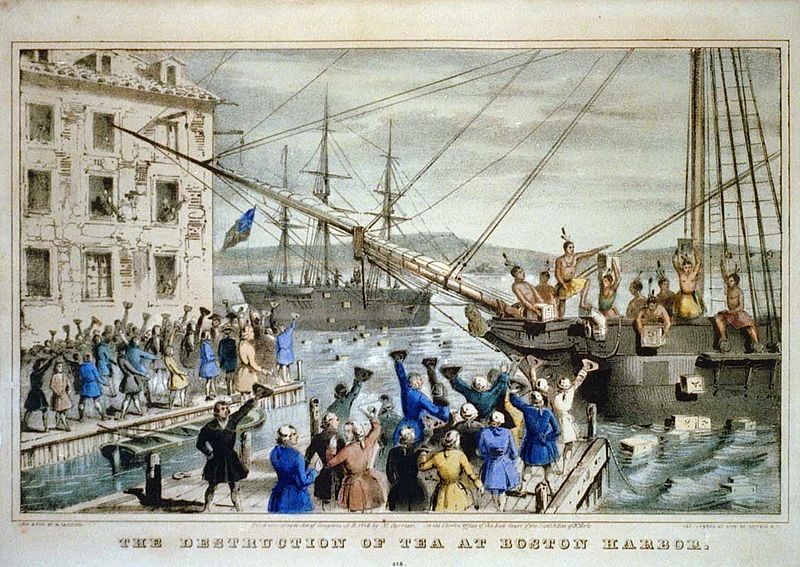
destruction-of-tea

The Destruction of Tea at Boston Harbor, by Nathaniel Currier, 1846, Hand-Colored Lithograph

On December 16, 1773, the Sons of Liberty checked their phones for messages about the plan. Some Tweeted about it as they crept on board the British ship; others posted Instagram pictures of the tea crates they dumped into the Boston Harbor, one after another. #coffeefromnowon. #revolution. #dumptea. Throughout the night, several Sons posted updates on the SoL Forum. Meanwhile, crate after crate of imported tea splashed into the salty, frigid water.

John Adams live-tweeted the affair with considerable criticism, but a new hashtag surfaced: #sitdownjohn. Frustrated, he stayed inside while the protest unfolded. Several Native American pages posted their own frustration that the Sons of Liberty were dressing up as Mohawks, pointing out the inaccuracies and retribution the British might take against them, but the protest continued unabated. Some tagged King George in their posts.

The next morning, King George deleted his Twitter account, then reopened it again to post “Not cool” several times. The Sons of Liberty felt like they had accomplished a good shaming.

A week later, Sons and Patriots returned home for Christmas. The media expressed a disorganized uproar about the protest, with Loyalist blogs calling the Sons of Liberty terrorists and the Sons of Liberty tagging everything #donttreadonme and #goteabagyourself. Some Sons returned to divided families: a Loyalist cousin here, a Quaker moderate in-law there.

It was particularly awkward at the Adams Christmas Party. Refusing to yield his position, John spent the entire time standing up, while his cousin Sam spent his time in a corner liking and retweeting every post of a tarred-and-feathered British tradesman. John called it grotesque of him to like so much shaming; Sam told him to stop shaming him for his views. Sam pointed out that John defended the Red Coats after the Boston Massacre three years earlier, calling him out for defending people who killed Americans; John called out Sam for passively defending a whiny group of protestors. Meanwhile, Abigail Adams drank whiskey in the billiard room and thought very seriously about tarring and feathering both John and Sam. She was, after all, ashamed of both of them. They liked the shock and awe of sharing listicles reinforcing their stances, like preaching to two different choirs. “Ten Horrible Things King George Has Done in Ireland,” “Nine Ways the Revolution Fails at Intersectionality,” “You Won’t Believe the Feathers on This Loyalist Cuck.”

Abigail had visited a Boston general hospital weeks earlier after a tax collector she had befriended was tarred and feathered at the docks. She remembered the way the hot tar stuck to his skin, the difficulty of pulling it off, the way it stuck to doctors who tried to remove it, making him untouchable, unapproachable. He refused to speak to Abigail for her husband’s politics, and instead stared at the ceiling while doctors treated his burn wounds.

Sam called John a feisty little tea drinker, and John called Sam a caffeinated warmonger. They were on the verge of tarring each other right there at the party, and if they did, Abigail knew that she would pull the dried tar from both morons while they lay side by side, listening to each other’s crying. Even that, she posted on Tumblr passive aggressively, wouldn’t get them to meet one another halfway.

-jk

Reflections on a First Semester of Teaching

pedagogy-2To the astonishment of many, I finished my first semester as a graduate instructor, and I now have a break from graduately instructing people. I have ambitious writing goals for the break (two new stories, four revisions, eight submissions), and I intend to stick to those goals (not just because my nonfiction instructor challenged me to email her if I succeeded), and now that I’ve submitted final grades, I have time to think about my first time being fully responsible teaching forty-six people to write arguments.

I still mostly don’t know what I’m doing, but I’m learning and have learned plenty, and I now know what not to do (mostly). Even with a syllabus, plans change, and even when I realize a lesson plan is about to fail (much like hope or democracy) ten minutes into class, I still have to go through with it. Teaching is a kind of theater, and I can hide my uncertainties about a lesson plan well enough.

I should be honest with my students, but not too honest. Teaching is still theater, but actors bring pieces of themselves on stage when they perform, even in subtle ways. I don’t want to be a mysterious professorfiguredude, because I’m not. I’m a graduate instructor trying to figure out the mechanics of a syllabus and how to factor in participation. I should be honest with my students if I make a mistake, and I expect the same from my students (and despite this semester’s rough patches, I still have high expectations).

A good cohort makes teaching easier, and not just because it’s lovely to have a group of friends with whom I can praise and complain about students, plan lessons, work on assignments, and stay motivated. It also helps to have people who need to stress-drink as much as I do.

A bad lesson plan does not make a bad semester, and I often have a hard time remembering that. Mistakes might feel worse and worse as the semester goes on, but it helps to remember that over Winter Break, students will forget most of them, and in a few years I probably will too.

Hypocrisy is inevitable, and that’s also okay. I’m a quiet student, and when confronted with a class of people who, like me, are very quiet, I’m forced to be speak more, because avant-garde pedagogy in which students and teachers sit in a room silently meditating on a reading is very uncomfortable. It’s hard to fill fifty minutes three times a week with discussions and lectures, and it makes me want to apologize to all my professors for having been such an aggressively quiet student.

A new semester means a new syllabus, which means countless more ways to make mistakes and learn, but now I know what to expect.

-jk

Genre, Nostalgia, and The Love Witch

I don’t normally do film reviews/analysis on this blog, but a recent viewing of The Love Witch with its “aggressive strangeness,” as a friend described it, warrants a a closer look.

witchAnna Biller’s 2016 The Love Witch begins as a parody of late 1960s/early ’70s sci-fi/fantasy sexploitation B movies such as Barbarella (1968) and A Touch of Satan (1971). Biller’s film establishes a concrete cinematic nostalgia that it then goes to great lengths to critique.

Spoilers and such: The main character, Elaine, is a witch utilizing her witchiness to seduce men in her supposedly endless search for love. After having killed her husband, Elaine quickly finds a new partner (Wayne) and uses her excessive witchitudes to convince him to take her to his getaway cabin. There, she gives him a “potion,” which causes him to “feel love” too intensely and die. (Audiences can recognize that taking beverages from strangers is also a possible way to die). Elaine attributes Wayne’s death to men being unable to cope with their emotions, and moves on from there, as we all should when someone feels emotions to death.

When Elaine finds  Griff, “the right one,” the film has veered from its established genre, becoming at different points a Hallmark romcom and a buddy cop drama. Disappointed that he fails to feel love for her (and also happens to be the cop who finds that she is guilty of “loving” people to death), Elaine stabs Griff in the chest. The film ends with a disturbingly quiet fantasy of Elaine marrying Griff in a Renaissance setting, interrupting the campy tone and ending with a serious meditation on the consequence’s of the film’s own logic.

The Love Witch exploits viewers’ nostalgia for a unique cultural moment that existed only after the emergence of birth control and before the HIV/AIDS epidemic, an era that felt like it was going places and might have were it not for the sudden death of hope that came with Reagan and the moral majority.

Elaine’s treatment of men is cynical and essentialist, and the film’s male characters buy into it just as much as she does. Audiences are meant to see her views as a product of her frustration with social expectations for happiness and monogamy, and she turns to witchliness to prevent further disappointment. Witchcraft here functions as a cult-like ideology: Elaine seeks improvement in relationships and cedes her agency to something beyond her (a program/product/cult), but as a result of that program/product/cult, she only ends up killing people (which, to no surprise, ends up hurting her relationships). Witchcraft is a stand-in for any commodified, pre-packaged self-help ideology, such as Sedona’s vortexes, Scientology, or the books of Rob Bell (all of which, I’m sure, have resulted in someone’s death).

Marriage appears most colorfully in a scene at a Renaissance fair, pulling back the curtain on Elaine’s personal investment in the program/product/cult. Elaine, like many Americans, is drawn to witchcraft simply for the nostalgia of a pre-globalized Europe, one without the intrusion of Christianity but all the aesthetics of a Pagan religion without the human sacrifice and patriarchy. All the fun without the historicity. Tolkien made even whiter and somehow less sexy. Halloween ruined by Medieval and Renaissance Studies majors. The list goes on. The film critiques the audience for participating in nostalgia for a style it portrays as commodified, pre-packaged, and self-consuming.

The Love Witch dissects the way many Americans imagine the sexual revolution, which existed between two periods of extreme repression, the 1950s and 1980s, and captures the strangeness of that moment of hope while simultaneously undermining it just as violently as it was subverted historically.

The film’s generic experimentation acts as a mechanism exploiting viewers’ nostalgia. The Love Witch tricks audiences the way time and politics often do, by taking its viewers on a trip they never signed up for but feel unable to step out of, forcing them to walk away with questions and pretentious blog post ideas about witch hunts and the 1970s or something.

-jk

American Discourse and Islamic States

globeIn contemporary American discourse, the ways we talk about Islam and the Muslim world tend to be limited. The phrase “Middle East” has become synonymous with Islam in the American imagination. In recent years, the self-proclaimed “Islamic State” has dominated western discourse about a large and malleable region of the world, but the concept of an Islamic state has appeared in numerous other historical moments, warranting a more nuanced understanding of the phrase.

Edward Said points out that “before the sudden OPEC price rises in early 1974, ‘Islam’ as such scarcely figured either in the culture or the media. One saw and heard of Arabs and Iranians, of Pakistanis and Turks, rarely of Muslims” (36). Discussions of nationality and ethnicity were practical for American discourse. Economically and politically, American discourse began homogenizing these polities under one overarching category: Islam. Oil price changes, revolutions in Iran, protests in India, and socialism in Afghanistan in the 1970s and 1980s slipped away as Americans perceived dozens of countries as simply “The Middle East.”

The concept of the Islamic World actually has its roots in Medieval Islamic thought as the dar al-Islam, or the abode of Islam, which was a (most likely idealized) view of the Medieval world in which a Muslim could move freely throughout regions with Muslim rulers, ranging from Spain to the borders of China. The dar al-Islam was not a state, but a conceptualization of territories.

An older article in The Atlantic defined a Caliphate as “an Islamic State,” which is a historically insufficient definition.Nation-states emerged in Europe as a result of geographic borders solidified by absolutist monarchs who dictated what qualified as citizenship, namely religion, taxation policy, and loyalty to the crown. As European nations and colonies swept aside absolutism and attempted to create secular liberal republics, the concept of the state as a geographic fence with a common language and fiscal arrangement remained the same: a homogeneous block of identity.

Thomas Barfield calls this the American Cheese model of statehood, and uses Swiss Cheese as a metaphor for premodern regions of Central Asia such as Afghanistan (Barfield 67). Rather than a solid block, polities were porous, malleable, and not always ruled through and through by a dominant king or ideology. This is true, I think, of what most Americans call the Middle East. It is largely Islamic, but it is far from homogeneous. The relationship between citizen and state often differs from the easy system many Americans paint onto the world, trying to mark which populations are with us or against us. The U.S. and Pakistan share more in common historically, as republics formed from anti-British/anti-colonial independence movements, yet the U.S. has a better working relationship with Saudi Arabia, an oppressive regime that likes to bomb its neighbors and censor its people. (Maybe the U.S. has more in common with Saudi Arabia than I’d thought).

Likewise, the Caliphate did not function the way we often think state-religion relationships function today. The nineteenth century Egyptian reformer Muhammad ‘Abduh wrote that Muslims never experienced “something that resembled the power wielded by the Papacy of Europe, nor were they ever exposed to a Pope-like figure who could and did exert power to remove Kings and banish princes, extract taxes and decree Divine laws” (Haj 93). Writing from the 1900s, his statement was true. Caliphs were not believed to rule the way Popes and monarchs claimed to, as infallible and acting as spokespeople of God to his otherwise hapless subjects. This is not to say that Caliphal rule was always just, but suggests that religion and state in the Islamic world grew up functioning alongside one another, but never competing with one another for control.

For most of Islam’s history, the initial Caliphate “remained head of the umma [community of believers] and a symbol of Muslim unity” but “would represent the administrative and executive interests of Islam while the scholars and Sufis defined Islamic religious belief” (Lapidus 102), and even that diminished as the Caliphate moved around, ending up in the Ottoman Empire where, after World War One, it was officially abolished. Smaller caliphates appeared every so often, but the use of the phrase “Islamic state” to describe a caliphate is too simplistic, because for much of history the Caliphate represented the separation of Islamic doctrine from political administration, at least in theory.

As such, the concept of a secular state grew up differently than it did in the west, perhaps with a greater dissonance. A single glance at the United States today, which passes laws about abortion based on religiously inspired magical definitions of personhood, suggests that we have yet to actually implement the separation of church and state.

Depending upon what is convenient for media and politicians, the Middle East contains parts of Africa, the Arab world, and Central Asia. If used literally, the Muslim World should be expanded to include China, Russia, the Caucasus, Southeast Asia, the Balkans, and regions of the Western Hemisphere where African Muslims were forcibly shipped during the Atlantic slave trade. The majority of the world’s Muslims are in Indonesia, not western Asia. The Islamic World is neither unified nor homogeneous, and instead encompasses a broad spectrum of religious, philosophical, and political discourses.

When Americans talk about the Islamic world, they typically think only of the Arab world plus Iran, because, as Said points out, it became convenient for Americans to think of themselves as persecuted by a collective polity (Islam) during the 1970s and 1980s. Violent extremists exist within a unique historical context; their crimes are not justified by that history, but they should nevertheless be understood as stemming from particular origins. It is neither useful nor intelligent to homogenize one billion people. States are intrinsically porous and malleable; Americans should recognize that this applies to the U.S. as well as the rest of the world.


Barfield, Thomas. Afghanistan. Princeton University Press, 2010.

Haj, Samira. Reconfiguring Islamic Tradition. Stanford University Press, 2009.

Lapidus, Ira. A History of Islamic Societies. Cambridge University Press, 2002.

Said, Edward. Covering Islam. Random House Vintage, 1997.