
Category Archives: Writing

“Don’t be a writer. Be writing.” -William Faulkner

John Steinbeck’s Peach Upside-Down Cake

the-lone-survivorIn 1902 on February 27, John Steinbeck was born, kicking off a wonderful century of war and economic strife. To celebrate his birthday, you can either have a disgusting beer milkshake or delicious mush or even a glass of extremely fresh milk. Or you can be sensible about the whole thing and make peach upside-down cake.

First, lose your land to a bank and drive to California, where the good peaches are. You should lose one or two family members on the trip, which means more cake for you. Lucky you. Find work at a peach orchard and collect four to five un-bruised peaches that you can take back to the rusted-out boiler you live in with your seven remaining children back in Monterey. Sell one of those children to buy 1/2 cup of butter, 2/3 cup of brown sugar, 1/2 teaspoon of cinnamon, and use whatever is left to buy as much bourbon as possible. Slice the peaches, melt the butter, add the brown sugar and cinnamon and a little bourbon if there’s any left after you’ve coped with the Great Depression that is living in California.

Work a few shifts at an apple orchard as a scab while a strike occurs and make enough to buy 2 cups of flour, one teaspoon of baking powder, 1/2 teaspoon salt, two sticks of butter, 1/2 teaspoon cinnamon, 2 eggs, 3/4 cup of sugar, 3 teaspoons vanilla, and several more cases of bourbon because one of your children broke into your stash and is no longer with us, which means one more child who doesn’t have to live in California. Beat the butter and sugar together, the way the system has beaten you, until smooth and creamy, unlike you. Mix in eggs, vanilla,and cinnamon. Add flour and baking powder and mix together. Meanwhile, you have probably lost a few more kids in the police raid on the striking apple pickers.

Take the hubcap of a Model T Ford and place the peach slices at the bottom with the butter-sugar mix. Pour the cake batter over it and cook at 350 degrees Fahrenheit or over an open fire on the side of the road for 35 minutes or until the bosses catch you and have you sent to jail with your one remaining child.

Enjoy the cake barefoot at the side of a river while you contemplate modernism and the horrors of living in America and probably a turtle or some worthless birds or some other obvious metaphor. Also, you’re probably a metaphor for Jesus by now, so change your initial to JC.

Also, happy birthday, John Steinbeck.

-jk

The Life and Times of a Short Story

short-story-draftThe young short story begins with a bang as the author manages to write six thousand words in several non-continuous sittings over the course of two weeks, though the author will later describe it in workshop as a single moment of creative pure truth. The short story matures with each passing workshop, experiencing growing pains, expanding and then suddenly being cut by a thousand words repeatedly, and not just because Rick from workshop said it “felt a little novelish.”

Still young for a while, the short story has a weird look. The story has a lot of split endings and wears a tight title that leaves little to the reader’s imagination, which the author is unaware of for several weeks because the author is too busy trying to understand Rick’s workshop submission, which involves a duck and how great New York apparently is.

Eventually, the story graduates from college with a sense of completion: the story has a clear beginning and ending and a fitting title. The story is submitted to four small literary journals. Like many American short stories, this story waits confidently for six months while resting in the back of the author’s hard drive with several older, wiser short stories.

After the first four rejections, the short story wonders about getting a better title, or if there was something wrong with the cover letter. The author polishes the story a bit with a quick makeover and pedicure to work out the typos and plot holes, then sends the reinvigorated story out to five journals. The short story’s determination is palpable.

But palpable determination is not enough, because after five more rejections, the story spirals into a mid-life crisis and gets two new characters and a new ending and then loses five hundred words after going to the gym. The short story feels better and is sent off to seventeen journals, six of which have already rejected the story as politely as is possible in an email. Meanwhile, Rick from workshop has been coasting on his one probably accidental publication in The New Yorker.

Seventeen rejections later, the short story finally decides to retire out of frustration. The author sees the potential in the story, but understands the difficulty in publication and ultimately thinks that better stories are waiting to be written. The author could dwell on the story for ten more years, but several new ideas have emerged in the author’s imagination, so the short story quietly goes back into a file on the author’s computer, solemnly labeled “Short Stories,” and is never heard from again. But the story lives on quietly in the author’s memory, and the memory of Rick from workshop who said it was pretentious and overwritten, but his characters are all just watered down versions of himself, so he can go lick a brick.

-jk

Invite List of the Men’s March

tax-the-tea

Protestors in Flagstaff, AZ, Winter of 2009, who just so totally accepted (without complaint or whiny over-dramatic public display) the election of Obama, courtesy of Lost Compass Photography.

To begin with, organizers would disagree about who to invite. Percolating through social media spontaneity, the Men’s March would draw folks who (apparently unable to cope with the emotions they felt at the sight of women moving forward in a linear direction expressing a desire to not be assaulted) would want to band together and reclaim their long-lost manhood.

Robert Bly would be there of course, but because Manly Men © have been defunding the humanities for so long, nobody would actually know who he was, and he would sit in a corner shirtless beating a drum, alone.

There would be a substantial debate about inviting women. Sarah Palin, Kellyanne Conway, Michelle Bachman, and other female meninist allies would show up, but would be accused by a few marchers of preventing men from enjoying their bro-friendly safe spaces.

Glenn Beck would show up and, within ten minutes, begin crying. Even though his tears would be patriotic and cowboy-like, a few hardliners would dismiss him. Attempting to recover their lost ideal manly hair-sweat manhood, organizers would publicly invite Nick Offerman, only to realize that he attended the Women’s March, thus disqualifying him. Organizers would desperately tag alt-righters with questions about which men they would invite to help recover America’s manly bearded manhood.

Ernest Hemingway? dead. Evel Knievel? dead. Charlton Heston? dead. John Wayne? dead. David Foster Wallace? dead. Elvis Presley? probably dead. George Washington? very dead. Freddie Mercury? queer and dead. Muhammad Ali? Muslim pacifist and dead. Johnny Cash? advocated for Native Americans too often and dead. Roger Goodell? too many penalties. Nick Offerman? feminist. Robert Bly? poet. Clint Eastwood? old Hollywood elite. JFK? dead cuck. John McCain? living cuck. Mike McCarthy? did you even see the Falcons game? All the oldschool manly male beer-stained men would be either dead or somehow disqualified. Organizers would realize this too late, but could easily tweet photos of the Women’s March and call it the Men’s March as a convenient alternative.

In the end, the number of men fitting the standard would be thirty-seven. Those in attendance would chant about being persecuted by society’s trends, like all the feminists not in congress, not passing laws requiring men to father children even if they don’t want to. They would complain about the woman who is not President and who was never recorded bragging about grabbing men by the purifier. Marchers would lament their dead sense of manhood in a prolonged circle-jerk of one another’s angst (but not in a fun way).

There would be many issues marchers would not discuss. Mike Pence would not mention mental illness among men or alcoholism or drug abuse. Franklin Graham would not mention institutional poverty or suicide rates among men, boys, and gay youths in particular. Piers Morgan would not bring up the consequences of concussions for football players or the fact that male rape victims tend not to be taken seriously. From the start organizers would be unconcerned with men as a totality. They would not care enough to lobby for men who are gay, foreign, disabled, or suffering a mental illness. Instead, they would see only themselves reflected in a wilderness of mirrors as they marched, self-consciously alone.

-jk

The Workaholic Catches Cabin Fever

author-pic-5This weekend, an ice storm fluttered over eastern Nebraska, coating Lincoln in thin layers of slick ice and making it difficult to drive or walk. It has warmed up today, but UNL cancelled classes. I left my apartment only once this weekend for the sacred ritual of movies and food. Otherwise I’ve been inside my apartment avoiding the weather’s risks.

Granted, Lincoln is usually dangerous because the sidewalks are coated in football players’ sweat and the ejaculatory spittle of Governor Pete Ricketts as he laughs at Nebraskan voters from the golden tower overlooking the city, but this weekend it was especially dangerous.

Regular readers of this blog know that I partly enjoy bad weather, especially if it involves snow. It allows me to stay inside, drink coffee, write, and read. I freely admit that I’m a workaholic. I maintain a strict work ethic, in part because it nags me to have unfinished tasks. Knowing I have a deadline coming up feels like hot, smelly breath on my neck, which is also the sensation I have when I look at the face of P. Ricketts. I work hard in order to avoid having things gnaw at me.

This weekend, though, I had few deadlines that I could meet from home. I have yet to receive papers for grading or major assignments to begin. I forced myself to plunge back into the habit of writing regularly, which I had lost over winter break, and what writing I did was weak and unsatisfying.

For once, I wasn’t productive, though society doesn’t normally benefit from my labor. The hours I put into writing, revising, submitting, and making fun of politicians usually go unnoticed, especially by politicians named Pricketts. I’m a workaholic, but I realized this weekend that I’m not a productive workaholic.

I realized that I deal in temporary moments. When I produce, it’s usually particular instances, things that dissipate into the air. As a teacher, I produce lessons, rather than capital. As a writer, I produce reactions and responses, usually from my loyal readership of five people, my dog, and maybe even Pricketts the Farmer of Nebraskan Tears. I’d like to think I produce moments of companionship, like the hairy dog I’m quickly becoming. What I obsessively create doesn’t last. Lessons, reactions, and responses always melt, one way or another, but I still enjoy producing them. Nobody gains capital as a result, but maybe they gain affirmation, if I work hard enough.

I could do very little affirming from my apartment while sheets of ice formed in the freezing rainfall. I still prefer the snowy weather, but I’m glad to be out and about writing, wandering, and listening.

-jk

For Me, the Year is Only Half Over

I won’t be making New Year’s Resolutions on January 1. To be honest, I never have, but not because I’m against resolutions. It’s because for me a new year won’t begin on January 1. As long as I can remember, I’ve never marked new and old years by the Gregorian calendar. These twelve-month chunks don’t reflect my own endings and beginnings. Instead, I’ve always marked years by the academic calendar.

I count school years instead of Gregorian years because summers have always marked the major changes for me: every June I leave behind classes and teachers and prepare to meet new ones in August. Friends graduate and leave, relationships end, and the next school year offers new possibilities. The end of 2016 means nothing to me. It’s still winter, I’m still in grad school, I’m still 24. What will actually change tomorrow?

Now, while folks wallow in the regret of not fulfilling their 2016 resolutions, I still have six months left until I have to wallow in regret, and even then I have the whole summer to do my wallowing. I have plenty of time to not get in shape and not get published in The Paris Review.

I also have half a year left to finish my MA, improve my teaching, become a regular at a bar where everybody knows my name, and find inner peace. Piece of cake. Then, in summer, I can start the next year fresh and accomplished. I still don’t know where I’ll be next year, how many publications I’ll have, and whether or not I’ll have to cope with martial law, but that’s fine, because I still have half a year to figure it out.

For the rest of you folks celebrating 2017 like it somehow means something, I wish you a Happy New Year. For me, though, kindly hold your New Year’s wishes until summer. The weather will be nicer then, anyway.

Peace,

-jk

Coming Home for Christmas After the Boston Tea Party

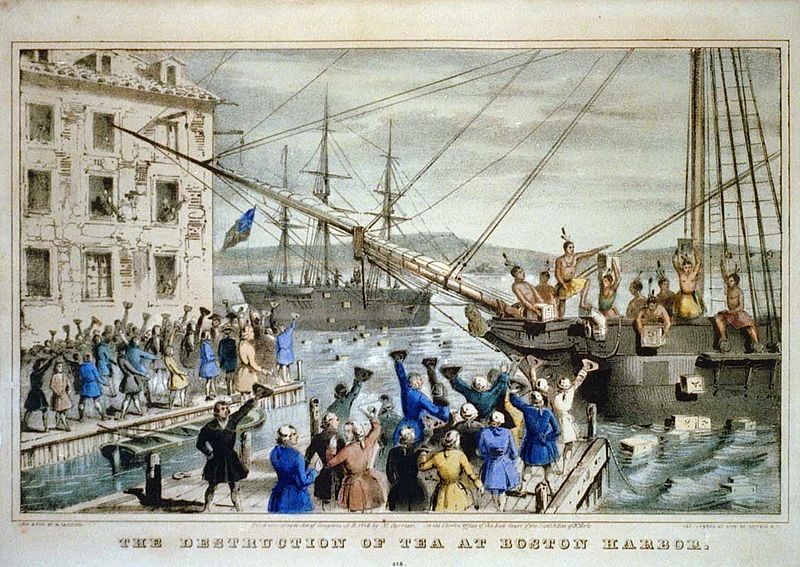
destruction-of-tea

The Destruction of Tea at Boston Harbor, by Nathaniel Currier, 1846, Hand-Colored Lithograph

On December 16, 1773, the Sons of Liberty checked their phones for messages about the plan. Some Tweeted about it as they crept on board the British ship; others posted Instagram pictures of the tea crates they dumped into the Boston Harbor, one after another. #coffeefromnowon. #revolution. #dumptea. Throughout the night, several Sons posted updates on the SoL Forum. Meanwhile, crate after crate of imported tea splashed into the salty, frigid water.

John Adams live-tweeted the affair with considerable criticism, but a new hashtag surfaced: #sitdownjohn. Frustrated, he stayed inside while the protest unfolded. Several Native American pages posted their own frustration that the Sons of Liberty were dressing up as Mohawks, pointing out the inaccuracies and retribution the British might take against them, but the protest continued unabated. Some tagged King George in their posts.

The next morning, King George deleted his Twitter account, then reopened it again to post “Not cool” several times. The Sons of Liberty felt like they had accomplished a good shaming.

A week later, Sons and Patriots returned home for Christmas. The media expressed a disorganized uproar about the protest, with Loyalist blogs calling the Sons of Liberty terrorists and the Sons of Liberty tagging everything #donttreadonme and #goteabagyourself. Some Sons returned to divided families: a Loyalist cousin here, a Quaker moderate in-law there.

It was particularly awkward at the Adams Christmas Party. Refusing to yield his position, John spent the entire time standing up, while his cousin Sam spent his time in a corner liking and retweeting every post of a tarred-and-feathered British tradesman. John called it grotesque of him to like so much shaming; Sam told him to stop shaming him for his views. Sam pointed out that John defended the Red Coats after the Boston Massacre three years earlier, calling him out for defending people who killed Americans; John called out Sam for passively defending a whiny group of protestors. Meanwhile, Abigail Adams drank whiskey in the billiard room and thought very seriously about tarring and feathering both John and Sam. She was, after all, ashamed of both of them. They liked the shock and awe of sharing listicles reinforcing their stances, like preaching to two different choirs. “Ten Horrible Things King George Has Done in Ireland,” “Nine Ways the Revolution Fails at Intersectionality,” “You Won’t Believe the Feathers on This Loyalist Cuck.”

Abigail had visited a Boston general hospital weeks earlier after a tax collector she had befriended was tarred and feathered at the docks. She remembered the way the hot tar stuck to his skin, the difficulty of pulling it off, the way it stuck to doctors who tried to remove it, making him untouchable, unapproachable. He refused to speak to Abigail for her husband’s politics, and instead stared at the ceiling while doctors treated his burn wounds.

Sam called John a feisty little tea drinker, and John called Sam a caffeinated warmonger. They were on the verge of tarring each other right there at the party, and if they did, Abigail knew that she would pull the dried tar from both morons while they lay side by side, listening to each other’s crying. Even that, she posted on Tumblr passive aggressively, wouldn’t get them to meet one another halfway.

-jk

Genre, Nostalgia, and The Love Witch

I don’t normally do film reviews/analysis on this blog, but a recent viewing of The Love Witch with its “aggressive strangeness,” as a friend described it, warrants a a closer look.

witchAnna Biller’s 2016 The Love Witch begins as a parody of late 1960s/early ’70s sci-fi/fantasy sexploitation B movies such as Barbarella (1968) and A Touch of Satan (1971). Biller’s film establishes a concrete cinematic nostalgia that it then goes to great lengths to critique.

Spoilers and such: The main character, Elaine, is a witch utilizing her witchiness to seduce men in her supposedly endless search for love. After having killed her husband, Elaine quickly finds a new partner (Wayne) and uses her excessive witchitudes to convince him to take her to his getaway cabin. There, she gives him a “potion,” which causes him to “feel love” too intensely and die. (Audiences can recognize that taking beverages from strangers is also a possible way to die). Elaine attributes Wayne’s death to men being unable to cope with their emotions, and moves on from there, as we all should when someone feels emotions to death.

When Elaine finds  Griff, “the right one,” the film has veered from its established genre, becoming at different points a Hallmark romcom and a buddy cop drama. Disappointed that he fails to feel love for her (and also happens to be the cop who finds that she is guilty of “loving” people to death), Elaine stabs Griff in the chest. The film ends with a disturbingly quiet fantasy of Elaine marrying Griff in a Renaissance setting, interrupting the campy tone and ending with a serious meditation on the consequence’s of the film’s own logic.

The Love Witch exploits viewers’ nostalgia for a unique cultural moment that existed only after the emergence of birth control and before the HIV/AIDS epidemic, an era that felt like it was going places and might have were it not for the sudden death of hope that came with Reagan and the moral majority.

Elaine’s treatment of men is cynical and essentialist, and the film’s male characters buy into it just as much as she does. Audiences are meant to see her views as a product of her frustration with social expectations for happiness and monogamy, and she turns to witchliness to prevent further disappointment. Witchcraft here functions as a cult-like ideology: Elaine seeks improvement in relationships and cedes her agency to something beyond her (a program/product/cult), but as a result of that program/product/cult, she only ends up killing people (which, to no surprise, ends up hurting her relationships). Witchcraft is a stand-in for any commodified, pre-packaged self-help ideology, such as Sedona’s vortexes, Scientology, or the books of Rob Bell (all of which, I’m sure, have resulted in someone’s death).

Marriage appears most colorfully in a scene at a Renaissance fair, pulling back the curtain on Elaine’s personal investment in the program/product/cult. Elaine, like many Americans, is drawn to witchcraft simply for the nostalgia of a pre-globalized Europe, one without the intrusion of Christianity but all the aesthetics of a Pagan religion without the human sacrifice and patriarchy. All the fun without the historicity. Tolkien made even whiter and somehow less sexy. Halloween ruined by Medieval and Renaissance Studies majors. The list goes on. The film critiques the audience for participating in nostalgia for a style it portrays as commodified, pre-packaged, and self-consuming.

The Love Witch dissects the way many Americans imagine the sexual revolution, which existed between two periods of extreme repression, the 1950s and 1980s, and captures the strangeness of that moment of hope while simultaneously undermining it just as violently as it was subverted historically.

The film’s generic experimentation acts as a mechanism exploiting viewers’ nostalgia. The Love Witch tricks audiences the way time and politics often do, by taking its viewers on a trip they never signed up for but feel unable to step out of, forcing them to walk away with questions and pretentious blog post ideas about witch hunts and the 1970s or something.

-jk

Nobody Actually Has Time to Write a Novel (But We Do It Anyway)

train-1November 1 kicked off the beginning of National Novel Writing Month, or NaNoWriMo, the long-standing tradition in which writers and readers alike decide to write a novel (or 50,000 words at least) during the month of November. The idea isn’t to have a novel finished by December 1, but to have written enough of a first draft of a novel (or memoir or novella even) to build on during the next year, something to return to and tinker with at a more casual, realistic pace.

Writing at a bout 1600 words a day, writers might finish. Most don’t. I’ve only finished once, and I was a very sleepless college freshman, full of ideas and not much else. Now, I’m a graduate student in English. Now, I’m full of ideas and stress, and not much else. I have deadlines to meet, books to read, authors to research, research to catch up on, and workshop material to write. I have classes to teach and a full 13 credit hours of graduate coursework to focus on, as well as graduate applications and a brand new hip flask to make proper use of. Do I really want to add the pressure of a novel to that?

The answer, of course, is no. But I’m doing it anyway. I don’t expect to finish, even if I write during all of Thanksgiving break. Even when I inevitably don’t meet the standard 50,000 words, I’ll still have a novel draft to tinker with in 2017. Like many writers across the globe, I’m enjoying more ambition than I can justify having, and the companionship of fellow writers struggling near me.

So, to my fellow November-long novelists, I wish you luck and sudden bouts of free time. Say goodbye to your loved ones and the prospect of having clean dishes. It’s noveling season.

-jk

Useful Tips for Making Time to Write

make-timeStephen King once suggested that aspiring writers carve out time to write every single day, which probably works for wealthy retired people like him. For the rest of us proles trying to be writers, carving out time to write can be a challenge. There are, however, numerous ways one can make time to write.

  1. Give up sleep. Talk to your doctor to let her know that you no longer require the recommended seven to eight hours of sleep; four or three or two should be sufficient. That’s what coffee is for, right? If your doctor protests, just let her know that she can have a free signed copy of your fantastic novel-in-progress, American Noun, once you finally get it written.
  2. If sleep is too difficult to give up, try giving up on friends. Thanks to social media, dropping off the face of the Earth has become quite easy. Delete your Facebook, Instagram, Twitter, Pinterest, Bumble, Thorax, PurpleDeth, and whatever other social media you have. No more notifications from you will quickly let your friends know that you are now and always have been an illusion. No more friends, no more distractions! Now get writing!
  3. If you somehow need friends and sleep, another way to make time is to quit your job. Many aspiring artists have done it. You can call it breaking out of the system, but we all know it’s to make time to write. After a month or so, you can consider more tenable versions of giving up on a well-paying job to pursue your dream, like getting an MFA in something or volunteering with the Green Party.
  4. If you’re the kind of loser who needs sleep, friends, and a job, another way to make time to write is to literally create time. For many writers, this is the most realistic option. Build a time machine (instructions are on Wikipedia) and spend a day writing, then go back twenty-four hours and respend that day working with friends and sleeping. You’ll have a novel in no time, but the problem is that, to the rest of us, you will age twice as fast.
  5. Making time to write is difficult, and you may have to give up a few things: regular TV, some social events, a few good meals. The important thing is to not give up on writing, if you really, really want to write. You can’t have it all, but the parties you get invited to after publication will make up for it.

-jk

Getting Over the Beats

on-the-road

“We’re all golden sunflowers inside, bae.” -Allen Ginsberg, probably

In high school, I took a creative writing elective, and the teacher assigned numerous Beat Generation authors. We read sections of Dharma Bums and “Howl” and numerous Jack Kerouac poems. It turns out that the influence of the Beats on a youngboredsmallwhitemale is that he starts wearing black button-up shirts and fantasizing about expensive liquor. After reading On the Road the following summer, I spent a great deal of time fantasizing about drinking absinthe on road trips through the desert at night while listening to something called bop. I bought used jazz records that I listened to once, maybe twice.

I thought about rebelling, but I was convinced that the key to rebellion was originality, and just about everything had been done before. I learned the value of originality from the Beats, who were apparently the very first people to realize that dharma and karma fall under the category of “hip.” I learned more from various articles summarizing the Beat Generation that I found online to save time, and it was there that I discovered how powerful single  arbitrary out-of-context half-cited quotes can be, even with no subsequent explanation. I thought about growing out my hair, learning how to sculpt with metal, driving a motorcycle, making out with trees, but they had all been done before.

As time went on, I encountered other writers and poets who influenced me in more nuanced, healthier ways. Had I kept up with my Beat fixation, I might have grown up to the kind of person who uses Kerouac quotes to make myself feel better about spending fifteen dollars on one local IPA at a bar I frequent only because the regular server is an aspiring country saxophonist named Cynthia. Or I could have become the kind of teacher who wears skinny dungarees and Pink Floyd T-shirts with holes in the front and sits on the desk telling his students that Jesus and Steinbeck were both Zen masters who shared some sweet flashbacks to one another.

I still dig the Beats sometimes, but that scene has passed. I’m still not sure what kind of writer I am, but I can’t be a Beat, or any other writer from the past. It’s better to write for and from the present. I’ve almost entirely moved on, man.

-jk