Category Archives: History

“We are digging up the foundations of a very old world.” -Alan Sharp

1917: Kerensky’s Sidestep

Alexander Kerensky and Map

Alexander Kerensky, briefly Prime Minister, 1917. Via Keystone/Hulton Archive, Getty Images

In early 1917, rebelling Russians wanted three things: political reform, economic reform, and for Russia to withdraw from the Great War. The Provisional Government that took over many of the Tsar’s administrative tasks attempted to satisfy the various Soviets that appeared throughout Russia, which represented the interests of soldiers, workers, and peasants (often in that order). Without mutinying soldiers, the February Revolution would likely not have happened, but many soldiers were divided about whether or not to continue a war that had proven disastrous for them under the Tsar.

The crisis of leadership following the February Revolution placed several key figures into powerful positions. Pavel Miliukov, a pro-monarchy and pro-war politician, became the Provisional Government’s Minister for Foreign Affairs, and in contrast, the moderate socialist Alexander Kerensky simultaneously held positions in the Petrograd Soviet and the Provisional Government, as the vice chairman and Minister of Justice, respectively. Kerensky’s role in the chaotic time between March and November of 1917 shaped Russian policy between the year’s revolutions.

At the start of the war, Kerensky was the leader of the center-left Trudoviks. After the February Revolution, he came to power in both the Petrograd Soviet and the Provisional Government against official Soviet policy, which made it illegal for Soviet members to hold government positions. Kerensky occupied  a position comparable to a US Senator who somehow managed to also hold a seat in the US House of Representatives.

Led by the Mensheviks, the Petrograd Soviet held a firm grip over the capital, but refused to act as a new government because Mensheviks predominantly believed that “the February Revolution was a ‘bourgeois revolution.’ . . it was the task of the workers’ party to refrain from compromising itself in the workers’ eyes by taking power” (Treadgold & Ellison 96). As a result, the Petrograd Soviet and Provisional Government created a power vacuum that could not be filled, preventing elites from exercising power but also making it difficult to pass economic or military reforms, what Trotsky called “dual power.” Kerensky managed to bridge that gap.

Kerensky was liked by those to the political right of him. In isolation, Tsar Nicholas II wrote in his journal that the “more power [Kerensky] gets, the better” (91), and Miliukov said in a speech to the Provisional Government shortly after its formation that he “just received the consent of [his] comrade A. F. Kerensky to assume a position in the first Russian public cabinet. We are eternally joyful to place into the trusty hands of this public activist the ministry that will mete out out just retribution to the servants of the old regime” (Daly and Trofimov 51).

He continued to rise to power as the year progressed and the Bolsheviks continued to attempt to stir up support after their mid-April return from exile. In late April, Miluikov’s pro-war policy found little support, and he resigned from office on May 2, days after the Minister of War, Alexander Guchkov, resigned. Once again, Kerensky filled the power gap by replacing Guchkov as War Minister on May 5. However, Kerensky adopted a similar stance on the war, and rededicated the Russian military to the Allies. Kerensky slid to the center and Russia stayed in the war.

After a failed coup in summer, he would replace Prince Lvov (appointed by the Tsar) as Prime Minister. In four months, Kerensky would rise to power by moderation, rhetorical savvy, and his continual sidestep closer to the right. The stalled gears of “dual power” in the capital made it possible for one person straddling both branches to exert more and more influence, foreshadowing Stalin’s power grab a decade later. But Kerensky was neither a dictator nor a cynic. His politics were pragmatic, though increasingly conservative. His betrayal of leftist idealism makes sense in the wake of leftist hesitation while his rise to power was possible only through the failure and resignation of other powerful figures. Because his lack of immediate shortcomings contrasted the inadequacies of those he continually replaced, his rise to power was seen as stabilizing rather than centralizing. But his military failures and insufficient land and economic reforms imitated the same failures that led to the Tsar’s ousting. If February was a bourgeois revolution against Tsarism, October was an intelligentsia’s revolt against Kerenskyism, which was a bourgeois liberal’s attempt at restoring order without changing the order of things.


Daly, Jonathan, Leonid Trofimov. Russia in War and Revolution, 1914-1922. Hackett Publishing Group, 2009.

Treadgold, Donald W., Herbert J. Ellison. Twentieth Century Russia. Westview Press, 2000.

1917: The Ides of March

Nicholas II and Alexei

Nicholas II and his son Alexei inspecting troops near Mogilev.

On March 15 in the Gregorian Calendar, Tsar Nicholas II abdicated the throne.

Nicholas was returning to Petrograd by train from the Eastern Front. However, the train’s operators “in contact with the Duma Committee” in Petrograd “deliberately exaggerated the threat [of rebels at the train station] in order to keep Nicholas away” from the capitol under the control of the Petrograd Soviet, where he had lost almost all favor with his subjects. (Steinberg & Khrustalev 58). A General and two political leaders met Nicholas at Pskov, where Nicholas ordered the imperial train to reroute to, and encouraged him to abandon the throne at the station. Ultimately, the dissent of generals and military leaders pushed Nicholas to accept that he had been politically defeated.

Nicholas abdicated that night, naming his brother Grand Duke Michael as the next Tsar instead of his son Alexei, whom he deemed too sick. However, Michael decided not to accept the position. In his own statement of abdication on March 16, the Grand Duke wrote,

“. . . I have firmly resolved to assume supreme power only if that should be the will of our great people who will be required by popular vote, through their representatives in the Constitutional Assembly, to create a form of government and new fundamental laws for the Russian State. Therefore, in appealing to God’s blessing, I ask all citizens of the Russian Empire to obey the Provisional Government” (105).

He officially waited for the Duma to pass a resolution favoring him as Tsar, but they never allowed for a vote. Nicholas was infuriated, but he had already abdicated, and there was nothing he could do.

It is only a poetic coincidence that Nicholas abdicated on the Ides of March, or March 15. In 44 BCE, numerous conspirators in Rome assassinated Julius Caesar on March 15 in the midst of Rome’s political crises of the era, through which Rome mutated from a republic to an empire. The Roman historian Plutarch noted that a seer warned Caesar that he would be killed by this date. William Shakespeare made famous the Ides in his own dramatization when a soothsayer shouts to Caesar, “Beware the Ides of March!” to which Caesar responds, “He is a dreamer; let us leave him” (Shakespeare 1.2.100-110). But there is another connection between Caesar and Nicholas.

The word Tsar comes from the word Caesar, which eventually came to mean Emperor. Ivan IV (the Terrible one) was the first Russian Tsar, claiming the title in 1547. An earlier Ivan (Ivan III and presumably not as terrible) had married the niece of the last Byzantine emperor, Constantine XI Palaiologos. The Tsar, then, was a political-religious emperor of Roman-style prestige, with the demise of that prestige already embedded in the title’s narrative as early as Plutarch and sealed in popularity by Shakespeare. By claiming the title Tsar, Ivan IV created a lineage connecting Rome, Byzantium, Orthodox Christianity, Muscovy (Moscow), and Imperial Russia, a lineage that Nicholas II inherited.

But Nicholas was not assassinated on March 15. He merely stepped down from the throne, for what might have been a peaceful transition of government from autocrat to soviet, from empire to republic.

Following abdication, the Romanovs planned to flee to England, but were instead arrested and eventually assassinated, in their entirety, by communists in July of 1918. When Lenin learned about the assassinations, he had been drafting healthcare plans for the new regime. According to historian Wendy Slater, “Lenin showed no obvious reaction to the news. . . The answer, of course, is that Lenin had not wanted Nicholas’s death to happen in this manner. If the Tsar had to die in order for the Revolution to assume legitimacy as Russia’s new government, then his death ought to have been a public execution, following a public trial” (Slater 152-153). For the Bolsheviks, it would have been better politically to let all Russians determine the Tsar’s fate.

For Russia in 1917, March was a volatile turning point, but not a stopping point. The Revolution spun forward, taking monarchs and peasants and dissenters with it. March 15 was significant for the Revolution because a monarch willingly conceded defeat. At the time, there was no conspiracy to depose him, and the assassins would come later. Power, then, was seized quite fluidly by the Provisional Government and the Petrograd Soviet, putting the burden of order entirely on the temporary leadership established by force in the capital.


Shakespeare, William. Julius Caesar.

Slater, Wendy. The Many Deaths of Tsar Nicholas II. Routledge, 2007.

Steinberg, Mark, Vladimir M. Khrustalev. The Fall of the Romanovs. Yale University Press, 1995.

1917: The First Soviets

petrograd-soviet-1917

Petrograd Soviet of Workers’ and Soldiers’ Deputies, 1917. Photograph by Viktor Bulla (1883-1938)

The Russian word Soviet means council or congress, a unified and organized body of persons, a congregation or polity. The first Soviet appeared in the Revolution of 1905 when urban workers organized. It diminished quickly soon after, and did not implement the socialist revolution that many early factions (Socialists, Marxists, Anarchists) had hoped for. It would take twelve years for Soviets to form again, in early 1917.

Lenin described the first Soviets as workers spontaneously developing class consciousness. In 1918, he called the Soviets the “direct organization of the working and exploited people themselves” (Lenin). He viewed them as self-organizing microstates, writing that “Soviets are the Russian form of the proletarian dictatorship [and should] be transformed into state organizations” rather than mere revolutionary organs (Lenin). From Lenin’s perspective, the Soviets could be utilized as more than workers’ organizations and instead be states.

However, Lenin and some other Bolshevik leaders were out of the country during the Soviets’ formation because they were exiled from Russia at the time. Despite their inability to participate in the February Revolution, the Bolsheviks had a clear end in mind (a new state) while the Soviets themselves had a variety of connected motives (hunger, peace, land).

World War One is an important context for the 1917 Soviets. In February, Tsar Nicholas II left for the Eastern Front, abandoning citizens to concentrate on a failing war that had already killed thousands of Russians. Additionally, as Mark Steinberg points out, the emergence of a “sphere of civic activities situated in a social space beyond private life and not completely under the control of the state, made enormous differences in the lives of many Russians. . . Voluntary associations proliferated. They included literacy and temperance societies, business and professional associations, workers’ mutual assistance funds, private schools, and varied cultural circles” as well as trade unions and new political parties (38). Turn-of-the-century organizations legitimized new political ideologies, including anarchism and socialism, which, coupled with increased literacy and private discourse beneath the radar of the regime, contributed to Russians’ range of organizational possibilities.

By March 8 (in the Gregorian calendar), on International Women’s Day, working-class women joined protestors and marched through Petrograd. A police officer named Ilia Mitrofanovich Gordienko recalls in a memoir that women chanted “‘Down with the war! Down with high prices! Down with hunger! Bread to the workers'” and that “Clashes with the police took place near the City Duma and in other places, but these were only minor skirmishes. . . The same thing happened the next day” (Daly & Trofimov 36). The Petrograd Police Chief, Aleskandr Pavlovich Balk, noted that on March 10, “the factories functioned less intensively than on the previous days. Workers walked off the job in groups, holding rallies as they went” and that soldiers from the Pavlovskii Guard Regiment not only protested but fired upon officers attempting to disperse them (41).

On March 12, desperate and with little left to lose, workers stormed Tauride Palace, occupying it while protests continued in the streets. Inside the Palace, striking workers and mutinous soldiers created the Provisional Executive Committee of the Soviet of Workers’ Deputies, a new Petrograd Soviet, as documented by the socialist witness Nikolai Nikolaevich Himmer:

“There was no order even in the meeting itself. There was no permanent chairman. Chkheidze, who later performed the chairman’s duties almost permanently, didn’t do much work in the Ex. Com. during its first days. He was constantly being summoned–either to the Duma Committee or the Soviet sessions or, above all, ‘to the people,’ the constantly-changing crowd standing in front of Tauride Palace. . . If anyone had the means to [restore order to the city] it was the Soviet, which was beginning to acquire control over the masses of the workers and soldiers” (46).

He later critiqued the Soviet as too disparate to function as a government, stating that it was capable only of “moral functions” (48). The act of occupying Tauride Palace was the moment of class consciousness Lenin and other orthodox Marxists obsessed over, but after that moment, the desire for restoring order became a difficult task, resulting in the negotiated creation of a Provisional Government meant to restore order in the absence of the Tsar, who would abdicate on March 15.

The spontaneous, illegal occupation of public space was the revolutionary moment of crisis that Lenin and the Bolsheviks missed. It was the moment workers and soldiers united for the primal task of surviving a system that was rapidly killing them. Like Egyptians taking Tahrir Square in 2011, the Women’s March on Versailles in 1789, and the successful slave rebellion of the Haitian Revolution, the impromptu formation of a Soviet in Tauride Palace was a purely revolutionary moment, one of Hakim Bey’s Temporary Autonomous Zones. It occurred before the state could monitor and contain it and resulted in a new approach to governance.

Bey describes such autonomous zones as temporary. Utopia, if achieved in a revolutionary context, is always temporary. Soviets coalesced spontaneously without a clear end, but most managed to redistribute food, water, and health to suffering workers and rebellious soldiers. The October Revolution that followed later in the year was much more organized and had specific steps and goals, and its subsequent political state lasted much longer, but the introduction of statehood into the Soviets moved the Revolution from a moment with an imagined future to the constant need to support, protect, and update a highly-structured present.


Bey, Hakim. From TAZ: The Temporary Autonomous Zone, in Cultural Resistance Reader, ed. Stephen Duncombe, New York: Verso (2002), 113-118.

Daly, Jonathan, Leonid Trofimov. Russia in War and Revolution, 1914-1922. Hackett Publishing Group, 2009.

Lenin, Vladimir. The Proletarian Revolution and the Renegade Kautsky. 1918.

Steinberg, Mark. Voices of Revolution, 1917. Yale University Press, 2001.

1917: Tsar Nicholas II, Celebrity Autocrat

nicholas-ii-huntingNicholas II was crowned Tsar at the age of twenty-six in 1894, following the sudden death of Tsar Alexander III. Nicholas inherited a relatively stable regime that he was determined to sustain without change. He grew up believing he had been born simply to preserve the institution of God-granted Russian royalty, to maintain the status quo. Alexander, thinking he would live longer, had not trained Nicholas in diplomacy or politics. Living like a king was all Nicholas knew how to do.

His central policy was autocracy. Nicholas rigidly adhered to a particular image of Russia as ordered beneath and for him, and attacked anything that contradicted his sense of that order. He placed himself in the public eye regularly, but only filtered through artificial expressions of his status. This was clear in the 1913 Romanov Tercentenary, a national celebration of the Romanov dynasty. Virginia Rounding points out that “as many as one and a half million commemorative rubles were issued on the occasion of the tercentenary,” and that Nicholas appeared on numerous stamps and in over a hundred film reels (9-10). The monarchy also granted permission “for the production of scarves bearing a portrait of the Tsar, but only with the proviso that the scarves should not be of the right size to be used as handkerchiefs” (10), because Nicholas did not want anybody blowing their noses on images of him. He viewed himself in religious terms, and treated even petty disrespect as sacrilege.

The Romanov Tercentenary was an elaborate publicity stunt scheduled after numerous disasters under Nicholas’s rein. The Russo-Japanese War of 1904-1905 ended with an absolute Japanese victory, and was considered an unprecedented humiliation for Imperial Russia. In 1905, Russia’s political and economic problems proved that Nicholas II was not the carefree celebrity he wanted the world to believe he was. That year, strikes and protests formed in the capital amid widespread unrest. Nicholas responded to protestors by ordering police to fire on them on January 22, 1905, now known as Bloody Sunday. The Revolution of 1905 put enough pressure on the Tsar to allow for modest state reforms, including the formation of the Duma as a legislative body and the Russian Constitution of 1906. Nevertheless, Nicholas continued to rule as an authoritarian, dissolving the first Duma and manipulating the second. Entering he Great War in 1914 was just one more disastrous move.

The elaborate publicity displays were what Nicholas wanted the world to see of his empire. Instead, he met countless challenges to his authority, to which he responded with oppression or dismissal, sometimes removing ministers who disagreed with him and distrusting many others. By September of 1915, he had taken complete control of the military, leaving the capitol for the front. By 1916, unrest among soldiers had grown such that in April, “orders were issued forbidding free and open exchange between enlisted men and aid workers unless specifically allowed by the military leaders”  (Sanborn 170).

Nicholas was untrained for leadership and unwilling to admit his shortcomings. He took more interest in sports and his family than in political reforms, which he viewed as a threat to his sovereign, divine authority. He had been raised to live as a ruler, but not to rule, and he began ruling at a time when many Russians grew tired of aristocrats flaunting their inherited God-given wealth and silencing anyone who pointed out the problems in the system. When he abdicated the throne on March 15, 1917, Imperial Russia was a lost cause. With his extravagance and sweeping political abuses and abrasive leadership, Nicholas II exhausted Russian statehood to the breaking point.


Rounding, Virgina. Alix and Nicky, St, Martin’s Press, 2011.

Sanborn, Joshua. Imperial Apocalypse, Oxford University Press, 2014.


1917: Rasputin and the Great War

anna_theodora_krarup_portrait_of_rasputin_1916

Portrait of Rasputin by Anna Theodora Karup, December 1916.

“Dear friend, I will say again a menacing cloud is over Russia lots of sorrow and grief it is dark and there is no lightning to be seen. A sea of tears immeasurable and as to blood? What can I say? There are no words the horror of it is indescribable. . . they will conquer Germany and what about Russia? If one thinks verily there has not been a greater sufferer since the beginning of time she is all drowned in blood. Terrible is the destruction and without end the grief.” -Grigorii Rasputin, in a letter to Tsar Nicholas II, summer, 1914

In late December in 1916, the Russian mystic Grigorii Rasputin was assassinated, two and a half years into the Great War, two and a half months before the Russian Revolution took shape. Aristocrats in the Empire, notably Prince Felix Yusupov, who had grown to hate the holy man invited him to dinner in Moika Palace in Petrograd, now Saint Petersburg. For years, the Tsar had placed Rasputin closer to his family, or Rasputin inserted himself into the family by influence. In 1907, the Romanovs invited Rasputin to visit the royal family and heal Alexei, heir to the throne and ill with inherited hemophilia. Regardless of who pulled whose strings, he became a strange, alien force in the regime’s inner circles, a peasant-turned-occultist who joined the royal family.

Rasputin was an independent religious leader claiming metaphysical power and an extensive knowledge of the Bible, but he ignored the moral norms of Christianity through his abuse of alcohol and frequent sexual affairs. He was not a priest, but served the role of priest to a family that was just as much a facade as he was. He may have been a sophist or a lunatic, serving an incompetent autocrat to preserve the Romanov lineage, however doomed it was.

He could also be seen as a Shakespearean fool, the peasant-turned-entertainer who speaks candid truths to the audience and characters. Rasputin was a pacifist opposed to the Great War, though his graphic prophecy was not enough to prevent Russia from entering the conflict. His description of the war, noted above, was apocalyptic, and predicted the horror Russia would suffer as a result. Here, then, was a man willing to help the Tsar despite knowing the violence he could allow.

Russia lost approximately 1,997,500 soldiers in the First World War, with France trailing behind at 1,400,000, colonies and all. The brutal winters of the war years devastated armies and limited supplies for the Russian population. Military historian John Keegan points out that the “nature of these titanic battles on the Eastern Front is difficult to represent at a human or individual level. The Russian army, 80 per cent peasant when a majority of Russian peasants were still illiterate, left no literature to compare with that of the Western Front” (161). The majority of those who survived the Eastern Front, in other words, could not record their experiences.

However, a few written texts are telling. A Russian nurse named Lydia Zakharova, for instance, described a trench on the Eastern Front one winter as a “city of the dead, its inhabitants frozen in the most unlikely positions, as if a raging, deadly hurricane had just swept past them” (Storey 116). She adds, almost numbly, that “there is a limit, by the way, beyond which the human mind can perceive no more horrors, as a saturated sponge can soak up no more water” (117). Rasputin did not live to see the totality of the violence he predicted in 1914, but millions of Russian peasants experienced it.

Tsar Nicholas II shares much of the blame for the failures of the Great War. In 1914, he took personal control of the military, deeming himself a kind of commander-in-chief. Like many European leaders, Nicholas naively thought the war would end by Christmas of 1914. Instead it continued year after year after year.

Finally, in early 1917, starved of food and hope, bled of its population, and openly mocked by the Tsar’s aggressive displays of wealth and indifference, Russians began to protest. The Russian Revolution began only as a series of strikes. People were hungry; they couldn’t work anymore; they stopped until they got food. The Tsar, whose brutality was clear in 1905 when he ordered police to shoot protestors in Russia’s Bloody Sunday, ordered soldiers to fire into the crowds of strikers.

However, those who were meant to guard Petrograd consisted of wounded veterans or very young recruits. Healthy, loyal, and experienced soldiers were stationed on the Eastern Front, and those left behind revolted too and chose to protect the protestors. First, the holy fool protested, then soon after the workers, soldiers, guards, and even a few aristocrats realized that 1917 was an apocalypse year for Imperial Russia.

Rasputin’s place in the regime seems like an ill-fitting cog in a machine, but that might be a limited perspective because almost nobody in the regime was fit for rule. The Tsar was incompetent and disinterested, his children were sick with inherited hemophilia, his ministers were torn between the possibility of a democratic Russia or the Tsar’s brutal autocracy. The monarchy was a network of ill-fitting parts. Rasputin, for all his mysteries, might have had the last good idea for Russia’s future: don’t go to war, it will be the end. Instead, Nicholas ignored the dissenting fool and plunged Russia into the sea of tears immeasurable Rasputin predicted.


Keegan, John. The First world War. Vintage Books, 2000.

Storey, William Kelleher. The First World War. Rowman & Littlefield, 2014.

Treadgold, Donald W., Herbert J. Ellison. Twentieth Century Russia. Westview Press, 2000.

Coming Home for Christmas After the Boston Tea Party

destruction-of-tea

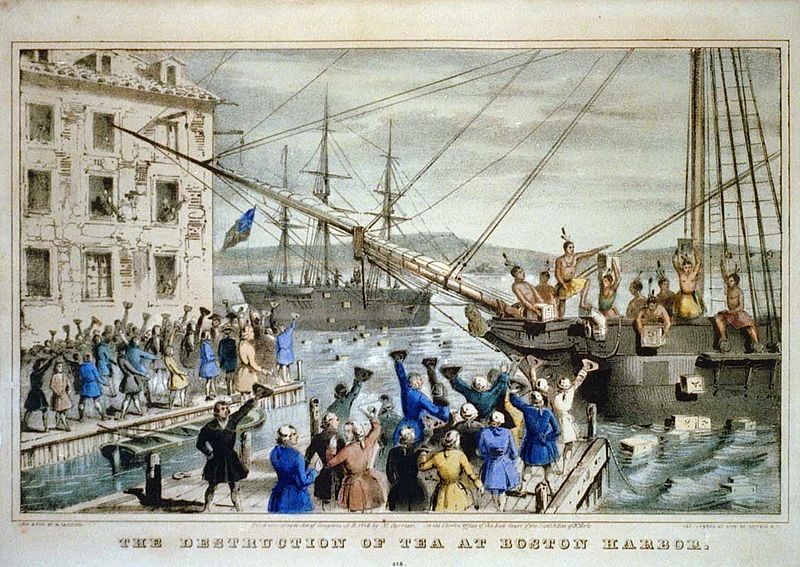
The Destruction of Tea at Boston Harbor, by Nathaniel Currier, 1846, Hand-Colored Lithograph

On December 16, 1773, the Sons of Liberty checked their phones for messages about the plan. Some Tweeted about it as they crept on board the British ship; others posted Instagram pictures of the tea crates they dumped into the Boston Harbor, one after another. #coffeefromnowon. #revolution. #dumptea. Throughout the night, several Sons posted updates on the SoL Forum. Meanwhile, crate after crate of imported tea splashed into the salty, frigid water.

John Adams live-tweeted the affair with considerable criticism, but a new hashtag surfaced: #sitdownjohn. Frustrated, he stayed inside while the protest unfolded. Several Native American pages posted their own frustration that the Sons of Liberty were dressing up as Mohawks, pointing out the inaccuracies and retribution the British might take against them, but the protest continued unabated. Some tagged King George in their posts.

The next morning, King George deleted his Twitter account, then reopened it again to post “Not cool” several times. The Sons of Liberty felt like they had accomplished a good shaming.

A week later, Sons and Patriots returned home for Christmas. The media expressed a disorganized uproar about the protest, with Loyalist blogs calling the Sons of Liberty terrorists and the Sons of Liberty tagging everything #donttreadonme and #goteabagyourself. Some Sons returned to divided families: a Loyalist cousin here, a Quaker moderate in-law there.

It was particularly awkward at the Adams Christmas Party. Refusing to yield his position, John spent the entire time standing up, while his cousin Sam spent his time in a corner liking and retweeting every post of a tarred-and-feathered British tradesman. John called it grotesque of him to like so much shaming; Sam told him to stop shaming him for his views. Sam pointed out that John defended the Red Coats after the Boston Massacre three years earlier, calling him out for defending people who killed Americans; John called out Sam for passively defending a whiny group of protestors. Meanwhile, Abigail Adams drank whiskey in the billiard room and thought very seriously about tarring and feathering both John and Sam. She was, after all, ashamed of both of them. They liked the shock and awe of sharing listicles reinforcing their stances, like preaching to two different choirs. “Ten Horrible Things King George Has Done in Ireland,” “Nine Ways the Revolution Fails at Intersectionality,” “You Won’t Believe the Feathers on This Loyalist Cuck.”

Abigail had visited a Boston general hospital weeks earlier after a tax collector she had befriended was tarred and feathered at the docks. She remembered the way the hot tar stuck to his skin, the difficulty of pulling it off, the way it stuck to doctors who tried to remove it, making him untouchable, unapproachable. He refused to speak to Abigail for her husband’s politics, and instead stared at the ceiling while doctors treated his burn wounds.

Sam called John a feisty little tea drinker, and John called Sam a caffeinated warmonger. They were on the verge of tarring each other right there at the party, and if they did, Abigail knew that she would pull the dried tar from both morons while they lay side by side, listening to each other’s crying. Even that, she posted on Tumblr passive aggressively, wouldn’t get them to meet one another halfway.

-jk

American Discourse and Islamic States

globeIn contemporary American discourse, the ways we talk about Islam and the Muslim world tend to be limited. The phrase “Middle East” has become synonymous with Islam in the American imagination. In recent years, the self-proclaimed “Islamic State” has dominated western discourse about a large and malleable region of the world, but the concept of an Islamic state has appeared in numerous other historical moments, warranting a more nuanced understanding of the phrase.

Edward Said points out that “before the sudden OPEC price rises in early 1974, ‘Islam’ as such scarcely figured either in the culture or the media. One saw and heard of Arabs and Iranians, of Pakistanis and Turks, rarely of Muslims” (36). Discussions of nationality and ethnicity were practical for American discourse. Economically and politically, American discourse began homogenizing these polities under one overarching category: Islam. Oil price changes, revolutions in Iran, protests in India, and socialism in Afghanistan in the 1970s and 1980s slipped away as Americans perceived dozens of countries as simply “The Middle East.”

The concept of the Islamic World actually has its roots in Medieval Islamic thought as the dar al-Islam, or the abode of Islam, which was a (most likely idealized) view of the Medieval world in which a Muslim could move freely throughout regions with Muslim rulers, ranging from Spain to the borders of China. The dar al-Islam was not a state, but a conceptualization of territories.

An older article in The Atlantic defined a Caliphate as “an Islamic State,” which is a historically insufficient definition.Nation-states emerged in Europe as a result of geographic borders solidified by absolutist monarchs who dictated what qualified as citizenship, namely religion, taxation policy, and loyalty to the crown. As European nations and colonies swept aside absolutism and attempted to create secular liberal republics, the concept of the state as a geographic fence with a common language and fiscal arrangement remained the same: a homogeneous block of identity.

Thomas Barfield calls this the American Cheese model of statehood, and uses Swiss Cheese as a metaphor for premodern regions of Central Asia such as Afghanistan (Barfield 67). Rather than a solid block, polities were porous, malleable, and not always ruled through and through by a dominant king or ideology. This is true, I think, of what most Americans call the Middle East. It is largely Islamic, but it is far from homogeneous. The relationship between citizen and state often differs from the easy system many Americans paint onto the world, trying to mark which populations are with us or against us. The U.S. and Pakistan share more in common historically, as republics formed from anti-British/anti-colonial independence movements, yet the U.S. has a better working relationship with Saudi Arabia, an oppressive regime that likes to bomb its neighbors and censor its people. (Maybe the U.S. has more in common with Saudi Arabia than I’d thought).

Likewise, the Caliphate did not function the way we often think state-religion relationships function today. The nineteenth century Egyptian reformer Muhammad ‘Abduh wrote that Muslims never experienced “something that resembled the power wielded by the Papacy of Europe, nor were they ever exposed to a Pope-like figure who could and did exert power to remove Kings and banish princes, extract taxes and decree Divine laws” (Haj 93). Writing from the 1900s, his statement was true. Caliphs were not believed to rule the way Popes and monarchs claimed to, as infallible and acting as spokespeople of God to his otherwise hapless subjects. This is not to say that Caliphal rule was always just, but suggests that religion and state in the Islamic world grew up functioning alongside one another, but never competing with one another for control.

For most of Islam’s history, the initial Caliphate “remained head of the umma [community of believers] and a symbol of Muslim unity” but “would represent the administrative and executive interests of Islam while the scholars and Sufis defined Islamic religious belief” (Lapidus 102), and even that diminished as the Caliphate moved around, ending up in the Ottoman Empire where, after World War One, it was officially abolished. Smaller caliphates appeared every so often, but the use of the phrase “Islamic state” to describe a caliphate is too simplistic, because for much of history the Caliphate represented the separation of Islamic doctrine from political administration, at least in theory.

As such, the concept of a secular state grew up differently than it did in the west, perhaps with a greater dissonance. A single glance at the United States today, which passes laws about abortion based on religiously inspired magical definitions of personhood, suggests that we have yet to actually implement the separation of church and state.

Depending upon what is convenient for media and politicians, the Middle East contains parts of Africa, the Arab world, and Central Asia. If used literally, the Muslim World should be expanded to include China, Russia, the Caucasus, Southeast Asia, the Balkans, and regions of the Western Hemisphere where African Muslims were forcibly shipped during the Atlantic slave trade. The majority of the world’s Muslims are in Indonesia, not western Asia. The Islamic World is neither unified nor homogeneous, and instead encompasses a broad spectrum of religious, philosophical, and political discourses.

When Americans talk about the Islamic world, they typically think only of the Arab world plus Iran, because, as Said points out, it became convenient for Americans to think of themselves as persecuted by a collective polity (Islam) during the 1970s and 1980s. Violent extremists exist within a unique historical context; their crimes are not justified by that history, but they should nevertheless be understood as stemming from particular origins. It is neither useful nor intelligent to homogenize one billion people. States are intrinsically porous and malleable; Americans should recognize that this applies to the U.S. as well as the rest of the world.


Barfield, Thomas. Afghanistan. Princeton University Press, 2010.

Haj, Samira. Reconfiguring Islamic Tradition. Stanford University Press, 2009.

Lapidus, Ira. A History of Islamic Societies. Cambridge University Press, 2002.

Said, Edward. Covering Islam. Random House Vintage, 1997.

Before Wounded Knee

wounded-knee-massacre

Photograph of civilians collecting the dead at Wounded Knee.

The Wounded Knee Massacre of December 29, 1890 is widely considered the end of military hostilities between the U.S. government and Native American Indian tribes. The Standing Rock protest today, however, is building up in similar ways to the Wounded Knee Massacre, and although there are key differences, it seems that the relationship between the U.S. government and American indigenous peoples has remained largely the same since 1890.

In 1888, a Paiute man named Wovoka began a religious movement centering around the Ghost Dance. Wovoka’s movement asserted that the Messiah would return as a Native American Indian and the continent would be freed from pioneering and settler oppression, and the Ghost Dance would usher in the Messiah’s return. The movement quickly swept across Native American communities, reaching the Dakotas by summer of 1890.

Followers of Wovoka such as Arnold Short Bull, brought the Ghost Dance to the Lakota Pine Ridge Indian Reservation during a drought and amid numerous treaty violations, which included reduced food rations for the reservation and white settlement on land designated for Lakota use. The Ghost Dance accompanied federally sanctioned violence, starvation, and a small environmental disaster. The U.S. government was suspicious of the Ghost Dance as early as May of 1890, and continued to treat it as a militaristic threat rather than a religious movement. On October 30, an agent for the Pine Ridge office of the Bureau of Indian Affairs wrote a letter to the BIA commissioner indicating that, in his view after observing the Ghost Dance,

“. . . the only remedy for this matter is the use of the military, and until this is done, you need not expect any progress from these people; on the other hand, you will be made to realize that they are tearing down more in a day than the government can build up in a month” (Royer 65).

Here, the BIA acted as an observation tool for the U.S. government, keeping track of Native American Indians forced onto reservations with little water and food. A religious spectacle became a mode of unity, an expression of organization, which the government deemed, without question, a threat. Earlier, BIA commissioner R. V. Belt wrote in a letter dated October 17, 1890, that the Pine Ridge Agency should inform those

“. . . engaged in encouraging the Ghost Dance and other like demoralizing conduct, and inciting and fomenting dissatisfaction and discontent among the peaceably disposed Indians that [the Secretary of the Interior John Noble] is greatly displeased with their conduct” (Belt 75).

Belt went on to describe the Ghost Dance as “bad advice and evil,” and that the Secretary of the Interior will “exert whatever influence he may have over any of the Indians to turn their backs upon the medicine men who are seeking to divert the Indians from the ways of civilization” (75-76). There was a connection of correspondence linking BIA agents at Pine Ridge to the White House expressing anxiety about the Ghost Dance. These agents wanted “peaceably disposed Indians” who did not express discontent.

But all evidence suggests that they had every reason to express discontent. They were surviving a genocide, forced onto difficult land after military engagements against them, after numerous other massacres and battles. It seems that BIA agents and the U.S. government associated Native American discontent with militaristic hostility, conflating the two, because to the U.S., the moment a tribe became vocal, the moment its members made themselves visible, they challenged the established systematic erasure of an indigenous population and the colonial narrative of European settlement on an otherwise unpeopled land rich with untapped resources.

The Ghost Dance as a religious practice did not emphasize military struggle or armed combat. On October 31, Short Bull gave a sermon to his followers, referring mostly to the coming of the Messiah and mentioning combat only once, when he said,

“You must not be afraid of anything. The guns are the only things we are afraid of, but they belong to our Father in Heaven. He will see they do no harm. Whatever white men tell you, do not listen to them. My relations, this is all” (Sitting Bull 65).

Anxieties over Native Americans not listening to those attempting to defeat, control, indoctrinate, and relocate them culminated in the military’s arrival in November at Pine Ridge, to keep the peace. Following Royer’s suggestions, the military became a remedy to stop the Ghost Dancers from breaking down what the U.S. government had built up. Cavalry divisions arrived at Pine Ridge, forcing surrender and disarmament. On December 29, in the process of disarming a few Ghost Dancers, a rifle went off, and soldiers panicked after being informed that an armed insurrection would take place. Fueled by fear and rumors, soldiers fired at the Ghost Dancers, and a massacre ensued. There were casualties on all sides as some Ghost Dancers attempted to defend themselves. Estimates vary, but up to 300 Lakota were killed, most of them unarmed, many of them children.

The logic leading up to the massacre might be difficult to track, but was built on a number of assumptions. First, that Native Americans practicing a large, organized demonstration was the equivalent of cultural and military dissent, or in other words, a problem. Second, that the only way to “solve” the problem was through the use of military force. Third, that expressing dissatisfaction with an understandably bad situation was unacceptable.

One of the defining features of the 21st century is the blurring of police and military forces. In a post-9/11 surveillance state in which citizens and combatants are considered difficult to distinguish from one another, the police and military begin to serve similar functions. While this fact has become more obvious in recent years, and while there have been many instances in the U.S. in which the state treated its citizens as combatants, this has always been the case for Native Americans. Since the founding of the United States, Native Americans have always been designated a threat to westward expansion simply by their presence, their visibility, their voice. Historically, soldiers keeping peace and soldiers engaged in combat have served the same purpose for the U.S. when engaging its indigenous population.

I’m not a proponent of the notion that history repeats itself; I find it too simple. However, the events surrounding the Standing Rock protest are eerily similar to those that led up to the Wounded Knee Massacre: Native American Indians express discontent over treaty violations, land abuse, and environmental disasters, and as a reaction, a militarized police force steps in. Tensions have already resulted in violence against protestors and the arrest of journalists for covering the events. Contexts may be different, but the logical framework the U.S. uses to understand and address the protest remains almost identical to how the U.S. addressed and understood the Ghost Dance. Whether or not there will be another massacre remains to be seen.

Coleman, William S. E. Voices of Wounded Knee. University of Nebraska Press (2000).

Wounded Knee Massacre,” Encyclopedia of the Great Plains, 2011. Accessed October 30, 2016.

Reading Terry Tempest Williams in Zion

Zion 2This week, I had the pleasure of joining one of my best friends for a trip through parts of southern Utah, starting in Moab and ending in Zion National Park. We went for the usual reasons (viewing nature, camping, hiking, burning a dictionary and cooking quesadillas over it). After hiking the Wildcat Canyon Trail (a good ten miles of limb-crunching views), we went to our campsite and read our selected book in the fading light, both collections of short pieces on the Southwest and West, Getting Over the Color Green and Northern Lights.

In Northern Lights, I stumbled upon an essay by Terry Tempest Williams, “The Clan of One-Breasted Women.” Williams grew up in Utah in the 1950s when fallout from nuclear testing in Nevada drifted beyond the test sites. As a result, many people downwind of the tests, including her family, suffered from radiation. Williams meditates in her essay on the many women (many in her family) downwind of the test sites who developed breast cancer from the radioactive fallout.


At the peak of the hike in Zion, I could see far, far out into the distance. I was surrounded by a place brimming with life; the whole area is a complexity of ecosystems overlapping, intertwined: red and tan oceans spotted green or lush with ponderosa and aspen or colored with sand and pale sunlight. Much of the Southwest doesn’t look alive to the untrained eye. Deserts play tricks on us by hiding their life, but life is always there. Overlooking Zion, I was overwhelmed and haunted by its history.

Zion

In the 1860s, Mormon pioneers founded a town near Zion, Springdale, and named the nearby canyon Zion. To Mormons, Zion refers to a gathering place for the faithful, and naming the canyon was an act of claiming the land for Mormon culture. But while pioneers were in the process of colonizing the area, the region was home to Southern Paiute communities pushed out by U.S. settlement. Like much of the Southwest, Zion is part of overlapping histories and state-sanctioned narrative revision.

The place was shaped by geologic hands, the fingers of rivers, a mind of clouds and rain, then engulfed with diverse flora and fauna, indigenous communities, overrun by Spanish colonization, Mexican statehood, Mormon expedition, and U.S. authority that ignored all previous layers by deeming the Southwest an absolute desert, a place so deserted they could safely test nuclear weapons there without harming anyone or anything worth mentioning. But Williams contests, as many do, that all of it is worth mentioning, worth respecting and preserving and revering.

After reading Williams’s essay, I stargazed with my friend in the desert where the stars are aggressively visible. The Southwest is misleading to those unfamiliar with it. The stars are brighter here, the air is heavier with scent, the land is rougher, and the going can be tough. Zion, a place of peace, a place of eternity, may be an apt name. The whole Southwest may be a kind of Zion, a refuge for wanderers and romantics. Its beauty is rare and atypical, taking on strange shapes and colors, rich sounds and haunting narratives. Its beauty is misfit and misleading, but in its presence it’s impossible to miss.

-jk

Writers and the Easter Rising

IMG_5610

Arbour Hill, Dublin, where Patrick Pearse and other leaders of the Easter Rising are buried.

One hundred years ago today in Dublin, an Irish writer named Patrick Pearse stood on the steps of the General Post Office and read aloud the Proclamation of the Irish Republic on behalf of the Irish Republican Brotherhood, while revolutionary groups like the IRB and the women’s nationalist organization Cumann na mBan occupied Dublin and other locations in Ireland. Many of the revolutionaries were intellectuals, socialists, writers, stemming from different backgrounds; Patrick Pearse was a playwright and poet. Their goals included workers’ rights and women’s rights, alongside concerns that Britain would implement a military draft in Ireland to supplement its effort in the First World War. In the following week, known as the Easter Rising, the British responded as they often have when a colony declares independence: with excessive military force, which devastated Dublin and the rising’s core membership.

In the wake of the Rising, the British rounded up, arrested, and executed many of the rebellion’s leaders. Within a few weeks, the British executed much of Ireland’s intellectual community. Remaining leaders, such as Eamon de Valera, would go on to lead a more conservative Ireland, almost erasing the role of women and workers in the Irish Revolution from Ireland’s historical memory.

Patrick Pearse was executed on May 3. He joined what he believed was a just cause, and saw his responsibility not in writing, but in direct action, alongside other Irish writers, including the poet Joseph Plunkett.

IMG_5981

Thoor Ballylee

The poet William Butler Yeats felt differently. He sympathized with the IRB, but distanced himself from it before the Easter Rising. Some time after the Rising, he purchased a castle called Thoor Ballylee in rural western Ireland, where he placed himself both literally and figuratively above what would become the Irish War for Independence, Partition, and Civil War.

James Joyce had already relocated to the Continent, leaving Ireland behind physically but not artistically. Sean O’Casey, an Irish playwright, did not participate in the Easter Rising but would continue to write plays through the revolutionary period. While not all who participated in the Rising were executed, Britain’s heavy-handed response resulted in the deaths of numerous Irish writers, leaders, and thinkers. Meanwhile, writers who refused to participate allowed themselves more years to write, and therefore critique and contribute.

What is the role of writers in social change? In social upheaval? The Easter Rising may be an extreme example, but so was the American Revolution. What is a writer’s responsibility to a cause? It requires humility to surrender oneself to an active political movement, and a vast ego to situate oneself above the fray. But direct involvement is risky, and with the loss of intelligentsia comes the kind of one-sided leadership de Valera seemed to emphasize in the 1940s and 1950s when he found himself in charge of Ireland. Many American thinkers today threaten to leave the country if this or that candidate is elected president, but doing so abandons those Americans who cannot afford to leave to potentially brutal leadership that is suddenly without domestic criticism.

I try to be an activist, but I’m the first to admit I’m not very good at it, and that’s mostly because I can easily stop. If I wanted to, I could afford to escape into a pleasant countryside and write from afar; or I could join an activist group on the streets. I wish I knew which I would choose. All I know is that I admire Patrick Pearse’s bravery and humility in putting writing on hold for what he saw as a more admirable calling.

-jk