A Changing Interest in the Islamic World

Middle Eastern StudiesToday, i consider myself a student of world history, and I know that an interest in the Islamic world drew me into history. I have not always been fascinated with this region, but I can trace a my interest as far back as my childhood, growing up in a household that read news, politics, and political satire.

If I remember correctly, my family began watching The Daily Show right after the 9/11 terrorist attacks. That was my first introduction into world politics, but I was too young to understand any of it. Years later, in my sophomore year of high school, I developed a greater awareness of the world. It started when I read Persepolis by Marjane Satrapi for a creative writing class. Then, in a world history class, we discussed the spread of Islam. I watched Jon Stewart, Gary Trudeau, and other political humorists dissect the war on terror. Lastly, at the end of the year, my friends and I saw a woman in a niqab pass us in the street. One of my friends turned and asked me if Flagstaff had any mosques. I shrugged. Another friend said that there were none, and then both expressed their thankfulness for the lack of mosques in our town.

That moment left a strange impression on me. It was not my first encounter with bigotry. After all, I grew up in Arizona. But it left a sour taste in my mouth being so close to friends as they said something that to me was unfounded in sound logic. Why be happy that there are no mosques? I was baffled.

In college, I decided to educate myself about the Islamic world. I wanted to combat bigotry at first, but the more I learned about Edward Said and Orientalism, the more I learned about the Safavids and Ottomans and Mughals, the more interviews I saw of Afghan women who smile when they bring up the forty years of warfare they’ve seen, the more I realized that my true interest was not in combating bigotry, but in seeing a region of the world through the eyes of that region’s inhabitants. I don’t know exactly when I arrived at my next conclusion, but I am now fully aware that if I were to study only bigotry, hatred, and misrepresentation, I would still have a skewed view of the Islamic world. Opposing bigotry is necessary, but if it’s the main focus of study, one is left with a perception of Muslims as hapless victims whose lives began with the emergence of an oppressive Europe, and as nothing else. In truth, the history I learned about was full of great passions, eras of peace and poetry contrasted with periods of strife, poverty, combat, and reconstruction. The history of the Islamic world, as is the case with any other history, should be studied not from the perspective of lofty postcolonial analysts, but from the perspective of the history’s communities as they lived and thought.

My interest in world history began with a desire to oppose misrepresentation, and has become an interest in how people lived, ate, thought, worshiped, wrote, constructed buildings, saw the world, saw their neighbors, encountered one another, wrote music, traded goods, and understood their mortality. Postcolonial criticism, I think, should never serve to make scholars feel better about the academic ancestry’s role in justifying colonialism. A liberal European perspective of Europe is still a Eurocentric perspective. Instead, I want to study how Afghans constructed their own identities. I want to study court society in the Mughal Empire. I want to study Palestinian love poetry, the development of algebra and astronomy and science in the medieval era, and different Sufi brotherhoods in North Africa.

How else can we study history?

-jk


The Publication of a Poem

Tea and PoetryMy poem “Dublin” has been accepted for publication by Burningword Literary Journal, an online journal featuring poetry, fiction, and nonfiction. It’s my first published poem, and I hope that many more will come.

For me, this is no time to be complacent. This is a signal that I should keep writing and keep sending my work off for publication. But for now, I hope you all enjoy reading my poem and the other stories and poems published in the seventy-second issue of Burningword.

-jk

The War to Start All Wars

August 4, 1914

Political cartoon by Walter Trier (1890-1951).

Political cartoon by Walter Trier (1890-1951).

Today marks the hundredth anniversary of two major events in the First World War, Germany’s invasion of neutral Belgium to gain strategic access to France, and Britain’s declaration of war with Germany.

France was allied with Russia in 1914 through the Franco-Russian Alliance of 1892. Germany had declared war with Russia on August 1, 1914, to retaliate against Russia’s military organization and its allegiance with Serbia, which was in conflict with Austro-Hungary, Germany’s ally as part of the Triple Alliance of 1882 between Austro-Hungary, Germany, and Italy.

The conflict began with the assassination of Franz Ferdinand, heir to the Austro-Hungarian Throne, on July 28, 1914 in Sarajevo. The assassin, Gavrilo Princip, was one of six Slavic nationalists whose plot was intended to cut ties between Austro-Hungary and Serbia in order to create Yugoslavia as an independent, pan-Slavic state incorporating Bosnia, Croatia, Serbia, and other south-Slavic regions.

As the conflict escalated from a reactionary political crisis to a military conflict between powerful alliances, other nations entered the war, including Bulgaria, Italy, Japan, the Ottoman Empire, and the United States.

WWI

An estimated 9 million people died in the First World War. It brought to light outdated imperial agendas and alliances, introduced horrendous new military technologies including the tank and chemical weapons, and put on hiatus intellectual movements pushing for women’s rights, minority rights, and worker’s rights. Multiple nations are responsible for atrocities, including the German treatment of Belgian civilians and the Ottoman implementation of the Armenian Genocide.

Empires collapsed during the war. Irish and Russian political revolutionaries took up arms during the war, partially motivated by the appalling death toll by 1916 and 1917. As a result of subsequent events, England partitioned Ireland, the USSR replaced the Russian Empire, and the Ottoman empire dissolved along with the centuries-old Caliphate.

In a desperate effort to prevent another such war, the League of Nations was formed. So too was the Treaty of Versailles, which placed astronomical debt on Germany and fueled radical parties left and right. The aftermath of the War led to numerous other conflicts: civil wars, partitions, decolonization, and the Second World War. As a result of World War Two, superpower nations entered the Cold War, accompanied by the Space Race, Arms Race, nuclear proliferation, and military intervention in Latin America, Asia, Africa, and the Arab World.

The War influenced Modernism and ultimately obliterated popular perceptions of war as romantic. It changed art, literature, music, popular culture, and even cinema with the adaptation of Erich Remarque’s All Quiet on the Western Front.

The First World War was a humanitarian calamity; almost all conflicts today can be traced to the War. The exact causes are still contested. Some point to imperial allegiances; others point to an interest, especially by Britain, to suppress political activism from suffragists and socialists. Others point to a moment of panic among imperial leaders. Regardless of the causes, it repeatedly defined and redefined the twentieth century. Today, as Russia enters Ukraine, as Israel assaults Gaza, as complex networks of allegiances overlap and the U.S. flails when asked about whom it considers its allies, the conditions for a world conflict are strikingly similar.

The Great War mutilated the twentieth century, but it is not yet clear if it will do the same to the twenty-first. If political leaders panic in a moment of crisis and declare war within a month, world conflict may continue. Alternatively, we could all take a moment and consider the dangers of reactionary retaliation and ask ourselves if we want another century of war and genocide, if we want to see 9 million more dead for a war that can so easily be avoided. I hope that commemorations such as this one in London will motivate nations to pause before considering military action. One day, I hope military action will no longer be perceived as an easy option, because for the victims and survivors, there’s nothing easy about it.

-jk

Three Nights, Three Theaters, Three Plays

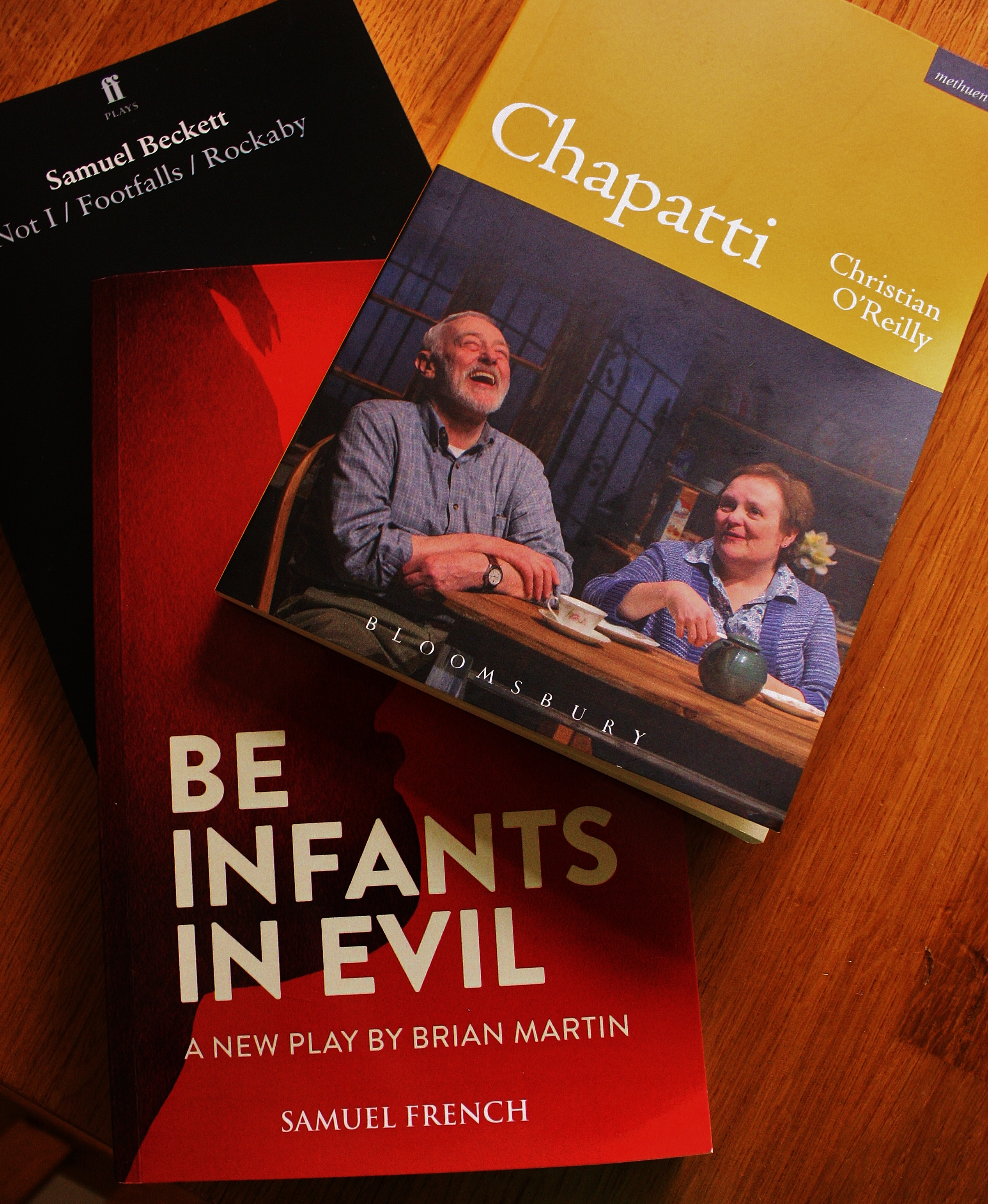
PlaysThis week, I attended three plays in Galway, three nights in a row. The marathon of shows was part of the Galway International Arts Festival. I do not attend plays regularly, and seeing three in a row was a unique experience for me. I barely had a moment to process the last show before sitting down for the next one, until today when I paused to contemplate them separately.  At the end of each performance, the venues sold copies of the scripts, and I decided they would make good souvenirs from a city embedded in art, music, and theater.

The first show, at An Taibhdearc, was a trio of three short plays by Irish playwright Samuel Beckett. The plays were Not I, Footfalls, and Rockaby. They were performed in total darkness; even the exit lights were turned off. The first is a monologue spoken so quick that much of it is lost. The only light is shown on the actress’s mouth, so that all the audience can see is a disembodied mouth babbling intensely. The second portrays a daughter pacing as her mother passes away. They speak to one another as the actress (providing the voice for both characters) walks slowly like a clock, from left to right. The last, and perhaps most disturbing, shows an elderly woman in a rocking chair. She is motionless; the chair is not. The chair rocks her face into and out of a pale beam of light as she reflects morosely on her last days and lonely life. Each play is darker than the last, more disturbing, unsettling, and saddening. Evidently, Samuel Beckett does with plays what Stephen King does with novels.

The second was a new play by Christian O’Reilly, entitled Chapatti, at Town Hall Theater. Costarring American actor John Mahoney, it was a cheerful romantic comedy about a dog-owner and a cat-owner. For all its cute jokes and warm humor, it touches on several serious issues: terminal illness, dissatisfaction in marriage, suicide, and the poor way men treat women. The author places two lonely, elderly characters close together and draws them closer, but each time the plot delves into the complexities of the characters’ pasts, the plot veers in another, more lighthearted direction.  There are many instances when the author brushes aside these disconcerting issues, but the humor is well-written, and thoroughly enjoyable, especially after three live nightmares courtesy of Samuel Beckett.

The third play was another new show, Be Infants in Evil by Brian Martin, performed at the Mick Lally Theater, or Druid Theater. This play remains my favorite of the three. The audience walks into a room filled with incense and a Catholic Priest kneels and prays on stage. The author focuses on what first seems like too many issues to balance in a one-act play. The priest hides numerous secrets, a young woman and long-time friend has converted to Islam to marry a wealthy man, an elderly blind woman is beginning to catch on to the priest’s secrets, and a thirteen-year-old boy from the priest’s past has just shown up. The play juggles science and religion, child abuse scandals, abortion, forgiveness, guilt, and revelation, and ties them together by slowly binding the characters into concentric rings of conflict and secrecy. There is humor where there shouldn’t be, and love for characters who should not be loved.

I have often thought that the two primary centers of culture in the U.S. are Hollywood and Broadway, and while I love films, I find myself daydreaming about attending a new play on Broadway, but I have never once dreamed of going to Hollywood. I regret that I do not go to plays more often, and that I do not participate in theater more. Flagstaff has what I believe to be a rich but precarious theatrical culture. When I return, I hope to participate in that culture. Theater is far more intimate than cinema. The silences are more unsettling, and the noise is more overwhelming. The audience becomes a part of the show, and there is always the possibility that the players will improvise, develop a set of inside jokes with the audience, and wait outside to meet the fans. These three plays were written, staged, and performed brilliantly. Each was different from the last, and it’s thrilling to see the house lights dim and see the first characters step on stage to deliver the opening lines. It’s a thrill I hope to feel more often.

-jk

A Brief Note About Galway

Corrib River

On the furthest western edge of Europe, on the western coast of Ireland, is a city called Galway. The River Corrib flows through the city into the Atlantic, and Galway is crisscrossed with bridges and waterways. Although it seems to be far-removed from most of European activity, an isolated region of an isolated country, Galway is exceptionally cosmopolitan, with roots as a trading network and a social junction during the seventeenth century. Galway merchants sailed to Italy with Irish wool, and returned with goods from the Mediterranean, including fine wines and art. Maritime commerce was, and still is, a central part of life here.

Galway

Today, it reminds me of my hometown, Flagstaff. The National University of Ireland, Galway, brings in new students and faculty, and with them ideas, to the city. There is a flourishing art scene here, which includes the Galway Film Fleadh, the Arts Festival, and a farmer’s market every Saturday. But more like Flagstaff, it is a point between destinations. Flagstaff is on Route 66 and in addition sees about a hundred trains pass through each day, it is a stopping point for many people; similarly, Galway is a coastal trading city where travelers, ideas, cuisine, and cultures converge. Both cities are driven by university life and academic patronage, whose dispensation is evident in artistic displays, festivals, and even graffiti. In fact, I have seen more graffiti in Galway than my own town. Graffiti

Medium-sized, quirky communities can be found anywhere, I think. They act like cities and small towns at the same time. They are twilight cities on the edge of the new and the old. For a writer, these are the best places, because they tend to be the strangest, in my experience. Places like Boulder, Missoula, Flagstaff, and even Galway on the edge of the Atlantic, are in my opinion the most authentic, appealing communities in the world.

-jk

To Whom It May Concern

Yesterday, while wandering the streets of Galway around the river, I found myself in front of a Catholic church built in the 1800s. I stepped inside, eager to explore a tradition with which I was unfamiliar. I had been in Catholic churches before, but only on guided tours with a camera in my hands and a ball cap on my head. This was different. This was an opportunity to find a new experience.

Church

I was alone inside the old church, and the silence was overwhelming in a city that otherwise was suffocated by the noise of traffic, crowds, and the river. I walked past a statue of St. Francis of Assisi, turned toward an organ, and made my way up the church to the front pew. There, I sat down in silence and looked around the bright room, engulfed in its old and magnificent imagery. The silence was almost alarming, as I had hardly a moment of solitude since my arrival in Ireland. I worried that somebody might come in and tell me I was in the wrong place, or ask me how I got past the Swiss Guard. After a while, though, I closed my eyes and listened to nothing, and managed to stop thinking for a few soft moments.

After a while, I opened my eyes, took out my notebook, and wrote a simple, one-page poem. I wrote it slowly, deliberately, one word at a time. I rarely take such care when writing. It was a brief poem entitled “To Whom It May Concern.” I tore it from my notebook, rose quietly from my seat, and placed it on the altar. After that, I left quickly, afraid that I would be caught.

I do not remember the contents of the poem. After I left it on the altar, it no longer belonged to me. It was a gift to the first person to find it. All I remember about it is that I felt satisfied when I finished it, that it was about light, that it ended with the line “Dona Nobis Pacem,” and I signed it “jk.” Perhaps they will think I was joking, or maybe it’ll be thrown away, or maybe it will be read aloud at Sunday Mass by a curious priest. For me, it was out of the ordinary, but I felt peaceful when I placed the paper on the sunlit altar. I’ll never know what happened to that little poem; all I know is that it set sail for uncharted territory just as I did two weeks ago.

-jk

Kiss Me, I’m Torn by Sectarian Violence

Church

Many people go to Ireland to drink, look at the lush green landscape, have another drink, and fantasize about ancient Celtic culture as they understand it from Renaissance festivals. Often, the turbulent nature of Irish history, as is the case with much of history, goes ignored. Ireland has suffered tremendous oppression and violence, as well as poverty and disease. This can be seen in the capital city’s cemeteries. Glasnevin Cemetery, in Dublin, holds 1.5 million bodies, and the population of Dublin is 1.2 million; there are more dead Irish in one cemetery alone than there are living in the entire city. For a brief time during the Famine in the nineteenth century, fifty percent of the population of Dublin died before reaching the age of eighteen, dying in the slums which were considered among the worst in Europe.

With these and other atrocities in mind, outraged and lamenting Irish citizens formed organizations to counter and ultimately oust British rule over the island, and as a result, hundreds died in a bloody insurrection in April and May of 1916. A civil war followed the negotiated partition of the country into two halves, and sectarian violence from both Catholic Republicans and Protestant loyalists continued well into the latter half of the twentieth century. Some Irish and Northern Irish citizens were targeted only for their religious conviction, and bombings became commonplace in Ireland, as is the case in Iraq, Afghanistan, and Syria today.
Issues surrounding commemoration involve a shared place but not a shared memory. Many Catholic citizens have an emotional stake in keeping the memory of British oppression alive, while many loyalists want Ireland to acknowledge that the IRA committed atrocities against innocent Protestants. A historian told me today that when the meaning is stripped away from history, all that remains is a list of the dead, the one universality that all remembrances share. Thousands of people died in Ireland fighting for what they believed was a just cause; the reasons for the conflict are still disputed today, and there is no concurrence regarding who should be blamed, resulting in a society where one figure can be a villain and a hero at the same time, in the same region, even in the same pub. Keeping intact a divided country is still a challenge, and historiography plays a major role.

The Irish façade of beer and merry musicians is a part of Irish history, as my cabby made clear to me when he discussed the many gigs he has played in Irish pubs. But he was also frank in explaining the problems of remembrance, the survival of the Irish language, and the Irish emigration during the Famine years. This is not a place that can possibly live up to the façade for which so many tourists come. This is a place where, as we approach the hundredth anniversary of a century of violence and conflict, the complexity of a shared atrocity across sectarian lines is unavoidable, no matter how many ridiculous T-shirts one buys.

-JK


A Nation of Writers

Irish Books

In a few days, I will depart across the Atlantic and spend a month in Ireland studying its history and literature. In many ways I’ll be a fish out of water. I willingly admit that I know very little about Ireland. The authors I have read have mostly been from the Americas, and the history I’ve studied has mainly been twentieth century conflict and the Cold War. Apart from a small ancestral connection, Ireland has not played a major role in my studies or my life. So naturally I decided to spend five weeks there, because among the few things I know about Ireland, I know it’s a nation of writers.

Four of Ireland’s writers (William Butler Yeats, George Bernard Shaw, Samuel Beckett, and Seamus Heaney) have been awarded the Nobel Prize in Literature. Countless other Irish writers have left the world with outstanding literary works. A handful of the Irish writers includes James Joyce, Elizabeth Bowen, Oscar Wilde, John B. Keane, Brian Friel, Sean O’Casey, Johnathan Swift, Edna O’Brien, Molly Keane, and numerous others. In contrast to the rich literary tradition, there are few major Irish painters, sculptors, and composers. There is a longstanding oral tradition, and in the past century a theatrical tradition has developed. The essential form of artistic expression in Ireland is the written word.

Ninety years ago, Ireland was engulfed in sectarian violence along religious and geopolitical lines, similar to what is seen today in parts of the Arab world and parts of Africa. A violent uprising and civil war began in 1916 accompanying the First World War, and the country split in two. Meanwhile, the Irish wrote poetry, novels, and plays amid the chaos. Their history is no different from the history I have studied. The Irish have suffered colonialism, violence, and poverty, and have expressed themselves through art and literature the way Russians, Afghans, Indians, Syrians, and Chileans have. I hope to immerse myself in the literature in its original context, to know the ins and outs of literature as thoroughly and intimately as I can.

-JK

London, 1945

Some flash fiction set in London, late November, 1945.

Umbrella 2Because his favorite pub was closed for repairs, Simon hobbled into a new one, closing his umbrella and dripping puddles onto the hardwood floors. The room was mostly empty, but warm and dry. He set his hat and coat on a rack and leaned the umbrella against the wall, next to four other identical coats and hats, each one drier than the last. Four men sat at the bar drinking a pint and reading copies of the morning paper. None of them spoke or looked up, not even when the news correspondent on the radio described the mess of Poland and Germany and France. It was only when Simon hobbled toward the bar, leaning on his cane for support, that he realized he had forgotten a key element in his post-war life: a newspaper. When he sat down, he leaned the wooden cane next to him and ordered a pint from the barkeep, a gaunt woman with a fat scar on her left cheek.The four other men turned to look at him, each head tilting slowly to the right.

“Forgot my paper,” he mumbled.

One of the men looked back at his own paper, but the other three men, none of whom had completely dried off yet, glared at Simon for several seconds longer, then returned to their reading. The barkeep placed a dark beer in front of him, the foam sloshing over the top and down the side as she set it down.

Simon drank idly and listened to the static-ridden BBC radio from the corner. Radio was only so helpful in describing the ugliness of warfare, Simon thought, but he did not need any help remembering.

“Excuse me,” he asked as the barkeep passed. “Could you switch to something else? I think the London Symphony might be on this evening.”

“The radio?” she asked. Simon was caught off guard by her Russian accent. At the same time, the four men turned once again and glared at him. The one furthest on the left folded up his paper and left two grimy pound coins on top of it, got up, and walked out with his coat, hat, and umbrella.

“Why do you want me to change it?” she asked.

“I just. . . I’d rather listen to music.” Another man got up and left, leaving two more pounds atop his folded, wrinkled paper.

“You don’t want to hear the news?”

“No. I can only handle so much of it.”

When he said this, the last two men stood up and left in the same fashion as the others. The woman paused, then walked toward the radio at the other end of the bar, collecting the pounds two by two as she went. As she turned the dial, static flooded the pub, slowly giving way to more news, more static, and finally an old recording of the London Symphony Orchestra performing Edward Elgar’s cello concerto. It was somewhere in the second movement. Simon closed his eyes and finished the beer in three gulps.

“One more, please?”

“Very well, then.” As she poured him another pint, he squinted in the dark, gray light at the scar beneath her eye. “What?” she asked.

“You’re from Russia, are you?”

“Yes, I came from Russia. Why?”

“Just curious.” Simon took a sip. “Before or after? If you don’t mind, that is.”

She folded her arms.

“I was a soldier, just like you,” she said. “I was in the Red Army. I came here while it was ending.”

The music thrummed against the rain, which grew louder as it shifted direction and pummeled the windows and the door. Taking another sip, Simon paused, closed his eyes again, and listened to the orchestra interrupted by brief pauses of rusty static.

“You are very different,” the barkeep noted. Simon opened his eyes.

“I beg your pardon?”

“You won’t listen to anything about the war or read anything about the war, but you feel free talking about it. Why is that? If you don’t mind, that is.”

“Oh. I don’t know. I can’t help it, sometimes.” He gulped half the beer. “Do you ever talk about it? I imagine the Red Army is much more interesting than just an old British infantry division.”

“Before the war, do you know what I used to do? I was a musician. A clarinetist.”

“You were?”

“Yes. I played all over the country. Then they came and told me I had to fight to save the motherland. So I went and fought. I was in Leningrad for some time.”

“Well, I’m glad you got out of there. I could never play. I was a terrible musician. I still love to listen, though.” He drained the last of the beer and stood up. “Thank you for listening. It’s getting late, though. I need to be off.”

“I’m closing up soon, anyway.”

As he stood up, he dumped a pile of pound coins around the empty glass like presents beneath a tree. He reached for his cane; she collected the coins and picked up the glass. The concerto continued to rise and fall, to lean forward and pull back like dancers. She pulled off her dusty white apron as he slid into his nearly dried coat and hat. Looking around, he turned on the axis of his cane.

“My umbrella is gone. I. . . did one of them take it? I don’t suppose you have a spare?”

“I only have mine.”

“Oh. Thanks anyway.”

“Wait a moment.”

Putting on her own coat and hat, the barkeep stepped out and tossed her own black umbrella to him while she turned stools up onto the smooth wooden top of the bar. She switched the lights off and finally did the same to the radio. Together, they stepped outside; he opened the umbrella while she turned around and locked the door, before they walked up the street. She took the umbrella as Simon limped forward, frowning as she opened the umbrella and swung it above their heads.

“Did you ever play Tchaikovsky?” he asked.

“Oh, yes.” They walked slowly and Simon’s cane clicked against the hard cobblestone with every other step. “I haven’t thought of music since the bombing.”

“Tell me about Tchaikovsky. About music before the war. If you don’t mind, that is.”

Around them, rings of rain slid off the umbrella as they passed empty pubs and shops together.

-JK

Ten Minutes to Tell a Story

TheaterEvery year, Flagstaff Theatrikos hosts a 10-minute playwriting contest, and this year I intend to enter. I’ve submitted plays in past contests, but they all had one thing in common: there was too much in the plot to fit into ten minutes.

The rules are simple. There can be no more than three characters and the play should be no more than ten pages, and must not involve complicated scenery or props. Apart from the rules there are certain parameters that a ten-minute play should reside within. To move the plot, it is best to have a change in action every two to four minutes. It should be like a short story, with a beginning conflict, a middle crisis, and an ending resolution. Because other people volunteer to direct the plays, stage directions from the writer should be kept to a minimum.

On the surface, it’s just one more writing contest. At the same time, it’s different from short story contests because in this case, the audience watches the story unfold rather than imagines it unfolding. It’s an opportunity for a writer to pack a great deal of information into a thin wedge of time for a live audience. For me, writing plays has always been more difficult than prose. My plots have always been too ambitious, too embedded in history, and had characters too complex to develop in sixteen hundred words. A few years ago, one of my plays was about the Napoleonic Wars; another was about Irish independence from England.

Conversely, the few full-length plays I have written have always been too short, and involved plots and characters more suited for a sitcom. How can I pack conflict, crisis, and resolution into ten minutes and keep it important? Similarly, how can I make a simple story worth telling? The deadline is fast approaching; this will likely be my last opportunity to enter, and I’d like to be able to hone this particular skill, like packing five weeks worth of luggage into one carry-on bag. It’s a unique challenge, and the entire Watergate scandal simply won’t fit into a ten-minute play, no matter how hard I try.

Enough thoughtfulness and reflection. I have a play to write.

-JK