Tag Archives: History

“We are digging up the foundations of a very old world.” -Alan Sharp

Before Wounded Knee

wounded-knee-massacre

Photograph of civilians collecting the dead at Wounded Knee.

The Wounded Knee Massacre of December 29, 1890 is widely considered the end of military hostilities between the U.S. government and Native American Indian tribes. The Standing Rock protest today, however, is building up in similar ways to the Wounded Knee Massacre, and although there are key differences, it seems that the relationship between the U.S. government and American indigenous peoples has remained largely the same since 1890.

In 1888, a Paiute man named Wovoka began a religious movement centering around the Ghost Dance. Wovoka’s movement asserted that the Messiah would return as a Native American Indian and the continent would be freed from pioneering and settler oppression, and the Ghost Dance would usher in the Messiah’s return. The movement quickly swept across Native American communities, reaching the Dakotas by summer of 1890.

Followers of Wovoka such as Arnold Short Bull, brought the Ghost Dance to the Lakota Pine Ridge Indian Reservation during a drought and amid numerous treaty violations, which included reduced food rations for the reservation and white settlement on land designated for Lakota use. The Ghost Dance accompanied federally sanctioned violence, starvation, and a small environmental disaster. The U.S. government was suspicious of the Ghost Dance as early as May of 1890, and continued to treat it as a militaristic threat rather than a religious movement. On October 30, an agent for the Pine Ridge office of the Bureau of Indian Affairs wrote a letter to the BIA commissioner indicating that, in his view after observing the Ghost Dance,

“. . . the only remedy for this matter is the use of the military, and until this is done, you need not expect any progress from these people; on the other hand, you will be made to realize that they are tearing down more in a day than the government can build up in a month” (Royer 65).

Here, the BIA acted as an observation tool for the U.S. government, keeping track of Native American Indians forced onto reservations with little water and food. A religious spectacle became a mode of unity, an expression of organization, which the government deemed, without question, a threat. Earlier, BIA commissioner R. V. Belt wrote in a letter dated October 17, 1890, that the Pine Ridge Agency should inform those

“. . . engaged in encouraging the Ghost Dance and other like demoralizing conduct, and inciting and fomenting dissatisfaction and discontent among the peaceably disposed Indians that [the Secretary of the Interior John Noble] is greatly displeased with their conduct” (Belt 75).

Belt went on to describe the Ghost Dance as “bad advice and evil,” and that the Secretary of the Interior will “exert whatever influence he may have over any of the Indians to turn their backs upon the medicine men who are seeking to divert the Indians from the ways of civilization” (75-76). There was a connection of correspondence linking BIA agents at Pine Ridge to the White House expressing anxiety about the Ghost Dance. These agents wanted “peaceably disposed Indians” who did not express discontent.

But all evidence suggests that they had every reason to express discontent. They were surviving a genocide, forced onto difficult land after military engagements against them, after numerous other massacres and battles. It seems that BIA agents and the U.S. government associated Native American discontent with militaristic hostility, conflating the two, because to the U.S., the moment a tribe became vocal, the moment its members made themselves visible, they challenged the established systematic erasure of an indigenous population and the colonial narrative of European settlement on an otherwise unpeopled land rich with untapped resources.

The Ghost Dance as a religious practice did not emphasize military struggle or armed combat. On October 31, Short Bull gave a sermon to his followers, referring mostly to the coming of the Messiah and mentioning combat only once, when he said,

“You must not be afraid of anything. The guns are the only things we are afraid of, but they belong to our Father in Heaven. He will see they do no harm. Whatever white men tell you, do not listen to them. My relations, this is all” (Sitting Bull 65).

Anxieties over Native Americans not listening to those attempting to defeat, control, indoctrinate, and relocate them culminated in the military’s arrival in November at Pine Ridge, to keep the peace. Following Royer’s suggestions, the military became a remedy to stop the Ghost Dancers from breaking down what the U.S. government had built up. Cavalry divisions arrived at Pine Ridge, forcing surrender and disarmament. On December 29, in the process of disarming a few Ghost Dancers, a rifle went off, and soldiers panicked after being informed that an armed insurrection would take place. Fueled by fear and rumors, soldiers fired at the Ghost Dancers, and a massacre ensued. There were casualties on all sides as some Ghost Dancers attempted to defend themselves. Estimates vary, but up to 300 Lakota were killed, most of them unarmed, many of them children.

The logic leading up to the massacre might be difficult to track, but was built on a number of assumptions. First, that Native Americans practicing a large, organized demonstration was the equivalent of cultural and military dissent, or in other words, a problem. Second, that the only way to “solve” the problem was through the use of military force. Third, that expressing dissatisfaction with an understandably bad situation was unacceptable.

One of the defining features of the 21st century is the blurring of police and military forces. In a post-9/11 surveillance state in which citizens and combatants are considered difficult to distinguish from one another, the police and military begin to serve similar functions. While this fact has become more obvious in recent years, and while there have been many instances in the U.S. in which the state treated its citizens as combatants, this has always been the case for Native Americans. Since the founding of the United States, Native Americans have always been designated a threat to westward expansion simply by their presence, their visibility, their voice. Historically, soldiers keeping peace and soldiers engaged in combat have served the same purpose for the U.S. when engaging its indigenous population.

I’m not a proponent of the notion that history repeats itself; I find it too simple. However, the events surrounding the Standing Rock protest are eerily similar to those that led up to the Wounded Knee Massacre: Native American Indians express discontent over treaty violations, land abuse, and environmental disasters, and as a reaction, a militarized police force steps in. Tensions have already resulted in violence against protestors and the arrest of journalists for covering the events. Contexts may be different, but the logical framework the U.S. uses to understand and address the protest remains almost identical to how the U.S. addressed and understood the Ghost Dance. Whether or not there will be another massacre remains to be seen.

Coleman, William S. E. Voices of Wounded Knee. University of Nebraska Press (2000).

Wounded Knee Massacre,” Encyclopedia of the Great Plains, 2011. Accessed October 30, 2016.

Reading Terry Tempest Williams in Zion

Zion 2This week, I had the pleasure of joining one of my best friends for a trip through parts of southern Utah, starting in Moab and ending in Zion National Park. We went for the usual reasons (viewing nature, camping, hiking, burning a dictionary and cooking quesadillas over it). After hiking the Wildcat Canyon Trail (a good ten miles of limb-crunching views), we went to our campsite and read our selected book in the fading light, both collections of short pieces on the Southwest and West, Getting Over the Color Green and Northern Lights.

In Northern Lights, I stumbled upon an essay by Terry Tempest Williams, “The Clan of One-Breasted Women.” Williams grew up in Utah in the 1950s when fallout from nuclear testing in Nevada drifted beyond the test sites. As a result, many people downwind of the tests, including her family, suffered from radiation. Williams meditates in her essay on the many women (many in her family) downwind of the test sites who developed breast cancer from the radioactive fallout.


At the peak of the hike in Zion, I could see far, far out into the distance. I was surrounded by a place brimming with life; the whole area is a complexity of ecosystems overlapping, intertwined: red and tan oceans spotted green or lush with ponderosa and aspen or colored with sand and pale sunlight. Much of the Southwest doesn’t look alive to the untrained eye. Deserts play tricks on us by hiding their life, but life is always there. Overlooking Zion, I was overwhelmed and haunted by its history.

Zion

In the 1860s, Mormon pioneers founded a town near Zion, Springdale, and named the nearby canyon Zion. To Mormons, Zion refers to a gathering place for the faithful, and naming the canyon was an act of claiming the land for Mormon culture. But while pioneers were in the process of colonizing the area, the region was home to Southern Paiute communities pushed out by U.S. settlement. Like much of the Southwest, Zion is part of overlapping histories and state-sanctioned narrative revision.

The place was shaped by geologic hands, the fingers of rivers, a mind of clouds and rain, then engulfed with diverse flora and fauna, indigenous communities, overrun by Spanish colonization, Mexican statehood, Mormon expedition, and U.S. authority that ignored all previous layers by deeming the Southwest an absolute desert, a place so deserted they could safely test nuclear weapons there without harming anyone or anything worth mentioning. But Williams contests, as many do, that all of it is worth mentioning, worth respecting and preserving and revering.

After reading Williams’s essay, I stargazed with my friend in the desert where the stars are aggressively visible. The Southwest is misleading to those unfamiliar with it. The stars are brighter here, the air is heavier with scent, the land is rougher, and the going can be tough. Zion, a place of peace, a place of eternity, may be an apt name. The whole Southwest may be a kind of Zion, a refuge for wanderers and romantics. Its beauty is rare and atypical, taking on strange shapes and colors, rich sounds and haunting narratives. Its beauty is misfit and misleading, but in its presence it’s impossible to miss.

-jk

Writers and the Easter Rising

IMG_5610

Arbour Hill, Dublin, where Patrick Pearse and other leaders of the Easter Rising are buried.

One hundred years ago today in Dublin, an Irish writer named Patrick Pearse stood on the steps of the General Post Office and read aloud the Proclamation of the Irish Republic on behalf of the Irish Republican Brotherhood, while revolutionary groups like the IRB and the women’s nationalist organization Cumann na mBan occupied Dublin and other locations in Ireland. Many of the revolutionaries were intellectuals, socialists, writers, stemming from different backgrounds; Patrick Pearse was a playwright and poet. Their goals included workers’ rights and women’s rights, alongside concerns that Britain would implement a military draft in Ireland to supplement its effort in the First World War. In the following week, known as the Easter Rising, the British responded as they often have when a colony declares independence: with excessive military force, which devastated Dublin and the rising’s core membership.

In the wake of the Rising, the British rounded up, arrested, and executed many of the rebellion’s leaders. Within a few weeks, the British executed much of Ireland’s intellectual community. Remaining leaders, such as Eamon de Valera, would go on to lead a more conservative Ireland, almost erasing the role of women and workers in the Irish Revolution from Ireland’s historical memory.

Patrick Pearse was executed on May 3. He joined what he believed was a just cause, and saw his responsibility not in writing, but in direct action, alongside other Irish writers, including the poet Joseph Plunkett.

IMG_5981

Thoor Ballylee

The poet William Butler Yeats felt differently. He sympathized with the IRB, but distanced himself from it before the Easter Rising. Some time after the Rising, he purchased a castle called Thoor Ballylee in rural western Ireland, where he placed himself both literally and figuratively above what would become the Irish War for Independence, Partition, and Civil War.

James Joyce had already relocated to the Continent, leaving Ireland behind physically but not artistically. Sean O’Casey, an Irish playwright, did not participate in the Easter Rising but would continue to write plays through the revolutionary period. While not all who participated in the Rising were executed, Britain’s heavy-handed response resulted in the deaths of numerous Irish writers, leaders, and thinkers. Meanwhile, writers who refused to participate allowed themselves more years to write, and therefore critique and contribute.

What is the role of writers in social change? In social upheaval? The Easter Rising may be an extreme example, but so was the American Revolution. What is a writer’s responsibility to a cause? It requires humility to surrender oneself to an active political movement, and a vast ego to situate oneself above the fray. But direct involvement is risky, and with the loss of intelligentsia comes the kind of one-sided leadership de Valera seemed to emphasize in the 1940s and 1950s when he found himself in charge of Ireland. Many American thinkers today threaten to leave the country if this or that candidate is elected president, but doing so abandons those Americans who cannot afford to leave to potentially brutal leadership that is suddenly without domestic criticism.

I try to be an activist, but I’m the first to admit I’m not very good at it, and that’s mostly because I can easily stop. If I wanted to, I could afford to escape into a pleasant countryside and write from afar; or I could join an activist group on the streets. I wish I knew which I would choose. All I know is that I admire Patrick Pearse’s bravery and humility in putting writing on hold for what he saw as a more admirable calling.

-jk

Navigating the Language of Genocide

ubiquity

Recently, some activists called for the U.S. to formally charge the self-proclaimed Islamic State with acts of genocide. I can use the word informally on a blog post, but Secretary of State Kerry’s hesitation to use the word formally proves the power of language. If he makes a formal accusation of genocide, the word brings certain political ramifications, and expectations that may not be fulfilled.

U.S. officials have avoided using the word in the past, in order to avoid necessitating political and military action. During the Clinton Administration, U.S. officials were explicitly told to refrain from using the word genocide to describe the situation in Rwanda, which is now recognized as very obviously a genocide. Reluctance alone to use the word allowed the U.S. to justify not intervening.

This is where language falls short: refusing to call something murder does not change the fact that it is murder. Regardless of whether or not Secretary Kerry calls the destruction of Yazidi, Shi’i, Sunni, and Christian life genocide, that destruction counts as genocide.

However, there is a deeper, more complex narrative. To begin with, most of the groups pushing for a formal accusation are Christian organizations, and focusing on the Christian victims alone risks ignoring the multitude of other victims of the self-proclaimed Islamic State. Kerry would also need to contend with the fact that the U.S. has supported other genocidal regimes in the region complicit in aiding the Islamic State. Saudi Arabia, for instance, is religiously and politically invested in the destruction of Shi’i Muslims and Sufi shrines. Turkey, another U.S. ally, is involved in crimes against its Kurdish population, another group the Islamic State has targeted.

There is also Palestine. While the contexts and implementation for the Israel and the Islamic’s State’s actions against innocent civilian populations differ in a few crucial ways, they are overwhelmingly similar. Palestinians, in many cases children, are held captive without just cause; the Israeli military regularly encroaches upon Palestinian land, removes the indigenous population by force, and occupies it by destroying local property and replacing it with Israeli property. If the U.S. accuses the Islamic State of genocide, which it should, the U.S. would be remiss if it did not make the same accusation against the Netanyahu Administration, which it should.

The issue of language is complex; the word genocide holds so much meaning, but we often ignore the meaning of its absence, and in its absence genocides continue to occur. History has proven this, and it proves it now. There is no way to measure suffering, and I do not intend to give that impression. All victims of genocide deserve justice, Jews, Palestinians, homosexuals, Kurds, Bosnians alike. Ranking the suffering of others is the heart of the problem: it allows those who can stop the slaughter to pick and choose who deserves to be salvaged, and if he is a responsible leader, Secretary Kerry will acknowledge all acts of genocide in the region rather than a select few.

-jk

To Vote From Afar

ForeverA while ago, I mailed forms to my home state of Arizona requesting an absentee ballet for the upcoming primary and Presidential elections. I sent a little letter into a sea of mail, and now I wait earnestly for my approved absentee ballet.

It’s Arizona, though, so there’s a statistical likelihood that my vote won’t make a difference. Each election I’ve voted in, my vote failed to put into office my preferred candidate (a ham sandwich named Marty who wears a hop hat and monocle running as a Neo-Whig Anarchist, obviously). Because the Whigs (and every other party I would realistically vote for) don’t stand much of a chance in Arizona (unless more people voted), I will once again have the honor of not making a difference in 2016.

It’s possible, however unlikely, that voting will make a political difference, but that’s not necessarily why I vote. I vote to be part of a community, to participate in an almost religious experience, to be part of something bigger than I am, a kind of highly-organized mob mentality centering around mostly rich, unconcerned smiling people in suits I couldn’t afford with my life’s savings. It’s enchanting to be part of a communion that has the potential to involve so many. I’m sad how often we collectively waste that potential.

In the 1952 election in India, 105,944,495 people voted. It was the first election after Independence, the first with universal suffrage, and although it constituted only 45% of the electorate, it was a colossal success considering that India’s literacy rate was only 18% in 1951, and is even more impressive given the vast number of languages spoken by India’s electorate: as of 2001, only 22 of India’s 844 languages and dialects were officially used for constitutional purposes. India’s first election involved all levels of society in a nation stratified by centuries of colonialism and damaged by Partition with East and West Pakistan, and nevertheless one hundred million people turned out to vote. Despite the militaristic turmoil around Partition, people turned out to explore an (admittedly western-designed and implemented) experiment in voting.

The upcoming U.S. Presidential election is quite different from India’s 1952 election, but I want to be a part of the masses. In a strange way, becoming a statistic feels transcendental to me, like I’ve moved into a part of history that exists outside all indicators of the self, outside personality, documentation, religion, class, race, and into a cloud of participatory revelry, into a quantifiable oneness. I wish I could vote in person, but from my temporary home in Nebraska, I will still move beyond myself. And maybe, just maybe, Marty the ham sandwich will finally usher in four years of Neo-Whig Anarchism.

-jk

Cited: Wendy Singer. Independent India. Edinburgh: Pearson Education, 2012. Print.

.

After Gallipoli

ANZAC Soldiers on the Gallipoli Peninsula

ANZAC Soldiers on the Gallipoli Peninsula

Today marks an important moment in the First World War: the final evacuation of British and ANZAC (Australian and New Zealand Army Corpse) troops from the Gallipoli Peninsula, ending a disastrous months-long Allied campaign to gain control of a narrow a sea route to Russia, the Dardanelles, and to push troops through Anatolia (Turkey) to the Ottoman capitol Constantinople and knock the Ottoman Empire out of the war.

Allied Strategy for the Gallipoli Campaign. Keagan, John, The First World War.

Allied Strategy for the Gallipoli Campaign. Keegan, John, The First World War.

First Lord of the Admirality Winston Churchill schemed the invasion. Allied ships would sail through the Dardanelles accompanied by minesweepers and land thousands of troops onto the Gallipoli Peninsula, where they would secure the area and push on to Constantinople. The initial landing was on April 25, 1915, involving many soldiers from Australia, New Zealand, and Ireland.

The Allies were unprepared for the harsh environment on Gallipoli and the ferocity of Ottoman Turkish soldiers, led by the now famous commander Mustafa Kemal, who directed his troops in successfully defending the Peninsula. The Allied troops became entrenched on Gallipoli for a grueling eight months. Kemal proved his military prowess; Churchill’s plan, on the other hand, proved to be a quagmire. On this day one hundred years ago, the Gallipoli Campaign came to a close. The Ottomans had defeated the British Empire for the time being.

That victory was arguably the last great moment in Ottoman history, and the first in a long time. Earlier in 1915, Ottoman troops committed acts of genocide against Armenian civilians. The Ottoman Empire had been in decline for decades amid encroaching Russian and European empires, and would later suffer British and French diplomats carving it into colonial mandates after the end of World War One. Winston Churchill was involved in that process; he even said that he created the country of Jordan “with the stroke of a pen one Sunday afternoon.” When the War finally ended in 1918, the British and French saw the defeated Ottoman Empire as property to divide among them: Britain took Palestine, Jordan, and Iraq, while France seized Lebanon and Syria, divided artificially. Those artificial borders continue to create problems today in these countries, pitting groups together or dividing cultures along superficial lines.

The Ottoman Empire had practiced its own form of imperialism, and ruled over its Arab territories from its imperial center in Anatolia, just as the British Empire ruled India and South Africa from England. Just as the British and French are guilty of reprehensible war crimes to maintain imperial power, the Ottomans were guilty of the same, such as the Armenian Genocide. Despite the emphasis on self-determination that dominated discussions at the Treaty of Versailles, Arab, Kurdish, Armenian, and other groups were simply shifted from Ottoman rule to British and French rule with as much regard as plunder shifted between pirates.

The Allies also wanted to divide Anatolia, but the Young Turks, led by Mustafa Kemal, fought a war for Independence from 1919 to 1922, and formed a stable, secular, but complex democracy. The Greek minority in Anatolia fought its own smaller rebellion, leading to the eventual forced migration of thousands of Greeks from Anatolia and Turks from Greece in 1923. Kemal had nevertheless defended his homeland from the British, and would not allow the Allies to make property of it.

New nations were formed from the defeated Ottoman Empire, but Turkey may have been the only one to form itself on at least some of its citizens’ own terms. The rest were carved artificially by Churchill and his ilk, Similarly, many Irish soldiers returned to a British-controlled Ireland torn by rebellion in the 1916 Easter Uprising. April 25 is commemorated as Anzac Day in New Zealand and Australia. The Battle of Gallipoli brought British loyal subjects to the edge of the Ottoman imperial center; it was a devastating failure for the otherwise almost obnoxiously successful British, who continued to claim colony after colony across the globe. For the crumbling Ottoman Empire, it was one final act of defiance against the empires surrounding it. Two of the most complex figures of the twentieth century emerged from the battle with profoundly different scars: Mustafa Kemal won, and Winston Churchill lost. Both men went on to be war heroes and war criminal simultaneously, and their role in history will likely always be contentious. At least, both played crucial roles in the destruction and recreation of nations.

By January 9, 1916, about 265,000 Allied soldiers and 300,000 Ottoman soldiers died on Gallipoli. Many of the them were probably unconcerned with the survival or strengthening of empires. They were concerned, most likely, with fighting for something they were told, and genuinely believed, was bigger than them: nationhood. Many Irish joined the war thinking the British would reward them with independence. Australians and New Zealanders had an emerging sense of national identity separate from but loyal to the British. The Turks fought on their homeland against invading Europeans. Thousands died trying to make a nation of their world. Indeed, nations formed, but maybe those who fought created their own kind of temporarily autonomous nationhood of spaceless unity. Amid the destruction of empires, it may be tricky to honor that unity on both sides of Gallipoli equally, but we should strive to anyway. Nationhood is what we make of it, and despite what Churchill seems to have believed, sovereignty means more than a pen stroke.

-jk

John Keegan. The First world War. New York: Vintage Books, 2000.

Midnight Train to Colorado

LocomotiveYesterday afternoon, I crawled off the California Zephyr after spending sixteen hours next to a window watching snowy mountains go by as I sat alone with a good book (Chang-Rae Lee’s Native Speaker), some new music on my iPod (Bombay Bicycle Club), and laptop to write short stories (Sci-Fi and Cli-Fi, with very little Wi-Fi). I was completely alone, standing up only to stretch and get coffee from the service car. It was spectacular.

A century ago, trains propelled people into expanses of uncertainty. They helped us contract time and space, a theme I regularly wrestle with. Trains pushed Europe into Asia, and solidified New England. They stapled towns together across the American Midwest like a string of Christmas lights, one after another after another, bringing them to the foot of the Rockies and knitting cross-communal quilts in the process. The railroad changed history entirely.

Today, trains are far from the fastest form of transportation. I could have gone home by plane in a fifth of the time it took by train. But for a historian and writer, trains are the perfect form of travel. Being able to slow down, lean back, and reflect on the past semester was just what I needed.

Midnight Train to Colorado

It’s difficult for me not to be reflective this time of year. Winter break imposes introspection. In one year, I’ve changed more than I thought possible. I almost wrote a novel but completed a poetry manuscript, and saw the publication of two poems, an essay, a story, and a ten-minute play. In the past year, I found more of my voice than I had in ten years prior. I also moved to a new home and school, leaving behind everything familiar. I raced through the last semester too fast to enjoy it, propelled by a locomotive of too much ambition.

These days, trains are a way of retracting time and space, and after running through the semester at full speed, slowing down to watch the nightscapes and frosted mountains go by was a healthy step back, a way to manage the introspection overwhelming me after a year of so many wonderful, terrifying changes.

-jk

After Two Years of Blogging, Your Guess is Still as Good as Mine

toastWordPress reminded me that today is my two-year blogiversary. I missed last year’s for the obvious reasons (grad school applications, Macbeth, mud wrestling, etc.). Today, though, I slide two years into the past when I was surrounded by the mess of my education: Beloved, essays on the Holocaust, a textbook on linguistics, The Outlaw Bible of American Poetry, and drafts of my own poetry. The liberal arts defined my life, but lacked definition; in a confused fervor I wrote my first blog post asking simply, why get a liberal education in the first place?

Two years have gone by. I created this blog to explore the liberal arts generally, the life of a wannabe writer specifically. At varying times, it has served as an open journal, editorial, bully pulpit, and archive of my writing. I started out posting short vignettes satirizing myself as a freshman, but moved on to better creative writing, philosophy, travelogues, history, and humor. If my blog feels eclectic, it’s only because my brain is eclectic. I move rapidly from Steinbeck to colonial Egypt to writing a short story. This blog is one part journal, one part art, and one part scholarship, with three extra parts marked “miscellaneous.” I strive to make sure no two posts are alike, which may be a bad idea when blogging is supposed to be about consistency and ritual, two qualities I lack.

I’ve explored numerous moments in my life on this blog: I mourned Pete Seeger, challenged myself to write a poem every day each April, founded a photography business, announced publications, had breakfast in Ireland, lunch in Jerome, dinner in Wisconsin, went to my first big fancy writing conference, broke up with my hometown of twenty years for graduate school in Nebraska.

For the most part, though, I’ve read, and written about what I read, and read what others wrote about what I wrote about what I read. An endless reading list is the bedrock of any good liberal education.

Liberal Education

On this blog, I’ve also reached many half-baked conclusions, but one thing has remained clear post after post: a good liberal education is worthless if it stays inside the classroom. Sitting around reading and writing is no way to be a writer, if it’s all I do. I have to experiment with baking or acting, work for a charity, travel, read for a literary journal. I should traverse the gridlock of cities, the innards of bars, the vast organs of campsites. My blog may be ineffectively unconventional; the only binding theme is the continual mess of my lifelong education and my desire to be a writer. But I know blogging has made me a better writer, a more considerate reader, a more confident thinker. It’s been an eclectic two years. I hope the next two will be even more eclectic.

jk

Why a liberal education? Your guess is as good as mine, and I mean that. If you’re engaged in the liberal arts, especially outside of academia, let me know in the comments what you study or write or create, and why.

-jk

Europe’s Refugee Crisis of 1492

Expulsion of Spanish Jews Universal History Archive

The Alhambra Decree. Credit: Universal History Archive/Getty Images

1492 marks an important moment in world history, not just because it’s the year Columbus landed in the Caribbean, along with smallpox, mercantilism, and other European diseases. It is also an important year in Spanish, Ottoman, and Jewish history. As European powers were slowly consolidating into modern nation-states, King Ferdinand and Queen Isabella of Spain passed a decree, the Alhambra Decree of 1492, that required all Jews to be expelled from Spain, or else convert to Christianity. This pattern of expulsion began with the centuries-long Reconquista, ending with the 1491 fall of the Emirate of Granada. The Spanish monarchs wanted not just a larger nation-state, but a religiously pure one. Thus, they expelled any Jew who refused to convert. Many crossed the border into Portugal; a few years later, the Portuguese crown declared the same policy, but directed its efforts at forced conversion rather than expulsion. The Spanish Inquisition played a crucial role in these events, as well.

Thousands of Jewish and Muslim refugees were left without a home as a result. The next month, after hearing about the expulsion, the Ottoman Sultan Bayezid II, issued decrees of his own allowing any and all Jewish refugees to resettle in Ottoman territories. He sent the massive Ottoman navy to Spain, under the famous admiral Kemal Reis, to help Jews, as well as Muslims, flee religious persecution in the Iberian Peninsula, known as Al-Andalus to the Ottomans. The refugees settled throughout the Ottoman Empire, often in large urban centers such as Cairo, Jerusalem, and Damascus. Today, Sephardic Jewish communities still hold a presence in Turkey.

The Ottoman Empire was at its height in the fifteenth and sixteenth centuries. It enjoyed economic influence over its surrounding polities, had a strong military, and was known for its extreme religious tolerance. A diverse empire to begin with, encompassing Turks, Arabs, Greeks, Kurds, and Armenians, the Sultanate practiced tolerance for all religious traditions inside the empire, including Sunni and Shi’i Islam, Eastern Orthodox Christianity, long-standing Judaism, and at its edge Catholic and later Protestant Christianity. In many ways, the Ottoman Sultan was the leader of the free world at the time.

I’ve never believed history repeats itself. I don’t want history to repeat itself. It’s often hideous and unfair. But maybe the western world should take a lesson from the Ottoman Empire and open its borders to Syrian and Iraqi refugees fleeing many of the same places Europe’s refugees resettled in the 1490s. Maybe this is one of the few moments in history that should be repeated. European nations cannot reverse the policies of Assad and ISIS, just as the Ottoman Sultan could not reverse the equally barbarous policies of King Ferdinand (yes, ISIS and the Spanish Monarchy are equally evil). But Europe and the U.S., as much as the Ottomans, can commit to an act of compassion in the face of unmitigated brutality. After all, it’s clearly been done before.

-jk

Jewish History Sourcebook: The Expulsion from Spain, 1492 CE

Lapidus, Ira. A History of Islamic Societies. New York: Cambridge University Press, 2002.

Srebrenica and Why I Still Study Genocide

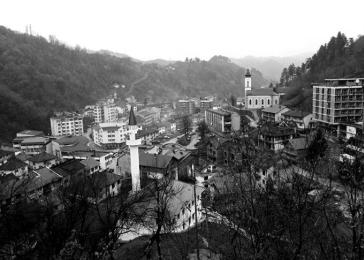
Photo of Srebrenica City, 2002, from the United States Holocaust Memorial Museum.

Photo of Srebrenica City, 2002, borrowed from the United States Holocaust Memorial Museum.

I should begin with a brief clarification about why I post so often about war and genocide. It affects me deeply, and I often have trouble bringing myself to read about it any more. As a result of the professors I’ve worked with, I find myself compelled to study and write about violent conflict in history. I do not find any satisfaction in studying it, and I feel the need to mention this because I know from experience that some people do find satisfaction in reading about genocides, especially the Holocaust; too often, I’ve heard people refer to it as ‘fascinating’ or ‘intriguing.’ I suppose I cannot dispute the value of somebody’s motivation, but I do not believe one should explore the industrialized slaughter of civilians because it arouses fascination. It should disgust, it should repulse, but I do not think it should invite intrigue. My motive for studying it is not rooted in a sick fixation with the gruesome details, which often keep me up at night; I do not believe enjoyment should be my sole motive, however. I feel compelled to study it in part because I have no power to change it.

I admit that the more I delve into historical traumas, the more guilt I feel, and I don’t think there is necessarily a problem with that. A guiltless being is a soulless one, and a belief that one is free of guilt, that guilt will never inflict legal or psychological damage, might be a common trait of the perpetrators. I think there is merit in a little collective guilt. History’s ghosts haunt us, all of us, if we stop and listen. The thing about history is that it persists, it continues into the present, and the battles are still going on.

I can distance myself from the details enough to write about them, just enough to maybe offer a brief commentary. The exception, however, is the Srebrenica Genocide. Today marks twenty years after the start of the massacre, and I have wanted to write about it. Anniversaries can be convenient opportunities to engage moments in the past, though they are also quite arbitrary: historical traumas are not relevant every ten years, but continually.

Though I have tried to write about the Srebrenica Genocide, I find it almost impossible. What happened in Srebrenica affects me more than other genocides. When I read about the details, I feel chest pressure and panic, and have to turn away from the research.

The region of Bosnia-Herzegovina, where Srebrenica is located, was solidified in the former Yugoslavia during the Cold War under the dictatorship of Josip Broz Tito, who took power after World War Two. Prior to that, the region had a brief period of independence after being ruled by the Austro-Hungarian Empire, and before that the Ottoman Empire. By the twentieth century, Bosnia was religiously and ethnically diverse, and the two are often conflated: With Catholic Croats, Orthodox Serbs, and Muslim Bosniaks, the region had few moments of independence despite strong nationalist movements, such as Young Bosnia. Gavrilo Princip, one of Young Bosnia’s members, assassinated the Austrian Archduke Ferdinand and his wife in Sarajevo in 1914, sparking the First World War.

While Yugoslavia collapsed in the early 1990s alongside the Soviet Union, Bosnia declared its independence. Serbian nationalists attempting to solidify the region again under the new Republic of Srpska, rejected the declaration of independence, invaded the region, and began a campaign to cleanse it of its Muslim population. This event is similar to how the Irish War for Independence and Civil War broke out, devolving into sectarian violence between Catholic Republicans and Unionist Protestants after the Republicans declared a kind of independence; this event is also similar to what is currently going on in Iraq, where a right-wing Sunni organization has the apparently unquestioning loyalty of many of Iraq’s Sunnis who felt oppressed by a Shi’i-led, and US-backed, government. Ireland did not witness a genocide against the island’s Protestants, though sectarian violence continued well into the 1980s and beyond. In contrast, Iraq and Syria may be witnessing a genocide now, despite the almost universal condemnation of ISIS and its tactics.

That is precisely the situation Bosnia was in, starting in 1992. The United Nations, appalled at the Serb nationalists’ tactics, intervened in the war (at least in theory) and declared the town of Srebrenica one of several safe zones. UN peace-keeping soldiers were placed on the ground, world powers condemned the violence, but nobody wanted to intervene directly. Instead, the United Nations designed a system that effectively blocked any nation from direct confrontation with combatants.

This is where I find it difficult to go on reading, sometimes. In 1995, Serbian nationalists, under the presence and observation of the UN, took Muslim men and boys from Srebrenica at gunpoint, ushered them into the surrounding woods, and slaughtered them. They buried them in mas graves, often with the intention of preventing the bodies from ever being found, proof that they were aware that the world would look upon them as criminals, proof that they wanted to hide the evidence of their crimes. But there is something wholly corrupt about a system that prevents peace-keeping soldiers from intervening in the slaughter of 8,000 men and boys.

Some UN soldiers express guilt, shame, and even sought treatment for PTSD afterwards. I should also note that this is not the only crime against humanity committed during the Bosnian War. The perpetrators also implemented a campaign of systematic rape against women and girls, a crime that victims report ISIS has committed in recent months (trigger warning if you open the link). But I have not been able to bring myself to read about these crimes beyond broad overviews. I simply can’t, unless I choose to tolerate the inevitable anxiety I feel from researching it.

Historical trauma does not continue only in a communal sense. Russia recently rejected a UN resolution to classify the Srebrenica Genocide as genocide, and right-wing Serbian organizations threatened to disrupt commemoration events. Many Serbs deny that Muslim casualties were as high as reported, and several mass graves remain yet to be uncovered and documented. The trauma persists daily; many perpetrators still walk among the victims’ families, and collective denial of the genocide, which is strong in many circles, is an active assault on the Muslim community in Bosnia.

Maybe, in some ways, I feel like one of those UN soldiers, unable to intervene but forced to watch. I feel helpless when I read about these and other crimes, and guilt can be overwhelming. It should not be debilitating, though I often let it become too much to handle. There is more that I can be doing.  There is more that I should be doing. But I will continue to engage these traumas as best I can, even if I leave historical research behind academically. It will haunt me no matter what I do, and I can invite the ghosts in or close the door on them. I’d rather leave the door open, because I believe that history’s ghosts have something to say, and it’s our responsibility to listen. Will these blog posts make a difference? Probably not. But I’d rather not be silent when the past is so loud.