Category Archives: Writing

“Don’t be a writer. Be writing.” -William Faulkner

Play Wins Contest, Writer Absent

stage fright

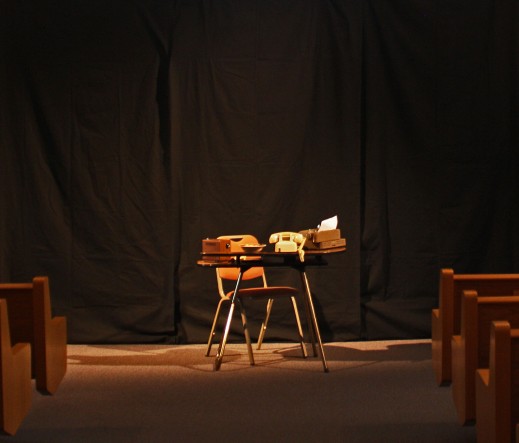
I’m pleased to announce that my ten-minute play “The Real Deal” is one of seven winning plays in this year’s Northern Arizona Playwriting Showcase. The seven short plays will be given a staged reading on August 28, 29, and 30. I’ve submitted to the contest before, under the guidance of various NAU Creative Writing faculty. Last year, I volunteered to be a reader for NAPS 2014, and was typecast to read for “Morons,” by William Baer. This year I’m honored the judges selected one of my plays, and I hope my Flagstaff friends will be able to attend. However, I will be absent, as I will be starting graduate school in Lincoln, Nebraska. It’s a two-day drive back to Flagstaff, and plane tickets are expensive.

The few times I’ve dabbled in theater have been rewarding, as well as painful. I’ve written, directed, and acted for fundraiser plays, and my experiences taught me that volunteer theater is a collectively-driven form of indentured servitude. The drama you see on stage is nothing like the drama behind the curtain. As a moron for NAPS 2014, I discovered the difficulty in holding a script while using props on stage. As with all volunteer activities, there is the challenge of people committing but dropping out at crucial moments.

Although I’ll be several states away from the stage, I’m still proud of my little play. Perhaps I’ll find similar contests in Lincoln; perhaps I’ll even see a full-length play of mine performed. Of course, that will never happen unless I keep writing.

Time to break a leg.

-jk

Out of the Frying Pan, Into Graduate School

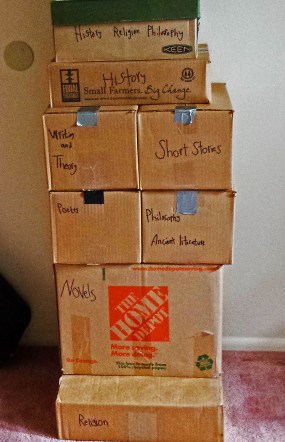
book boxes A few months ago, I attended the AWP Conference where eager representatives from MA and MFA programs stuffed fliers into my hands. They all offered the same possibility: a few years in paradise with nothing to do but write, read, workshop, and inevitably publish. I was drawn into the illusion that ignored the work, the expenses, the debt, and the difficulty in getting anything published.

While preparing for life after NAU, I knew that graduate school was not the only way to become a writer. I could serve overpriced coffee to people in suits, slipping them poems on their receipts to show them my talent, or I could work as a governess for a rich man with gigantic muttonchops who helps me publish my sad story. Or I could take the realistic approach and work, write, and submit short pieces to journals, like most writers I know, gradually building up a longer and longer list of published works.

After I returned from the conference, I received an email from the University of Nebraska-Lincoln. I had applied to eight schools last fall, and all rejected me but UNL; late in April they informed me they would offer me full funding and a stipend through a research assistantship. It was a lucky break, and I took the offer, not because I believed it was the only path I could take, but because I believed it was the best path for me at the moment. It’s the opportunity to get a Master’s Degree in English without any debt, which is just short of a fantasy these days. I don’t believe I deserve such an opportunity over other applicants, but because I have the opportunity now, it’s my responsibility to make the best of it that I can.

I’m not going just to improve my writing, though of course my emphasis will be in creative writing, and of course I intend to come out of it a better writer. But I also hope to become a more scholarly reader, a better student, a more disciplined person.  I was born into academia, and I can handle it a few more years without losing my mind. I am immensely grateful for the opportunity. So I’ll buckle down, pack up my four thousand books and my no. 2 pencils, and plunge into the fire.

-jk

In Which the Pen Name, Nickname, and Legal Name Meet Each Other

Who? More authors than I can count have used a pen name at one point. Dean Koontz has used Aaron Wolfe; Charlotte Bronte used Currer Bell; Daniel Foe, being the creative genius that he was, used Daniel Defoe, not to conceal his identity but to convince his readers he was more gentlemanly. My favorite is Daniel Handler’s pseudonym Lemony Snicket, because Snicket becomes a character in Handler’s Series of Unfortunate Events, one who navigates the reader through the troubling plots. I’ve never imagined myself using a pen name, until I realized how many names I’ve gone by.

For most of my life, I’ve gone by my middle name Keene. In middle school, I got tired of correcting people who thought I said Ken or Keenan or Keith, and I also wanted a name requiring no spelling correction. Not Keen, not Keane, not Frank, but Keene! I tried my first name Jeffery, but even then most people misplaced the R, spelling it Jeffrey. So I shortened it to Jeff. This was also around the time I started writing, and I wrote my earliest stories as Jeff Short. But Jeff was not a very pleasant person, nor a very good writer. He was obnoxiously political, and was competitive in music, writing, and grades.

Along the way, I decided that I liked Keene better. Keene Short. It’s a good name for a writer, and frankly I like Keene as a person more than Jeff. Whereas Jeff was picky, Keene embraced just about everything. He had a better sense of humor than Jeff. Most importantly, he gave up competitiveness. Keene wasn’t concerned with being superior with distinction, but with enjoying the show. Jeff slowly diminished into a forgotten nickname.

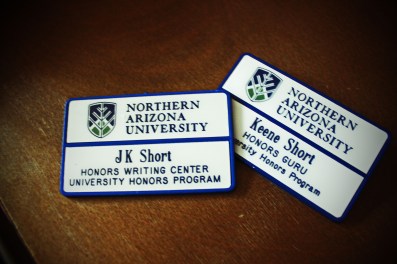
In the last years of college, I adopted another name: JK. The nickname originated in the place I worked, the NAU Honors Writing Center, which I can only describe as a mythical realm where the drawers are stuffed with candy and sarcasm flows freely from the tutors. My boss began calling me JK, and soon I started signing emails, letters, and even blog posts as JK. Keene now blogs as JK, who can withhold his sarcasm and be somber when the time calls for it but prefers to be lighthearted. You do not know everything about Keene; you don’t need to and I don’t want you to, which is why JK is here as a literary filter.

But I will always be Keene Short, even in publication. JK is a nice nickname, but I can’t see critics taking Collected Stories of JK very seriously. Maybe JK is just the fictionalized version of Keene, and I’m content with that. I don’t think of Keene Short as a pen name because Jeffery Short, to me, isn’t a real person. I’d be lying if I published under Jeffery or Jeff, both strangers to me. I am simply Keene Short.

-jk

The Summer Limbo

Giant wheel bw

The sun rises earlier, the nights are warmer, yellow pollen is in the air, and Flagstaff’s population shifts from students at the University to tourists on their way to the Grand Canyon or Lake Powell. Like birds in migration, people move backward or forward in summer, propelled into greener forests, taller mountains, warmer beaches. Among those birds in migration, I am absent. I am still perched in Flagstaff.

My time at Northern Arizona University is over; my time at the University of Nebraska has yet to begin. Now I’m in limbo, with no schoolwork, no tests, and lots of free time on my hands. I still have to pack up my life and move to a new state, but I will not be moving for a while, which means I suddenly have no major obligations. After four years of deadlines and assignments, I hardly know what to do with myself.

So far, I’ve been spending my time exploring parts of Arizona I haven’t seen much, like Prescott and Jerome; I’ve been camping, doodling, learning to play the mandolin, working through my reading list of over twenty books (I’m seven books in), and trying to teach my dog that fetch requires letting go of the ball.

I’ve also taken advantage of the free time by writing, or trying to at least. But I feel like I’m in an episode of The Twilight Zone, “Time Enough at Last,” in which the main character Henry finally has enough time to read all the books he can after he becomes the only survivor of a nuclear war. Being The Twilight Zone, poor Henry’s thick glasses slide from his nose and break, rendering him too blind to read. Like Henry, I have plenty of time to do what I love most, more time than I’ll probably ever have again, but something about this summer limbo is blinding me from my creative intuition.

Being in Flagstaff is a nice way to spend the summer. I may not need greener forests, taller mountains, or warmer beaches, but I do need something to realign the way I see my writing, a new perspective, something wrought from a new experience. I’ve had some fantastic experiences this summer, but being stuck between two worlds, physically and emotionally, is disconcerting. Hopefully I’ll break out from this creative complacency soon.

-jk

Ghosts of the West in Jerome’s Public History

Jerome Jerome, Arizona, is one of the oddest, most colorful towns in the state. Its history is rich, and its public history is thriving. Now a major tourist destination, as well as a small artists’ community, one can see Arizona history, and indeed U.S. history, in every corner. At a wine tasting one can see a passing motorcycle gang maneuver up the narrow streets, while a ghost tour marches downhill toward one of Jerome’s many historic sties. Jerome is itself a museum, an exercise in public history, but it is caught along the fault lines that make public history a contentious endeavor.

ruins

Ruins of a primary school.

Many go to Jerome to see the Old West as John Wayne, Clint Eastwood, John Ford, and others portrayed it. By the time How the West Was Won debuted in 1963, the Jerome Historical Society, founded a decade earlier, was already busying itself purchasing saloons, churches, mining equipment, and other property to advertize Jerome as a ghost town. Today, the Jerome Historical Society tends to dominate public history, and their goal from the beginning was to draw a crowd. Popularizing the town’s title, ghosts are now a prevalent motif. One can go on a ghost tour, visit a haunted hotel, then eat lunch at a ghost-themed restaurant. The Wild West narrative appears in the ruins of Jerome’s schools, jails, brothels, and saloons, and a past rife with outlaws, sheriffs, and western debauchery in a lawless city where anybody can make it big with the swing of a pickaxe.

The Cuban Queen

Entrance to an abandoned brothel, The Cuban Queen.

Jerome is haunted by this history, but by other histories as well. History is contentious, often snagged between fragmented political agendas. Today, several state legislatures want to change AP U.S. History curriculum to emphasize American Exceptionalism, a word that makes most historians cringe. Jerome may not be as fraught with politics, but the ghosts that haunt it are more than the usual characters in a typical western.


BenchThere is Charley Hong, who emigrated from China in 1880, two years before the U.S. passed the Chinese Exclusion Act. He became a wealthy businessman, owner of the popular Bon Ton Restaurant (later the English Kitchen). Though a local celebrity in Jerome, the xenophobic climate in the west persisted, to the point that his restaurant was bombed in 1909. Miners haunt the town as well. Making it rich by mining may sound appealing, but the work was arduous, usually deadly, and compensation was minimal. To make matters worse, in 1917 corporate managers rounded up miners suspected of affiliating with workers’ rights organizations like the Industrial Workers of the World (IWW), forced them onto cattle trains, and deported them out of town. Meanwhile, the local hospital witnessed approximately 9,000 deaths.

Ruins of a prison

Ruins of a prison

It is impossible to fully capture the diversity of Jerome’s history, and here I fail to do it justice. Public history, however, is an important venue for historical inquiry. The ghosts that haunt Jerome are more than just a handful of quirky characters. Jerome is haunted by the miners, the migrants, the unnamed lawbreakers, the women who worked in the town under challenging and dangerous conditions, the indigenous communities in the area. Jerome is indeed haunted, but most of its ghosts remain unheard. I intend to conduct more research, because for me history is about listening past the vast silence of time to let the old voices speak, and Jerome is shaking with eager voices.

Jerome Landscape


Instructions for a Camping Trip: An Interactive Short Story

I love camping, so I wrote a short story (in the form of an instruction manual) about it.

shadows

Step One: Pack matches, a tent, sleeping bags, pads, pillows, snacks, beer, camera, books, flashlights, water, knives, and then proceed to follow directions from printed maps, a GPS, and a passenger’s memory of “shortcuts” from five years ago.
If you make a wrong turn, proceed to Step Two.
If you miraculously make all the right turns, proceed to Step Four.

Step Two: Following one of several misleading directions, you find yourself in a condo development several miles off course. Find the nearest dirt road back to the freeway.
If you make it back to the freeway, proceed to Step Four.
If you find yourself in a deserted farm with fifteen scarecrows all facing you, proceed to Step Fifteen.
If you stop and ask for directions, proceed to Step Three.

Step Three: After finding the right directions back to the freeway, having asked between one and thirteen grizzled old farmers holding shotguns and potted daisies, you get back on track two hours late but determined nevertheless. Proceed to Step Four.

Step Four: You pull into the campsite, pay the grizzled old camp director holding a shotgun and a potted daisy, and proceed to set up the camping equipment.
If the tent you brought is not broken, proceed to Step Seven.
If the tent you brought is broken, proceed to Step Five.

Step Five: Use everything in your car to fix the tent (clamps, chairs, knives, potted daisies, etc.). Proceed to Step Six.

Step Six: After fixing the tent, you find yourselves exhausted and take a nap. Missing an hour of daylight, you wake up and realize
that someone forgot the bug spray and you are surrounded by bees (proceed to Step Sixteen), or
that you all brought and used bug spray but it inevitably failed and you are nevertheless surrounded by bees (proceed to Step Seven).

bees

Step Seven: You set up all camping equipment, including a bee trap fashioned from a plate of syrup well away from your tent, and you proceed to make a campfire.
If you succeed on the first try, proceed to Step Ten.
If you fail on the first try, proceed to Step Eight.

Step Eight: Nobody can get the fire started.
If you put your heads together and manage to build a successful fire using old copies of Dan Brown novels, proceed to Step Ten.
If you insist on starting the fire the way you saw that survivalist on TV do it involving a shoelace and several ounces of beer, inevitably failing, proceed to Step Nine.

Step Nine: You all give up and decide to camp without a fire, end up freezing, and drink what little alcohol is left for warmth. Proceed to Step Sixteen.

Step Ten: The tent is up, the fire is going, and you are all sitting comfortably in a circle making s’mores and drinking frosty cold beers. You lean back, gaze up at the stars, and
realize that you are insignificant but stranded beautifully on a fragile planet, and that it is your responsibility to care for your world (proceed to Step Eighteen), or
realize that you are insignificant, which induces an existential crisis causing increased alcohol consumption (proceed to Step Nineteen), or
fall backward in your chairs and wonder why you went camping in the first place (proceed to Step Eleven).

Step Eleven: Annoyed at camping in general, you all pull out your phones to see which celebrities have started dating each other, but discover there is no service in the woods.
If this frustrates you, proceed to Step Twelve.
If you return to toasting marshmallows, proceed to Step Thirteen.

Step Twelve: Your unquenchable desire for modern technology drives you to wander into the woods holding your smartphones into the air hoping to find a signal. Proceed to Step Seventeen.

Step Thirteen: Somebody pulls out a harmonica and plays a soulful rendition of Paul Simon’s “You Can Call Me Al.” Proceed to Step Fourteen.

Step Fourteen: You realize that a desire for luxury is the last chain enslaving humankind to capitalism, and that if we all lived a minimalist’s life together in a commune and devoted ourselves to art and human companionship, the corporations would all go extinct and we would open up the doors to Heaven on Earth. Proceed to Step Eighteen.

Step Fifteen: Now stuck countless miles from any sign of human life, you all get out of the car and proceed to argue. Proceed to Step Sixteen.

Step Sixteen: Furious at one another for your collective insensitivities, self-centeredness, and refusal to accept responsibility for your mistakes, you use all the camping equipment to kill each other. Proceed to Step Seventeen.

Step Seventeen: You are all eaten by coyotes. The End.

Step Eighteen: After waking up to the sound of birds and running water the next day, you feel spiritually and socially invigorated and return to the plastic confines of civilization with a renewed sense of meaning and a deeper understanding of the divine, determined to be a better person to the world as a whole. You then sell all the pointless crap you’ve spent decades accumulating, give the money to charity, and finally start playing music again. The End.

Step Nineteen: Having had too much to drink, you sob about the terrible state of the world, the wars, the power that big business has over you, how expendable you are in the scheme of things, the fact that Unfriended was ever produced in the first place, and wander around the campground despondent and terrified.
When the camp director finds you, he
uses his shotgun to “motivate” you back into your tent for a night of silent introspection (proceed to Step Eighteen), or he
uses his shotgun to “motivate” you out of the campground entirely (proceed to Step Seventeen), or he
kindly offers you bread, water, and painkillers, then proceeds to teach you about Zen Buddhism, which you diligently listen to as long as drunk people can before falling asleep (Proceed to Step Eighteen).

Campfire

For more information on camping, consult your nearest grizzled old farmer.

-jk

Copyright Keene Short, 2015

Once Upon a Time, Graduation Meant Something

Empty It finally happened. I graduated. I shook hands with the Dean of Arts and Letters and some of my favorite literature professors, and was handed a fancy diploma case for after the real one arrives in the mail. I went through the whole ritual, but when I left the Skydome amidst Flagstaff’s annual early-May snowstorm, I felt about as empty as the diploma case they gave me.

Most of my friends and family expect graduation to be a time of great joy, relief, sadness, and memory. I reflected on many things, but I tend to be reflective in general. For me, graduation offered no profundity. It was a mess of finding the right place, shaking the right hands, and enduring vague speeches about the future. Walking onto stage, having my name (and other information) announced, and receiving a diploma case should have been meaningful experiences, but I couldn’t keep myself from thinking that it was all a show.

Commencement was a self-congratulatory performance for the university, and the profiteering involved in the current education system was not only evident but ever-present. All students were required to have a cap and gown to participate in commencement, and the only way to obtain them, short of cheating and borrowing them from a friend, is to purchase them from a company; I was among those who cheated. After receiving an empty diploma case, students were ushered into two photo shoots. I was literally pulled into position, but I cannot get any of the photos taken unless I spend more money to purchase them. The commencement speeches had nothing to do with any of our own problems, our crippling student debts, an unnavigable job market, a scary world with an even scarier future. Instead, the speeches were about the university’s accomplishments, its growth and benefits, all at our expense.

College is no longer about advancing art and science and law; it’s become a business for the corporations benefiting from the on-campus dining, the corporations who make and sell caps and gowns, the construction companies profiting on new buildings the school can’t afford without cutting valuable tutoring and learning initiative programs. Education is one of the most important assets of the modern world, but the education system has become a method of exploitation.

All through commencement, I felt exploited. That’s not to suggest I did not receive an adequate education. Indeed, my professors exceeded my expectations, and they’ve changed me immeasurably. But college, as a system, profits regardless of anybody’s intellectual, scientific, artistic, political, technical, or social improvement. Instead, it encourages us to bankrupt ourselves so it can grow. In the end, NAU’s leaders do not care whether or not I graduate; they care about getting my money, and that realization hurts. I’m fortunate to have worked with professors who sincerely value their students’ collective improvement, to the point that they run themselves into the ground physically and emotionally by the end of each semester just to help us. But NAU, and the modern college-industrial complex, has done little, if anything, to contribute to its students’ intellectual improvements. I owe nothing to my university, but I do not blame it. This is a national pattern, and all of us are caught up in it. How long will it last? How long can it last before students realize that they are on a conveyer belt for the profit of private firms with no investment in literature, law, environmental science, political science, understanding globalization, or the development of compassion?

And now I’m going to pursue a graduate degree at the University of Nebraska-Lincoln. Now I’m plunging myself back into the factory.

Am I wrong about all this? Is it not the case that my friends have been placed on a conveyer belt for the past four years? For the next fifteen? Will the education system ever be returned to the hands of the educators and not the businesses? In a perfect world, the students gain more from a four-year program than the university they attend; we’ll never make it to a perfect world, but I think we deserve more than we’ve been given. We are more than crops with full pockets to harvest from. We are more than fruit to be drained and dried. We are scared, we are angry, we are curious, and we seek understanding. We are passionate and seek the means to express. We are knowledgeable and seek to use our knowledge. We deserve to be treated honestly about what we’ve been given, what we can do, and where we are going. Although I’m disappointed in my graduation, my university, and my country for voting the universities into such positions, I’m far from disheartened. Behind the curtain and the profiteering are professors who still work hard to teach and improve us. It is because of these professors that I have the means to express my discontent, and it is only through these means that I see any possibility for change.

-jk

A Brief Note About the Best Weekend of the Year*

*or, That Time I Went to the Association of Writers and Writing Programs 2015 Conference in Minneapolis

Conference 1

“Listen to the language you start with in the first paragraphs. That will shape the rest of the story more than you are aware.” –Pamela Painter on first drafts.

Every year, thousands of writing programs, small presses and literary magazines, publishing companies, writers new and old, writing teachers, and students flock together to share their books, writing programs, new releases, and innovations in the literary community. Thanks to the NAU Honors Program, I joined several friends in attending the conference, and it was one of the most beneficial experiences of my academic life.

“The MFA program is useful because it’s a break from the capitalist shitstorm. It lets you work without giving you black lung, and lets you focus on writing. The problem is that it doesn’t prepare you for life back in the capitalist shitstorm after it’s over.” –Claire Vaye Watkins.

Conference 2

Despite our travel plans going wrong, we made it. Because Arizona does not acknowledge daylight savings time  (but Greyhound does), we missed our bus by an hour. We decided to take a shuttle to Phoenix and ended up taking two different shuttles an hour apart, but eventually gathered in Sky Harbor with enough time to bankrupt ourselves from airport food. By late afternoon and with much applause, we landed in Minneapolis, Minnesota, amidst rain and snow.

“One of the hardest things for an Arab to accomplish is to live apolitically.” –Hayan Charara on whether or not writing should be political.

The conference has two features, an exhaustive list of panels and a colossal book fair. I spent most of my time in the less popular conferences, and tried to explore as rich and diverse a selection of topics as possible:

conference swagLiterature from communities in diaspora, featuring Vietnamese-, Korean-, and Arab-American writers; a reading of flash fiction, from six-word memoirs to 1,000-word short-shorts; a reading from Cuban poet Víctor Rodríguez Núñez and a signing of his newest collection With a Strange Scent of World; a set of memoir readings from U.S. veterans of the wars in Iraq and Afghanistan; a discussion on translating Brazilian minority poets; a lengthy discussion from MFA teachers about the usefulness of seeking an MFA in Creative Writing in the first place; a panel on the usefulness of historical fiction and the rules one can break with it; a beautiful poetry reading from Iranian Farzaneh Milani, Syrian Mohja Khaf, and Iraqi Dunya Mikhail plus a list of historical women poets in the Arab-speaking world; a panel on writing as advocacy; and a reading of creative nonfiction about the value of speculation in nonfiction works.

“The ‘other’ for the writer is simply everyone.” –Elizabeth Kadetsky on the relationship between writers and the world.

The conference reinvigorated my love of writing, but unmasked a great many myths and expectations upon which I had previously built my understanding of the writing life. I now understand that the MFA racket is not all it’s cracked up to be; though certainly useful if applied correctly, MFAs are neither necessary nor financially sustainable if one wants to be a writer. I now have a greater appreciation for the need for good translators, and how deeply politicized translations can become when meaning and identity are at stake crossing the thresholds between languages. Flash fiction is more than an exercise in economizing language but a growing form of art itself.

Lastly, and most importantly, being a lone writer, while romantic, is terrible; good writing can only ever come from the experiences a writer internalizes and interprets, so I must accumulate as many experiences as possible, good, unpleasant, awkward, funny, humiliating, beautiful, terrifying, or calming. Time is not what I need as a writer; a community of friends, loved ones, people who inspire me, are what I really need. This trip generated more ideas for stories than anything I’ve done inside a classroom, and it is to my friends that I owe my ability to write, if I can say I possess such an ability in the first place.

friends

-jk

The Case of the Empty Inbox

The Vast Unknown In December, I submitted five short stories to small literary presses and journals for potential publication. One sent me a rejection within a week, but the rest took their time. Four months later, I had received one new rejection, leaving three still looking over my work or letting it rust in a fat stack of emails from countless other writers.

Curious about the long wait, I looked up each remaining journal to check the reading periods, see if they posted information about a delay, or (I vainly hoped) had published my work and simply forgot to tell me. I remembered that one journal had not sent a confirmation email, and I discovered that it was no longer active, and indeed no longer available. Their links on databases for writers only took me to empty Could Not Be Found pages. Information about it existed on other sites, blogs, and five-year-old lists of calls for submissions, but the journal itself was simply gone. I know it was up and running in December when I sat at a cold kitchen table adjusting my cover letter and drinking Christmas-gift coffee. It’s not surprising that small online journals struggle, even stop publishing, but what would prompt it to vanish from the face of the Internet?

Somewhere in the foggy bays of the web sits an email containing a short story, a cover letter, and my name at the bottom. Is it still drifting along in the electronic waves, lost forever? Did it find itself to the inbox before the editors abandoned their little island? Did anybody bother to unpack the document in its cargo? Did other emails not make it in time and drift away into the darkness? I once read a sample of short stories and poems from this journal, not only defunct but scuttled and drowned, without proof that anybody once perused its archives, and it’s a bit spooky. I will probably never know why the little journal disappeared. The mystery may go unsolved forever.

-jk

The Snow, the Writer, the Time

Campus Snow Day

Yesterday started so safely. It was overcast and raining, but the roads were clear. By 11:00 AM, though, the city of Flagstaff was covered in snow and slush. Ponds sprouted in road dips and parking lots became marshes. Northern Arizona University cancelled all classes after 2:00 PM, after everybody was already on campus and desperate to get home. Students, faculty, and staff were told to leave before it got worse.

Com Building

I opted to stay on campus and not wait in the snow swamps amid dozens of tense drivers. I chose not to risk driving down Milton or Butler to get home, not wanting to wait ninety minutes because some inevitably bad drivers congested traffic after skiing their cars into each other. Instead, I found a warm corner on campus and set up shop with everything I needed: my computer, hot chocolate, a lengthy playlist of folk music, and a window giving me an unmitigated view of the snowfall.

Cline and Tree

I not-so-secretly harbor an obsession with snow. It’s often a subject in my writing. I’ve written many poems about snow alone, how it feels against my skin and glows under streetlamps. I’ve set numerous short stories in a mountain town in December, a Russian field in January, a Montanan cabin in February, or Flagstaff in March. Snow delights me immeasurably, and imposes an opportunity to sit back and do what I have so little time to even contemplate. When it snows so monstrously, I refuse to let the cold and darkness drag me down. Instead, I accept them as unexpected gifts. I don’t think sitting in front of a cold window improves my writing, but it often gives me direction and motivation. Yesterday, it forced isolation upon me, and isolation prompts writing. I’m grateful for being ushered indoors sometimes. Otherwise, I might never begin sewing the words together.

-jk