Category Archives: Poetry

“Nations are born in the hearts of poets. They prosper and die in the hands of politicians.” -Muhammad Iqbal

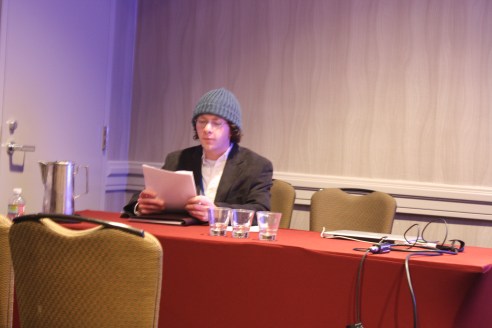
Reading at the Southwest Popular/American Culture Association Conference

In other news, I read some poetry at a big fancy academic conference.

index

This week, scholars, musicians, writers, film critics, professors, fans of The Grateful Dead, zombie fanatics, pop culture critics and lovers (one in the same, here) flocked to Albuquerque, New Mexico, to discuss their ideas, share their theses, their creative works, their analysis of other people’s creative works, and generally enjoy the spirit of popular culture.

In one day alone, I’ve heard scholar/fans discuss the relationship between Rick and Morty in Rick and Morty, compare Jurassic World and the TV series Zoo, analyze countless horror movies (from Poltergeist to The Babadook), explore various media’s fixation with underage serial killers, give two different interpretations of David Cronenberg’s eXistenZ, explore the role of nature as a setting in The Walking Dead, critique consumer culture in prepper magazines and the capitalist frenzy to buy things before the coming apocalypse, and read a variety of poetry.
IMG_2210.JPG

Reading my own work for an audience was not entirely new to me; I’ve made use of open-mic nights and poetry slams now and again. This venue certainly was new to me, though, but I don’t want readers to assume that I think a conference is somehow better than a slam. Poetry is meant to be read out loud, and all venues are equally worthy and professional; poetry slams are just as important as big fancy academic conferences. But here, my audience differs, and the tone is more critical, more focused on poetry within popular culture rather than poetry alone. Where else can I backup a poem about the end of the world with information I’d heard half an hour before?

I’m centered in the academic world, and this is an academic pilgrimage that I’m honored to take. Reading in front of a live audience, of course, is terrifying, but also thrilling, and I hope to enjoy that thrill again soon.

There are still plenty of days left in the conference, and there is more to come.

-jk


Two Poems Published in NEAT

Portrait of the City as FatherhoodI’m pleased to announce that two poems of mine, “Portrait of the City as a Love Story” and “Fatherhood,” have been published in Issue 9 of NEAT, a lovely online journal showcasing Midwestern writers, and the edition is up for viewing now. I’d be honored if any and all read them, and the other excellent work in this edition of NEAT. There’s obviously only one adjective to describe this: cool.

While the city in this picture is Lincoln, the first poem was actually written in Minneapolis.

-jk

P.S. I listened to “Tristesse Suspendue” by Chic Gamine and “Far From Any Road” by The Handsome Family wile writing and revising these two poems, respectively. The songs should demonstrate the drastically different moods I was in while writing them.

In the Company of Roses

Flower Last week, a man told me a parable about a lump of clay and some roses. He cited it as a Persian parable, but I did some research and found that it actually comes from the thirteenth century Persian poet Abū-Muhammad Muslih al-Dīn bin Abdallāh Shīrāzī, commonly known as Sa’di. He is one of the most influential poets in Islamic and Asian literature. In Iran, April 21 is celebrated as Sa’di Day.

While Europeans were busy killing each other in the medieval period, which they eventually termed the Dark Ages like a bad sequel to the Roman Empire, most of Western and Central Asia witnessed an artistic, philosophical, and scientific renaissance. Sa’di was only a part of this unique cultural era.

The poem I heard comes from the “Adoration and Preamble” section of Gulistan, or “the rose garden,” one of Sa’di’s most famous works. It reads something like this:

“I held in my bath a per­fumed piece of clay
that came to me from a beloved’s hand.
I asked it, ‘Are you musk or amber­gris?
Like fine wine, your smell intox­i­cates me.’

Till some­one set me down beside a rose,’
it said, ‘I was a loath­some lump of clay.
My companion’s scent seeped into me.
Oth­er­wise, I am only the earth that I am.'”

Apart from talking lumps of clay, I love this poem because it reminds me that I am defined by my proximity to others more than I realize.

Artistically, I am the product of the writers and poets I read: Billy Collins, Sylvia Plath, Douglas Adams, John Steinbeck, Dunya Mikhail, Jamaica Kincaid, and Pablo Neruda have made me the writer I am. Aesthetically, the Southwest made me an experimental, avant-garde magical realist. Socially, I am shaped by my friends, family, lovers, mentors, and the two or three enemies I keep around for good measure. Professionally, I’m a workaholic, being the son of professors who know education is a religious devotion serving the many at the expense of the few, the happy few.

I’m honored to live in the company of roses. I surround myself with those who inspire me. It took me a while to figure out how miserable one can get surrounded by those who are negative, over-critical, dishonest, manipulative, and toxic. I don’t mean I’m in the company of the perfect; all roses have their thorns. But for what it’s worth, I’m glad to let my friends rub off on me. It makes me a better person (and apparently more appealing to bathe with) to walk with roses.

-jk

The Publication of a Poem

Tea and PoetryMy poem “Dublin” has been accepted for publication by Burningword Literary Journal, an online journal featuring poetry, fiction, and nonfiction. It’s my first published poem, and I hope that many more will come.

For me, this is no time to be complacent. This is a signal that I should keep writing and keep sending my work off for publication. But for now, I hope you all enjoy reading my poem and the other stories and poems published in the seventy-second issue of Burningword.

-jk

To Whom It May Concern

Yesterday, while wandering the streets of Galway around the river, I found myself in front of a Catholic church built in the 1800s. I stepped inside, eager to explore a tradition with which I was unfamiliar. I had been in Catholic churches before, but only on guided tours with a camera in my hands and a ball cap on my head. This was different. This was an opportunity to find a new experience.

Church

I was alone inside the old church, and the silence was overwhelming in a city that otherwise was suffocated by the noise of traffic, crowds, and the river. I walked past a statue of St. Francis of Assisi, turned toward an organ, and made my way up the church to the front pew. There, I sat down in silence and looked around the bright room, engulfed in its old and magnificent imagery. The silence was almost alarming, as I had hardly a moment of solitude since my arrival in Ireland. I worried that somebody might come in and tell me I was in the wrong place, or ask me how I got past the Swiss Guard. After a while, though, I closed my eyes and listened to nothing, and managed to stop thinking for a few soft moments.

After a while, I opened my eyes, took out my notebook, and wrote a simple, one-page poem. I wrote it slowly, deliberately, one word at a time. I rarely take such care when writing. It was a brief poem entitled “To Whom It May Concern.” I tore it from my notebook, rose quietly from my seat, and placed it on the altar. After that, I left quickly, afraid that I would be caught.

I do not remember the contents of the poem. After I left it on the altar, it no longer belonged to me. It was a gift to the first person to find it. All I remember about it is that I felt satisfied when I finished it, that it was about light, that it ended with the line “Dona Nobis Pacem,” and I signed it “jk.” Perhaps they will think I was joking, or maybe it’ll be thrown away, or maybe it will be read aloud at Sunday Mass by a curious priest. For me, it was out of the ordinary, but I felt peaceful when I placed the paper on the sunlit altar. I’ll never know what happened to that little poem; all I know is that it set sail for uncharted territory just as I did two weeks ago.

-jk

One Final Poem

Today marks the end of National Poetry Month. Tomorrow, I will begin a short story I have been planning to write since March. For me, this month brought numerous rejections, one after another, including three short stories, several poems, and a complete poetry manuscript. Nevertheless, I have written twenty-two fresh poems, and to make things better, some of them are not too bad. To celebrate the end of April, I will post one more poem I wrote this month, entitled “Carpe Nix.” Enjoy.

April Snowstorm

Carpe Nix

There may be no good days to be useless,
but what use is today
when it snows three inches, when professors

grow pale over glasses of wine,

when coffee shops contract like muscles
as students file in one by one
preparing for public execution
sanctioned by professors
with sharp wine on their breath?

What good is today
over any other day
when we can’t make snow angels together
because there are convoluted superstructures
to deconstruct into postmodernity?

But I insist on today’s uselessness. I lean in
and whisper to you that you need not
sever your ear and mail it to the Dean
of Arts and Letters for inspection.

That can wait, but
snow angels dance only for so long
before curling up in blankets of mud,

just as you and I will curl up beneath six feet
of fattened worms and swollen soil.
Today it snows voraciously

and you spend three hours conducting surgery
on Albert Camus’s footnotes.

Let them soak for a while in Chardonnay.
The snow angels are calling to us,
announcing a need for dance partners
atop their moistened deathbeds.

Today is a fine day to be useless,
even though coffee-stained idols
must be composed for wine-drunk priests
holding the keys to our future.

But what good is a field of grass
beneath three inches of snow,

or a poet beneath a tombstone?
No more useful than warm fingers,
smooth hands, or sloping shoulders
if they freeze holding a pen
tucked indignantly over the nail-solid logic

of how useless it is to be useful for so long.


30 Days of Poetry

Today in Flagstaff, it is likely to be another windy Spring day. One hundred trains will pass through the city and frustrate drivers on Beaver Street on their way to Macy’s. Today, people will drink their coffee, polish their motorcycles, steal away a quick hour of yoga, and hopefully realize that it is the start of National Poetry Month.

Writer's Day Off

For me, poetry is already a fundamental property of my structure. It’s a religion for me. It’s a way to orient my life toward a deeper understanding of myself and my place in the world. I am the first to admit that I am not a great poet, and probably never will be. But most poets are not great. Most write privately for their own purpose, like prayer or meditation, a quiet ritual done in secret. Nevertheless, I strive to become a better poet because I believe it will improve myself as well as my relationship with the world around me. It may not be real magic, but it’s as close to magic as we can get. Stephen King once called good writing is a kind of telepathy. Poetry, to me, is no different.

I cannot become a better poet in a month, short of miracles or cheating. But I can improve my devotion to it. This month, I intend to read and write more. I hope to write at least one poem every day. I’ll be lucky if I get two or three good ones out of thirty, but by the start of May, I’ll have written two or three good poems. Statistically, that would be an improvement. I also hope to spread more poetry using this blog as a venue, certainly not ever day, but regularly enough that people discover a few new poems.

So I wish you a happy April and a good, long month of poetry.


Why a Liberal Education? Your Guess is as Good as Mine

I study English, poetry and fiction writing, literature, twentieth century history, the Western and Central Asia, colonialism, post-colonialism, feminism (waves 1-3), war, culture, comparative religion, social movements, world religions, and philosophy. I spend my time reading, then writing about what I read, and then reading what people wrote about what I wrote about what I read. Why do I do it? Because I have no choice. I am compelled to study the world as it is today by studying the way it was. I read and write fiction and poetry as a way to make sense of the world, only to find that I am still as ignorant. I pore over Persian poetry, Soviet policy records, and Twitter feeds from Tahrir Square, even when I’m not required to for a class, and I still have no answers.

That’s what it feels like to study in the liberal arts. You want answers to questions, but the only answers you find lead to more questions. You are taught to question all answers. There are no answers. For that matter, there are no questions. But that is an answer, so it must be wrong. Right?                                                            When I Return