

Peasant, Victor Vasnetsov, 1878.
Discussion of the Russian Revolution tends to focus on Petrograd and urban workers. Almost from the beginning of the February Revolution, the Soviets and Provisional Government directed most of their energy toward those striking in the capital or the military.
Alexander Kerensky, a centrist leader between February and October, writes in his 1927 account of the Revolution, The Catastrophe, that no “mention of [the land] is to be found in the declaration of the Provisional Government made public on the day of its assumption of office” and that it was not until April 2 that “the Provisional Government promulgated its agrarian reform, which was to give all the land into the hands of those who worked it” (Kerensky 121-122). He then quickly moves on to discuss industrial reforms.
Lenin and Trotsky were divided about the role Russian peasantry would play in a socialist revolution. Trotsky did not want to count on peasants to unite alongside workers. On the other hand, in his April Theses, Lenin contends that “the class-conscious proletariat can give its consent to a revolutionary war” only if “the power passes to the proletariat and the poorest sections of the peasants aligned with the proletariat” (Lenin). He also called for the nationalization of all land. It is important to note, however, that Lenin’s emphasis is on the power of the workers and peasants united, which suggests he did not see them as a unified class but as two separate categories. The distinction between worker and peasant was taken for granted in 1917, in part because of the peasantry’s history.
Donald Treadgold and Herbert Ellison note that in “1900, 80 to 90% of the Russian people were peasants” who had, since the medieval period, been subjugated to serfdom (20). Tsar Alexander II initiated sweeping economic and agrarian reforms, including the emancipation of the serfs in 1861, and that “at that time the Russian peasants were liberated either from private landlords, to whom about half of them had been in virtual personal bondage, or from the state, which controlled the other half” (20). Despite the 1861 emancipation, two years before the Emancipation Proclamation in the United States, Russian peasants remained tied by debt and poverty to communes and landowners, much like the development of the American South’s economy after slavery, which utilized debt peonage and Jim Crow laws as another form of bondage.
The Russian government in the nineteenth century exerted bureaucratic organization over the post-serfdom peasantries across the empire. Specifically, three years after emancipation, peasants were organized into zemstvos. A zemstvo was “an elective body instituted in 34 provinces within European Russia in 1864, empowered with certain local administrative responsibilities and assigned limited taxing authority“ but were nevertheless still controlled largely by landed gentry (Miller 6).
In other words, after emancipation, Russian peasants were granted a means of local self-regulation, almost a kind of proto-Soviet, but because this means came from the top-down, it was more a way to appease peasants rather than give them any real power. Still “at the mercy not only of meteorological factors as they affected harvests, but also of the equally unpredictable predatory depredations of local officials” (130), Russian peasants lived 53 years under a new, more covertly oppressive system until 1917 when more radical reforms were possible. Nevertheless, because peasants had not participated in the February Revolution in a city whose leaders had a history of giving peasants one freedom in exchange for new forms of exploitation, there was a clear divide between workers, striking in Petrograd, and peasants, growing food for the war that never seemed to end.
A 1909 book entitled The Terror in Russia: An Appeal to the British Nation details the Tsardom’s ruthlessness, including the “drastic measures” taken as a response to “a famine in several provinces of European Russia” (Kropotkin 70). These measures allowed for “a wholesale flogging of the peasants, men and women alike. . . in order to obtain the arrears” of peasants who, because of the famine, were behind on debts owed to landowners (70-71). The famine itself is more important to note, because the response of the government outweighed any potential protection peasants’ zemstvos might have offered. By 1917, the situation had not changed, because the system had not changed.
Peasants grew restless in the countryside waiting for Petrograd’s dual power to enact real reforms, but many peasants participated in the smaller revolutionary acts of organization and asserting their collective authority. Just as workers’ Soviets emerged, many peasants’ Soviets formed as well. In May of 1917, the leftist-dominated All-Russian Congress of Soviets of Peasants’ Deputies met in Petrograd to represent the interests of peasants, though in part the meeting reemphasized the sense of alienation that many politically minded peasants felt. Nothing constructive had come from the Tsar’s reforms, the Provisional Government was stalled except to continue the war effort, and the Bolsheviks, who promised land redistribution, had made little progress.
The vast majority of imperial Russia’s population was not entirely neglected by the Revolution, but because of a long history of poverty, rural isolation, and top-down oppression coupled with a Marxist investment in industrial workers over rural workers, peasants had a difficult time making their desires known, if those desires could actually be expressed in a uniform way. Peasants’ Soviets could only make so much noise in the ongoing political crisis that took place, almost daily, in the Russian capital.
Kerensky, Alexander. The Catastrophe. D. Appleton and Company, 1927.
Kropotkin, Peter. The Terror in Russia. Methuen & Co., 1909.
Lenin, Vladimir. “April Theses,” in Pravda No. 26, April 7, 1917.
Miller, Burton Richard. Rural Unrest during the First Russian Revolution. CEU Press, 2013.
Treadgold, Donald W., Herbert J. Ellison. Twentieth Century Russia. Westview Press, 2000.
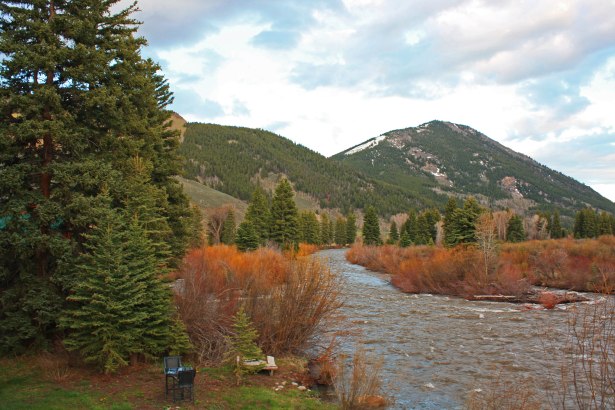 Two weeks ago, I graduated from UNL with a Master’s degree in English. It is the result of two years of reading, writing, and writing about what I read. More importantly, I had the pleasure of spending time with the friends and colleagues I worked with this past year. To celebrate the end of the semester and our program, several folks in my graduate cohort took a vacation by driving from Lincoln, Nebraska, to Crested Butte, Colorado, for a weekend next to a river. Soon, we will scatter and go our separate ways, and the slice of time we gave one another without responsibility, without the need to work for someone else, without tasks to fulfill, was a small slice of heaven (which is, as we all know, a place on Earth).
 In a
In a 
 April is
  Is there a place for soft-spoken introverts in the competitive fast-paced aggressively limited-time-offer college-industrial complex? The short answer is no. The long answer is no, thank goodness.
 Let’s face it: Spring Break is an undergrad’s game. Most of them flock to some sunny island whose painful history of colonization you learned about last week in a story form PRI’s The World. Grad students just don’t have the time or money or energy for a ritzy vacation, but that doesn’t mean they can’t have a glamorous Spring Break from the comfort of their university. There are many fun activities grad students can enjoy.
 In 1902 on February 27, John Steinbeck was born, kicking off a wonderful century of war and economic strife. To celebrate his birthday, you can either have a disgusting beer milkshake or delicious mush or even a glass of extremely fresh milk. Or you can be sensible about the whole thing and make peach upside-down cake.
