Tag Archives: writer

Writing on Game Day

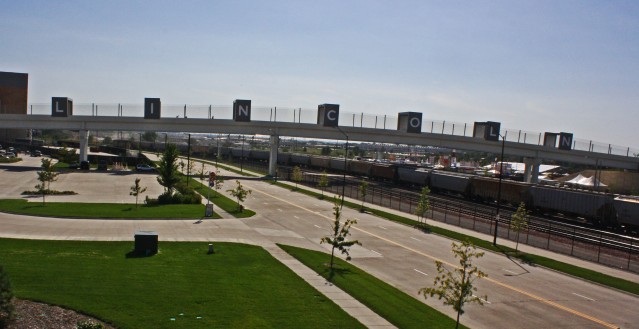
The Mill It’s another game day in Lincoln, Nebraska. The city is dripping with redshirts (not the kind from Star Trek, but closer than you’d think) and people asking for tickets. It’s hot, dry, loud, and alive. There is energy and consumerism in Lincoln today. Parking here, fifty dollars! Hot dogs, popcorn, soda, beer! Families move through the streets as the day builds toward the big game. Parties, I’m certain, are in planning, if not already in mid-construction.

Currently I am not involved in the game day activities. It’s nothing personal, Nebraska, but I have work to do. I have a novel to write, several novels to read, essays to research, critiques to work on, and Renaissance comedies to struggle through. I have work for my research assistantship on top of my graduate classes, plus my ongoing attempts to write and publish.

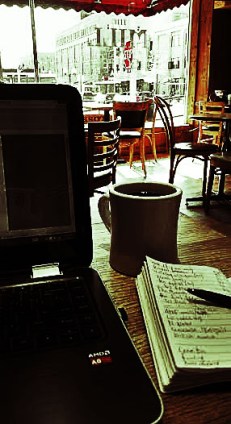
I’ve tucked myself into a corner coffee shop downtown to caffeinate and induce sleeping problems. I’m going to spend the whole of game day here, watching the red sea of fans part against the street corner while rushing to complete the next section of my novel for workshop on Monday, then finish the 4,501 other projects I have (blogging notwithstanding, of course). I can’t afford to see a game, anyway. Four dollars for a cup of coffee and a scone is better than fifty for a ticket. Even if I watched the game, I wouldn’t particularly care who won. I’m told we’re having a bad season, but I couldn’t tell you a single score. It’s nothing personal, Lincoln; fandom just doesn’t suit me.

-jk

After Two Years of Blogging, Your Guess is Still as Good as Mine

toastWordPress reminded me that today is my two-year blogiversary. I missed last year’s for the obvious reasons (grad school applications, Macbeth, mud wrestling, etc.). Today, though, I slide two years into the past when I was surrounded by the mess of my education: Beloved, essays on the Holocaust, a textbook on linguistics, The Outlaw Bible of American Poetry, and drafts of my own poetry. The liberal arts defined my life, but lacked definition; in a confused fervor I wrote my first blog post asking simply, why get a liberal education in the first place?

Two years have gone by. I created this blog to explore the liberal arts generally, the life of a wannabe writer specifically. At varying times, it has served as an open journal, editorial, bully pulpit, and archive of my writing. I started out posting short vignettes satirizing myself as a freshman, but moved on to better creative writing, philosophy, travelogues, history, and humor. If my blog feels eclectic, it’s only because my brain is eclectic. I move rapidly from Steinbeck to colonial Egypt to writing a short story. This blog is one part journal, one part art, and one part scholarship, with three extra parts marked “miscellaneous.” I strive to make sure no two posts are alike, which may be a bad idea when blogging is supposed to be about consistency and ritual, two qualities I lack.

I’ve explored numerous moments in my life on this blog: I mourned Pete Seeger, challenged myself to write a poem every day each April, founded a photography business, announced publications, had breakfast in Ireland, lunch in Jerome, dinner in Wisconsin, went to my first big fancy writing conference, broke up with my hometown of twenty years for graduate school in Nebraska.

For the most part, though, I’ve read, and written about what I read, and read what others wrote about what I wrote about what I read. An endless reading list is the bedrock of any good liberal education.

Liberal Education

On this blog, I’ve also reached many half-baked conclusions, but one thing has remained clear post after post: a good liberal education is worthless if it stays inside the classroom. Sitting around reading and writing is no way to be a writer, if it’s all I do. I have to experiment with baking or acting, work for a charity, travel, read for a literary journal. I should traverse the gridlock of cities, the innards of bars, the vast organs of campsites. My blog may be ineffectively unconventional; the only binding theme is the continual mess of my lifelong education and my desire to be a writer. But I know blogging has made me a better writer, a more considerate reader, a more confident thinker. It’s been an eclectic two years. I hope the next two will be even more eclectic.

jk

Why a liberal education? Your guess is as good as mine, and I mean that. If you’re engaged in the liberal arts, especially outside of academia, let me know in the comments what you study or write or create, and why.

-jk

Writer Seeks Characters

newspaper

March 3: Aspiring writer seeks three to four characters for minor literary endeavor, entitled Untitled Novel. Characters must be diverse, original, and snappy. Villains always appreciated.

March 9: Writer seeks one to two sympathetic protagonists to balance the fourteen unsympathetic villains who answered prior ad. One must be fluent in Russian. Quirks and comic relief are highly valued.

March 10: Fourteen unused unsympathetic villains seek good writer. Willing to die violently; highly skilled in diabolical laughter, fear, surprise, ruthless efficiency, etc.

March 15: Lonely protagonist seeks sidekick and/or love interest. Must have agency, thorough backstory, and moderate comic relief. Static characters strictly prohibited.

March 22: Writer seeks spare subplot involving a gun. Alternative subplots acceptable, but must end in the death of an unexpected love interest the writer doesn’t know what else to do with.

March 25: Postmodern short story seeks ironic resolution for a plot involving fourteen unsympathetic villains. Violent deaths are acceptable, but must be meaningless.

March 29: Writer has unused Chekhovian subplot available, after finding a stray Deus Ex Machina in the shed.

April 9: Hastily killed-off love interest seeks new story, preferably one with a less obviously Freudian subtext and better dialogue.

April 11: Writer has unused Freudian subtext available. Writer also requests to be given a break, Marsha, the dialogue wasn’t that bad.

April 15: Postmodernist writer seeks editor and agent for polished fourteen-villain ironic story.

April18: Protagonist seeks new writer who doesn’t kill off characters just to fill a few chapters.

April 20: Struggling writer seeks copyright lawyer for advice on a recently run-away protagonist.

April 25: Escaped protagonist looking for work, has experience with romantic subplots but prefers complex internal conflict.

April 30: Aspiring writer seeks runaway protagonist. Please come back, Harold.

May 1: Postmodernist writer seeks complex internal conflict for new protagonist.

May 16: Writer seeks runaway protagonist, promises to try harder this time, really he will.

May 18: Seriously, Harold, I created you. What am I supposed to do now?

May 23: Postmodernist writer seeks good journal for a metafictional buddy/love story entitled “Marsha, Harold, and the Writer.”

May 30: Writer seeks three to four characters to collaborate on revising an old plot; is willing to work with characters closely; is willing to let the characters move the plot along.

June 2: Unused plot devices, tropes, and schemes available, no charge.

-jk

Big League Academia

New WriterTwo months into my first year of graduate school, I think I’ve finally started to settle in. The workload is not beyond my management (I somehow function better with less sleep), the faculty are just as thoughtful and thought-provoking, and my descent deeper into the cult of academia is going smoothly; soon, I’m told, I’ll be a card-carrying postmodernist. The support my writing receives is frequent, and the possibility of a writing career is even starting to take shape.
For example, this past week I had the opportunity to meet with two agents and two editors, to have them critique a section of my novel-in-progress and discuss the publishing industry. They told me what they liked about the short section, offered insights, made revision suggestions, and allowed me to see the project in grander terms. I learned that when I eventually get an agent and editor, publishing becomes a collaborative effort, a group project. They offered to stay in contact when I have a polished draft. Suddenly, the fantasy of publication no longer feels so impossible.

Is this it? Is this the next step for my writing? Or is this just the next phase in my hike up the ranks into academia? I ask myself this question because I’m surrounded by people who have it figured out already. I’m surrounded by serious academics, doctoral students devoting years to studying, students fulfilling long-term plans. Many of them took a break after college to figure out the rest of their lives, get married, travel, go on adventures, experience things they can then write about. And here I am, fresh out of my undergraduate career.

Am I here because I want to be a writer, or because I want to be an academic? I feel like a kid who doesn’t yet know what he wants to be when he grows up, and time is running out. Do I teach? Get a PhD? Another MA? An MFA? Is there life after publication? Or should I let my ambitions dictate my future? Tired of studying tragedy but never taking that study out of the classroom, I still want to join a charity, volunteer in a hospital in Palestine or Afghanistan or Jordan, or work on an organic farm in Chile or Brazil. I want to see the world, because I know if I stay in the confines of an English Department, I’ll run out of things to write about.

I’m still just a kid, academically speaking, and I’m surrounded by intellectual adults. I can’t count the number of times I’ve been asked about my PhD, as if that’s the only end in sight, and I can’t count the number of times I’ve silently shrugged and changed the subject. I only have until next fall to figure it out, though. Do I become a career academic? Teach? Work? Let me know in the comments your own thoughts or plans.

-jk

Like a Writer in a Candy Store

Lincoln

My books are on my shelves, my violin is tuned, and my spice rack is full. I’ve finally settled into Lincoln, Nebraska, with a few weeks before I start my first semester of graduate school. I spent yesterday exploring the city on foot, and a few sunburns and several hours later I returned to my apartment exhausted but satisfied.

Wandering alone in a big city is a new experience for me. I knew my former home of Flagstaff was relatively small, but getting lost in Lincoln proved to me that I am only one brick in the world’s framework. In my exploration, every corner I turned showed me a new organ in Lincoln’s body. I flew through decades into the Midwest’s past, into rustic red brick buildings, some dating back to the 1870s. I perused this place’s history, its survival on the plains, and those strange intersections where the past meets the present in the connective tissue of reinvigorated neighborhoods and gentrification.

River

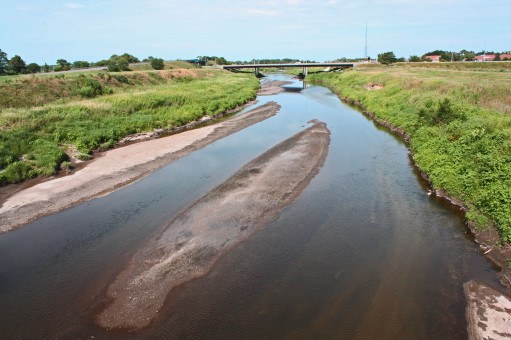
Although being in a big city should be overwhelming, for a writer it’s like being a kid in a candy store. I can use any one of a dozen metaphors to describe my place in the city, a cell in a body or a brick in a building, and all of them describe how I feel. They all express my belief that individuality is overrun by community, and I’m sure that Lincoln will organically change me as a person regardless of whether or not I want it to. But for a writer, a city is just one big candy store because it’s not made of bricks or cells, but of stories. There is street art, there is sewage, there are coffee shops, there are dimly lit bars, and right now all of it is new to me.

UNL

One day of exploration has already transformed me. Today, I’ll find a few good places to write on campus and around town, all of which are within walking distance of my apartment. But for the moment, I am still freefalling through Lincoln’s grid of stories, hardly able to contain my excitement.

-jk

P.S. A surprisingly fitting song to have stuck in one’s head while wandering around lost in a new city is H.S.K.T by Sylvan Esso. I also find it suitable for writing about cities.

My Last Letter to Flagstaff

Dear Flagstaff,

autumn forest

There’s no easy way to say this, but I have to say goodbye.

Northern Arizona University

It’s not that I don’t like you. On the contrary, you’re the finest community I’ll ever know. Never mind that you’re the only community I’ve ever known. Having lived in Flagstaff for twenty years and with no actual memories of my life in Pocatello, Idaho, before moving to you, it might be unfair to future communities, but I mean it, Flagstaff. Where else can I see a herd of deer pass in front of my car just uphill from my high school? Where else can I have a mountain for a backyard? Where else will I be an hour from the Grand Canyon and Sedona?

Flagstaff

You’ve been great to me, Flagstaff, but it would be naive to say it was all fountains of chocolate. I mean, you are in Arizona, after all. The snow was nice, but driving downhill on an icy road to a stop light was a little scary. I appreciated the dog food factory, but the smell was a little overwhelming sometimes.

Macy's

Everything good and bad that has ever happened to me, with a few exceptions (Ireland, Montana, Minneapolis), has happened to me in Flagstaff: failed orchestra concerts, a broken arm, publication, falling in love for the first time, crippling self-doubt, hangovers in church, learning to play the violin, becoming an Eagle Scout, rejections from journals, writing my first good poem, writing my first bad poem, saying goodbye at the train station to the woman I loved. I’ve had colds and stage fright, I’ve had frog dissections and marching band performances, I’ve had reader’s theater and photography gigs. I lurched through high school and college in Flagstaff. Spending two decades in a place allows for the accumulation of immeasurable joy and bitterness, and leaving you, Flagstaff, is a tough decision, perhaps the toughest I’ll ever have to make. Sticking around is quite tempting.

Train Station Bench

But I need to see other cities, other states, other countries. I need to travel. I need to study and write and learn. I’ll start by going to graduate school in Lincoln, Nebraska. Lincoln may be the opposite of you, Flagstaff, but everything is packed, and I’ll be out the door by the time you read this. After graduate school, I’ll traverse shores yet untarnished by my footprints.

Duck Pond

Even if I fall for Lincoln, I’ll always miss you, Flagstaff. You were the rough draft of a misshapen side character dropped into the world; you were a place of enlightenment in the saints’ cult of writers; you were the architect of this backpack stuffed with art and questions that I am honored to call my soul.

Christmas in Flagstaff

I owe you more than I’ve given, and you’ve given me more than I deserve, Flagstaff. Perhaps I’ll come back to you someday. I would like to see you at least once more before I die. If I do make it back, I hope you have not changed except to become more beautiful, but I cannot, for the life of me, imagine a more beautiful city.

Pipeline Trail

I’ll miss the hippies and cowboys and geriatric motorcyclists. I’ll miss the perpetual smell of pine trees and incense and dog food. My memories of Flagstaff are like photographs in a gallery hung at random. No real structure binds these moments, and it’s more breathtaking that way. With that, I say goodbye Flagstaff. Wish me luck.

Appalachia

Sincerely,

jk

Out of the Frying Pan, Into Graduate School

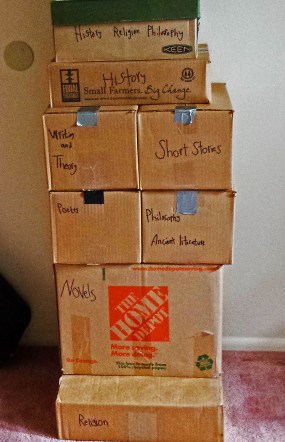
book boxes A few months ago, I attended the AWP Conference where eager representatives from MA and MFA programs stuffed fliers into my hands. They all offered the same possibility: a few years in paradise with nothing to do but write, read, workshop, and inevitably publish. I was drawn into the illusion that ignored the work, the expenses, the debt, and the difficulty in getting anything published.

While preparing for life after NAU, I knew that graduate school was not the only way to become a writer. I could serve overpriced coffee to people in suits, slipping them poems on their receipts to show them my talent, or I could work as a governess for a rich man with gigantic muttonchops who helps me publish my sad story. Or I could take the realistic approach and work, write, and submit short pieces to journals, like most writers I know, gradually building up a longer and longer list of published works.

After I returned from the conference, I received an email from the University of Nebraska-Lincoln. I had applied to eight schools last fall, and all rejected me but UNL; late in April they informed me they would offer me full funding and a stipend through a research assistantship. It was a lucky break, and I took the offer, not because I believed it was the only path I could take, but because I believed it was the best path for me at the moment. It’s the opportunity to get a Master’s Degree in English without any debt, which is just short of a fantasy these days. I don’t believe I deserve such an opportunity over other applicants, but because I have the opportunity now, it’s my responsibility to make the best of it that I can.

I’m not going just to improve my writing, though of course my emphasis will be in creative writing, and of course I intend to come out of it a better writer. But I also hope to become a more scholarly reader, a better student, a more disciplined person.  I was born into academia, and I can handle it a few more years without losing my mind. I am immensely grateful for the opportunity. So I’ll buckle down, pack up my four thousand books and my no. 2 pencils, and plunge into the fire.

-jk

In Which the Pen Name, Nickname, and Legal Name Meet Each Other

Who? More authors than I can count have used a pen name at one point. Dean Koontz has used Aaron Wolfe; Charlotte Bronte used Currer Bell; Daniel Foe, being the creative genius that he was, used Daniel Defoe, not to conceal his identity but to convince his readers he was more gentlemanly. My favorite is Daniel Handler’s pseudonym Lemony Snicket, because Snicket becomes a character in Handler’s Series of Unfortunate Events, one who navigates the reader through the troubling plots. I’ve never imagined myself using a pen name, until I realized how many names I’ve gone by.

For most of my life, I’ve gone by my middle name Keene. In middle school, I got tired of correcting people who thought I said Ken or Keenan or Keith, and I also wanted a name requiring no spelling correction. Not Keen, not Keane, not Frank, but Keene! I tried my first name Jeffery, but even then most people misplaced the R, spelling it Jeffrey. So I shortened it to Jeff. This was also around the time I started writing, and I wrote my earliest stories as Jeff Short. But Jeff was not a very pleasant person, nor a very good writer. He was obnoxiously political, and was competitive in music, writing, and grades.

Along the way, I decided that I liked Keene better. Keene Short. It’s a good name for a writer, and frankly I like Keene as a person more than Jeff. Whereas Jeff was picky, Keene embraced just about everything. He had a better sense of humor than Jeff. Most importantly, he gave up competitiveness. Keene wasn’t concerned with being superior with distinction, but with enjoying the show. Jeff slowly diminished into a forgotten nickname.

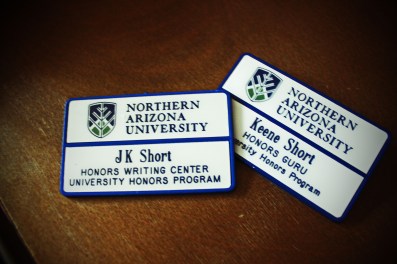
In the last years of college, I adopted another name: JK. The nickname originated in the place I worked, the NAU Honors Writing Center, which I can only describe as a mythical realm where the drawers are stuffed with candy and sarcasm flows freely from the tutors. My boss began calling me JK, and soon I started signing emails, letters, and even blog posts as JK. Keene now blogs as JK, who can withhold his sarcasm and be somber when the time calls for it but prefers to be lighthearted. You do not know everything about Keene; you don’t need to and I don’t want you to, which is why JK is here as a literary filter.

But I will always be Keene Short, even in publication. JK is a nice nickname, but I can’t see critics taking Collected Stories of JK very seriously. Maybe JK is just the fictionalized version of Keene, and I’m content with that. I don’t think of Keene Short as a pen name because Jeffery Short, to me, isn’t a real person. I’d be lying if I published under Jeffery or Jeff, both strangers to me. I am simply Keene Short.

-jk

The Case of the Empty Inbox

The Vast Unknown In December, I submitted five short stories to small literary presses and journals for potential publication. One sent me a rejection within a week, but the rest took their time. Four months later, I had received one new rejection, leaving three still looking over my work or letting it rust in a fat stack of emails from countless other writers.
Curious about the long wait, I looked up each remaining journal to check the reading periods, see if they posted information about a delay, or (I vainly hoped) had published my work and simply forgot to tell me. I remembered that one journal had not sent a confirmation email, and I discovered that it was no longer active, and indeed no longer available. Their links on databases for writers only took me to empty Could Not Be Found pages. Information about it existed on other sites, blogs, and five-year-old lists of calls for submissions, but the journal itself was simply gone. I know it was up and running in December when I sat at a cold kitchen table adjusting my cover letter and drinking Christmas-gift coffee. It’s not surprising that small online journals struggle, even stop publishing, but what would prompt it to vanish from the face of the Internet?

Somewhere in the foggy bays of the web sits an email containing a short story, a cover letter, and my name at the bottom. Is it still drifting along in the electronic waves, lost forever? Did it find itself to the inbox before the editors abandoned their little island? Did anybody bother to unpack the document in its cargo? Did other emails not make it in time and drift away into the darkness? I once read a sample of short stories and poems from this journal, not only defunct but scuttled and drowned, without proof that anybody once perused its archives, and it’s a bit spooky. I will probably never know why the little journal disappeared. The mystery may go unsolved forever.

-jk

The Snow, the Writer, the Time

Campus Snow Day

Yesterday started so safely. It was overcast and raining, but the roads were clear. By 11:00 AM, though, the city of Flagstaff was covered in snow and slush. Ponds sprouted in road dips and parking lots became marshes. Northern Arizona University cancelled all classes after 2:00 PM, after everybody was already on campus and desperate to get home. Students, faculty, and staff were told to leave before it got worse.

Com Building

I opted to stay on campus and not wait in the snow swamps amid dozens of tense drivers. I chose not to risk driving down Milton or Butler to get home, not wanting to wait ninety minutes because some inevitably bad drivers congested traffic after skiing their cars into each other. Instead, I found a warm corner on campus and set up shop with everything I needed: my computer, hot chocolate, a lengthy playlist of folk music, and a window giving me an unmitigated view of the snowfall.

Cline and Tree

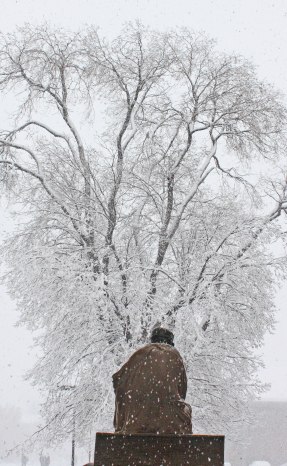
I not-so-secretly harbor an obsession with snow. It’s often a subject in my writing. I’ve written many poems about snow alone, how it feels against my skin and glows under streetlamps. I’ve set numerous short stories in a mountain town in December, a Russian field in January, a Montanan cabin in February, or Flagstaff in March. Snow delights me immeasurably, and imposes an opportunity to sit back and do what I have so little time to even contemplate. When it snows so monstrously, I refuse to let the cold and darkness drag me down. Instead, I accept them as unexpected gifts. I don’t think sitting in front of a cold window improves my writing, but it often gives me direction and motivation. Yesterday, it forced isolation upon me, and isolation prompts writing. I’m grateful for being ushered indoors sometimes. Otherwise, I might never begin sewing the words together.

-jk