
 This fall will be my third year teaching first-year composition at the college level, and my fifth time drafting my syllabus from scratch. Some instructors keep a syllabus, but so far, I’ve opted to rebuild and try something new. Fifth time’s the charm, or maybe not.
Each time I teach an introductory writing class, I have made significant changes to the syllabus, the assignments, the readings. I change the amount of points that participation is worth, because I am still redefining what qualifies as sufficient participation. Should I have more shorter assignments or just a few really long essays? How can I get students to read what is required? I’ve never believed in reading quizzes, but this year I may try them out.
I am returning to some of the standard readings I’ve used from my first semester in Nebraska, way back in Fall, 2016, during simpler, less stupid times. I will still assign Stephen King’s “What Writing Is” and show Chimamanda Ngozi Adichie’s “The Danger of a Single Story.” But I’m also adding new readings, like Tiffany Midge’s essay “Bury My Heart at Chuck E. Cheese’s” and Joy Castro’s essays “Grip” and “Getting Grip.”
Every semester is a tri-weekly exercise in trial and error, and to a degree I regret doing this to my students. I have been in classes where professors try new things and talked excitedly about their brand new syllabus, and now, after three years on the other side of the classroom, I wonder if I shouldn’t just repeat what is familiar, but I know that repeating even the most familiar trials will still result in plenty of errors. Every class is different, and within those classes are unpredictable factors.
Students might hate what I assign. They might not. Conversely, I might hate teaching something they end up loving. It’s rare that we’re all in agreement. The question is how can I teach them this lesson–that speakers struggle to connect with their audiences in the most ideal circumstances–without simply telling them it’s the case. Teaching is like writing in that showing is preferred over telling, but just like writing too, honesty is the best policy.
So, this year, I will write at the top of my syllabus “Please anticipate technical difficulties.” Extra credit to students who pay enough attention to notice it.
-jk
 My second year of teaching, now in my second Master’s degree, is keeping me busy. Last fall, I took a class on pedagogy and read selections on composition and rhetoric theory by Peter Elbow, David Bartholomae, Janice Lauer, and Paulo Freire. Mostly, though, I learned how to teach by rapidly switching from my role as an instructor to my role as a student, wearing several hats several times a day. This fall, I’m in a similar pedagogy class and teaching similar composition courses, and I find myself learning the basics all over again, with perhaps a better sense of how to fail with grace.
 On behalf of Satan and his minions and CEOs and several charitable people who donated buildings to us, we would like to welcome you, personally, to the University of Hell.
 To the astonishment of many, I finished my first semester as a graduate instructor, and I now have a break from graduately instructing people. I have ambitious writing goals for the break (two new stories, four revisions, eight submissions), and I intend to stick to those goals (not just because my nonfiction instructor challenged me to email her if I succeeded), and now that I’ve submitted final grades, I have time to think about my first time being fully responsible teaching forty-six people to write arguments.
 You sit down at your desk awaiting students with questions. Some have already sent you emails with one concern or another; they have questions and it’s your job to answer them in office hours. So you wait.
 In a week, I’ll be teaching two sections of an introductory English class using a syllabus of my own design, for my graduate program. I can choose the readings, assignments, and discussion topics, all within reason, of course (I probably wouldn’t be allowed to teach my students math; lucky them). While I’ve been a TA and writing tutor before, I’ve never been in charge of a class for a full sixteen weeks. And now I’m charge of two classes.
 Among the many things coming this Fall is the second season of me being in Graduate School. This next year looks promising, and I’m looking forward to the goofy Nebraska antics, the creative writing classes I’ll be taking, and finally teaching a class on my own.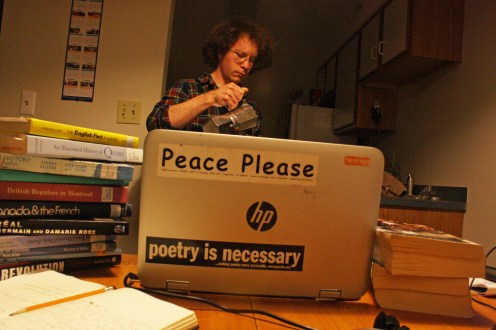


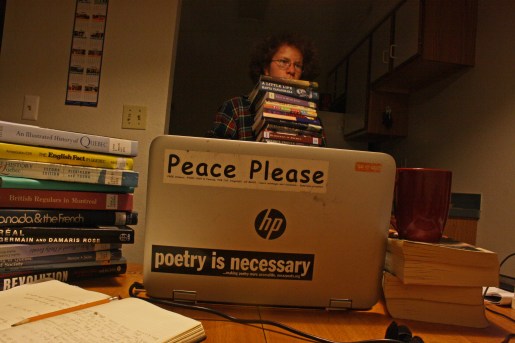
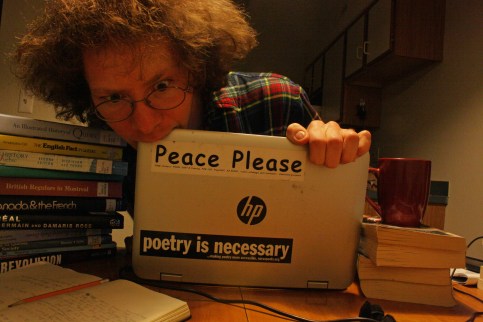
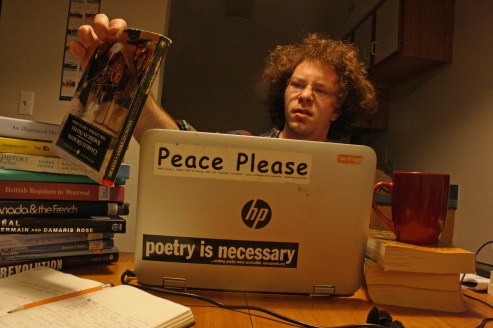

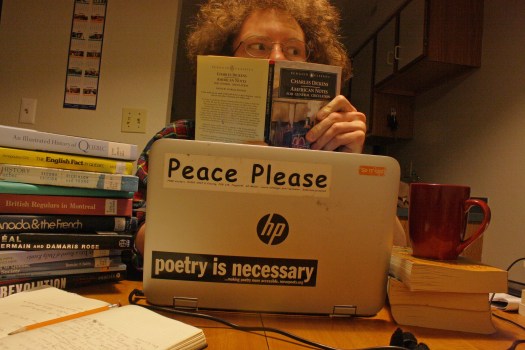
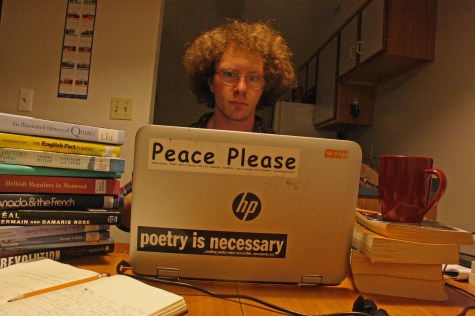
 WordPress reminded me that today is my two-year blogiversary. I missed last year’s for the obvious reasons (grad school applications, Macbeth, mud wrestling, etc.). Today, though, I slide two years into the past when I was surrounded by the mess of my education: Beloved, essays on the Holocaust, a textbook on linguistics, The Outlaw Bible of American Poetry, and drafts of my own poetry. The liberal arts defined my life, but lacked definition; in a confused fervor I wrote

 Two months into my first year of graduate school, I think I’ve finally started to settle in. The workload is not beyond my management (I somehow function better with less sleep), the faculty are just as thoughtful and thought-provoking, and my descent deeper into the cult of academia is going smoothly; soon, I’m told, I’ll be a card-carrying postmodernist. The support my writing receives is frequent, and the possibility of a writing career is even starting to take shape.
 Keene Short