Category Archives: History

“We are digging up the foundations of a very old world.” -Alan Sharp

Navigating the Language of Genocide

ubiquity

Recently, some activists called for the U.S. to formally charge the self-proclaimed Islamic State with acts of genocide. I can use the word informally on a blog post, but Secretary of State Kerry’s hesitation to use the word formally proves the power of language. If he makes a formal accusation of genocide, the word brings certain political ramifications, and expectations that may not be fulfilled.

U.S. officials have avoided using the word in the past, in order to avoid necessitating political and military action. During the Clinton Administration, U.S. officials were explicitly told to refrain from using the word genocide to describe the situation in Rwanda, which is now recognized as very obviously a genocide. Reluctance alone to use the word allowed the U.S. to justify not intervening.

This is where language falls short: refusing to call something murder does not change the fact that it is murder. Regardless of whether or not Secretary Kerry calls the destruction of Yazidi, Shi’i, Sunni, and Christian life genocide, that destruction counts as genocide.

However, there is a deeper, more complex narrative. To begin with, most of the groups pushing for a formal accusation are Christian organizations, and focusing on the Christian victims alone risks ignoring the multitude of other victims of the self-proclaimed Islamic State. Kerry would also need to contend with the fact that the U.S. has supported other genocidal regimes in the region complicit in aiding the Islamic State. Saudi Arabia, for instance, is religiously and politically invested in the destruction of Shi’i Muslims and Sufi shrines. Turkey, another U.S. ally, is involved in crimes against its Kurdish population, another group the Islamic State has targeted.

There is also Palestine. While the contexts and implementation for the Israel and the Islamic’s State’s actions against innocent civilian populations differ in a few crucial ways, they are overwhelmingly similar. Palestinians, in many cases children, are held captive without just cause; the Israeli military regularly encroaches upon Palestinian land, removes the indigenous population by force, and occupies it by destroying local property and replacing it with Israeli property. If the U.S. accuses the Islamic State of genocide, which it should, the U.S. would be remiss if it did not make the same accusation against the Netanyahu Administration, which it should.

The issue of language is complex; the word genocide holds so much meaning, but we often ignore the meaning of its absence, and in its absence genocides continue to occur. History has proven this, and it proves it now. There is no way to measure suffering, and I do not intend to give that impression. All victims of genocide deserve justice, Jews, Palestinians, homosexuals, Kurds, Bosnians alike. Ranking the suffering of others is the heart of the problem: it allows those who can stop the slaughter to pick and choose who deserves to be salvaged, and if he is a responsible leader, Secretary Kerry will acknowledge all acts of genocide in the region rather than a select few.

-jk

To Vote From Afar

ForeverA while ago, I mailed forms to my home state of Arizona requesting an absentee ballet for the upcoming primary and Presidential elections. I sent a little letter into a sea of mail, and now I wait earnestly for my approved absentee ballet.

It’s Arizona, though, so there’s a statistical likelihood that my vote won’t make a difference. Each election I’ve voted in, my vote failed to put into office my preferred candidate (a ham sandwich named Marty who wears a hop hat and monocle running as a Neo-Whig Anarchist, obviously). Because the Whigs (and every other party I would realistically vote for) don’t stand much of a chance in Arizona (unless more people voted), I will once again have the honor of not making a difference in 2016.

It’s possible, however unlikely, that voting will make a political difference, but that’s not necessarily why I vote. I vote to be part of a community, to participate in an almost religious experience, to be part of something bigger than I am, a kind of highly-organized mob mentality centering around mostly rich, unconcerned smiling people in suits I couldn’t afford with my life’s savings. It’s enchanting to be part of a communion that has the potential to involve so many. I’m sad how often we collectively waste that potential.

In the 1952 election in India, 105,944,495 people voted. It was the first election after Independence, the first with universal suffrage, and although it constituted only 45% of the electorate, it was a colossal success considering that India’s literacy rate was only 18% in 1951, and is even more impressive given the vast number of languages spoken by India’s electorate: as of 2001, only 22 of India’s 844 languages and dialects were officially used for constitutional purposes. India’s first election involved all levels of society in a nation stratified by centuries of colonialism and damaged by Partition with East and West Pakistan, and nevertheless one hundred million people turned out to vote. Despite the militaristic turmoil around Partition, people turned out to explore an (admittedly western-designed and implemented) experiment in voting.

The upcoming U.S. Presidential election is quite different from India’s 1952 election, but I want to be a part of the masses. In a strange way, becoming a statistic feels transcendental to me, like I’ve moved into a part of history that exists outside all indicators of the self, outside personality, documentation, religion, class, race, and into a cloud of participatory revelry, into a quantifiable oneness. I wish I could vote in person, but from my temporary home in Nebraska, I will still move beyond myself. And maybe, just maybe, Marty the ham sandwich will finally usher in four years of Neo-Whig Anarchism.

-jk

Cited: Wendy Singer. Independent India. Edinburgh: Pearson Education, 2012. Print.

.

After Gallipoli

ANZAC Soldiers on the Gallipoli Peninsula

ANZAC Soldiers on the Gallipoli Peninsula

Today marks an important moment in the First World War: the final evacuation of British and ANZAC (Australian and New Zealand Army Corpse) troops from the Gallipoli Peninsula, ending a disastrous months-long Allied campaign to gain control of a narrow a sea route to Russia, the Dardanelles, and to push troops through Anatolia (Turkey) to the Ottoman capitol Constantinople and knock the Ottoman Empire out of the war.

Allied Strategy for the Gallipoli Campaign. Keagan, John, The First World War.

Allied Strategy for the Gallipoli Campaign. Keegan, John, The First World War.

First Lord of the Admirality Winston Churchill schemed the invasion. Allied ships would sail through the Dardanelles accompanied by minesweepers and land thousands of troops onto the Gallipoli Peninsula, where they would secure the area and push on to Constantinople. The initial landing was on April 25, 1915, involving many soldiers from Australia, New Zealand, and Ireland.

The Allies were unprepared for the harsh environment on Gallipoli and the ferocity of Ottoman Turkish soldiers, led by the now famous commander Mustafa Kemal, who directed his troops in successfully defending the Peninsula. The Allied troops became entrenched on Gallipoli for a grueling eight months. Kemal proved his military prowess; Churchill’s plan, on the other hand, proved to be a quagmire. On this day one hundred years ago, the Gallipoli Campaign came to a close. The Ottomans had defeated the British Empire for the time being.

That victory was arguably the last great moment in Ottoman history, and the first in a long time. Earlier in 1915, Ottoman troops committed acts of genocide against Armenian civilians. The Ottoman Empire had been in decline for decades amid encroaching Russian and European empires, and would later suffer British and French diplomats carving it into colonial mandates after the end of World War One. Winston Churchill was involved in that process; he even said that he created the country of Jordan “with the stroke of a pen one Sunday afternoon.” When the War finally ended in 1918, the British and French saw the defeated Ottoman Empire as property to divide among them: Britain took Palestine, Jordan, and Iraq, while France seized Lebanon and Syria, divided artificially. Those artificial borders continue to create problems today in these countries, pitting groups together or dividing cultures along superficial lines.

The Ottoman Empire had practiced its own form of imperialism, and ruled over its Arab territories from its imperial center in Anatolia, just as the British Empire ruled India and South Africa from England. Just as the British and French are guilty of reprehensible war crimes to maintain imperial power, the Ottomans were guilty of the same, such as the Armenian Genocide. Despite the emphasis on self-determination that dominated discussions at the Treaty of Versailles, Arab, Kurdish, Armenian, and other groups were simply shifted from Ottoman rule to British and French rule with as much regard as plunder shifted between pirates.

The Allies also wanted to divide Anatolia, but the Young Turks, led by Mustafa Kemal, fought a war for Independence from 1919 to 1922, and formed a stable, secular, but complex democracy. The Greek minority in Anatolia fought its own smaller rebellion, leading to the eventual forced migration of thousands of Greeks from Anatolia and Turks from Greece in 1923. Kemal had nevertheless defended his homeland from the British, and would not allow the Allies to make property of it.

New nations were formed from the defeated Ottoman Empire, but Turkey may have been the only one to form itself on at least some of its citizens’ own terms. The rest were carved artificially by Churchill and his ilk, Similarly, many Irish soldiers returned to a British-controlled Ireland torn by rebellion in the 1916 Easter Uprising. April 25 is commemorated as Anzac Day in New Zealand and Australia. The Battle of Gallipoli brought British loyal subjects to the edge of the Ottoman imperial center; it was a devastating failure for the otherwise almost obnoxiously successful British, who continued to claim colony after colony across the globe. For the crumbling Ottoman Empire, it was one final act of defiance against the empires surrounding it. Two of the most complex figures of the twentieth century emerged from the battle with profoundly different scars: Mustafa Kemal won, and Winston Churchill lost. Both men went on to be war heroes and war criminal simultaneously, and their role in history will likely always be contentious. At least, both played crucial roles in the destruction and recreation of nations.

By January 9, 1916, about 265,000 Allied soldiers and 300,000 Ottoman soldiers died on Gallipoli. Many of the them were probably unconcerned with the survival or strengthening of empires. They were concerned, most likely, with fighting for something they were told, and genuinely believed, was bigger than them: nationhood. Many Irish joined the war thinking the British would reward them with independence. Australians and New Zealanders had an emerging sense of national identity separate from but loyal to the British. The Turks fought on their homeland against invading Europeans. Thousands died trying to make a nation of their world. Indeed, nations formed, but maybe those who fought created their own kind of temporarily autonomous nationhood of spaceless unity. Amid the destruction of empires, it may be tricky to honor that unity on both sides of Gallipoli equally, but we should strive to anyway. Nationhood is what we make of it, and despite what Churchill seems to have believed, sovereignty means more than a pen stroke.

-jk

John Keegan. The First world War. New York: Vintage Books, 2000.

In the Company of Roses

Flower Last week, a man told me a parable about a lump of clay and some roses. He cited it as a Persian parable, but I did some research and found that it actually comes from the thirteenth century Persian poet Abū-Muhammad Muslih al-Dīn bin Abdallāh Shīrāzī, commonly known as Sa’di. He is one of the most influential poets in Islamic and Asian literature. In Iran, April 21 is celebrated as Sa’di Day.

While Europeans were busy killing each other in the medieval period, which they eventually termed the Dark Ages like a bad sequel to the Roman Empire, most of Western and Central Asia witnessed an artistic, philosophical, and scientific renaissance. Sa’di was only a part of this unique cultural era.

The poem I heard comes from the “Adoration and Preamble” section of Gulistan, or “the rose garden,” one of Sa’di’s most famous works. It reads something like this:

“I held in my bath a per­fumed piece of clay
that came to me from a beloved’s hand.
I asked it, ‘Are you musk or amber­gris?
Like fine wine, your smell intox­i­cates me.’

Till some­one set me down beside a rose,’
it said, ‘I was a loath­some lump of clay.
My companion’s scent seeped into me.
Oth­er­wise, I am only the earth that I am.'”

Apart from talking lumps of clay, I love this poem because it reminds me that I am defined by my proximity to others more than I realize.

Artistically, I am the product of the writers and poets I read: Billy Collins, Sylvia Plath, Douglas Adams, John Steinbeck, Dunya Mikhail, Jamaica Kincaid, and Pablo Neruda have made me the writer I am. Aesthetically, the Southwest made me an experimental, avant-garde magical realist. Socially, I am shaped by my friends, family, lovers, mentors, and the two or three enemies I keep around for good measure. Professionally, I’m a workaholic, being the son of professors who know education is a religious devotion serving the many at the expense of the few, the happy few.

I’m honored to live in the company of roses. I surround myself with those who inspire me. It took me a while to figure out how miserable one can get surrounded by those who are negative, over-critical, dishonest, manipulative, and toxic. I don’t mean I’m in the company of the perfect; all roses have their thorns. But for what it’s worth, I’m glad to let my friends rub off on me. It makes me a better person (and apparently more appealing to bathe with) to walk with roses.

-jk

Europe’s Refugee Crisis of 1492

Expulsion of Spanish Jews Universal History Archive

The Alhambra Decree. Credit: Universal History Archive/Getty Images

1492 marks an important moment in world history, not just because it’s the year Columbus landed in the Caribbean, along with smallpox, mercantilism, and other European diseases. It is also an important year in Spanish, Ottoman, and Jewish history. As European powers were slowly consolidating into modern nation-states, King Ferdinand and Queen Isabella of Spain passed a decree, the Alhambra Decree of 1492, that required all Jews to be expelled from Spain, or else convert to Christianity. This pattern of expulsion began with the centuries-long Reconquista, ending with the 1491 fall of the Emirate of Granada. The Spanish monarchs wanted not just a larger nation-state, but a religiously pure one. Thus, they expelled any Jew who refused to convert. Many crossed the border into Portugal; a few years later, the Portuguese crown declared the same policy, but directed its efforts at forced conversion rather than expulsion. The Spanish Inquisition played a crucial role in these events, as well.

Thousands of Jewish and Muslim refugees were left without a home as a result. The next month, after hearing about the expulsion, the Ottoman Sultan Bayezid II, issued decrees of his own allowing any and all Jewish refugees to resettle in Ottoman territories. He sent the massive Ottoman navy to Spain, under the famous admiral Kemal Reis, to help Jews, as well as Muslims, flee religious persecution in the Iberian Peninsula, known as Al-Andalus to the Ottomans. The refugees settled throughout the Ottoman Empire, often in large urban centers such as Cairo, Jerusalem, and Damascus. Today, Sephardic Jewish communities still hold a presence in Turkey.

The Ottoman Empire was at its height in the fifteenth and sixteenth centuries. It enjoyed economic influence over its surrounding polities, had a strong military, and was known for its extreme religious tolerance. A diverse empire to begin with, encompassing Turks, Arabs, Greeks, Kurds, and Armenians, the Sultanate practiced tolerance for all religious traditions inside the empire, including Sunni and Shi’i Islam, Eastern Orthodox Christianity, long-standing Judaism, and at its edge Catholic and later Protestant Christianity. In many ways, the Ottoman Sultan was the leader of the free world at the time.

I’ve never believed history repeats itself. I don’t want history to repeat itself. It’s often hideous and unfair. But maybe the western world should take a lesson from the Ottoman Empire and open its borders to Syrian and Iraqi refugees fleeing many of the same places Europe’s refugees resettled in the 1490s. Maybe this is one of the few moments in history that should be repeated. European nations cannot reverse the policies of Assad and ISIS, just as the Ottoman Sultan could not reverse the equally barbarous policies of King Ferdinand (yes, ISIS and the Spanish Monarchy are equally evil). But Europe and the U.S., as much as the Ottomans, can commit to an act of compassion in the face of unmitigated brutality. After all, it’s clearly been done before.

-jk

Jewish History Sourcebook: The Expulsion from Spain, 1492 CE

Lapidus, Ira. A History of Islamic Societies. New York: Cambridge University Press, 2002.

Srebrenica and Why I Still Study Genocide

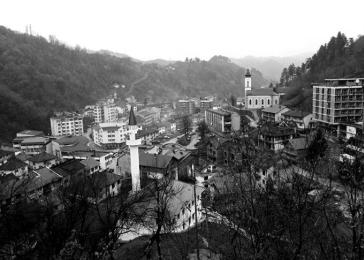
Photo of Srebrenica City, 2002, from the United States Holocaust Memorial Museum.

Photo of Srebrenica City, 2002, borrowed from the United States Holocaust Memorial Museum.

I should begin with a brief clarification about why I post so often about war and genocide. It affects me deeply, and I often have trouble bringing myself to read about it any more. As a result of the professors I’ve worked with, I find myself compelled to study and write about violent conflict in history. I do not find any satisfaction in studying it, and I feel the need to mention this because I know from experience that some people do find satisfaction in reading about genocides, especially the Holocaust; too often, I’ve heard people refer to it as ‘fascinating’ or ‘intriguing.’ I suppose I cannot dispute the value of somebody’s motivation, but I do not believe one should explore the industrialized slaughter of civilians because it arouses fascination. It should disgust, it should repulse, but I do not think it should invite intrigue. My motive for studying it is not rooted in a sick fixation with the gruesome details, which often keep me up at night; I do not believe enjoyment should be my sole motive, however. I feel compelled to study it in part because I have no power to change it.

I admit that the more I delve into historical traumas, the more guilt I feel, and I don’t think there is necessarily a problem with that. A guiltless being is a soulless one, and a belief that one is free of guilt, that guilt will never inflict legal or psychological damage, might be a common trait of the perpetrators. I think there is merit in a little collective guilt. History’s ghosts haunt us, all of us, if we stop and listen. The thing about history is that it persists, it continues into the present, and the battles are still going on.

I can distance myself from the details enough to write about them, just enough to maybe offer a brief commentary. The exception, however, is the Srebrenica Genocide. Today marks twenty years after the start of the massacre, and I have wanted to write about it. Anniversaries can be convenient opportunities to engage moments in the past, though they are also quite arbitrary: historical traumas are not relevant every ten years, but continually.

Though I have tried to write about the Srebrenica Genocide, I find it almost impossible. What happened in Srebrenica affects me more than other genocides. When I read about the details, I feel chest pressure and panic, and have to turn away from the research.

The region of Bosnia-Herzegovina, where Srebrenica is located, was solidified in the former Yugoslavia during the Cold War under the dictatorship of Josip Broz Tito, who took power after World War Two. Prior to that, the region had a brief period of independence after being ruled by the Austro-Hungarian Empire, and before that the Ottoman Empire. By the twentieth century, Bosnia was religiously and ethnically diverse, and the two are often conflated: With Catholic Croats, Orthodox Serbs, and Muslim Bosniaks, the region had few moments of independence despite strong nationalist movements, such as Young Bosnia. Gavrilo Princip, one of Young Bosnia’s members, assassinated the Austrian Archduke Ferdinand and his wife in Sarajevo in 1914, sparking the First World War.

While Yugoslavia collapsed in the early 1990s alongside the Soviet Union, Bosnia declared its independence. Serbian nationalists attempting to solidify the region again under the new Republic of Srpska, rejected the declaration of independence, invaded the region, and began a campaign to cleanse it of its Muslim population. This event is similar to how the Irish War for Independence and Civil War broke out, devolving into sectarian violence between Catholic Republicans and Unionist Protestants after the Republicans declared a kind of independence; this event is also similar to what is currently going on in Iraq, where a right-wing Sunni organization has the apparently unquestioning loyalty of many of Iraq’s Sunnis who felt oppressed by a Shi’i-led, and US-backed, government. Ireland did not witness a genocide against the island’s Protestants, though sectarian violence continued well into the 1980s and beyond. In contrast, Iraq and Syria may be witnessing a genocide now, despite the almost universal condemnation of ISIS and its tactics.

That is precisely the situation Bosnia was in, starting in 1992. The United Nations, appalled at the Serb nationalists’ tactics, intervened in the war (at least in theory) and declared the town of Srebrenica one of several safe zones. UN peace-keeping soldiers were placed on the ground, world powers condemned the violence, but nobody wanted to intervene directly. Instead, the United Nations designed a system that effectively blocked any nation from direct confrontation with combatants.

This is where I find it difficult to go on reading, sometimes. In 1995, Serbian nationalists, under the presence and observation of the UN, took Muslim men and boys from Srebrenica at gunpoint, ushered them into the surrounding woods, and slaughtered them. They buried them in mas graves, often with the intention of preventing the bodies from ever being found, proof that they were aware that the world would look upon them as criminals, proof that they wanted to hide the evidence of their crimes. But there is something wholly corrupt about a system that prevents peace-keeping soldiers from intervening in the slaughter of 8,000 men and boys.

Some UN soldiers express guilt, shame, and even sought treatment for PTSD afterwards. I should also note that this is not the only crime against humanity committed during the Bosnian War. The perpetrators also implemented a campaign of systematic rape against women and girls, a crime that victims report ISIS has committed in recent months (trigger warning if you open the link). But I have not been able to bring myself to read about these crimes beyond broad overviews. I simply can’t, unless I choose to tolerate the inevitable anxiety I feel from researching it.

Historical trauma does not continue only in a communal sense. Russia recently rejected a UN resolution to classify the Srebrenica Genocide as genocide, and right-wing Serbian organizations threatened to disrupt commemoration events. Many Serbs deny that Muslim casualties were as high as reported, and several mass graves remain yet to be uncovered and documented. The trauma persists daily; many perpetrators still walk among the victims’ families, and collective denial of the genocide, which is strong in many circles, is an active assault on the Muslim community in Bosnia.

Maybe, in some ways, I feel like one of those UN soldiers, unable to intervene but forced to watch. I feel helpless when I read about these and other crimes, and guilt can be overwhelming. It should not be debilitating, though I often let it become too much to handle. There is more that I can be doing.  There is more that I should be doing. But I will continue to engage these traumas as best I can, even if I leave historical research behind academically. It will haunt me no matter what I do, and I can invite the ghosts in or close the door on them. I’d rather leave the door open, because I believe that history’s ghosts have something to say, and it’s our responsibility to listen. Will these blog posts make a difference? Probably not. But I’d rather not be silent when the past is so loud.

Boots on the Ground

Civil War Soldiers

Statue Commemorating Civil War Veterans

Some of the best advice I received about historical research is that oftentimes the surest way to find sources is to have boots on the ground and look for sources in person. This usually involves going into public archives or getting access to private ones, but I’ve heard tales of finding rare documents forgotten in the trunk of a car or simply on display in a book fair. This week, while visiting family in Appleton, Wisconsin, I decided to experiment with boots-on-the-ground-history.

March to SocialismI discovered that historical research is more than just skimming through a few letters. It’s detective work, a methodological investigation, and I did not rise to the challenge. As I prepare to go to graduate school to study creative writing, I worry that I may leave history behind. History is close to my heart, but requires a patient diligence.
McCarthy

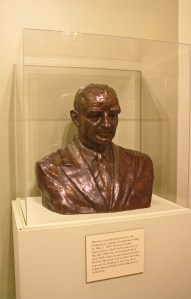
Statue of Senator Joseph McCarthy

The challenge of in-person research yielded a few interesting results. Appleton’s public history emphasizes its positive qualities, such as the fact that magician Harry Houdini claimed it as his hometown, though he was born in Hungary. There is a museum with an entire floor devoted to Houdini’s life and work. However, another famous man claimed Appleton as his hometown, Senator Joseph McCarthy, who engaged in congressional witch hunts during the early 1950s to remove suspected communists. Popular opinion has since turned against McCarthy, but as journalist Edward R. Murrow said in an open challenge to the Senator’s unethical methods, “He did not create this situation of fear, he merely exploited it.” Now that Red SpiesMcCarthy is remembered as an aggressive demagogue, his hometown has taken a statue of him that once stood in public view and placed it in a museum’s bottom floor, under the stairs.

Apart from some obscure anti-communist propaganda, one from 1950 and the other from 1967, a World War One Dough Boy memorial statue and a Civil War memorial statue, I could not find any major historical documents in Appleton’s history, simply because I did not look that hard. It is not surprising that they hide McCarthy’s image and highlight a still-popular celebrity. Any research on the Cold War in Wisconsin daily life would require interviews with those who remember it, access to radio and news archives, local newspapers, and other hidden sources. Perhaps I might be able to dig up a few rare pieces of propaganda if I looked deeper, or uncover a story of Cold War espionage, but such research requires more time and energy than I can offer. I’m not a specialist, or a driven detective. I am, for the time being, only an interested amateur.

Patriotic WWI Statue

Doughboy Statue Commemorating World War One Veterans

Perhaps I can one day conduct better historical research. Perhaps I will one day dare to dig deeper, open doors that should not be opened, find people who have answers. I was inspired by a year-old article about Amor Masovic, who has been looking for burial sites from the Srebrenica massacre in Bosnia-Herzegovina, in 1995. That massacre, part of the Bosnian Genocide, was the first act of genocide on European soil since the Holocaust, and one that the world ignored for years. Today, the perpetrators still live side-by-side with the families of the victims, and reconciliation is a great challenge. But Masovic pursues burial grounds, is still looking for the missing victims to piece together the community of Bosniak Muslims that existed before the massacre. He’s been working for nearly twenty years and there are still bodies unaccounted for.

Will I ever be such a researcher? Will I ever contribute to as admirable an effort as Masovic? It’s unlikely, but I do not want to leave history behind. I’m too compelled and too haunted by its ghosts to allow myself to give it up completely. History truly is obsessive, and maybe the only way to make a difference is to simply embrace that obsession, dig my boots into the ground, and dig as deep as the past will allow.

-jk


If Napoleon Had Won

View of Paris from the Louvre, by Lost Compass Photography

View of Paris from the Louvre, by Lost Compass Photography

Today, as we mark the two hundredth anniversary of Napoleon’s defeat at Waterloo and a definite end to his conquest of Europe, I wonder what would have happened if he’d won. If the French had defeated the British-led coalition, France would still have faced Britain across the English Channel, Prussia (part of modern-day Germany) to the east, and Russia even further to the east. In other words, Napoleon would have faced a potential war on two fronts, the same situation Germany faced in both World Wars. French forces were already stretched thin, particularly from colossal defeats in Russia, so it seems unlikely that the French would win a two-front war.

Perhaps Napoleon would turn to diplomacy. Britain historically fears a continental empire, preferring a divided and contentious Europe. If Spain, France, Prussia, Russia, and the Netherlands cannot work together, England can keep them from uniting against the island Kingdom. Napoleon would be wise, then, to turn to Prussia and make a political pact against Britain. Such treaties were common during the nineteenth century, eventually creating a complex alliance system that some blame World War One on. So, to avoid a military defeat, Napoleon turns to Prussia and promises to work with them if Britain or Russia ever turn against their interests.

What would certainly be known as the Franco-Prussian Alliance creates a strong central-European power. Napoleon dies decades later of stomach cancer, but in this universe he dies a hero. Statues are built to him, poems in French and German are composed, and peace settles now that Imperial France has secured its assets abroad. A Franco-Prussian alliance changes the shape of Europe completely. German unification never happens, but Franco-Prussia probably allies with Austro-Hungary anyway. As a result, the First World War pits central European powers against Britain and Russia rather than France and Britain against Germany and Austria. However, the combined strength of France and Prussia, along with France’s imperial allies of Italy, Spain, Portugal, Romania, and probably the Ottoman Empire, manage to defeat Russia and Britain. The U.S. never involves itself regardless of the outcome, and France gains all of Britain’s colonies. As a result, French becomes the dominant language in the world, no fascist dictators come to power, and the U.S. keeps to itself and Latin America.

Of course, this is not an objective speculation. Counterfactual history is subject to individual decisions as well, namely those of the historian. My own bias against fascism motivates me to see a possible way out of it. There’s no indisputable likelihood that there would be no World Wars if Napoleon had won a single battle. There may have been a worse war, there may have been no more wars, but there’s no way of knowing for certain. As such, counterfactual history can sometimes show more about the historian’s own bias than about history itself. In any case, thousands died at Waterloo, and millions have died in combat since. Speculating about how we could have avoided past conflicts, while intriguing, can be a distraction from how to avoid conflicts now.

-jk


Modern Turkey and a History of the Word Genocide

Photo of the Armenian Genocide Memorial Complex

Photo of the Armenian Genocide Memorial Complex

Earlier this week, an important but under-reported incident occurred in international politics. Brazil’s government passed a resolution to recognize atrocities committed against the Ottoman Empire’s Armenian population in 1915 as genocide, which dozens of countries and most historians already recognize. As a response, the Turkish Foreign Ministry responded by condemning the resolution, saying that it “distorts reality.”

This year marks the hundredth anniversary of the Armenian Genocide. One hundred years later, the use of the term genocide is still contentious. Historical truths can be malleable. In Brazil, what happened in 1915 is genocide; in Turkey, it is only a tragic conflict. The use of one word to describe an event might seem like a pointless semantic argument to some, but language is crucial when discussing history, and it’s important enough to spark discomfort between nations.

Part of the problem is that the Armenian Genocide occurred decades before the term genocide came into use. In 1915, the Ottoman Empire joined Germany and Austro-Hungary against Britain, France, and Russia in World War One; the Ottoman military, after a disastrous failed invasion of southern Russia, attacked civilian Armenian Christians through forced deportations, mass imprisonment, confiscation of property, death marches, and massacres. The total death toll is still in dispute, but a common estimate is 1.5 million Armenians. Some Ottoman officials thought the Armenians were a pro-Russian threat, and such an argument was used to justify the atrocities. After the war, the Allies carved up the Ottoman Empire, but an independent Turkey emerged after revolutionary forces took control of Anatolia. The revolution was partly led by Mustafa Kemal, a talented Ottoman military leader who defended the Gallipoli Peninsula during the War. Becoming the first president of Turkey, Kemal rewrote history to make the new Turkey a heroic nation. Taking control of national education, Kemal erased the Armenian Genocide from his new country’s textbooks and public discourse, and this pattern continues in Turkey today.

Despite a wealth of archival evidence, Turkey’s national investment in keeping the term genocide out of its history is wrapped up in the complicated nature of the word itself. Raphael Lemkin coined the term to describe Nazi atrocities during World War Two. Lemkin’s activism began much earlier; a Jewish migrant from Poland, he had heard many stories about Ottoman atrocities as well as pogroms against Jews. In 1948, the United Nations recognized genocide as an international crime in its Convention on the Prevention and Punishment of the Crime of Genocide, referring to it as requiring “the intent to destroy, in whole or in part, a national, ethnical, racial, or religious group.” Consequently, forced deportations and ethnic cleansing (the attempt to remove a group of people from a designated geographic area but not the group entirely) do not necessarily count as genocide (though they often lead to genocide, historically). Like most criminal matters, recognizing the Armenian Genocide, at least in a legal sense, requires proof that the perpetrators intended to erase the Armenian population from Anatolia through their physical and cultural destruction.

But for Armenians today, as well as countless activists and historians, genocide is not always a legal matter, but a matter of identity and truth. In Armenian collective memory, what the Ottoman military did goes beyond specific legal parameters; it was an assault against an entire culture resulting in the death of over one million people on the basis of a shared ethnic-religious identity. Its historical scars are still visible for many Armenians, but history is more than just past crimes; history is a living, evolving beast. Turkey’s refusal to recognize the Armenian Genocide is a direct attack on Armenians today. Such a refusal wipes away the validity and dignity of those Armenians the Empire slaughtered and the generations who are around today, the descendants of the survivors. Brazil’s resolution is a positive step, but real progress will come only when the Turkish government comes to grips with its predecessor’s crimes and its own complicity in the denial of those crimes.

-jk

Ghosts of the West in Jerome’s Public History

Jerome Jerome, Arizona, is one of the oddest, most colorful towns in the state. Its history is rich, and its public history is thriving. Now a major tourist destination, as well as a small artists’ community, one can see Arizona history, and indeed U.S. history, in every corner. At a wine tasting one can see a passing motorcycle gang maneuver up the narrow streets, while a ghost tour marches downhill toward one of Jerome’s many historic sties. Jerome is itself a museum, an exercise in public history, but it is caught along the fault lines that make public history a contentious endeavor.

ruins

Ruins of a primary school.

Many go to Jerome to see the Old West as John Wayne, Clint Eastwood, John Ford, and others portrayed it. By the time How the West Was Won debuted in 1963, the Jerome Historical Society, founded a decade earlier, was already busying itself purchasing saloons, churches, mining equipment, and other property to advertize Jerome as a ghost town. Today, the Jerome Historical Society tends to dominate public history, and their goal from the beginning was to draw a crowd. Popularizing the town’s title, ghosts are now a prevalent motif. One can go on a ghost tour, visit a haunted hotel, then eat lunch at a ghost-themed restaurant. The Wild West narrative appears in the ruins of Jerome’s schools, jails, brothels, and saloons, and a past rife with outlaws, sheriffs, and western debauchery in a lawless city where anybody can make it big with the swing of a pickaxe.

The Cuban Queen

Entrance to an abandoned brothel, The Cuban Queen.

Jerome is haunted by this history, but by other histories as well. History is contentious, often snagged between fragmented political agendas. Today, several state legislatures want to change AP U.S. History curriculum to emphasize American Exceptionalism, a word that makes most historians cringe. Jerome may not be as fraught with politics, but the ghosts that haunt it are more than the usual characters in a typical western.


BenchThere is Charley Hong, who emigrated from China in 1880, two years before the U.S. passed the Chinese Exclusion Act. He became a wealthy businessman, owner of the popular Bon Ton Restaurant (later the English Kitchen). Though a local celebrity in Jerome, the xenophobic climate in the west persisted, to the point that his restaurant was bombed in 1909. Miners haunt the town as well. Making it rich by mining may sound appealing, but the work was arduous, usually deadly, and compensation was minimal. To make matters worse, in 1917 corporate managers rounded up miners suspected of affiliating with workers’ rights organizations like the Industrial Workers of the World (IWW), forced them onto cattle trains, and deported them out of town. Meanwhile, the local hospital witnessed approximately 9,000 deaths.

Ruins of a prison

Ruins of a prison

It is impossible to fully capture the diversity of Jerome’s history, and here I fail to do it justice. Public history, however, is an important venue for historical inquiry. The ghosts that haunt Jerome are more than just a handful of quirky characters. Jerome is haunted by the miners, the migrants, the unnamed lawbreakers, the women who worked in the town under challenging and dangerous conditions, the indigenous communities in the area. Jerome is indeed haunted, but most of its ghosts remain unheard. I intend to conduct more research, because for me history is about listening past the vast silence of time to let the old voices speak, and Jerome is shaking with eager voices.

Jerome Landscape