Category Archives: Creative Nonfiction

Four Sundays in Indiana

“The desire to write comes (is the feeling you get) from certain readings: the kind of reading that agitates you into making a trace of itself. Or to put it another way, and reaching a little further for an answer to his outrageous, unanswerable question, Barthes arrives at the following claim: ‘to want to write is to want to rewrite,’ he says. And then: ‘Every beautiful work, or even every work to make an impression, every impressive work, functions as a desired work, but I would say, and it’s here that it starts to get interesting, that every work I read as desirable, even as I am desiring it, I experience as incomplete and somehow lost, because I didn’t do it myself, and I have to in some way retrieve it by redoing it; in this way, to write is to rewrite.'” -Kate Briggs, quoting Roland Barthes, 115.


i

I can’t remember where I heard (a professor, a book, a lecture, hearsay) that creative nonfiction is about distinction.

The genre is trustworthy hearsay, an oxymoron. The phrase creative nonfiction already raises more question than it answers.

I think of distinction as central to observation, and central to questions, the kind worth asking: What am I doing with my day? What makes it different? What distinguishes this breath this meal this prayer this walk from the last?

I’ve always hated February, how eager it is to be finished despite how slowly it takes. In my head, the month is pale blue, like gas station mint gum that loses its flavor as quickly as its shape. How do I distinguish these days beyond shades of murk and rhyme? What makes this February distinct from the previous thirty?

I am writing about February, if translator Kate Briggs (translating Roland Barthes) is correct, because I want to rewrite February.

ii

    At a panel at a conference in Kansas City, Lilly Dancyger says that creative nonfiction is about asking questions, which only raise more questions. It’s the act of asking that matters most, not the questions or the answers but this Socratic mitosis. I write this in my notebook, but fail to cite who in the panel said the following: “There are no answers, just a deepening and sharpening of the question.”

    In Evansville, a rideshare driver tells me about her life in this city that is actually a town. She tells me about her plans to leave. She tells me that people born in Evansville find themselves stuck because of one of two things: they get wrapped up in the legal system, its labyrinth of parole, fines, probation, and technicalities, or because of poverty. This is not a town anybody wants to stay in.

    The west side of town is where immigrant labor built bricks and commerce on the Ohio River. The east side is where the new money pools. The east side of town is a horizonless expanse of malls and chains and products and solutions and parking lots that never reach a quarter of their capacity. Buildings stand apart, hands in their pockets, trying to be noticed.

    Driving home from the conference on Superbowl Sunday, the roads are quiet and I have ten thousand things to think about/through/with. I listen to music, podcasts, audiobooks, podcasts, music. I laugh so hard at a podcaster’s stupid joke about the Internet, tears in my eyes, that I almost drive into a ditch. It seals the deal, really, to commit to a decision I had made months before. To get it over with.

    iii

    It is windy on the Ohio River. On the first Sunday of Lent, a season of repentance, I dress in black for a vigil. I recognize a few faces from the library, from bookstores, from somewhere indistinct. Some wear keffiyehs. Some carry flags. It is too windy to light the candles we hold but we manage. We share the flame from civilian to civilian as the wind snuffs it out. When my candle goes out in a burst of wind, I turn to a stranger and she lends me her flame. I share the fire with someone else after another gust of wind. Our hands numb, I think, but we keep the fire alive together. Is it a different fire from candle to candle? Do we carry the same message, or does it change meaning with every curved hand protecting it from the elements?

    People speak. People listen. A man describes his memories of Palestine before the Nakba. Another, his memories as a refugee in Syria. I am glad that there is so much turnout from Evansville. I thought about driving to Louisville or Indianapolis for such a vigil, but even here, there are enough hands to protect the fire from the wind.

    iv

    I used to think of Sundays as the simplest days. I have used them to do chores, prepare meals for the week, and rest for the next morning. That’s what a sabbath should be, a reiteration of itself, a returning-to. Right?

    Briggs likens translation to a group of women dancing in a gym. One line of women cannot see the dance instructor, so they imitate the moves the women in front of them do. Likewise, the women in the row behind them cannot see the instructor, so they imitate the women in the line ahead of them as they imitate the women in the line ahead of them. Each dance move is a translation of the instructor’s through the translation of each concurrent row of dancers.

    I go to the library before the screening and help the coalition set up for a documentary. I see more familiar faces. I see colleagues from the university. There is coffee, there are books, art displays about the fact that gauze may originate from the weavers of ancient Gaza City. And there are platters of dates. Once, I worked for a chef who insisted during Ramadan that we, her prep cooks, put down our knives and ladles and join her in breaking her fast at sundown with a feast of dates. That was in May, 2021, during another Israeli bombardment of Gaza, or, as one Israeli official has described it, mowing the grass.

    Is it enough to call a sabbath, a sabbatical (a respite, a prepared-for invitation to contemplate) a translation of the previous? Does this mean the dance instructor is God resting on the seventh day and we are all, in some way, trying to imitate the restfulness that follows Creation? And what does that mean for the eighth day? What comes after a sabbath? Is it recreation, a translation of the same creation, an apocalypse of the old to make way for another creation? Are these Sundays a thesis, antithesis, or synthesis?

    I like how Barthes (translated by Briggs, one dancing after the other) describes it: “I have to in some way retrieve it by redoing it.” This is about reading literature and responding by writing literature, but I think the same is (must be) true of looking at one’s weekly calendar, at oneself and one’s place in the community. I want to retrieve the previous week by redoing it. I want to find my previous self, shake him like a dusty rug. I want a second chance. Should or shouldn’t doesn’t (shouldn’t) matter. That I can do better is what propels me, what keeps me writing and rewriting and rerewriting.

    Briggs, Kate. This Little Art. Fitzcarraldo Editions, 2017.

    Quick Breads for Saint’s Days

    Every year, members of my family mark St. Patrick’s Day with loaves and loaves of Irish soda bread, which is partly an excuse to put currants from our many gardens into a quick bread for Spring. Where my grandparents live in western Montana, peppered with copper boom towns, massive St. Patrick’s Day celebrations are a holdover of the Irish who worked the mines alongside many other immigrant communities. Most Keenes I know aren’t Catholic, and we’re not connected to the nineteenth century Irish diaspora, so we’re not exactly using family recipes. Nevertheless, the soda bread is a way for my family to connect with each other and with communities in the Northwest. Baking bread is an excuse to celebrate, or maybe it’s the other way around.

    I don’t make quick breads often. For me, the joy in baking is the artistry of leavening, which requires patience, dedication, attention. We rarely made them in baking school, too, focusing instead on the science of yeast. Quick breads, leavened by salt and acid releasing carbon dioxide when applied to heat and moisture, have their name for a reason.

    Linda Civitello writes that the popularity of Irish soda bread in the US was in part because the 1847 famine in Ireland “produced an atypical diaspora. When Europeans migrated, the men usually came first, in order to work and then later send for their families. With the Irish, however, a disproportionate number of single women” emigrated (39), finding work in US and Canadian households as maids or cooks.

    When visiting some Keenes near Portland recently, one of my cousins told me that when he was in high school, boys were not allowed to take home economics, but because he and his friends wanted to learn to cook, they struck a deal with the teacher to show them some of the basics during her grading hour.

    This gendered division of culinary labor has deep roots. Civitello points out that women “have been connected to bread making since antiquity. . . The Old English word for ‘loaf,’ the staple of life, was hlaf. ‘Loaf-keeper,’ hlaford, became ‘lord’; loaf-kneader, hlafdige, became ‘lady'” (6).

    For most of human history, bakers relied on yeast that was locally available, either from old batches of bread, the residue of beer brewing, or yeast cultures that had to be maintained. In ancient kitchens, “the presence of yeast was mostly accidental” (Gisslen 4) because any mash of grain collects those microscopic organisms on their own. In medieval European bakeries, it was common for cooks to tend ovens separately from bakers, whose professional focus was on leavening (5). Baking was often mysterious because its ingredients were difficult to quantify, recreate, and package. No two yeast sources were alike.

    What makes Irish soda bread Irish isn’t the soda, though, which only became common in Ireland in the 1830s as a cheap alternative to yeast. The use of soda ash, or potash (potassium) from burned plant material, was common in the Americas centuries before. Instead, what makes Irish soda bread Irish is the buttermilk, which farmers had on hand to provide the acid necessary to act on the soda.

    Louis Pasteur identified yeast in 1857, around the same time American chemists began packaging commercial baking powder to eliminate the need to add acid to leaven quick breads. These developments democratized bread, but they also made it much easier to commercialize and monetize.

    By the time I was in high school, it was a given that baking is a science, not an art. My own high school cooking class was taught by a former military man from the South. A decade later, in baking school, I found myself disappointed that it wasn’t the art of baking I was being taught, but the science of cost efficiency. I was being trained to be a good employee, not a skilled baker.

    It’s almost a cliche to distinguish baking from cooking by the chemistry involved in the former, which itself is false because all cooking involves chemistry. In other respects, distinguishing cooks from bakers is also gendered.

    There’s a scene in the 2021 film Pig in which Chef Feld, played by Nicholas Cage, reconnects with a baker, Helen, played by October Moore. Feld has been off the Portland culinary scene for decades, and is only returning to find his stolen truffle pig. It’s unclear why he left the scene, but in his absence, the cooks he inspired became manipulative, self-serving, violent sell-outs, trading their own interests for trends, all except for Helen.

    In the logic of the film, cooks are cutthroat and solipsistic, while bakers are patient and generous. This dichotomy reflects the gender roles in a traditional action movie (the men stoically kill the bad guys on behalf of women who then tend to their wounds), and while Pig starts like a typical action movie, it ends somewhat differently.

    After talking with Helen, Feld changes his approach. When he confronts Darius, the restaurant owner who stole his pig, he doesn’t exact his revenge. Instead, he cooks the meal he once made for Darius and his now comatose wife years ago. We see him cooking slowly, patiently, finally serving a meal that brings Darius to tears. In the film’s logic, Feld acts as a baker, not a cook, using the dish (“a bird, a bottle, and a salted baguette”) as a medium for human connection.

    Bread is often a symbol for human connection. Political analysts describe household economic policies like taxes and local infrastructure as bread-and-butter issues. One Bolshevik slogan during the Russian Revolution called for three things: Bread, Peace, and Land. The Labor slogan bread and roses comes from suffragist Helen Todd’s statement, “we want bread for all, but roses too,” a call for material sustenance as well as social freedoms. Bread distinguished pastoral nomadic societies from sedentary agriculturalists who settled along rivers to grow their grain. In Biblical tradition, God tells the Israelites to eat unleavened bread in their hurried exodus from Egypt, and in the Gospels, Jesus breaks unleavened bread during Passover the night before his crucifixion, resulting in the production of billions of unleavened communion wafers for the Catholic Eucharist.

    In baking school, I became deeply depressed, in part because I had volunteered to overwork myself, but also because the program dissolved the sense of connectivity that I had associated with baking. I had to admit to myself that I was there not to learn new skills, but to monetize one of my hobbies, and in that monetization, I became alienated from it. Mark Fisher describes the process like this: “Work and life become inseparable. Capital follows you when you dream. Time ceases to be linear, becomes chaotic, broken down into punctiform divisions. As production and distribution are restructured, so are nervous systems” (34).

    So, I make a loaf of soda bread and think of family. I don’t have buttermilk, so I add vinegar for the acid. I use oat milk, too, and a recipe I’m unfamiliar with. It comes out soft and crumbly and a little dense. I cut into it too fast, too eager to taste it. I place a chunk on my tongue and chew it slowly.


    Civitello, Linda. Baking Powder Wars. University of Illinois Press, 2017.

    GIsslen, Wayne. Professional Baking. John Wiley & Sons, Inc., 2017.

    Fisher, Mark. Capitalist Realism. Zero Books, 2009.

    Notes from Flagstaff

    burn 2

    “As for me, I am a watercolor./I wash off.” -Anne Sexton, “For My Lover, Returning to his Wife


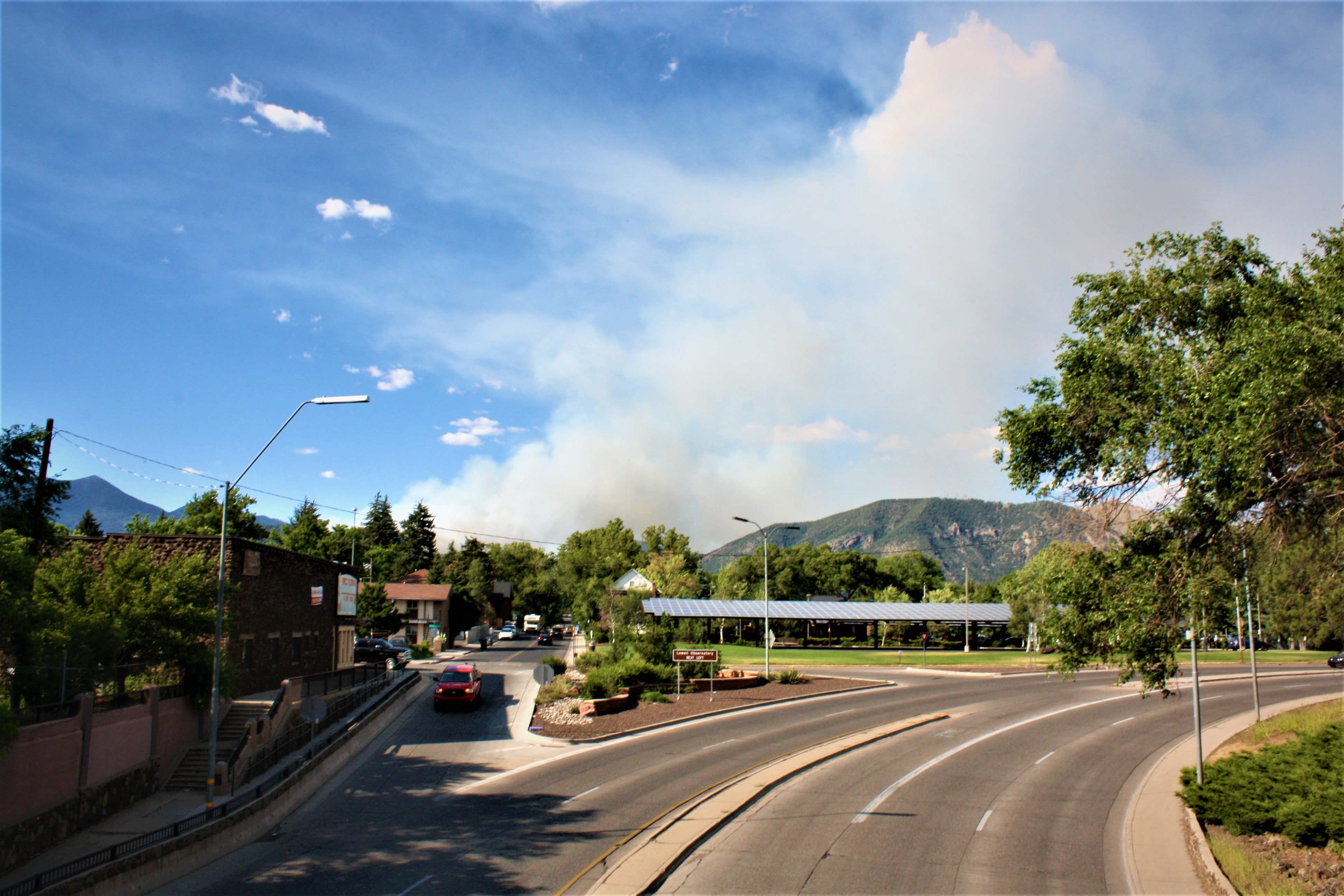
    It should be monsoon season in Flagstaff but the air is bone-dry and the only thing in the sky that isn’t hazy blue is a plume of wildfire smoke. I sit in a tea house while “Back in the USSR” plays on the radio, sipping oolong and watching passerby walk up Aspen Avenue in downtown Flagstaff. It’s just like the old days, or just like how I remember the old days, but something is different. I’m just like the passerby now. I can no longer be a smug local people-watching the tourists.

    My childhood in northern Arizona was defined by two local features: The inevitability of wildfires and the possibility of leaving for outer space. In 1884, a fire destroyed Old Town, leaving only the part of the city closest to the tracks. Ten years later, Percival Lowell founded an observatory on a hill above the city to look for life on Mars, though his research would later lead to the discovery of Pluto. Flagstaff is a city of dreamers, artists, mystics, and scientists. I landed squarely in one of these quadrants, or all of them.

    I left Flagstaff four years ago. It’s not as if this city is completely different. Instead, Flagstaff to me has entered the uncanny valley. It’s familiar enough that I recognize it for what it’s supposed to be, but enough of it has changed that it just doesn’t feel right. I am also a different person. We meet one another, the city and I, halfway at our respective crossroads, doing double takes.

    Still, I have connections. In a tiny house in a semi-familiar neighborhood, I help fold veggies into egg roll dough with four Flagstaff friends, two married couples, both of whose weddings I missed because I was traveling or had already skipped town. We sit outside under strings of lights in the now seasonably warm evening air and catch up.

    I used to live with one friend here in a house on Talkington Street near the ski resort. I’m glad how familiar this scene still is, how easy it is to cook with friends after so long apart. Later, we chat about people we remember from high school, wherever they’ve ended up. Sammie shows me an art project. Cari is going to seminary in New England in a few weeks. Ryan is preparing another album after a month-long tour.

    This is the Flagstaff I have always known, catering to the ambitious and the adamant. Following the emergence of art, mysticism, and dreams, though, there is always some form of commercialization, and Flagstaff is not immune from the power of Capital to market nostalgia.

    It’s fitting that the first settler structure here was a saloon, before the loggers and miners moved in. Gun violence was commonplace. In one apocryphal account, there was a saloon murder every week between 1882 and ’83. Were it not for the scientists who took an interest in the region, John Wesley Powell and Percival Lowell, Flagstaff would have likely become one more ghost town or company town, its residents finally driven out when logging and mining came to a standstill. Instead, Flagstaff became a tourist town and a college town. And, at a certain point, the college experience is sold to high school graduates using the same advertising techniques that tourist traps use. Come for the mountain view, stay for the nostalgia.

    Except, most people who can afford to stay in Flagstaff are long-time residents. And expensive student housing structures have popped up across from the tracks, and parking is now regulated with warnings and tickets, and there’s a fire close to my old neighborhood. The last few days I’m here, my phone is constantly buzzing with evacuation alerts and flash flood warnings from late rainstorms. I am used to waiting for evacuation notices. This is something they don’t advertise in the college brochures, to be ready to go at a moment’s notice, to have a bag packed at the door. And I heed the warning. I am ready to leave.

    -jk

    On Revisiting a Daybook I Gave Up On

    Garden.jpgHere’s what happened: on September 1, 2018, I started a daybook. My goal was to write a few paragraphs every single day, usually a detailed description of something I observed or did. The goal was to think in the present tense, to not compare moments, but simply describe what happened.

    I made it two months and six days, stopping short at Election Day, adding a few posts in November and December. By January, I cut my losses. Life got weird. I was involved with some political activism and needed to grade mid-term and term papers for my composition classes, and holiday travel coupled with other writing goals pushed the daybook out of my routine. What I have as a result is a detailed sketch of life in Moscow, Idaho, during the autumn of 2018. An artifact from which I can mine for inspiration.

    I wrote a total of seventy posts. Most of them were redundant, but some choice scenes emerged. Here is one scene: one evening in October, I stopped to pet a dog named Tuna outside the one good bar in town, the Garden, and a woman ran out to let Tuna lick her face. Tuna’s human apologized for the dog’s bad breath, but the woman said, “It’s okay,  I just had a shot of gin so I can’t smell anything,” before jogging off in the direction of the police station.

    I spent a lot of time in the daybook reflecting on the Muscovites I see everywhere. There is a man with a beard and a panama hat. There are the Neo-Confederate church members downtown. There are the activists I trucked with, a retired state senator I ate donuts with every Saturday morning in October.

    This last year, I’ve started to view my writing in the long tradition of creative nonfiction stemming from journalism: the dispatch, the report, the place study, the travelogue. I wonder how many notes essayists record that never make it to print, the observations that get cut. The simplest description of creative nonfiction I can think of is this: to describe what happened.

    In mining my daybook from last fall, I have now collected material for three essays by categorizing and cutting. I wrote a lot about food, a lot about politics, a lot about anxiety, plenty about the sheer weirdness of this town in the Idaho panhandle. I described, in the most boring details possible, what happened between September 1 and November 6, not just my experience, but the lay of the land writ large, the season, the changes and my acclimation to the changes.

    After the experience, I cannot recommend the practice of keeping a daybook strongly enough to other writers. It is tedious and boring in the moment, but so is exercise and meditation and learning to play music. A daybook for a writer is like scales for a musician. It is foundational, elemental, the bedrock of storytelling and keen observation. Maybe I’m becoming more of a reporter like Joan Didion, Truman Capote, Tom Wolfe. Maybe I’m just doing what poets and novelists do to build image and character. In any case, my writing style has come out better for the exercise, simply a paragraph at the end of a long day, a scene, a drink, a ritual like prayer.

    -jk

    Essay Published in Blue Earth Review

    ZionI’m pleased to announce that my flash essay “After Zion” is the featured online nonfiction for the next print issue of Blue Earth Review. It is what the title suggests: Dawdling after a long hike through Zion National Park. You should also check out the featured fiction and poetry for this issue while you’re there.

    This short essay, along with one recently published in Dark Mountain, is one in a long string of environmentally-focused flash essays I read back in September as part of an Idaho MFA tradition, the yearly symposium: Each second-year student reads a selection of their work in a low-stakes setting, usually a faculty member’s house, and responds to questions and comments about their work to prepare them for their third-year thesis defense. Two-thirds of the flash essays I read at my symposium have found homes in print or online. Does that mean that I will only successfully defend two-thirds of my thesis next year?

    -jk


    Essay Published in Dark Mountain

    Sunset in the WoodsI’m pleased to announce that my flash essay “Notes on Preparing for a Wildfire Evacuation” appears in Dark Mountain 15, which is themed around forest fires. The Dark Mountain Project is a UK-based literary and arts organization whose goal (they literally wrote a manifesto about it) is to use art to realistically address global ecological crises.

    Much of my writing is environmentally focused, and this particular essay is about growing up in the mountain West, where wildfire season is a yearly, ongoing fact of life. I’m glad to have an essay in Dark Mountain, and I’m glad for the encouragement for the weird, at times discomforting direction my personal essays are going. Now that I live in northern Idaho, wildfire season remains a fact of day-to-day life. So too, though, are forests and mountains, the quieter features of the mountain West, the areas I’m used to exploring freely, that I hope to continue to explore. My writing will inevitably dwell on forests and fires alike. Now that I am about to enter my final year in an MFA program, as I prepare a book of essays for my final defense, I’m grateful for institutions like Dark Mountain whom I can trust with my weird, discomforting work.

    -jk

    Essay Published in Split Lip Magazine

    highway 43 2

    I’m pleased to announce that I have an essay in the August issue of Split Lip Magazine. It’s titled “Faking It,” and it’s a creative nonfiction essay about the time I sold my soul to the devil. It might be called excessively creative nonfiction.

    Feel free to read it, but also check out the other work this month and in the archives. Split Lip publishes a small handful of writers each month, as opposed to many other journals who feature a lot of writers two or three times a year.

    For me, this is an honor, and also a good way to kick off the semester on the first day back to work for TA training.

    -jk

    After Hibernation

    SpringI found out recently that bears do not, as I had previously believed, hibernate. Now my whole world is thrown into chaos.

    I’ve been thinking about bears a lot lately. I took a short trip to Montana last weekend to visit my grandparents, and though I didn’t see any bears, the few I have seen crossing the road, if my memory is correct, have been in Montana. I passed the University of Montana, whose mascot is the Grizzly, and was saddened to discover that they will likely be cutting many of their programs, including English. My grandfather and my father both have pointed out to me it’s a good thing I didn’t get accepted into UM because of their financial issues. I could have been a Grizzly, but in the long run it’s better that I’m not.

    Biologically speaking, I am not a bear, but I share a few characteristics: I have a special affinity for honey and berries, I possess a quantity of brownish unruly fuzz, and I require a lot of alone time. Also, I like to stand in front of a river and wait for fish to jump into my open, gaping jaw, but who doesn’t? Most importantly, I have always appreciated bears because they hibernate, or so I thought. I, too, have always thought of myself as hibernating, but if I was wrong about bears, I might be wrong about myself.

    Hibernation is absolute isolation. Other species hibernate because they literally sleep the entire winter, clicking off their other functions to preserve heat and energy. Bears, on the other hand, wake up periodically during the winter months to leave their dens. During winter, they stay in their dens with stored energy and warmth, but move about to replenish their needs, but only sometimes, when it’s necessary. Bears don’t hibernate; they’re just introverted.

    It’s unlikely that bears clack away on a typewriter during winter, crescent moon glasses on their large wet bear noses as they squint their bear eyes at their bear memoir (beamoir) while taking a sip of mead and then glancing out of their den to contemplate the complexities and horrors of being alive. But if they did, I would sympathize.

    It was cold and rainy and almost snowing when I drove six hours to Montana through sloping mountain passes, driving past and in some cases over small secluded towns in the forests. I rarely leave the Palouse, or Moscow, or my apartment. I prefer long periods of seclusion storing energy, writing, digesting berries and honey and whatnot. But apparently, this is not hibernation. Even in summer, I burrow away to write and read. It’s more like conservation, if anything.

    Now that the weather in Moscow has finally become consistently warmer, I cannot justify staying inside my den all day. In some respects, I don’t want to. This has been the longest winter I have experienced in quite a while. It has been brutally windy, unpredictably cold, overwhelmingly sunless. It has become easy to stay inside my apartment in isolation, because going anywhere requires preparation, even on good days. For me, I’m realizing, this is true in other circumstances. But it’s comforting to know that what I do is not hibernation. I don’t vanish, I’m just resourceful.

    The road to Montana was clear and almost completely empty in the early morning. Low storm clouds obscured some of the mountaintops and dark green forests along the road. It was cold, but not violently so, and the clouds slipped away when I reached my grandparents’ house in the Bitterroot Valley. It was almost warm during the weekend excursion. As a break, it was even almost enough.

    -jk

    Etymology, From the Greek for Wordstuff

    Palouse 6At least 30 percent of creative nonfiction is devoted to reflecting on etymology. We examine the words we use everyday. Fruit, from the Latin frui, meaning to enjoy; paragraph, from the middle French for stroke, as in a painting; field, from the German Feld, for open country; language, from the Latin lingua for tongue. The trend in nonfiction is to meditate on the the roots of our language to explore its deeper, older meaning.

    But what about the etymology of etymology? The definition is embedded in the the word itself. It describes itself. The word etymology is self-referential, like a hipster trying to be ironic. Etymology is its own inside joke, wearing seventeen layers of irony. Etymology wears beanies with collared shirts and eats egg whites with spinach on whole wheat toast. Etymology knows what time it is.

    Etymology comes from the Greek etumos, for truth. It was adopted into Latin where it had a good life before going to middle French to mean a field of inquiry, and after graduation found its way into English, and then ended up in English departments, as the creative decision to plunge backward through itself into its own roots. Like all words that move from English to English departments, its meaning becomes questionable, which is why etymology is used so often in application, but not applied to itself. Worlds could end if etymology, too, was explored into its roots, dug up, transplanted to an essay, and placed in new soil.

    As field of inquiry into truth, in its origins, etymology is an artistic form. An essay could be an etymology, gathered into a collection of etymologies. An essay looks backwards, reflects, investigates. The sixteenth century French writer Michel de Montaigne, whose Essais established the literary tradition of using nonfiction to explore ideas, to “test their quality” according to the etymology of essay, may have simply been creating expansive etymologies, long-form etymologies, extended inquiries into truth. Maybe this is what the field of creative nonfiction, in all it encompasses, is meant to do. Journalism, biography, history, documentary, and auto-theory are all founded on etymology, rooted in root-seeking.

    I have only recently started using etymology in my writing, but I think it’s more than a trend. It’s a strategy, and one that is regularly tested. I am beginning to use this strategy more and more. When I write, I start on the ground and dig up the roots around me to see how far they go, to see where I can go from there.

    -jk

    Teacher Sweat Solutions, Ltd.

    shirt stainIf you’re a first-time college instructor, you may have heard this piece of encouraging advice on your first day: “Don’t sweat it!” Well, studies have shown that this is physiologically impossible. In fact, the classroom setting is designed specifically to create more sweat among teachers through a combination of lights, stress, and projectors to overheat the exact spot a teacher teaches in, and nowhere else. As a result, within minutes of teaching, teachers are inevitably drenched in a thin layer of sweat they know their students can see, even those students who spend entire classes with their eyes directed into their phone screens.

    We here at Teacher Sweat Solutions, Ltd., would like to offer you, a first-time sweaty teacher, a variety of solutions to alleviate what scientists and Rick who always shows up late to meetings have dubbed “frequent sweating issues.”

    1. To reduce the visibility of FSI, consider wearing only black clothes. This will make sweat stains visible only to the first two rows of students.
    2. Strategically reduce the heat in the classroom. Recent studies cited offhandedly by Rick that might have come from NPR but he can’t remember where suggest that body temperature increases the more teachers realize just how many of their students are judging them for mumbling or for saying “um” or for being a humanities professor who sometimes uses critical thinking. Consider turning down the heat and cranking up the AC. Your students can cope with it.
    3. Be careful with your layers. Wear a really tight undershirt and a really loose top over that, so that your undershirt can become a towel that almost never comes into contact with the rest of your clothes. No sweat stains! However, this solution only works if you do not move during the entire class period.
    4. Head sweat is a growing concern these days. Just ask Rick, who pointed out to you in the meeting he was late to that you look uncomfortably sweaty and offered you a tissue. Consider wearing a beanie or a bandana while teaching to mop up the sweat. Longer hair can also catch sweat, but be sure to wash it regularly.
    5. If all else fails, teach online classes only. This will make it impossible for your students to see the sweat you produce typing emails explaining to them that the answers to their questions are in the syllabus.

    Teaching is a risky career fraught with pitfalls and existential anxiety, and not just because tuition waivers are about to be taxed pointlessly while professors are scrutinized by petty, ideologically driven politicians. We can’t help with that, but we can at least help you reduce the visibility of your sweat while you anxiously watch the news unfold during your in-class free writes. We can’t reduce your stress, but we can help you deny that it’s there, like you do with the rest of your problems, Rick.

    -jk