Getting Over the Beats

on-the-road

“We’re all golden sunflowers inside, bae.” -Allen Ginsberg, probably

In high school, I took a creative writing elective, and the teacher assigned numerous Beat Generation authors. We read sections of Dharma Bums and “Howl” and numerous Jack Kerouac poems. It turns out that the influence of the Beats on a youngboredsmallwhitemale is that he starts wearing black button-up shirts and fantasizing about expensive liquor. After reading On the Road the following summer, I spent a great deal of time fantasizing about drinking absinthe on road trips through the desert at night while listening to something called bop. I bought used jazz records that I listened to once, maybe twice.

I thought about rebelling, but I was convinced that the key to rebellion was originality, and just about everything had been done before. I learned the value of originality from the Beats, who were apparently the very first people to realize that dharma and karma fall under the category of “hip.” I learned more from various articles summarizing the Beat Generation that I found online to save time, and it was there that I discovered how powerful single  arbitrary out-of-context half-cited quotes can be, even with no subsequent explanation. I thought about growing out my hair, learning how to sculpt with metal, driving a motorcycle, making out with trees, but they had all been done before.

As time went on, I encountered other writers and poets who influenced me in more nuanced, healthier ways. Had I kept up with my Beat fixation, I might have grown up to the kind of person who uses Kerouac quotes to make myself feel better about spending fifteen dollars on one local IPA at a bar I frequent only because the regular server is an aspiring country saxophonist named Cynthia. Or I could have become the kind of teacher who wears skinny dungarees and Pink Floyd T-shirts with holes in the front and sits on the desk telling his students that Jesus and Steinbeck were both Zen masters who shared some sweet flashbacks to one another.

I still dig the Beats sometimes, but that scene has passed. I’m still not sure what kind of writer I am, but I can’t be a Beat, or any other writer from the past. It’s better to write for and from the present. I’ve almost entirely moved on, man.

-jk

Writing With the Season

graveyard-walkI can’t tell you why I enjoy autumn as much as I do. Apart from the many holidays and the associated consumerism, I enjoy the aesthetic this time of year imposes on parts of the country. In my hometown of Flagstaff, AZ, the leaves on the aspen trees turn whole sides of Mount Elden a new, shocked shade of yellow. In my new home in Lincoln, NE, the season is just as magnificent, minus the mountain. It’s darker and windier every morning as I walk to campus. The nights are cool and toasty.

As a child, I once took a stapler to the woods and tried to “fix” the falling leaves. I was too young to understand the relationship between seasons and change. I liked the color green, and I was mortified that things could curl, turn red and yellow like infections, and fall to the ground. The pine needles, too, browned and plummeted. Before I could begin stapling the leaves back to the branches that I thought (wrongly) I’d be tall enough to reach, I wondered if maybe this change was good. If maybe it was supposed to happen. Maybe the leaves, like fingernails, would grow back to replace what has gone.

Now, I’ve come to prefer orange, red, yellow, and gold, but I still have trust issues with nature. I feel on edge watching it change, wanting it to be the same, but I can do nothing to stop the leaves from falling.

Autumn must be a good season for writers. I associate it with writing, at least. I associate these months with ghost stories and tall tales, and the existential crisis of trying to be static in a changing world. I associate the season with staying inside writing poems while eating pie or writing a novel every November. I want to celebrate the season, when I can, by writing, walking, and sharing. I enjoy the mystery, even the uncertainty. It’s a time to lean on the edge of our seats to see how the narrative will unfold.

Maybe autumn isn’t for everybody, but it suits me. I’m learning to enjoy the change.

-jk


Filling Office Hours

officeYou sit down at your desk awaiting students with questions. Some have already sent you emails with one concern or another; they have questions and it’s your job to answer them in office hours. So you wait.

You check your email; nothing. In looking at your schedule, you see you have readings, papers, and writing to do. You begin one project casually, expecting students to pop in. You’ve done that countless times to other professors, after all.

You finish your first project and check your email; nothing. Good. More time to write. You write. You write some more. You look up, and there’s a student, but she’s looking for another professor and is lost. You feel smugly accomplished as an educator for helping a lost student find the answer to her question (room 345, third floor, past the weird-smelling book case).

You revise an essay, check your email, and find yourself interested in the political spam in your inbox. You sign some petitions, feeling less accomplished than when you saved that student’s career that one time half an hour ago. No, ten minutes. Has it really only been ten minutes since?

You begin a new writing project and look up, just in case. Yes, you are happy you have this time to get things done, but what if your students have questions? What if they didn’t understand the assignments? What if their email just isn’t working? You want to be a good instructor; you want to be accessible. It’s the first part of your teaching statement, and you want to be like those other professors you had who were so available, so accessible, to save your life with their marvelous answers.

This time you simultaneously check your email and your syllabus to see if you listed the correct office hours and room number. Yes. Students can access it. You keep writing.

No students come by. Soon your office hours are done and you have completed all your work for the next week, plus submitted an essay to a literary magazine. Before heading out for lunch, you check your email one more time to find you have a new email from a student inquiring about the first paper’s requirements. Finally, you think, relaxing back in your seat, the work can begin.

-jk

The Next Morning

game 1UNL is empty as I walk through it early in the morning. The overcast sky dulls the stadium’s shadow. The sun is smothered and wind blows garbage around empty parking lots, sidewalks, concrete corners in the university maze. Red beer cups flounder down an overpass, and greasy napkins mingle with cardboard signs. Tongues of red licorice are flattened onto the sidewalk. A cap drowns in the mud.
Yesterday began with an earthquake in the morning, shaking me from my bed. Rain poured throughout the day over throngs of fans, and fireworks boomed like tanks around me. The streets were full. The streets were alive. Today, they are empty. I feel like I’ve walked onto the set of a zombie movie filmed in faded tones. There are no fans around the next morning. There is only the left-behind collage of plastic and paper and half-eaten food, and of course the alcohol.

Somewhere in the detriment is a cross, a necklace that fell from a fan. Or maybe it was torn, or fell from a pocket. It’s just another post-game testament to football’s force here. The stadium rises like a temple; didn’t some messiah once point to a football stadium and declare that not one brick will be left standing? Didn’t some messiah once bless a team to win the next game? The stadium looks unused, run-down after rain and the mass of fans. Nothing could keep them away.

I wonder where the heroes have all gone to. I grew up witnessing people ruin sports for me through doping scandals, gambling, dog-fighting, domestic violence. I learned the consequences of commodifying people, the exploitative measures taken to earn a profit, the cost of products sold. Who cleans up the mess? Who loses a parking lot in exchange for more playing space? Whose funding gets cut? There must have been heroes here and there, some legendary folks who made the sport an art and not a business. But for me, they departed a generation ago and live only in history, and it is just an empty stadium surrounded by trash right now. Trash, and one small piece of jewelry that I leave where I found it. It’s not mine to move. It’s not mine to rearrange. I leave it as it is.

-jk

Running Into Foucault at the Supermarket

cash stash

So there you are at the supermarket deciding whether or not it’s a macaroni and cheese week or more of a spaghetti week, and you turn a corner and there he is, Michel Foucault, judging wine in the wine section. You stare for a moment; his basket is mostly bread and wine and a pair of binoculars, and then he sees you, and it’s too late. He’s going to ask you if you’ve read his books yet. There’s no escaping it. You smile, he smiles. You ask him about the wine. He’s polite enough when you tell him no, not yet, but it’s in your reading list, you promise. You apologize, so he’s probably not hurt. Right?

It doesn’t help that Jacques Derrida is backing up the cash register with all his cheese cakes. He asks you how it’s going, but reads more into your answer of “fine” than you thought he would. You smile and ask him how Bourdieu is, but Derrida just keeps going on and on about how Foucault ruined his dinner party, and he’s throwing another one this evening with a book signing and everything, and you’re welcome to come of course, and you say no, so he guesses correctly that the subtext of “no” is actually “I’m so sorry but I still haven’t gotten to your work, please forgive me for being the skunk-flavored latte that I am.” You buy your spaghetti in silence.

You drop by the bank on your way home. While waiting in line you get bored, so you get on Tinder, and then there he is, Foucault, looking all smug in his first picture. Casually, you read his bio, which is the most Foucault you’ve actually read. “French writer and critic up for whatever. Let’s be visible together.” Your only common interest is wine; you swipe left after a moment’s hesitation.

You make it home, put away the spaghetti, and start working on your laundry. At the laundromat, you see Foucault again, leaning over a table with a pile of dark clothes, some of them folded. He is on his phone, his thumbs padding on the screen furiously. He doesn’t see you, thank God. You dump your clothes into a machine fast, cram in the quarters, and realize you’re one short. You turn around; Foucault is gone, clothes and all.

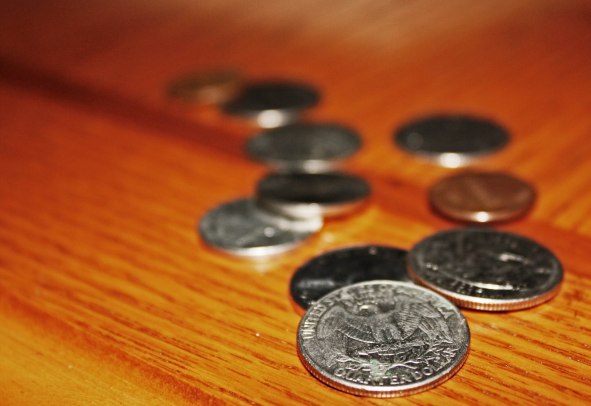
You should have said hello; he might have spared you a quarter. You begin crawling on the floor to look for a quarter someone might have dropped. You try, perhaps desperately, to remember where you left Foucault’s book on your shelf, with your unread Freud or your unread Butler. Sometime you’ll get to it all, but you are still short by a quarter. You think, “You will always be short a quarter,” but can’t remember if that’s existentialism or postmodernism or something else altogether. Either way, you are now covered in dust and you still don’t have a quarter. Like always.

-jk


It’s in the Syllabus

Calander 2In a week, I’ll be teaching two sections of an introductory English class using a syllabus of my own design, for my graduate program. I can choose the readings, assignments, and discussion topics, all within reason, of course (I probably wouldn’t be allowed to teach my students math; lucky them). While I’ve been a TA and writing tutor before, I’ve never been in charge of a class for a full sixteen weeks. And now I’m charge of two classes.
For a while, I thought of syllabi as surreal artifacts that came from thin air, or maybe from elves living in the College of Business. Even until recently, I didn’t think too much about the amount of work that can go into a syllabus. Some good friends have given me advice, and while a few peers have suggested I improvise the whole thing, I’d much rather work with a script.

Drafting a syllabus felt like writing a script more than anything else. There are formal parts, class goals and policies on plagiarism, but most of it is a kind of script. I worry that I may not play the role of “teacher” well enough, but at least I’ll have a day-to-day plan to navigate my way through the semester.

As a student, it’s easy to jump to the most important parts of a syllabus, the due dates and assignment descriptions (so we can know which days we should study and which days we can party), but for a teacher the syllabus is more than a binding contract with students. It’s a way of making the act of teaching much less daunting. I can worry less about sixteen weeks when I see those weeks compartmentalized into individual blocks of time: here, a discussion about a short story; there, a brief note about logos, pathos, and ethos; after that, a short paper is due.

I look forward to teaching in a week, and I’m terrified of teaching in a week. By next Monday, I’ll know what to say one day at a time, and if I get stumped, I’ll know the answer is in the syllabus.

-jk


In the Tradition of Poems for Dogs

IMG_0128

Recently, I read Andre Alexis’s novel Fifteen Dogs. Among the many delightful things in the novel (that it starts with the gods Hermes and Apollo in a bar in modern-day Toronto, that the characters are mostly sentient dogs, that it’s filled with excellent descriptions and dog-drama) is that one of its main dog characters, Prince, becomes a poet who uses a unique poetic form intended to make sense to both humans and dogs.

The French poet Francois Caradec invented this form of poetry for dogs, and Alexis lends him credit for its invention. The form requires the sound of a dog’s name to be embedded in the poem. In this way, dogs will hear their name if the poem is read aloud, and respond in their dogly way by wagging their tails and analyzing the poem from a critical dog studies perspective.

An example from the novel, for the dog named Prince, is as follows:

“Longing to be sprayed (the green snake
writhing in his master’s hand),
back and forth into that stream–
jump, rinse: coat slick with soap” (Alexis 81)

The name Prince can be heard in the words “jump, rinse,” and supposedly a dog named Prince will hear it in the poem. The rest, apparently, will be the usual human nonsense Prince is used to hearing by now.

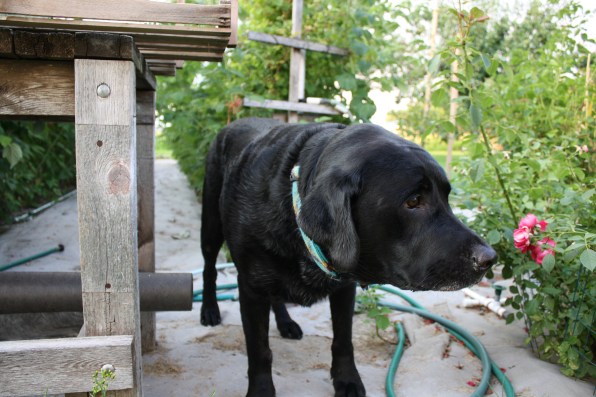
I wrote a poem in this form for my own dog, Pete, who has seasonal allergies and enjoys scratching his face on various surfaces, including people:

Rough carpet scratches
snatch up every face-itch
on the floor, sensations
to make easy sleep. Eat, sniff, dream
until the next itch, then scratch.

Do you have a dog? A pet? Write them a poem and see what they think.

-jk

Alexis, Andre. Fifteen Dogs. Toronto: Coach House Books, 2015

Graduate School, Season Two

teapotAmong the many things coming this Fall is the second season of me being in Graduate School. This next year looks promising, and I’m looking forward to the goofy Nebraska antics, the creative writing classes I’ll be taking, and finally teaching a class on my own.

I hope the next year of Graduate School corrects some of the mistakes of last season. For example, the protagonist last year came off as exceedingly pretentious, especially in his attitude toward the setting. The protagonist spent too much time complaining about the Midwest, and while the “missing home narrative” was compelling, it got old quickly. I for one hope the main character does more than sit around making bad jokes about the prairies.

The next season will most likely see more of the main character trying to get published, and the audience will enjoy the conflict between devotion to graduate studies versus the effort it takes to write, read, submit, and convince literary magazines to publish his work. Many of last season’s episodes focused on various low-stakes self-contained stories that take place in the protagonist’s apartment or the English department, which is why I hope Graduate School will venture out a little more this season. As a show with a whole city for a setting, it’s strange that so much of it uses only two interior buildings to shoot in.

The show has many strange components: the romance plots are all backstory, the drama is all internal, there’s very little dialogue, and the protagonist doesn’t seem to have changed in the first season, at least not in ways the audience would hope for. Where’s his arc?

The real question is whether or not Graduate School will go on for a third season, or if the show will wrap up with the protagonist just getting a Master’s Degree and stopping his college pursuits after that. Future years of Graduate School could be quite worthwhile, but without major character development, this could be Graduate School’s last year. In any case, I look forward to the season premier, and I hope the coming year will be, at the very least, entertaining.

-jk

Reading Terry Tempest Williams in Zion

Zion 2This week, I had the pleasure of joining one of my best friends for a trip through parts of southern Utah, starting in Moab and ending in Zion National Park. We went for the usual reasons (viewing nature, camping, hiking, burning a dictionary and cooking quesadillas over it). After hiking the Wildcat Canyon Trail (a good ten miles of limb-crunching views), we went to our campsite and read our selected book in the fading light, both collections of short pieces on the Southwest and West, Getting Over the Color Green and Northern Lights.

In Northern Lights, I stumbled upon an essay by Terry Tempest Williams, “The Clan of One-Breasted Women.” Williams grew up in Utah in the 1950s when fallout from nuclear testing in Nevada drifted beyond the test sites. As a result, many people downwind of the tests, including her family, suffered from radiation. Williams meditates in her essay on the many women (many in her family) downwind of the test sites who developed breast cancer from the radioactive fallout.


At the peak of the hike in Zion, I could see far, far out into the distance. I was surrounded by a place brimming with life; the whole area is a complexity of ecosystems overlapping, intertwined: red and tan oceans spotted green or lush with ponderosa and aspen or colored with sand and pale sunlight. Much of the Southwest doesn’t look alive to the untrained eye. Deserts play tricks on us by hiding their life, but life is always there. Overlooking Zion, I was overwhelmed and haunted by its history.

Zion

In the 1860s, Mormon pioneers founded a town near Zion, Springdale, and named the nearby canyon Zion. To Mormons, Zion refers to a gathering place for the faithful, and naming the canyon was an act of claiming the land for Mormon culture. But while pioneers were in the process of colonizing the area, the region was home to Southern Paiute communities pushed out by U.S. settlement. Like much of the Southwest, Zion is part of overlapping histories and state-sanctioned narrative revision.

The place was shaped by geologic hands, the fingers of rivers, a mind of clouds and rain, then engulfed with diverse flora and fauna, indigenous communities, overrun by Spanish colonization, Mexican statehood, Mormon expedition, and U.S. authority that ignored all previous layers by deeming the Southwest an absolute desert, a place so deserted they could safely test nuclear weapons there without harming anyone or anything worth mentioning. But Williams contests, as many do, that all of it is worth mentioning, worth respecting and preserving and revering.

After reading Williams’s essay, I stargazed with my friend in the desert where the stars are aggressively visible. The Southwest is misleading to those unfamiliar with it. The stars are brighter here, the air is heavier with scent, the land is rougher, and the going can be tough. Zion, a place of peace, a place of eternity, may be an apt name. The whole Southwest may be a kind of Zion, a refuge for wanderers and romantics. Its beauty is rare and atypical, taking on strange shapes and colors, rich sounds and haunting narratives. Its beauty is misfit and misleading, but in its presence it’s impossible to miss.

-jk