Author Archives: keeneshort

Unknown's avatar

About keeneshort

I am a writer in Southern Indiana.

Findings, Purpose, and Apology

Plumbbob Los Alamos National Laboratory Archives

View of Atomic Test During Operation Plumbbob, Courtesy of the Los Alamos National Laboratory Archives

“The fear and inability to question authority that ultimately killed rural communities in Utah during atmospheric testing of atomic weapons was the same fear I saw being held in my mother’s body. Sheep. Dead sheep. The evidence is buried.” -Terry Tempest Williams, 1991


On October 5, 1990, President Bush signed into law the Radiation Exposure Compensation Act, or RECA. According to Section 2 of the bill, Congress finds that “fallout emitted during the Government’s above-ground nuclear tests in Nevada exposed individuals who lived in the downwind affected area in Nevada, Utah, and Arizona to radiation that is presumed to have generated an excess of cancers among these individuals.”

During the 1950s and 1960s, as the United States military conducted nuclear tests in the Nevada desert, northeastward winds swept radioactive fallout into the mountain West, carrying fallout over the Southwest. The federal government spent decades telling citizens that the tests were harmless. First, sheep and cattle died, and soon people showed signs of radiation-related sickness. And the illness took its toll.

During the 1980s, there had been numerous efforts to introduce legislation such as RECA, but these efforts never made it through committee, in addition to several legal battles. Irene Allen v. United States, for instance, was an initial victory for downwinders in 1984, when District Judge Bruce Jenkins of Utah ruled in favor of ten plaintiffs, though the case initially “represented 1,200 individuals who were deceased or living victims of leukemia, cancer, or other radiation-caused illnesses” (Utah Historical Quarterly). Unfortunately, when the federal government appealed in 1986, the Tenth Circuit Court reversed the decision, and the Supreme Court refused to take the case in 1988. A year later, as the Cold War began to wind down and the USSR faced greater scrutiny for its mishandling of the Chernobyl disaster, Congress began debating compensatory legislation.

The version of RECA that landed on Bush’s desk in 1990 was introduced a year earlier by Congressman Wayne Owens, who briefly represented Utah’s 2nd congressional district. Owens, a member of the Latter-Day Saints, was born in Panguitch, UT, directly in the downwind path of radioactive fallout from Nevada’s testing sites. Owens became one of the last environmentalists to represent Utah, and was a dedicated advocate for those who lived in radioactive fallout zones northeast of the Nevada testing sites, people known colloquially as downwinders. RECA Covered Areas

RECA-covered areas, according to the United States Department of Justice.

Representative Owens himself was not in southern Utah during the peak years of atomic testing. During the infamous Operation Plumbbob in 1957, which included 29 atomic detonations in Nevada, Owens was serving his Mission for the LDS Church in France, fulfilling the expectation that all Mormon men spend two years as a missionary. His time abroad may have spared him the radioactive exposure that many of his constituents would gradually begin to suffer from.

Among those constituents was Terry Tempest Williams, who writes about her memories of growing up in southern Utah during the atomic tests of the 1950s and ’60s. Her essay “The Clan of One-Breasted Women” is a poignant family narrative, reflecting on the renowned health of Utah’s Mormon families who grew up avoiding caffeine, alcohol, and tobacco, and the outlying frequency of cancer in her own family, which she connects directly to growing up downwind of atomic tests, including Operation Plumbbob and numerous others.

The problem with compensation is the longstanding notion that the government’s sovereignty is infallible–that the king can do no wrong. But after World War II, it was the military, not the government, that reigned supreme. In the 1950s, President Eisenhower inherited a problem that Truman allowed to fester, specifically the military’s domination over scientific developments. In his 1961 farewell address, Eisenhower himself decried what he called the “military-industrial complex,” though he made no concrete gestures during his presidency to return atomic research to civilian hands.

The military, rather than the legislature, had seemingly indefinite control of the nation’s nuclear program. Civilians had no power to vote out generals whose finger was on the bomb–and historically, it was the generals, not the Truman, who made the decision to use atomic weapons in war. General Leslie Groves drafted the order to use nukes during WWII, showed the memo to Truman for approval, and proceeded to bomb Japan twice. Truman only intervened to prevent a third scheduled bombing on August 10, 1945. As Commerce Secretary Henry Wallace wrote, Truman worried that massacring “another 100,000 people was too horrible.”

Decades later, cancer in the West was an undeniable concern, and in the wake of such tragedies as the 1986 Chernobyl incident in the waning USSR, the consequences of atomic weapons testing returned to the foreground of public discourse. RECA may have been the most important piece of legislation that Congressman Owens passed. The bill includes a short subsection titled “Apology,” in addition to its attention funds for affected families, reading “The Congress apologizes on behalf of the Nation to individuals described in subsection (a) and their families for the hardships they have endured.”

RECA continues to provide monetary compensation for individuals who can prove that they are downwinders. The bill goes to great lengths to explain how individuals can prove mistreatment from the nuclear program, and this method has been regularly updated to accommodate new research and understandings of the effects of radiation.

The United States military has a long, painful history of using and abusing the Southwest, first in military conquest in the Mexican-American War, then for resource extraction, internment camps, and lastly as a place to test nuclear weapons. The military-industrial complex fundamentally altered the climate of the Southwest, literally changing the chemical compounds that the high desert winds pushed outward across the plateaus and canyonlands.

There is now a clear precedent for federal apology and compensation for the damage it does to the ecosystem, something worth noting as a group of young people are now close to successfully suing the federal government for failing to respond to human-caused climate change. But precedent doesn’t really matter. For Congressman Owens, there had been no precedent for RECA. For Irene Allen, there had been no precedent her own lawsuit. RECA has its limits, and Allen’s lawsuit was easily overturned. Using the rules of a system that allowed for injustice to try to correct that injustice is a deeply limited strategy, but RECA provides evidence for at least one thing: that the government is not only fallible, but can be forced to admit as much to the public.


After Five Years of Blogging

The Dry SeasonWordPress has reminded me, as it does, that five years ago today I started this blog.

I began it initially as a personal website, but as I move forward as a teacher, writer, and for better or worse an academic, I think this blog will likely become more of a professional website. All writers have them; it’s the one piece of advice all published authors have given me in addition to reading and writing a lot.

As such, I expect to write fewer posts for this blog. For a while, I was ambitious: 4 posts a month. I’ve been generally consistent, but I am beginning to realize that even I have limits. Amazing, right?

This year has been good for me, all things considered. I am into the second year of my MFA program at the University of Idaho, I had four good publications (short stories, poems, essays), I compiled a draft of a short story collection (kind of), I had my first writing fellowship, I improved my syllabus for ENG 102, and I also took up a volunteer position as the creative nonfiction editor for Fugue. I also carved out some time for traveling around Idaho and Montana, to linger in places I’ve often passed without stopping to take a closer look.

I don’t want my life to be purely academic, but in grad school, that’s difficult to avoid. I’m also myself not good about leaving time for life outside work. This next year, I will blog inconsistently as I focus on writing, publishing, and teaching. I asked in my first post, why pursue a liberal arts education? After five years of writing about it and as I enter my fourth year as a grad student, your guess is still as good as mine.

-jk


The Oil Party of 1973

Gas rationing in Portland, Oregon, in December, 1973, as a response to the oil embargo.

Gas rationing in Portland, Oregon, in December, 1973, as a response to the oil embargo. Courtesy of the National Archives.

“For we have only just begun our confrontation with our imperial history, our imperial ethic, our imperial psychology. It is perhaps a bit too extreme, but if so only by a whisker, to say that imperialism has been the opiate of the American people.” -William Appleman Williams, 1980.

“Words like ‘monopoly,’ ‘cartel,’ and ‘block’ thereafter achieved a remarkably sudden if selective currency, although very rarely did anyone speak of the small group of American multinationals as a cartel, a designation reserved for the OPEC members.” -Edward Said, 1981.


On December 16, 1973, a few thousand Americans celebrated the 200th anniversary of the Boston Tea Party by filing onto an imitation eighteenth century shipping vessel called the Beaver II and dumping oil drum barrels into the Boston Harbor. Onboard the ship was an effigy of Richard Nixon in a crown with the names of oil companies written on it. This Boston Oil Party coincided with a city-wide celebration of the 1773 Tea Party, for which Bostonians reenacted the original tea-dumping protest with empty boxes, to avoid pollution, and hurried through their reenactment as demonstrators made their way to the ship chanting “Nixon, Exxon, ITT: Drive the tyrants in the seas!” (Hall 125).

An article on the event published a day later in the New York Times reports that from “a powerful loudspeaker operated by the People’s Bicentennial Commission, the organizers of the demonstration, on the fourth floor of a nearby warehouse, a voice asked: ‘How many people think he should be taken to the boat and hung?’ An enormous cheer broke out.” But only the effigy was hung as demonstrators began another call-and-response chant: “Down with King George, Down with King Richard!”

The People’s Bicentennial Commission, or PBC, was, as Simon Hall puts it, a group of disaffected “veterans of the of the civil rights, student, and antiwar movements” founded in late 1971 “with the goal of democratizing the US economy” (117). The Oil Party drew American leftists who were frustrated with the rhetoric of the New Left’s response to the Vietnam War, which was grounded in a critique of American imperialism. The BPC was instead self-consciously American, in ways that are confusingly familiar to those of us in the twenty-first century: They waved “Don’t Tread on Me” flags and protested unfairly taxed resources. While ideologically opposite from the Tea Party of the early Obama years, the BPC had basically the same idea decades earlier: to locate solutions to present problems squarely in the past.

The BPC’s founder, Ted Howard, wanted to identify in US history an American tradition of protest to critique what he saw as simply a sudden turn in the wrong direction. Their target was Richard Nixon, the oil companies, and the military-industrial complex that exercised imperialism, most recently in Chile by supporting an anti-democratic coup against the newly elected Salvador Allende.

Nixon’s foreign policy, though, was a resurgence of Eisenhower’s, who himself had clashed with protestors during the Great Depression. Eisenhower vowed to prevent communist influence in nonaligned nations, but not through direct military action. Unlike Truman, who invaded Korea, Eisenhower preferred to make cosmetic changes through CIA influence. As a tool, he utilized the CIA to train rightist protestors in Iran, Guatemala, and the Democratic Republic of the Congo whenever these countries tried to nationalize one or another resource for their own benefit, rather than the benefit of American businesses. Kennedy and Johnson returned to direct action in Vietnam, and in reaction to the war’s unpopularity, Nixon returned again to Eisenhower’s brand of covert influence.

In October of 1973, Arab nations in the Organization of Petroleum Exporting Countries (OPEC), decided to work together to combat this kind of imperialism by placing an embargo on the US, to protest American financial support for the Israeli occupation of Palestine. The result was a financial panic with national repercussions.

To express their outrage, the Oil Party drew a connection between Nixon and King George III, in part of a long, ongoing dialogue in which Americans see their present in someone else’s past. Recently, it has become popular to compare the US to empires in antiquity. Cullen Murphy’s 2007 book Are We Rome? is one example, and much more recently the far-right has drawn this comparison to support dictatorial leadership, going so far as to compare Senator Mitch McConnell to Julius Caesar. Likewise, Yale’s The Politic published an interview with Donald Kagan in 2011 in which Kagan compares America to the Athenian democracy.

The parallels between Athens and Rome are easy to make, but are hardly original. William Appleman Williams observes in Empire as a Way of Life that the Founders “knew the ideas, language, and reality of empire from their study of the classic literature about Greece and Rome. . . It became, indeed, synonymous with the realization of their Dream” (viii).

To be fair, Kagan also notes that the Founders studied the Athenian democracy, but he emphasizes that they wanted to craft a state that would be resilient to conflicts like the Peloponnesian War between Athens and neighboring Sparta, claiming that because “democracies are commercial republics. . . they require the approval of the population to wage war, and that checks them because the people may have contrary wishes.” His point here seems somewhat naive. Where was this “check” during American influence campaigns in Iran and Chile? Where was this “check” during drone strike campaigns in Pakistan and Libya?

But Athens may be a useful comparison. Like America during the Cold War, Athens controlled trade routes and islands with their powerful navy. In his account of the Peloponnesian War, the ancient historian Thucydides describes one episode in which the island of Melos wanted to be neutral, to the ire of Athens. This scene, known as the Melian Dialogue, is re-imagined hauntingly in the British film The War that Never Ends, with Michael Kitchen, Stephen Moore, and Oliver Ford Davies:

The Melian Dialogue is one of the most accurate summations of US foreign (and domestic) policy throughout the Cold War, although George W. Bush would provide a much simpler summation decades later: “Either you are with us or you are with the terrorists.” This strategy left no room for nonalignment, and those who tried for independence, like Melos, like Chile, Iran, and the OPEC nations, would find themselves ruined in the wake of American interventionism.

The Oil Party of 1973 was a reaction to the flaws of this policy, but failed to address the broader scope of it. OPEC’s protest had lasting consequences because it struck the heart of the empire: Wall Street. This is perhaps why the Oil Party faced no consequences for calling for the hanging of a sitting US president. The impact of their protest was short-lived and limited, seeing a temporary corrupt leader when the oil embargo should have prompted them to look inward at their own democracy.


Hall, Simon. “‘Guerilla Theater. . . in the Guise of Red, White, and Blue Bunting’: The People’s Bicentennial Commission and the Politics of (un)-Americanism.” Journal of American Studies, vol. 52 no. 1, 2018, pp. 114-136.

Said, Edward. Covering Islam. Vintage Books, 1997.

Williams, Appleman Williams. Empire as a Way of Life. Oxford University Press, 1980.


Sunshine, Colds, and Swarms of Aphids: October in Moscow

Fall in MoscowThis week in Moscow, several disconnected events are converging. It is exceptionally warm, there are swarms of aphids–called blue ash aphids, local only to this part of the country and, I’m told, one other region on another unspecified continent–and a seasonal cold. I am subject now to all three.
The aphids are so many and so thick they look like snowflakes in the air, and it is impossible to walk anywhere in town without running into them. They catch in my hair and fall into my lap long after I go inside, and get stuck on my glasses or in my ears or up my nose. This blizzard of aphids under the sun is inescapable.

This week, I also caught The Thing That Has Been Going Around. The Moscow Plague. The spread, the disease. I notice that everywhere I live wants to somehow own the common cold. The Flagstaff Flu. The Nebraska Crud. It really is just the common cold, and on a college campus, when I collect my students’ free writes or share an office with conferencing faculty or go anywhere that students who live in Petri dishes known as dorms go, I will inevitably get That Thing That’s Been Going Around. I noticed it early, took action with vitamin C and tea with honey and plenty of nutrients and proteins, and am nearly over it now. The warm weather helps. The aphids are also trying to help, presumably by clogging my nostrils.

This is my favorite time of year in Moscow, though. Soon, it will be too dark and cold to go outside. The aphids are keeping my company, and I’m well, all things considered. If this town is teaching me anything, it’s that at any given moment, everything will happen all at once, without announcement. Swarms of things, plagues, unseasonably warm weather, on top of the smaller things: anxiety, publications, readings, short road trips, sudden deadlines, too many overlapping meetings, and a season so short it could be gone before I notice.

-jk

Short Story Published in Longleaf Review

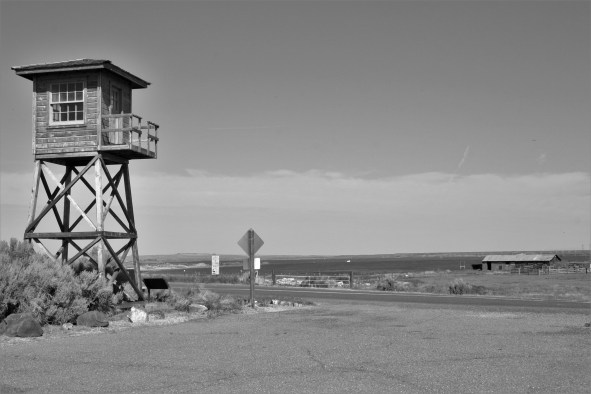
Guard TowerI’m honored to announce that I have a short story in Issue 4 of Longleaf Review, a relatively new and very cool online journal. The theme of the issue is aliens, just in time for the Halloween season, but the theme is broad. You can read my story “The International Congress for Kids Whose Dads are Commie Draft Dodgers,” among so many other great essays, stories, and poems. For me, this is one more historical fiction story, part of what I hope will amount to a manuscript for a collection. For now, though, I have a full, rich online journal to read.

-jk

Return from the Frank Church Wilderness: A Photo Essay

In the wilderness, public policy feels far away. But it has effects, eventually, inevitably. There is wildfire damage. There are species, or sometimes the lack thereof. This is the battleground for conservationism, but the conservationists spent too much of their time looking at the soil, not the sky. The air was filled with smoke one day while I was here, and the next day was clear. This place in central Idaho, this last wilderness, is a refuge, a haven. Given the failures of the environmental movement to solidify a real climate policy, or perhaps given the reactionary violence of counter-movements against environmentalism who have doomed my generation to extinction to preserve their precious branding, even public land that is preserved by the strictest laws will be affected by the inevitable. The connections cannot be felt, now, but what happens in D.C. will eventually alter the air, water, and greenery of this place. But this stretch of wilderness, unlike the rest of us who visit it, will not go without a fight. These photographs will, in ten or twenty years, be testaments to what is no longer there, not entirely. Soon, these will be photographs of spatial ghosts.


-jk

The Phoenix Oligarchs

Phoenix Democrats campaigning for Goldwater in 1958.

Phoenix Democrats campaigning for Goldwater in 1958 (Shermer 166).

“Lookouts perched high above the red butte looming to the side of the town spotted the caravan of government vehicles flowing out of the Kaibab Forest like a lava stream. . . As planned, they lit a stick of dynamite and sent it up and over the town, alerting those below that the raid had begun, and to be ready.” -Martha Sonntag Bradley, 2011.

“The two great forces pulling Arizona are California and Texas.” John Gunther, 1947


On July 26, 1953, the town of Short Creek, Arizona, witnessed a scene from an old west movie: The law came to clean up the town. The predominantly Fundamentalist-Latter Day Saint community may have seen it as the inverse, though, as corrupt outlaws leading a kidnapping raid on an innocent, God-fearing frontier town.

Martha Sonntag Bradley describes the Short Creek Raid as a dramatic episode, writing that when Mohave County Sheriff Fred Porter “climbed out of his police car, the first to enter town, he was greeted by the group’s religious leader, Leroy Johnson” who confronted the Sheriff by telling him “that they had run for the last time and would stand and shed their blood if need be” (12).

The raid was part of a crusade from governor John Howard Pyle and Arizona’s new GOP to make the state welcoming to post-war businesses by “cleaning up” its national image. In 1951, only a year in office, Pyle hired a private investigative firm from Los Angeles, the Burns Detective Agency, to investigate the conditions in Short Creek. By 1953, the Burns agency provided enough evidence for Pyle to order 102 officers to take all but six Short Creek residents into custody, including 263 children. On that day, he justified his actions on radio, saying the state “now has substantially concluded a momentous police action against insurrection within its own borders” and that police “arrested almost the entire population of a community dedicated to the production of white slaves” (Bradley 6).

The raid played out like a confusion of tropes, the culmination of Arizona’s changing political landscape. A few years earlier, a host of new political elites in Phoenix began a campaign to rapidly rebrand the state from a lawless frontier wilderness to a polished, suburban business-friendly sunbelt state.

Up to this point, many Arizonans had supported Pyle’s reforms, but the images that emerged from the raid of police officers separating children from their families on purely religious grounds horrified people enough to vote Pyle out of office two years later. Pyle’s reforms were seen as an overreach, but should be seen as the extension of a larger political trend based in the state’s capital.

Pyle came from a coalition of Phoenix-based business elites who had recently swept into several civic offices in 1949 (100 years after the polygamist Brigham Young claimed the Southwest as the independent Mormon state of Deseret). They all ran together on a pro-business platform, intending to run Phoenix essentially the way they ran their own enterprises.

They called themselves the Charter Government Committee, or CGC. Its fist members included local department store owner Barry Goldwater, a lawyer and college fraternity mate of Goldwater’s named Charles Walters, Phoenix mayor and disaffected Democrat Nicholas Udall (a former businessman from the Udall family), Hohen Foster (who owned a bottling company), Margaret Kober (active in local charities and married to a prominent Phoenician doctor), Frank Murphy (who worked in life insurance), and Harry Rosenzwieg, a childhood friend of Goldwater’s whose family owned a string of jewelry stores. They also had support from Eugene Pulliam, who owned the Arizona Republic and Phoenix Gazette, and openly used his newspapers to support the CGC.

United by shared financial interests, these eight Phoenicians met a divided opposition. Arizona had long been run by Jeffersonian-style Democrats, but the state’s labor movement had gravitated to the party in support of FDR’s New Deal. At the turn of the century, the Industrial Workers of the World had been instrumental in organizing miners’ unions in Arizona’s copper towns like Jerome and Bisbee. However, Arizona’s labor movement was consistently hampered by the state’s conservative Democratic leadership who were disinterested in workers’ rights.

Elizabeth Tandy Shermer notes that “Labor movements in the West flourished in the 1940s” (682), and pinpoints union-busting as the first battleground for the emerging proto-New Right in Phoenix. In 1946, the business leaders who would later form the CGC first campaigned for a statewide right-to-work initiative, which passed as a result of their aggressive, close-knit efforts. During this time, Goldwater drew on his own history of editorials railing against the New Deal throughout the 1930s, and it was his reputation as a capitalist public figure that “helped create a network of anti-regulatory, anti-labor Phoenicians” (686). Shermer notes elsewhere that many conservative Democrats began endorsing CGC candidates, seeing in Goldwater a return to Jeffersonian tendencies, leaving the party’s labor leaders even more isolated (Sunbelt Capitalism 166).

Goldwater and his compatriots were not satisfied with a right-to-work initiative alone. They wanted to sell Phoenix, and to Goldwater, “selling Phoenix also meant creating the proper community environment” (Goldberg 71). To that end, he “lobbied Arizona legislators to send the right message by cracking down on gambling” (72), as well as prostitution. The goal was to change Phoenix from a saloon into a department store.

In 1952, the CGC went on to win the governor’s office. Pyle actually hired Goldwater to run his campaign, and Goldwater literally flew the candidate across the state to meet voters in rural and Native American communities, a contrast to Goldwater’s later indifference to Native interests when he discussed selling indigenous land for uranium mining.

Pyle’s attempt to end “polygamist insurrection” was the next logical step of the CGC’s plan to sell Phoenix as a safe investment. Pyle’s mistake was to implement this plan in the loudest way possible, parading the end of the lawless frontier out to the public. His law-and-order style authority was a bad branding move: Phoenix needed to look like it had always been owned and operated by modern upper-class nuclear families, like it had never been a liability for stakeholders.

But Pyle being booted from office made no difference. The CGC managed to run Phoenix like a committee of shareholders, concentrating the state’s power to the capital and making that power as friendly to privatization as possible. What began as a city council election became the creation of an almost unstoppable political machine that ran the city for the next two and a half decades.


Bradley, Martha Sonntag. “A Repeat of History: A Comparison of the Short Creek and Eldorado Raids on the FLDS.” Modern Polygamy in the United States ed. Cardell K. Jacobson and Lara Burton, Oxford University Press, 2011.

Goldberg, Robert Alan. Barry Goldwater. Yale University Press, 1995.

Shermer, Elizabeth Tandy. “Origins of a Conservative: Barry Goldwater’s Early Senate Career and the De-legitimation of Organized Labor.” The Journal of American History 95.3 (2008), pp. 678-709.

Shermer, Elizabeth Tandy. Sunbelt Capitalism. University of Pennsylvania Press, 2013.


Into the Frank Church Wilderness

In a few days, I will drive south of Moscow to McCall,  hop on a bush plane at a nearby airstrip, and fly into the Frank Church Wilderness in central Idaho. There, I will spend a week writing in a cabin, in what is arguably the last stretch of land in the lower 48 that still counts as true wilderness. The cabin is connected to the Taylor Ranch research station, affiliated with the University of Idaho. For one free week, I will write, read, and reflect, all in a world without phone service and effectively no internet access. When I return to Moscow, it will be the first day of autumn, but the seasons are already rapidly turning.

This is my first writing fellowship, ever, and I’m lucky enough to have a program that sponsors such a fellowship. It will probably be my last writing fellowship, ever. I intend to make the most of it.

I won’t be completely alone. Some UI students spend a semester at the research station, and an ecocriticism professor (one who led the movement in its early days) will be there for part of the week. But I will have plenty of time to myself, to my thoughts, and hopefully to my writing, which is good, because I have had almost no time to write so far this semester.

I’m told the bears will be preparing for the winter, not hibernating (they don’t hibernate, as loyal readers will remember from an earlier post). A fellow nonfiction writer in the program who is familiar with the wilderness tells me that the area mostly has black bears, who will be filling up with wild berries (as will I).

This isn’t a vacation, but a writing opportunity. I need a direction for my thesis; I have essays to write, ideas to explore, maybe even a poem lurking somewhere. I will not be preparing for winter like the bears, but instead will be preparing for a practice thesis defense two weeks after I return (which, of course, I accidentally scheduled on my advisor’s birthday with my usual terrible timing). I’ll have a week free of teaching, classes, and other obligations. So I intend to make the most of it.

-jk


On Starting Yet Another Daybook Again

DaybookI’ve never been good at keeping journals. I’ve started many, but I leave them behind soon after starting them. I’ve tried keeping traditional journals or more work-related daybooks, and once I even tried keeping a dream journal, which was redundant because most of my dreams involved spiders or missing a deadline or sometimes missing a deadline given to me by the spiders.

I know it’s a good habit, not just for writers but for anyone with too many thoughts and too many tasks. It can be therapeutic, and a few times even was. But I’ve never managed to keep a journal for more than a few weeks, despite being a creature of habit. Last winter, I woke up at 6 every morning and exercised for half an hour, and ate the same meal every night for dinner (a can of beans with salsa and cheese). I’m good at regimentation, except when it comes to writing.

I don’t count this blog as a daybook, either, because it’s the opposite of habitual. I post inconsistently, and I have no specific topic. Last year I wrote twelve posts about the Russian Revolution between attempts at satire and wannabe McSweeney’s rants. This year I’m writing twelve posts about American history between joke recipes for smoothies and self-referential metablog posts. This blog is more like an intellectual junk drawer where everything that isn’t easily categorized finds itself one way or another.

Today, I started another daybook. I don’t know if I’ll see it through to the end of the year, but I want to write at least a paragraph every day. Maybe posting about it here will keep me in check; maybe the theme (observations about Moscow from September to May) will make it easier to write consistently. Lately, I’ve wanted to write about this weird place I now live. There’s a lot of take in, even for such a small town. Or maybe because it’s such a small town, there’s a lot to take in, just around the corners, subtle but always there.

My first entry in the daybook was about Farmers Market potatoes. Tomorrow, I hope something just as engaging will fall into my life.

-jk

Locating Gabriel Over the White House

Gabriel Over the White House 2

“The soldiers threw tear gas at them and vomiting gas. It was one assignment they reluctantly took on. They were younger than the marchers. It was like sons attacking their fathers. . . MacArthur was looked upon as a hero. And so the bonus marchers straggled back to the various places they came from. And without their bonus.” -Jim Sheridan in Hard Times, by Studs Terkel


Less than a month after Franklin D. Roosevelt’s inauguration on March 4, 1933, MGM released one of the first films to directly confront the Great Depression: Gabriel Over the White House. A fictional president named Judd Hammond, played by Walter Huston, is revealed to be a self-absorbed, party-loyal moron who ignores the protests of impoverished WWI veterans marching on Baltimore demanding fair compensation for their service, a direct reference to the historic Bonus March of 1932.

Spoiler alert: the film gets weirder. Hammond races his car, crashes, and is temporarily comatose. When he wakes up, he becomes possessed by the Angel Gabriel. Now under spiritual control, Hammond confronts the marchers, promising to create for them an “army of construction” to guarantee employment.

Facing impeachment from congress, he declares martial law and embraces accusations of dictatorship, proclaiming that he believes “in democracy as Washington, Jefferson, and Lincoln believed in democracy,” that his will be “a dictatorship based on Jefferson’s definition of democracy: a government of the greatest good for the greatest number.” Hammond then creates a Federal Police to round up and publicly execute Prohibition-era bootleggers, many of whom are portrayed as immigrants. The film’s climax is an international summit held at sea, where Hammond annihilates empty warships using an ultra-powerful Naval Air Force bomb, to force the international community into a permanent peace, warning that “the next war will depopulate the Earth [with] invisible poison gases, inconceivably devastating explosives, [and] annihilating death-rays.” Terrified, the international community agrees to their universal disarmament.

Gabriel Over the White House portrays a Washington insider who abolishes the law to solve several national crises, the logical antithesis of a later Depression-era film, Mr. Smith Goes to Washington, in which a Washington outsider masters the law to solve a small local problem. Ideologically, these films are worlds apart, but they both praise the same three American leaders: Washington, Jefferson, and Lincoln.

The film’s backstory is worth revisiting. After being fired from Paramount, producer Walter Wanger began working for MGM to make ends meet. When Wanger secured the rights to the story of Gabriel Over the White House, he pushed the film into production as quickly as possible on a budget of just over $200,000, “to avoid the scrutiny of [MGM manager] Louis B. Mayor, a dedicated Republican” (Carmichael 164). By February of that year, a month before FDR’s inauguration, the newspaper mogul William Randolph Hearst began aggressively micromanaging the script’s content.

Hearst and Wanger had ties dating to 1917, and after he began working for MGM, Hearst offered him financial support. Hearst, who disliked FDR but supported his running mate John Garner, was unusually interested in the film. He “ordered his own production company, Cosmopolitan Pictures, to take over production,” and it is “believed that Hearst himself wrote some of the speeches for President Hammond” (Shindler 112).

Several MGM managers took issue with the script’s political nature. Some worried that its portrayal of Congress as incompetent would motivate Congress to censor Hollywood in retaliation, while others decried its positive portrayal of dictatorship. The film seemed to communicate directly to FDR that he should solve the Depression by becoming a fascist: Hearst was a casual admirer of both Mussolini and Hitler, but in early 1933, such admiration was quite common. Both dictators would eventually be Time‘s Person of the Year.

By March, 1933, Mussolini had been in power eleven years, Stalin roughly eight, and Hitler barely a month. There were not yet wars, purges, or camps. Totalitarianism to many looked like a safe, if drastic, solution, and many Americans wanted a similarly authoritative leader to take charge and solve the economic crisis, regardless of ideology. The film is more a response to Hoover’s failings than FDR’s potential, and arguably its most important scene is its version of the Bonus March.

In the film, the president hears the pleas of protestors marching on Baltimore and responds by creating a federal jobs program. In 1932, the real Bonus Army marched on Washington and were met with a brigade of cavalry and tanks led by Douglas MacArthur and Dwight Eisenhower. At least one marcher died as a result. What little action Hoover took was one injustice on top of a dozen other injustices during the early years of the Depression. Ironically, Hoover’s response would become a defining tactic of totalitarian regimes: military action against civilian protest.

The most compelling scene is the one that corrects this recent injustice by presenting a fantasy of what Hoover should have done, which accounts for the film’s success and FDR’s own warm reception to it. We know that FDR planned to take critical economic action long before taking office. He stated in his inaugural address that Americans should treat the Depression “as we would treat the emergency of a war.” But FDR also took the time to write Hearst to say that he thought the film was “an intensely interesting picture and should do much to help” (Carmichael 174).

FDR admired Hammond’s decisive rhetoric, though it’s impossible to discern how much Gabriel Over the White House, and by extension Hearst, influenced his policies. Maybe it inspired his Works Progress Administration or his later war policies, or maybe it had no influence whatsoever.

There is at least one key difference between FDR and Hammond. While declaring martial law, Hammond cites Washington, Jefferson, and Lincoln; in his inaugural address, FDR makes no reference to any of these presidents. Hammond’s dictatorship is self-consciously all-American.

As president, Washington led the militias of several states to stop a tax protest in rural Pennsylvania called the Whiskey Rebellion, making him the only sitting president to lead troops into battle (against tax protestors, no less). Jefferson attempted to use the navy to force peace with Barbary Coast pirates, and later invoked executive privilege when he refused to hand over subpoenaed documents to the Supreme Court during the investigation of his own Vice President for treason. During the Civil War, Lincoln pushed a de facto martial law through congress and suspended Habeas corpus for Confederate soldiers. The difference with Hammond is that he does all of these things simultaneously.

The underlying assertion of Gabriel Over the White House is that an American totalitarian does not need to import an ideological foundation from abroad. The seeds are already sown in a long chain of temporary American totalitarianisms in which presidents responded to crises with extralegal overreach. Hammond’s presidency is a Frankenstein’s monster of cobbled together, home-grown authoritarianism. An American totalitarian will not look like Mussolini, Stalin, or Hitler, but will instead look just like Hammond: very American, and very familiar.


Carmichael, Deborah. “Gabriel Over the White House (1933).” Hollywood’s White House, ed. Peter C. Rollins & John E. O’Connor. University of Kentucky Press, 2003, pp. 159-179.

Gabriel Over the White House. Directed by Gregory La Cava, MGM, 1933.

Shindler, Colin. Hollywood in Crisis. Routledge, 1996.

Terkel, Studs. Hard Times. Pantheon Books, 1986.