
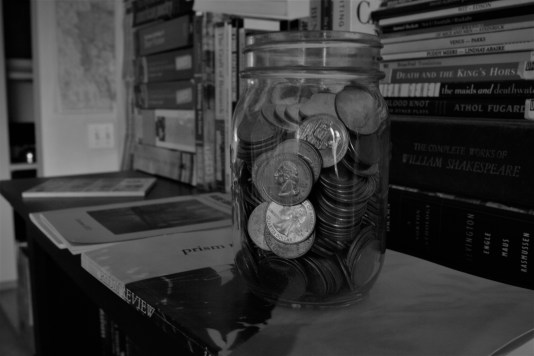
 Recently, I had a short story published in issue 20 of Prism Review, titled “The Next Best Thing.” This is good news, of course, and I’m honored to be featured in their journal. In addition to the contributor copy I received in the mail, the journal also offered monetary compensation. This was the first time in my life I have been paid for my writing. Even more exciting is that I have an essay debuting soon in an online journal that also pays its contributors. Twice this year, so far at least, I can say I’m a paid writer.
I haven’t done the math on this, but I know that what I’m been paid in writing this year will not meet or exceed what I’ve paid in reading and contest fees. I know these fees are important for literary journals to survive, and now that I’m volunteering for a literary journal in Idaho, I know how crucial these funds are. It’s standard to pay two or three dollars to submit to a journal online. In a way, it’s like gambling.
In an ideal world, the written word would be more collectively valued and publicly funded, and authors would be paid for their work, and ideally this would include journalists, reporters, and screenwriters. But this isn’t an ideal world. Instead, art is publicly devalued, journalists are called the enemy of the people, and production companies easily get away with underpaying their screenwriters.
To be clear, I didn’t go into writing for the money. If I wanted to be rich, I’d go into punditry or the gun lobby where writing fiction is valued. I’m not the kind of person who cares about, or really believes in, worshiping the bottom line or breaking even. I’m not struggling to make ends meet, but I’m still writing–and submitting–on a budget. I have to decide when to gamble and when to withhold a reading fee, and for many other writers, budgetary decisions are much more pressing.
The last thing writers and publishers need right now is to be divided over funding. Both of these things are true: publishers need to survive, and writers deserve to be paid. This is a balancing act, but it doesn’t need to be a competition. I hope I can more easily do what I can to get my writing into the world, and until then, I’ll happily balance reading fees and writing on a budget.
-jk
 “Commensalism or mutual benefit is a constitutive premise of housesitting, or maybe an enabling fiction. The housesitter is apt to recognize the opportunity as a private windfall, and the pleasure is tandem: first in his own dis-habituation, and then in the adoption of a new readymade home, a vacated life to try on. With the extra keys on his chain, the housesitter leaves work on a different train or by a new road, becomes a local in the café or dogpark, creates or stars in fantasies grown out of his new neighbors’ notice.”
 I found out recently that bears do not, as I had previously believed, hibernate. Now my whole world is thrown into chaos.
 For me, writing is a practice. More than a hobby, writing is a profession, though I’ve never been paid for it. Writing is work that I enjoy, but it’s not labor. It’s production, but not a job.
 The young short story begins with a bang as the author manages to write six thousand words in several non-continuous sittings over the course of two weeks, though the author will later describe it in workshop as a single moment of creative pure truth. The short story matures with each passing workshop, experiencing growing pains, expanding and then suddenly being cut by a thousand words repeatedly, and not just because Rick from workshop said it “felt a little novelish.”
 Stephen King once suggested that aspiring writers carve out time to write every single day, which probably works for wealthy retired people like him. For the rest of us proles trying to be writers, carving out time to write can be a challenge. There are, however, numerous ways one can make time to write.
 For almost a week, there has been an argument above me. I don’t know who is living in the apartment above mine, but it sounds like their fight has lasted days. As the drama unfolds, I stay where I am. Doors slam as I brush my teeth. Feet stomp over my kitchen as I wonder if my pasta is still too crunchy. I hear voices in rapid succession, back and forth, back and forth. I stay where I am, as if I’m living underneath a stage during rehearsals for a three-act play. I don’t know the story, and I never will.
 Keene Short