Tag Archives: World War One

Boots on the Ground

Civil War Soldiers

Statue Commemorating Civil War Veterans

Some of the best advice I received about historical research is that oftentimes the surest way to find sources is to have boots on the ground and look for sources in person. This usually involves going into public archives or getting access to private ones, but I’ve heard tales of finding rare documents forgotten in the trunk of a car or simply on display in a book fair. This week, while visiting family in Appleton, Wisconsin, I decided to experiment with boots-on-the-ground-history.

March to SocialismI discovered that historical research is more than just skimming through a few letters. It’s detective work, a methodological investigation, and I did not rise to the challenge. As I prepare to go to graduate school to study creative writing, I worry that I may leave history behind. History is close to my heart, but requires a patient diligence.
McCarthy

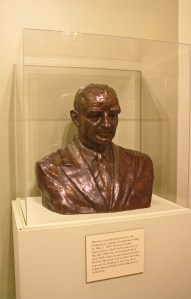
Statue of Senator Joseph McCarthy

The challenge of in-person research yielded a few interesting results. Appleton’s public history emphasizes its positive qualities, such as the fact that magician Harry Houdini claimed it as his hometown, though he was born in Hungary. There is a museum with an entire floor devoted to Houdini’s life and work. However, another famous man claimed Appleton as his hometown, Senator Joseph McCarthy, who engaged in congressional witch hunts during the early 1950s to remove suspected communists. Popular opinion has since turned against McCarthy, but as journalist Edward R. Murrow said in an open challenge to the Senator’s unethical methods, “He did not create this situation of fear, he merely exploited it.” Now that Red SpiesMcCarthy is remembered as an aggressive demagogue, his hometown has taken a statue of him that once stood in public view and placed it in a museum’s bottom floor, under the stairs.

Apart from some obscure anti-communist propaganda, one from 1950 and the other from 1967, a World War One Dough Boy memorial statue and a Civil War memorial statue, I could not find any major historical documents in Appleton’s history, simply because I did not look that hard. It is not surprising that they hide McCarthy’s image and highlight a still-popular celebrity. Any research on the Cold War in Wisconsin daily life would require interviews with those who remember it, access to radio and news archives, local newspapers, and other hidden sources. Perhaps I might be able to dig up a few rare pieces of propaganda if I looked deeper, or uncover a story of Cold War espionage, but such research requires more time and energy than I can offer. I’m not a specialist, or a driven detective. I am, for the time being, only an interested amateur.

Patriotic WWI Statue

Doughboy Statue Commemorating World War One Veterans

Perhaps I can one day conduct better historical research. Perhaps I will one day dare to dig deeper, open doors that should not be opened, find people who have answers. I was inspired by a year-old article about Amor Masovic, who has been looking for burial sites from the Srebrenica massacre in Bosnia-Herzegovina, in 1995. That massacre, part of the Bosnian Genocide, was the first act of genocide on European soil since the Holocaust, and one that the world ignored for years. Today, the perpetrators still live side-by-side with the families of the victims, and reconciliation is a great challenge. But Masovic pursues burial grounds, is still looking for the missing victims to piece together the community of Bosniak Muslims that existed before the massacre. He’s been working for nearly twenty years and there are still bodies unaccounted for.

Will I ever be such a researcher? Will I ever contribute to as admirable an effort as Masovic? It’s unlikely, but I do not want to leave history behind. I’m too compelled and too haunted by its ghosts to allow myself to give it up completely. History truly is obsessive, and maybe the only way to make a difference is to simply embrace that obsession, dig my boots into the ground, and dig as deep as the past will allow.

-jk


If Napoleon Had Won

View of Paris from the Louvre, by Lost Compass Photography

View of Paris from the Louvre, by Lost Compass Photography

Today, as we mark the two hundredth anniversary of Napoleon’s defeat at Waterloo and a definite end to his conquest of Europe, I wonder what would have happened if he’d won. If the French had defeated the British-led coalition, France would still have faced Britain across the English Channel, Prussia (part of modern-day Germany) to the east, and Russia even further to the east. In other words, Napoleon would have faced a potential war on two fronts, the same situation Germany faced in both World Wars. French forces were already stretched thin, particularly from colossal defeats in Russia, so it seems unlikely that the French would win a two-front war.

Perhaps Napoleon would turn to diplomacy. Britain historically fears a continental empire, preferring a divided and contentious Europe. If Spain, France, Prussia, Russia, and the Netherlands cannot work together, England can keep them from uniting against the island Kingdom. Napoleon would be wise, then, to turn to Prussia and make a political pact against Britain. Such treaties were common during the nineteenth century, eventually creating a complex alliance system that some blame World War One on. So, to avoid a military defeat, Napoleon turns to Prussia and promises to work with them if Britain or Russia ever turn against their interests.

What would certainly be known as the Franco-Prussian Alliance creates a strong central-European power. Napoleon dies decades later of stomach cancer, but in this universe he dies a hero. Statues are built to him, poems in French and German are composed, and peace settles now that Imperial France has secured its assets abroad. A Franco-Prussian alliance changes the shape of Europe completely. German unification never happens, but Franco-Prussia probably allies with Austro-Hungary anyway. As a result, the First World War pits central European powers against Britain and Russia rather than France and Britain against Germany and Austria. However, the combined strength of France and Prussia, along with France’s imperial allies of Italy, Spain, Portugal, Romania, and probably the Ottoman Empire, manage to defeat Russia and Britain. The U.S. never involves itself regardless of the outcome, and France gains all of Britain’s colonies. As a result, French becomes the dominant language in the world, no fascist dictators come to power, and the U.S. keeps to itself and Latin America.

Of course, this is not an objective speculation. Counterfactual history is subject to individual decisions as well, namely those of the historian. My own bias against fascism motivates me to see a possible way out of it. There’s no indisputable likelihood that there would be no World Wars if Napoleon had won a single battle. There may have been a worse war, there may have been no more wars, but there’s no way of knowing for certain. As such, counterfactual history can sometimes show more about the historian’s own bias than about history itself. In any case, thousands died at Waterloo, and millions have died in combat since. Speculating about how we could have avoided past conflicts, while intriguing, can be a distraction from how to avoid conflicts now.

-jk


Modern Turkey and a History of the Word Genocide

Photo of the Armenian Genocide Memorial Complex

Photo of the Armenian Genocide Memorial Complex

Earlier this week, an important but under-reported incident occurred in international politics. Brazil’s government passed a resolution to recognize atrocities committed against the Ottoman Empire’s Armenian population in 1915 as genocide, which dozens of countries and most historians already recognize. As a response, the Turkish Foreign Ministry responded by condemning the resolution, saying that it “distorts reality.”

This year marks the hundredth anniversary of the Armenian Genocide. One hundred years later, the use of the term genocide is still contentious. Historical truths can be malleable. In Brazil, what happened in 1915 is genocide; in Turkey, it is only a tragic conflict. The use of one word to describe an event might seem like a pointless semantic argument to some, but language is crucial when discussing history, and it’s important enough to spark discomfort between nations.

Part of the problem is that the Armenian Genocide occurred decades before the term genocide came into use. In 1915, the Ottoman Empire joined Germany and Austro-Hungary against Britain, France, and Russia in World War One; the Ottoman military, after a disastrous failed invasion of southern Russia, attacked civilian Armenian Christians through forced deportations, mass imprisonment, confiscation of property, death marches, and massacres. The total death toll is still in dispute, but a common estimate is 1.5 million Armenians. Some Ottoman officials thought the Armenians were a pro-Russian threat, and such an argument was used to justify the atrocities. After the war, the Allies carved up the Ottoman Empire, but an independent Turkey emerged after revolutionary forces took control of Anatolia. The revolution was partly led by Mustafa Kemal, a talented Ottoman military leader who defended the Gallipoli Peninsula during the War. Becoming the first president of Turkey, Kemal rewrote history to make the new Turkey a heroic nation. Taking control of national education, Kemal erased the Armenian Genocide from his new country’s textbooks and public discourse, and this pattern continues in Turkey today.

Despite a wealth of archival evidence, Turkey’s national investment in keeping the term genocide out of its history is wrapped up in the complicated nature of the word itself. Raphael Lemkin coined the term to describe Nazi atrocities during World War Two. Lemkin’s activism began much earlier; a Jewish migrant from Poland, he had heard many stories about Ottoman atrocities as well as pogroms against Jews. In 1948, the United Nations recognized genocide as an international crime in its Convention on the Prevention and Punishment of the Crime of Genocide, referring to it as requiring “the intent to destroy, in whole or in part, a national, ethnical, racial, or religious group.” Consequently, forced deportations and ethnic cleansing (the attempt to remove a group of people from a designated geographic area but not the group entirely) do not necessarily count as genocide (though they often lead to genocide, historically). Like most criminal matters, recognizing the Armenian Genocide, at least in a legal sense, requires proof that the perpetrators intended to erase the Armenian population from Anatolia through their physical and cultural destruction.

But for Armenians today, as well as countless activists and historians, genocide is not always a legal matter, but a matter of identity and truth. In Armenian collective memory, what the Ottoman military did goes beyond specific legal parameters; it was an assault against an entire culture resulting in the death of over one million people on the basis of a shared ethnic-religious identity. Its historical scars are still visible for many Armenians, but history is more than just past crimes; history is a living, evolving beast. Turkey’s refusal to recognize the Armenian Genocide is a direct attack on Armenians today. Such a refusal wipes away the validity and dignity of those Armenians the Empire slaughtered and the generations who are around today, the descendants of the survivors. Brazil’s resolution is a positive step, but real progress will come only when the Turkish government comes to grips with its predecessor’s crimes and its own complicity in the denial of those crimes.

-jk

World War One: The Unpopular Prequel to World War Two

World War One BooksThis semester I’m taking a senior seminar on World War One, for many different reasons: it’s an important event that changed the shape of the world in the twentieth century, I want to know more about it, it’s the hundredth anniversary. I’m also frequently disappointed by how often popular media ignore World War One.

European military history appears in popular arts on a regular basis. We have numerous video games, movies, and documentaries about World War Two. The History Channel has a long list of Hitler-fetish programs (Hitler and the Occult, Hitler’s Henchmen, Hitler’s Women), and in the U.S., WWII movies often come out on or near Christmas Day (Schindler’s List, Valkyrie, and most recently Unbroken, because there’s no better way to celebrate Christmas than by watching portrayals of crimes against humanity). I was excited this past summer when the History Channel announced a six-hour special on both World Wars, but was disappointed when it ignored much of World War One in favor of yet another biography of Hitler; I jokingly called the series Hitler: Origins. Complete with historical inaccuracies, it was effectively a Hollywood trilogy.

Nevertheless, there are some very good portrayals of history in popular media, such as the documentaries of Ken Burns and the BBC series Foyle’s War. These and others pay close attention to detail and often avoid simplifying history. The problem with so many popular depictions is that they present a simple Good Guy/Bad Guy narrative, to the point that World War Two is often reduced to a standard action movie format: bad guys do bad things to good people, good guys intervene, and there’s a happy ending. On the other hand, World War One resists this narrative completely: morally ambiguous empires kept promises to invade each other, millions died without significant progress, and nobody was happy about how it ended.

Popular arts can be useful if treated with the proper attention, and understanding World War One, I think, is sometimes more important than understanding its wildly popular sequel. The problem is that history never translates easily into narrative. It’s not a study of plot and characters, it’s a study of variable circumstance and decision-making without foresight, which can be messy, scary, and uncomfortable. It almost never works out the way we expect or want. Nevertheless, I long for better popular depictions of history. If the History Channel and Hollywood will not grant this wish, then I’ll simply have to do my part as a writer and contribute better, more accurate stories to the canon.

-jk

The 1914 Christmas Truce

December 24, 1914

Memorial for the 1914 Christmas Truce in Flanders, Belgium, where soldiers may have played soccer.

Memorial for the Truce in Flanders, Belgium, where soldiers may have played soccer.

“About five o’clock on Christmas Eve the Germans started lighting up Christmas trees in their trenches. We took no notice of them until they began to sing. Then we began to cheer them and to talk to one another as we are only about 80 yards apart.” -Rifleman C. Ernest Furneaux, British Rifle Brigade, January 4, 1915.

Along the Western Front in France and Belgium, soldiers waited in their trenches on Christmas Eve. British troops enjoyed puddings and cigarettes from home. Across the fields, sometimes only yards apart, German troops decorated small Christmas trees with candles. Both sides had started singing carols, and could hear their sworn enemies singing familiar tunes. French and British soldiers peered out of their trenches and saw hundreds of lights across the fields when curiosity took hold of them. Despite the language barriers and the months-long war, soldiers crawled out of their trenches, walked into the open air, traded gifts, and sang together. Some even played soccer, with a reported German victory of 3-2. They drank, sang, and celebrated Christmas on the battlefield. Later, many soldiers wrote about these events in letters to their friends and families.

“At dawn the Germans displayed a placard over the trenches, on which was written Happy Christmas, and then leaving their trenches unarmed they advanced towards us singing and shouting ‘comrades!’ No one fired.” -Unknown Belgian soldier, January 4, 1915.

The Great War began in August, 1914, and was expected to end before Christmas. By December, it was clear the war would drag on. Soldiers found themselves in appalling conditions. Sanitation was poor, food was scarce, and enemy gunfire was frequent. So, far away from home, threatened with death and disease, cold, hungry, and probably confused, many German, French, and British soldiers decided to stop fighting.

“The British burst into a song with a carol, to which we replied with ‘Stille Nacht, heilige Nacht.’ It was a very moving moment, hated and embittered enemies singing carols around the Christmas tree. All my life I will never forget that sight.” -Josef Wendl, German soldier, January 1915.

In some places, the Truce lasted until Christmas morning. In others, it lasted until New Year’s Day. Soldiers shared whatever food and drink they had, took the opportunity to bury their own dead, and befriended the men they were expected to kill. Some even joined together in a Christmas Mass on the battlefield. Suddenly, the Germans were no longer monsters trying to dismantle civilization; suddenly the French and British were not the greatest threat Europe had ever known.

“Friend and foe stood side by side, bare-headed, watching the tall, grave figure of the padre outlined against the frosty landscape as he blessed the poor broken bodies at his feet. Then with more formal salutes we turned and made our way back to our respective ruts.” -Unknown British soldier, January 15, 1915.

The ceasefire was spontaneous, informal, and technically illegal. Soldiers were forbidden from fraternizing with the enemy, which was relatively easy when trenches were so close, and such interactions sparked sympathy. Though common then, such fraternization is rare today.

In contemporary wars, it is easier to dehumanize the enemy because there are broader cultural differences. American troops during the Korean and Vietnam wars were told they alone prevented the spread of communism, and those Americans who celebrate Christmas now find it difficult to share that holiday with the mostly Sunni Muslim communities of Iraq and Afghanistan. Propaganda dehumanized communists as the negation of American values and contemporary media frequently call Muslim societies the antithesis of western culture.

“Further, they agreed that if by any mischance a single shot were fired, it was not to be taken as an act of war, and an apology would be accepted; also that firing would not be opened without due warning on both sides.” -Unknown Irish soldier, January 2, 1915.

But dehumanization is only a process of denial. No matter how well we deny it, everybody in the crosshairs is a human being. They all have families; they are all lost and confused and angry and shaken. It’s easy to deny the humanity of an Iraqi or a Korean whose language and culture we do not understand. But just like all Americans, they work like us; they make music like us; they bleed and yearn and gasp for one last breath like us.

The trenches were hell on Earth. Nevertheless, people chose to celebrate Christmas in hell. They chose to recognize their mutual humanity and stop their mechanized slaughter. We can learn from the Truce that peace is actually quite simple. All we have to do is realize that, no matter who we’re fighting, all we really want is good food, good music, and good company. If we all stopped listening to the propaganda and acknowledged how much we long for home, maybe we can stop the nonsensical industry of warfare. It may sound preposterous, but the letters prove that such an act, however brief, has a historical precedence. Who’s to say it can’t happen again?

Joyeux Noël.

Schöne Weihnachten.

Happy Christmas.

The War to Start All Wars

August 4, 1914

Political cartoon by Walter Trier (1890-1951).

Political cartoon by Walter Trier (1890-1951).

Today marks the hundredth anniversary of two major events in the First World War, Germany’s invasion of neutral Belgium to gain strategic access to France, and Britain’s declaration of war with Germany.

France was allied with Russia in 1914 through the Franco-Russian Alliance of 1892. Germany had declared war with Russia on August 1, 1914, to retaliate against Russia’s military organization and its allegiance with Serbia, which was in conflict with Austro-Hungary, Germany’s ally as part of the Triple Alliance of 1882 between Austro-Hungary, Germany, and Italy.

The conflict began with the assassination of Franz Ferdinand, heir to the Austro-Hungarian Throne, on July 28, 1914 in Sarajevo. The assassin, Gavrilo Princip, was one of six Slavic nationalists whose plot was intended to cut ties between Austro-Hungary and Serbia in order to create Yugoslavia as an independent, pan-Slavic state incorporating Bosnia, Croatia, Serbia, and other south-Slavic regions.

As the conflict escalated from a reactionary political crisis to a military conflict between powerful alliances, other nations entered the war, including Bulgaria, Italy, Japan, the Ottoman Empire, and the United States.

WWI

An estimated 9 million people died in the First World War. It brought to light outdated imperial agendas and alliances, introduced horrendous new military technologies including the tank and chemical weapons, and put on hiatus intellectual movements pushing for women’s rights, minority rights, and worker’s rights. Multiple nations are responsible for atrocities, including the German treatment of Belgian civilians and the Ottoman implementation of the Armenian Genocide.

Empires collapsed during the war. Irish and Russian political revolutionaries took up arms during the war, partially motivated by the appalling death toll by 1916 and 1917. As a result of subsequent events, England partitioned Ireland, the USSR replaced the Russian Empire, and the Ottoman empire dissolved along with the centuries-old Caliphate.

In a desperate effort to prevent another such war, the League of Nations was formed. So too was the Treaty of Versailles, which placed astronomical debt on Germany and fueled radical parties left and right. The aftermath of the War led to numerous other conflicts: civil wars, partitions, decolonization, and the Second World War. As a result of World War Two, superpower nations entered the Cold War, accompanied by the Space Race, Arms Race, nuclear proliferation, and military intervention in Latin America, Asia, Africa, and the Arab World.

The War influenced Modernism and ultimately obliterated popular perceptions of war as romantic. It changed art, literature, music, popular culture, and even cinema with the adaptation of Erich Remarque’s All Quiet on the Western Front.

The First World War was a humanitarian calamity; almost all conflicts today can be traced to the War. The exact causes are still contested. Some point to imperial allegiances; others point to an interest, especially by Britain, to suppress political activism from suffragists and socialists. Others point to a moment of panic among imperial leaders. Regardless of the causes, it repeatedly defined and redefined the twentieth century. Today, as Russia enters Ukraine, as Israel assaults Gaza, as complex networks of allegiances overlap and the U.S. flails when asked about whom it considers its allies, the conditions for a world conflict are strikingly similar.

The Great War mutilated the twentieth century, but it is not yet clear if it will do the same to the twenty-first. If political leaders panic in a moment of crisis and declare war within a month, world conflict may continue. Alternatively, we could all take a moment and consider the dangers of reactionary retaliation and ask ourselves if we want another century of war and genocide, if we want to see 9 million more dead for a war that can so easily be avoided. I hope that commemorations such as this one in London will motivate nations to pause before considering military action. One day, I hope military action will no longer be perceived as an easy option, because for the victims and survivors, there’s nothing easy about it.

-jk