One of the last things I did in the Midwest before departing yet again to yet another part of the country was to visit local museums.
I don’t go to museums as often as I’d like. It’s a practice I know is intellectually and culturally valuable for me and whichever community I’m in, but it’s one I tend to put off for something more familiar, like hiking or watching weird movies.
Sianne Ngai writes that criticism, in the artistic and literary sense, is a “conceptual justification for feeling based judgment.” Criticism is a way of organizing, articulating, and perhaps quantifying an emotional reaction to a particular artifact. This definition is satisfying to me because it retains a basic fact about criticism, that it is, at its heart, a subjective and emotional response, but without treating that fact as if it minimizes the value of criticism. A “conceptual justification for feeling based judgment” is more complex than simply stating which artifacts give me joy or disgust or boredom because it structures my ability to articulate why similar works evoke different responses, or the other way around.
I’m not going to try my hand at formal criticism here. I might try to justify my judgements, or my feelings, in a conceptual way, but the concept on my mind lately is a single verb, to move, as in, what moved me, and to where?
Movement has a religious connotation, which is why it’s on my mind. The most spiritual experiences I have felt have been in the context of learning about history. I am moved by learning about how my life is similar to the lives of people in the past, in different regions, in different cultures, in different languages, why the same stories about humility or sacrifice that moved people two thousand years ago move us today.
I found it moving to learn recently that medieval communities in rural Eastern Europe planted trees on the bases of mountains to reduce the impact of avalanches. I found it moving to visit the oldest city in the United States, Cahokia, one of the mound-building civilizations from the Mississippian peoples, and to stand at the top of the tallest mound and see the Saint Louis Arch in the distance. I was moved in the opposite direction by the constant sawing of traffic on the highway. Sometimes I am moved toward revulsion at how different I am from people who share my history, language, and culture, at their shallowness and desire for a smaller, flatter world.
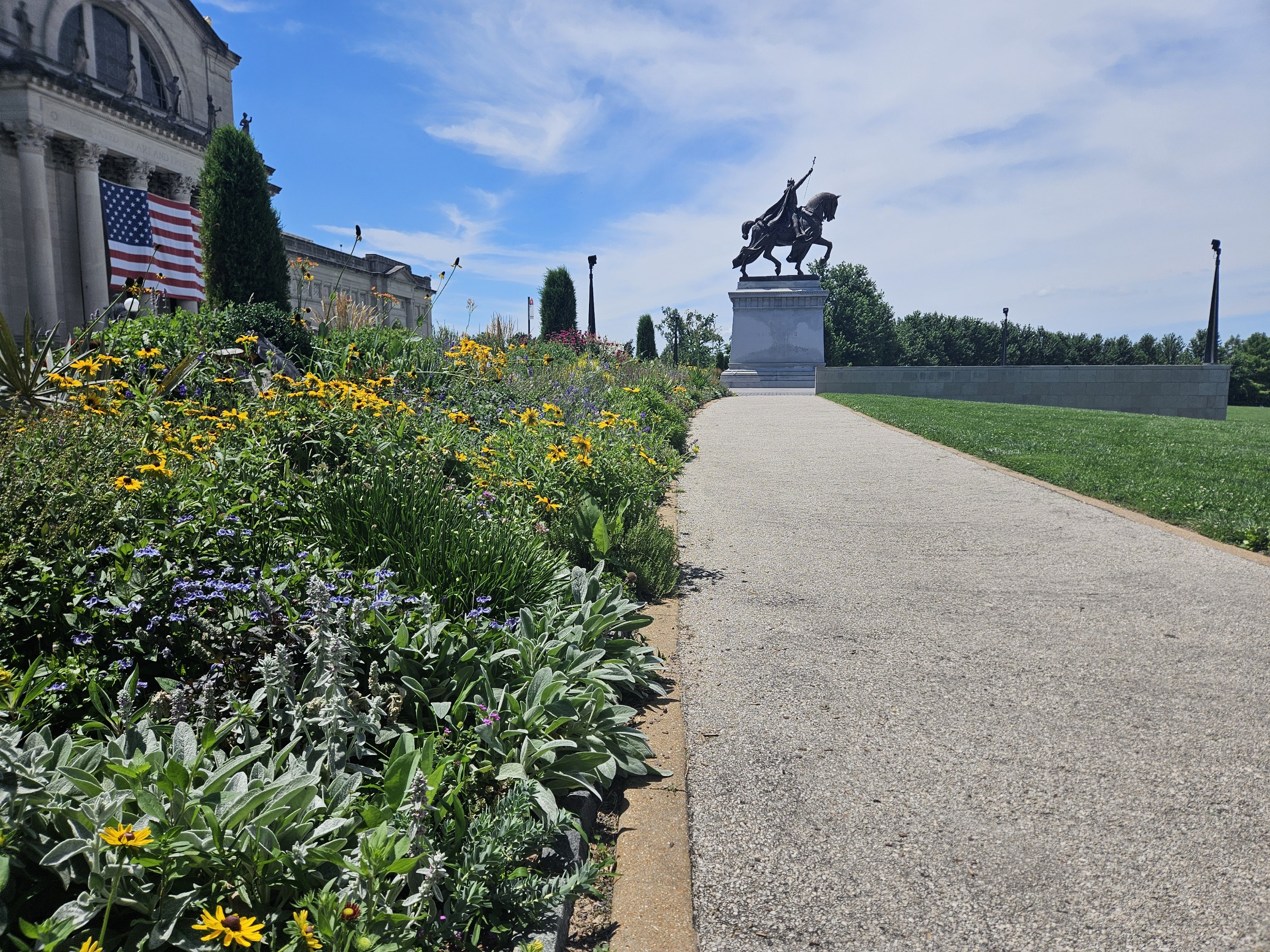
That same day, I went to the Saint Louis Art Museum, a circuitous and immense museum originally founded in 1879 and in a wider plot of land featuring an intricate park, the ideal third space for an industrial city where thousands of people that day alone came for a bit of nature, culture, and community.
The SLAM had a display of Roman art from the time of Emperor Trajan on one floor. A standing exhibition featured extensive world-spanning displays of religious and cultural art from every continent across multiple floors, including the Strait of Torres in northern Australia, Indigenous works from coastal Alaska, pottery from Safavid Persia, and baroque woodwork from eighteenth century Austria. I got lost in a display of modern interior design. I lingered in a too-small exhibit of Art Deco paintings of working-class Saint Louis.
A museum is curated by someone else. I don’t have the freedom to start and stop where I want. The circuitry that takes me from Persia to Papua New Guinea to expressionism is a movement built in someone else’s vision of patterns and deviations that I have to trust. A curated museum isn’t personalized, nor does it cater to specific interests. It’s my loss if I don’t accept the curator’s vision.
In this way, a museum is like an essay, more than a novel or play, because it is a curation of artifacts from the real world organized for the audience to navigate. The essayist makes a map of experience in which the space between artifacts imposes meaning, like the Kuleshov effect in film, and so maybe a museum is a much more collaborative version of that process. I’m a broken record on this, but curation, curiosity, and care all share the same etymological root.
All of this was deeply moving (conceptually, spiritually) because each work of art was carefully placed in relation to other works of art, bundled for meaning and laid out in a labyrinth for everyone to follow. Every reader brings their own insight to the page, and in the museum, perhaps pacing is where the curator’s role ends and the viewer’s begin, how long I spend contemplating the lives of the people who made a ritual mask or a helmet or a painting of wheat farmers.
Something that should have moved me but did not: the museum’s America 250 display. I think it’s partly exhaustion, partly that I know the story so well already, partly that the story itself is so reduced to a handful of events and people that it feels like a smashcut of the greatest hits played on loop over and over again. The display itself was thoughtful and insightful, of course, but it didn’t move me the way an Art Deco rendition of the city did.
This country is very good at being a commercial for itself, at treating itself as a product and its people as customers. There’s a compelling argument already made that the category of customer has replaced that of the citizen. When I witness something celebrating the revolution, no matter how earnest, I’ve lost trust that it isn’t anything other than a commercial for a product, that my participation in this empire is an exchange that someone else profits from. American Revolutionary imagery doesn’t evoke patriotism or inspiration in part, I think, because it’s designed to minimize curiosity.
Darren Aronofksy’s AI-generated series depicting the American Revolution is a good example of this: An artificial version of events built on decades of digital interpretations drawn from the work of actual historians who are now fully removed from the process of historical accounting. No records, no unresolved question, no actual conflict, just a cartoonish visualization of an encyclopedia entry turned into a commodity. A shiny palimpsest of a palimpsest.
My day at the SLAM was free. Likewise, visiting the Lincoln Boyhood Memorial in Indiana was free with my father’s National Parks pass. It was moving to witness so much art. It was moving to talk about Robert Caro’s monumental and ongoing biography of LBJ with my dad where Lincoln grew up, to engage with the actual process of history instead of its distillation into a digital trading card, a sameness that is the same as all the other samenesses.
Maybe it was the distinctions that made the Saint Louis Arm Museum so moving. Nothing was the same, and yet it was because of that exchange of differences that I felt a deeper connection to the people involved in the production, preservation, and curation of art and history. The exchange of experiences (like the World Cup or film festivals or shows about restaurants or museums curated by actual curators) is more moving than an artificial rendering of the same experience again and again. I think that’s what moves me this time of year the most, the possibilities for living in a larger and larger world, of finding myself smaller and smaller the farther away I zoom out.
