Tag Archives: publication

The Life and Times of a Short Story

short-story-draftThe young short story begins with a bang as the author manages to write six thousand words in several non-continuous sittings over the course of two weeks, though the author will later describe it in workshop as a single moment of creative pure truth. The short story matures with each passing workshop, experiencing growing pains, expanding and then suddenly being cut by a thousand words repeatedly, and not just because Rick from workshop said it “felt a little novelish.”

Still young for a while, the short story has a weird look. The story has a lot of split endings and wears a tight title that leaves little to the reader’s imagination, which the author is unaware of for several weeks because the author is too busy trying to understand Rick’s workshop submission, which involves a duck and how great New York apparently is.

Eventually, the story graduates from college with a sense of completion: the story has a clear beginning and ending and a fitting title. The story is submitted to four small literary journals. Like many American short stories, this story waits confidently for six months while resting in the back of the author’s hard drive with several older, wiser short stories.

After the first four rejections, the short story wonders about getting a better title, or if there was something wrong with the cover letter. The author polishes the story a bit with a quick makeover and pedicure to work out the typos and plot holes, then sends the reinvigorated story out to five journals. The short story’s determination is palpable.

But palpable determination is not enough, because after five more rejections, the story spirals into a mid-life crisis and gets two new characters and a new ending and then loses five hundred words after going to the gym. The short story feels better and is sent off to seventeen journals, six of which have already rejected the story as politely as is possible in an email. Meanwhile, Rick from workshop has been coasting on his one probably accidental publication in The New Yorker.

Seventeen rejections later, the short story finally decides to retire out of frustration. The author sees the potential in the story, but understands the difficulty in publication and ultimately thinks that better stories are waiting to be written. The author could dwell on the story for ten more years, but several new ideas have emerged in the author’s imagination, so the short story quietly goes back into a file on the author’s computer, solemnly labeled “Short Stories,” and is never heard from again. But the story lives on quietly in the author’s memory, and the memory of Rick from workshop who said it was pretentious and overwritten, but his characters are all just watered down versions of himself, so he can go lick a brick.

-jk

The Tunnels

Brick wall triptych 1.jpg

The English department at my Alma mater, Northern Arizona University, has released a cool new student literary journal called The Tunnels, and I’m pleased to announce that I have two pieces published in its inaugural issue: a poem, “List of Lists,” and a creative nonfiction essay, “Between Brick Walls.” The first was written after a First Friday Art Walk; the second is about photography, forest fires, and climate change. Both pieces are part of my never-ending love affair with Flagstaff, AZ. However, I mostly want to advertise the journal as a whole.

Two wonderful and talented professors, one in creative writing and one in literature, are the journal’s editors and creators, but it is heavily student-run. Last year, I was a reader for its earlier iteration, JURCE. The Tunnels is an academic and literary journal, and features literary criticism as well. One of my friends has a paper on one of Isaac Asimov’s stories; another friend of mine has a paper on Luigi’s Mansion. The whole journal is an excellent collection of literature and criticism, and a lovely reminder of how many people from Flagstaff and NAU have inspired and continue to inspire me. It also makes me excited for future editions.

So feel free to take a gander at this hip new journal, and I hope you enjoy it!

-jk

P.S. I listened to “Paper Moon” by Chic Gamine while writing the poem and “She Got Lost in the Observatory” by Motionless while writing the essay, to get in the right writing mood.

Short Story Published in Circa

sparks upI’m pleased to announce that my short story “The End of Akrotiri” has been published in Circa, an excellent online journal of historical fiction. The story is about life in a historical Bronze Age Aegean site called Akrotiri before it was destroyed during the eruption of Thera in the 1600s BCE. I would be honored if you took a gander at it, and please check out the other stories I have the privilege of sharing this volume with.
This story is also a taste of what I intend to be my Master’s Thesis: a collection of short historical fiction stories set in different moments of cataclysm and transition. I want to explore varying forms of intimacy between people and places as ways of transcending climactic turmoil. But these are all details for my committee. For now, just enjoy a gentle, loving story about a volcanic eruption that killed everyone everywhere.

-jk

P.S. I listened to “All Used Up” by the wonderful Utah Phillips and “Funtimes in Babylon by Father John Misty while writing and revising this story. Neither of these songs have anything to do with ancient Greek volcanoes, but they did put me in the right mood for writing about the end of the world.

Comfort in a Cookie

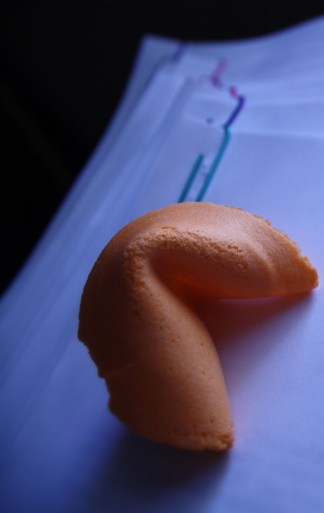
You Are Not What You EatFor an exercise in my fiction workshop, each student was given a fortune cookie and asked to interact with it. We interacted: we broke them, read the fortunes, nibbled on the cookie chunks or chomped them down in one bite. The exercise was about magical thinking in our own lives and our readers’ lives, and how stories so often rely upon the magic of symbols, the mystical confluence of coincidences. Despite of our capacity for logic, we often attach special meaning to mundane things.

I wanted to resist that superstitious behavior. I am, after all, a pretentious English Major, cold and unfeeling, so I instinctively dismiss all fortunes found in cookies, or any other bourgeois baked goods.

In this class, we have also discussed publication (and lack thereof) at great length. “Writing is an industry of rejection,” the instructor has pointed out. While we try to have thick skin, rejections pile up and start to hurt. So when I read my fortune, I will admit that for a moment I gave into magical thinking:

You will soon be receiving some good written news.

It could have been written just for me. Why not? Why can’t I find a little comfort in a cookie? Most writers know to take rejections in stride, but it’s difficult to take for so long, so why not admit that I wanted some factory-produced strip of paper to let me know that if I wait just a moment longer, I’ll get a big publication in a well-known journal?

After class yesterday, I checked my email, and was surprised to find a response from a literary journal I’d sent a collection of environmental poems to back in December. My heart skipped a beat as I read the email quickly, and to my utter amazement, the journal rejected the poems.

Maybe you thought for a moment that I got a big publication. I’d hoped so, too. Maybe I’ve just demonstrated how easily I can connect an arbitrary object (a fortune cookie) with the right combination of values and aspirations lurking in you, the reader. Or maybe not. Perhaps I’ve manipulated your own experience with rejection, especially if you’re a writer. This is an industry of rejection, and good fortune doesn’t correlate with publication. I’ll keep submitting, and I’ll keep writing and revising, and every now and then I’ll allow myself the comfort of dreaming that maybe, just maybe, I’ll get some good written news.

Fellow writers, how do you cope with rejections? Or have you fortuitously gotten any publications lately? Let me know in the comments, and spread the writerly love.

-jk

Two Poems Published in NEAT

Portrait of the City as FatherhoodI’m pleased to announce that two poems of mine, “Portrait of the City as a Love Story” and “Fatherhood,” have been published in Issue 9 of NEAT, a lovely online journal showcasing Midwestern writers, and the edition is up for viewing now. I’d be honored if any and all read them, and the other excellent work in this edition of NEAT. There’s obviously only one adjective to describe this: cool.

While the city in this picture is Lincoln, the first poem was actually written in Minneapolis.

-jk

P.S. I listened to “Tristesse Suspendue” by Chic Gamine and “Far From Any Road” by The Handsome Family wile writing and revising these two poems, respectively. The songs should demonstrate the drastically different moods I was in while writing them.

Big League Academia

New WriterTwo months into my first year of graduate school, I think I’ve finally started to settle in. The workload is not beyond my management (I somehow function better with less sleep), the faculty are just as thoughtful and thought-provoking, and my descent deeper into the cult of academia is going smoothly; soon, I’m told, I’ll be a card-carrying postmodernist. The support my writing receives is frequent, and the possibility of a writing career is even starting to take shape.

For example, this past week I had the opportunity to meet with two agents and two editors, to have them critique a section of my novel-in-progress and discuss the publishing industry. They told me what they liked about the short section, offered insights, made revision suggestions, and allowed me to see the project in grander terms. I learned that when I eventually get an agent and editor, publishing becomes a collaborative effort, a group project. They offered to stay in contact when I have a polished draft. Suddenly, the fantasy of publication no longer feels so impossible.

Is this it? Is this the next step for my writing? Or is this just the next phase in my hike up the ranks into academia? I ask myself this question because I’m surrounded by people who have it figured out already. I’m surrounded by serious academics, doctoral students devoting years to studying, students fulfilling long-term plans. Many of them took a break after college to figure out the rest of their lives, get married, travel, go on adventures, experience things they can then write about. And here I am, fresh out of my undergraduate career.

Am I here because I want to be a writer, or because I want to be an academic? I feel like a kid who doesn’t yet know what he wants to be when he grows up, and time is running out. Do I teach? Get a PhD? Another MA? An MFA? Is there life after publication? Or should I let my ambitions dictate my future? Tired of studying tragedy but never taking that study out of the classroom, I still want to join a charity, volunteer in a hospital in Palestine or Afghanistan or Jordan, or work on an organic farm in Chile or Brazil. I want to see the world, because I know if I stay in the confines of an English Department, I’ll run out of things to write about.

I’m still just a kid, academically speaking, and I’m surrounded by intellectual adults. I can’t count the number of times I’ve been asked about my PhD, as if that’s the only end in sight, and I can’t count the number of times I’ve silently shrugged and changed the subject. I only have until next fall to figure it out, though. Do I become a career academic? Teach? Work? Let me know in the comments your own thoughts or plans.

-jk

The Case of the Empty Inbox

The Vast Unknown In December, I submitted five short stories to small literary presses and journals for potential publication. One sent me a rejection within a week, but the rest took their time. Four months later, I had received one new rejection, leaving three still looking over my work or letting it rust in a fat stack of emails from countless other writers.

Curious about the long wait, I looked up each remaining journal to check the reading periods, see if they posted information about a delay, or (I vainly hoped) had published my work and simply forgot to tell me. I remembered that one journal had not sent a confirmation email, and I discovered that it was no longer active, and indeed no longer available. Their links on databases for writers only took me to empty Could Not Be Found pages. Information about it existed on other sites, blogs, and five-year-old lists of calls for submissions, but the journal itself was simply gone. I know it was up and running in December when I sat at a cold kitchen table adjusting my cover letter and drinking Christmas-gift coffee. It’s not surprising that small online journals struggle, even stop publishing, but what would prompt it to vanish from the face of the Internet?

Somewhere in the foggy bays of the web sits an email containing a short story, a cover letter, and my name at the bottom. Is it still drifting along in the electronic waves, lost forever? Did it find itself to the inbox before the editors abandoned their little island? Did anybody bother to unpack the document in its cargo? Did other emails not make it in time and drift away into the darkness? I once read a sample of short stories and poems from this journal, not only defunct but scuttled and drowned, without proof that anybody once perused its archives, and it’s a bit spooky. I will probably never know why the little journal disappeared. The mystery may go unsolved forever.

-jk

The Publication of a Poem

Tea and PoetryMy poem “Dublin” has been accepted for publication by Burningword Literary Journal, an online journal featuring poetry, fiction, and nonfiction. It’s my first published poem, and I hope that many more will come.

For me, this is no time to be complacent. This is a signal that I should keep writing and keep sending my work off for publication. But for now, I hope you all enjoy reading my poem and the other stories and poems published in the seventy-second issue of Burningword.

-jk