
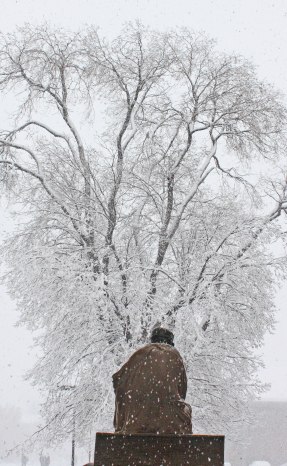
Statue Commemorating Civil War Veterans
Some of the best advice I received about historical research is that oftentimes the surest way to find sources is to have boots on the ground and look for sources in person. This usually involves going into public archives or getting access to private ones, but I’ve heard tales of finding rare documents forgotten in the trunk of a car or simply on display in a book fair. This week, while visiting family in Appleton, Wisconsin, I decided to experiment with boots-on-the-ground-history.
 I discovered that historical research is more than just skimming through a few letters. It’s detective work, a methodological investigation, and I did not rise to the challenge. As I prepare to go to graduate school to study creative writing, I worry that I may leave history behind. History is close to my heart, but requires a patient diligence.
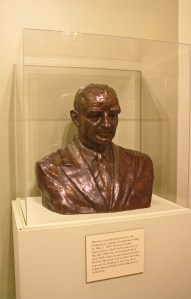
Statue of Senator Joseph McCarthy
The challenge of in-person research yielded a few interesting results. Appleton’s public history emphasizes its positive qualities, such as the fact that magician Harry Houdini claimed it as his hometown, though he was born in Hungary. There is a museum with an entire floor devoted to Houdini’s life and work. However, another famous man claimed Appleton as his hometown, Senator Joseph McCarthy, who engaged in congressional witch hunts during the early 1950s to remove suspected communists. Popular opinion has since turned against McCarthy, but as journalist Edward R. Murrow said in an open challenge to the Senator’s unethical methods, “He did not create this situation of fear, he merely exploited it.” Now that  McCarthy is remembered as an aggressive demagogue, his hometown has taken a statue of him that once stood in public view and placed it in a museum’s bottom floor, under the stairs.
Apart from some obscure anti-communist propaganda, one from 1950 and the other from 1967, a World War One Dough Boy memorial statue and a Civil War memorial statue, I could not find any major historical documents in Appleton’s history, simply because I did not look that hard. It is not surprising that they hide McCarthy’s image and highlight a still-popular celebrity. Any research on the Cold War in Wisconsin daily life would require interviews with those who remember it, access to radio and news archives, local newspapers, and other hidden sources. Perhaps I might be able to dig up a few rare pieces of propaganda if I looked deeper, or uncover a story of Cold War espionage, but such research requires more time and energy than I can offer. I’m not a specialist, or a driven detective. I am, for the time being, only an interested amateur.

Doughboy Statue Commemorating World War One Veterans
Perhaps I can one day conduct better historical research. Perhaps I will one day dare to dig deeper, open doors that should not be opened, find people who have answers. I was inspired by a year-old article about Amor Masovic, who has been looking for burial sites from the Srebrenica massacre in Bosnia-Herzegovina, in 1995. That massacre, part of the Bosnian Genocide, was the first act of genocide on European soil since the Holocaust, and one that the world ignored for years. Today, the perpetrators still live side-by-side with the families of the victims, and reconciliation is a great challenge. But Masovic pursues burial grounds, is still looking for the missing victims to piece together the community of Bosniak Muslims that existed before the massacre. He’s been working for nearly twenty years and there are still bodies unaccounted for.
Will I ever be such a researcher? Will I ever contribute to as admirable an effort as Masovic? It’s unlikely, but I do not want to leave history behind. I’m too compelled and too haunted by its ghosts to allow myself to give it up completely. History truly is obsessive, and maybe the only way to make a difference is to simply embrace that obsession, dig my boots into the ground, and dig as deep as the past will allow.
-jk

 Keene Short