Tag Archives: History

“We are digging up the foundations of a very old world.” -Alan Sharp

Boots on the Ground

Civil War Soldiers

Statue Commemorating Civil War Veterans

Some of the best advice I received about historical research is that oftentimes the surest way to find sources is to have boots on the ground and look for sources in person. This usually involves going into public archives or getting access to private ones, but I’ve heard tales of finding rare documents forgotten in the trunk of a car or simply on display in a book fair. This week, while visiting family in Appleton, Wisconsin, I decided to experiment with boots-on-the-ground-history.

March to SocialismI discovered that historical research is more than just skimming through a few letters. It’s detective work, a methodological investigation, and I did not rise to the challenge. As I prepare to go to graduate school to study creative writing, I worry that I may leave history behind. History is close to my heart, but requires a patient diligence.

McCarthy

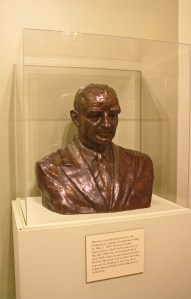
Statue of Senator Joseph McCarthy

The challenge of in-person research yielded a few interesting results. Appleton’s public history emphasizes its positive qualities, such as the fact that magician Harry Houdini claimed it as his hometown, though he was born in Hungary. There is a museum with an entire floor devoted to Houdini’s life and work. However, another famous man claimed Appleton as his hometown, Senator Joseph McCarthy, who engaged in congressional witch hunts during the early 1950s to remove suspected communists. Popular opinion has since turned against McCarthy, but as journalist Edward R. Murrow said in an open challenge to the Senator’s unethical methods, “He did not create this situation of fear, he merely exploited it.” Now that Red SpiesMcCarthy is remembered as an aggressive demagogue, his hometown has taken a statue of him that once stood in public view and placed it in a museum’s bottom floor, under the stairs.

Apart from some obscure anti-communist propaganda, one from 1950 and the other from 1967, a World War One Dough Boy memorial statue and a Civil War memorial statue, I could not find any major historical documents in Appleton’s history, simply because I did not look that hard. It is not surprising that they hide McCarthy’s image and highlight a still-popular celebrity. Any research on the Cold War in Wisconsin daily life would require interviews with those who remember it, access to radio and news archives, local newspapers, and other hidden sources. Perhaps I might be able to dig up a few rare pieces of propaganda if I looked deeper, or uncover a story of Cold War espionage, but such research requires more time and energy than I can offer. I’m not a specialist, or a driven detective. I am, for the time being, only an interested amateur.

Patriotic WWI Statue

Doughboy Statue Commemorating World War One Veterans

Perhaps I can one day conduct better historical research. Perhaps I will one day dare to dig deeper, open doors that should not be opened, find people who have answers. I was inspired by a year-old article about Amor Masovic, who has been looking for burial sites from the Srebrenica massacre in Bosnia-Herzegovina, in 1995. That massacre, part of the Bosnian Genocide, was the first act of genocide on European soil since the Holocaust, and one that the world ignored for years. Today, the perpetrators still live side-by-side with the families of the victims, and reconciliation is a great challenge. But Masovic pursues burial grounds, is still looking for the missing victims to piece together the community of Bosniak Muslims that existed before the massacre. He’s been working for nearly twenty years and there are still bodies unaccounted for.

Will I ever be such a researcher? Will I ever contribute to as admirable an effort as Masovic? It’s unlikely, but I do not want to leave history behind. I’m too compelled and too haunted by its ghosts to allow myself to give it up completely. History truly is obsessive, and maybe the only way to make a difference is to simply embrace that obsession, dig my boots into the ground, and dig as deep as the past will allow.

-jk


If Napoleon Had Won

View of Paris from the Louvre, by Lost Compass Photography

View of Paris from the Louvre, by Lost Compass Photography

Today, as we mark the two hundredth anniversary of Napoleon’s defeat at Waterloo and a definite end to his conquest of Europe, I wonder what would have happened if he’d won. If the French had defeated the British-led coalition, France would still have faced Britain across the English Channel, Prussia (part of modern-day Germany) to the east, and Russia even further to the east. In other words, Napoleon would have faced a potential war on two fronts, the same situation Germany faced in both World Wars. French forces were already stretched thin, particularly from colossal defeats in Russia, so it seems unlikely that the French would win a two-front war.

Perhaps Napoleon would turn to diplomacy. Britain historically fears a continental empire, preferring a divided and contentious Europe. If Spain, France, Prussia, Russia, and the Netherlands cannot work together, England can keep them from uniting against the island Kingdom. Napoleon would be wise, then, to turn to Prussia and make a political pact against Britain. Such treaties were common during the nineteenth century, eventually creating a complex alliance system that some blame World War One on. So, to avoid a military defeat, Napoleon turns to Prussia and promises to work with them if Britain or Russia ever turn against their interests.

What would certainly be known as the Franco-Prussian Alliance creates a strong central-European power. Napoleon dies decades later of stomach cancer, but in this universe he dies a hero. Statues are built to him, poems in French and German are composed, and peace settles now that Imperial France has secured its assets abroad. A Franco-Prussian alliance changes the shape of Europe completely. German unification never happens, but Franco-Prussia probably allies with Austro-Hungary anyway. As a result, the First World War pits central European powers against Britain and Russia rather than France and Britain against Germany and Austria. However, the combined strength of France and Prussia, along with France’s imperial allies of Italy, Spain, Portugal, Romania, and probably the Ottoman Empire, manage to defeat Russia and Britain. The U.S. never involves itself regardless of the outcome, and France gains all of Britain’s colonies. As a result, French becomes the dominant language in the world, no fascist dictators come to power, and the U.S. keeps to itself and Latin America.

Of course, this is not an objective speculation. Counterfactual history is subject to individual decisions as well, namely those of the historian. My own bias against fascism motivates me to see a possible way out of it. There’s no indisputable likelihood that there would be no World Wars if Napoleon had won a single battle. There may have been a worse war, there may have been no more wars, but there’s no way of knowing for certain. As such, counterfactual history can sometimes show more about the historian’s own bias than about history itself. In any case, thousands died at Waterloo, and millions have died in combat since. Speculating about how we could have avoided past conflicts, while intriguing, can be a distraction from how to avoid conflicts now.

-jk


Modern Turkey and a History of the Word Genocide

Photo of the Armenian Genocide Memorial Complex

Photo of the Armenian Genocide Memorial Complex

Earlier this week, an important but under-reported incident occurred in international politics. Brazil’s government passed a resolution to recognize atrocities committed against the Ottoman Empire’s Armenian population in 1915 as genocide, which dozens of countries and most historians already recognize. As a response, the Turkish Foreign Ministry responded by condemning the resolution, saying that it “distorts reality.”

This year marks the hundredth anniversary of the Armenian Genocide. One hundred years later, the use of the term genocide is still contentious. Historical truths can be malleable. In Brazil, what happened in 1915 is genocide; in Turkey, it is only a tragic conflict. The use of one word to describe an event might seem like a pointless semantic argument to some, but language is crucial when discussing history, and it’s important enough to spark discomfort between nations.

Part of the problem is that the Armenian Genocide occurred decades before the term genocide came into use. In 1915, the Ottoman Empire joined Germany and Austro-Hungary against Britain, France, and Russia in World War One; the Ottoman military, after a disastrous failed invasion of southern Russia, attacked civilian Armenian Christians through forced deportations, mass imprisonment, confiscation of property, death marches, and massacres. The total death toll is still in dispute, but a common estimate is 1.5 million Armenians. Some Ottoman officials thought the Armenians were a pro-Russian threat, and such an argument was used to justify the atrocities. After the war, the Allies carved up the Ottoman Empire, but an independent Turkey emerged after revolutionary forces took control of Anatolia. The revolution was partly led by Mustafa Kemal, a talented Ottoman military leader who defended the Gallipoli Peninsula during the War. Becoming the first president of Turkey, Kemal rewrote history to make the new Turkey a heroic nation. Taking control of national education, Kemal erased the Armenian Genocide from his new country’s textbooks and public discourse, and this pattern continues in Turkey today.

Despite a wealth of archival evidence, Turkey’s national investment in keeping the term genocide out of its history is wrapped up in the complicated nature of the word itself. Raphael Lemkin coined the term to describe Nazi atrocities during World War Two. Lemkin’s activism began much earlier; a Jewish migrant from Poland, he had heard many stories about Ottoman atrocities as well as pogroms against Jews. In 1948, the United Nations recognized genocide as an international crime in its Convention on the Prevention and Punishment of the Crime of Genocide, referring to it as requiring “the intent to destroy, in whole or in part, a national, ethnical, racial, or religious group.” Consequently, forced deportations and ethnic cleansing (the attempt to remove a group of people from a designated geographic area but not the group entirely) do not necessarily count as genocide (though they often lead to genocide, historically). Like most criminal matters, recognizing the Armenian Genocide, at least in a legal sense, requires proof that the perpetrators intended to erase the Armenian population from Anatolia through their physical and cultural destruction.

But for Armenians today, as well as countless activists and historians, genocide is not always a legal matter, but a matter of identity and truth. In Armenian collective memory, what the Ottoman military did goes beyond specific legal parameters; it was an assault against an entire culture resulting in the death of over one million people on the basis of a shared ethnic-religious identity. Its historical scars are still visible for many Armenians, but history is more than just past crimes; history is a living, evolving beast. Turkey’s refusal to recognize the Armenian Genocide is a direct attack on Armenians today. Such a refusal wipes away the validity and dignity of those Armenians the Empire slaughtered and the generations who are around today, the descendants of the survivors. Brazil’s resolution is a positive step, but real progress will come only when the Turkish government comes to grips with its predecessor’s crimes and its own complicity in the denial of those crimes.

-jk

Ghosts of the West in Jerome’s Public History

Jerome Jerome, Arizona, is one of the oddest, most colorful towns in the state. Its history is rich, and its public history is thriving. Now a major tourist destination, as well as a small artists’ community, one can see Arizona history, and indeed U.S. history, in every corner. At a wine tasting one can see a passing motorcycle gang maneuver up the narrow streets, while a ghost tour marches downhill toward one of Jerome’s many historic sties. Jerome is itself a museum, an exercise in public history, but it is caught along the fault lines that make public history a contentious endeavor.

ruins

Ruins of a primary school.

Many go to Jerome to see the Old West as John Wayne, Clint Eastwood, John Ford, and others portrayed it. By the time How the West Was Won debuted in 1963, the Jerome Historical Society, founded a decade earlier, was already busying itself purchasing saloons, churches, mining equipment, and other property to advertize Jerome as a ghost town. Today, the Jerome Historical Society tends to dominate public history, and their goal from the beginning was to draw a crowd. Popularizing the town’s title, ghosts are now a prevalent motif. One can go on a ghost tour, visit a haunted hotel, then eat lunch at a ghost-themed restaurant. The Wild West narrative appears in the ruins of Jerome’s schools, jails, brothels, and saloons, and a past rife with outlaws, sheriffs, and western debauchery in a lawless city where anybody can make it big with the swing of a pickaxe.

The Cuban Queen

Entrance to an abandoned brothel, The Cuban Queen.

Jerome is haunted by this history, but by other histories as well. History is contentious, often snagged between fragmented political agendas. Today, several state legislatures want to change AP U.S. History curriculum to emphasize American Exceptionalism, a word that makes most historians cringe. Jerome may not be as fraught with politics, but the ghosts that haunt it are more than the usual characters in a typical western.


BenchThere is Charley Hong, who emigrated from China in 1880, two years before the U.S. passed the Chinese Exclusion Act. He became a wealthy businessman, owner of the popular Bon Ton Restaurant (later the English Kitchen). Though a local celebrity in Jerome, the xenophobic climate in the west persisted, to the point that his restaurant was bombed in 1909. Miners haunt the town as well. Making it rich by mining may sound appealing, but the work was arduous, usually deadly, and compensation was minimal. To make matters worse, in 1917 corporate managers rounded up miners suspected of affiliating with workers’ rights organizations like the Industrial Workers of the World (IWW), forced them onto cattle trains, and deported them out of town. Meanwhile, the local hospital witnessed approximately 9,000 deaths.

Ruins of a prison

Ruins of a prison

It is impossible to fully capture the diversity of Jerome’s history, and here I fail to do it justice. Public history, however, is an important venue for historical inquiry. The ghosts that haunt Jerome are more than just a handful of quirky characters. Jerome is haunted by the miners, the migrants, the unnamed lawbreakers, the women who worked in the town under challenging and dangerous conditions, the indigenous communities in the area. Jerome is indeed haunted, but most of its ghosts remain unheard. I intend to conduct more research, because for me history is about listening past the vast silence of time to let the old voices speak, and Jerome is shaking with eager voices.

Jerome Landscape


Muhammad ‘Abduh and Egyptian Islamic Reform

Note: I was offered the opportunity to present a paper at the Middle Eastern and North African Studies Undergraduate Conference at the University of Arizona, but have had numerous cases of the flu since December and the worst case yet hit the day before the conference. As such, I cancelled my presentation, to my immense regret and disappointment, but have decided to post a much briefer version here. Thank you for reading.

Contemporary western discourse on Islam often impose a liberal-conservative, moderate-extremist dichotomy on the Muslim world, ignoring local, idiosyncratic contexts. For instance, such discourse labels the Muslim Brotherhood as a conservative organization, and the Egyptian theologian Muhammad ‘Abduh as a liberal counterexample. The measuring stick western media use, however, is how willing Muslims are to accommodate western influence. ‘Abduh is often seen as sympathetic to western influence, but his political and religious goals were effectively those of the Muslim Brotherhood–to bring the community of believers back to a more authentic practice of Islam because the community has strayed and allowed unlawful innovation.
Abduh

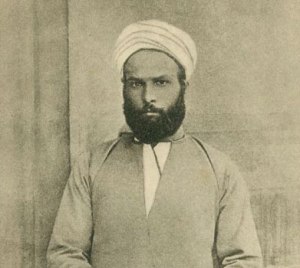
Muhammad ‘Abduh

The youngest child of a rural farmer, ‘Abduh was born in 1849 in a village called Mahallat Nasr, on the Egyptian Nile Delta, into a middle-class family. Egypt was under a series of economic reforms first initiated by Muhammad Ali, a military leader who wanted to industrialize Egypt like Europe. His economic reforms benefited peasants, including ‘Abduh’s father, and those benefits allowed ‘Abduh to leave his rural home to become an Islamic scholar, or ‘alim. ‘Abduh showed much potential; he reportedly memorized the Qur’an at the age of ten. At thirteen, he went to study at the Ahmadi Mosque at Tanta, and later the University of al-Azhar in Cairo. However, ‘Abduh’s experience with the traditional education system was disappointing. The outdated practice of having students memorize centuries-old commentaries on the Qur’an and Hadith frustrated him to the point that he ran away from school multiple times, returning only when his father forced him back.

In addition to his formal education, ‘Abduh received an informal education with his uncle Shaykh Darwish, whom he visited when he was not in school. Darwish had a profound influence on ‘Abduh. He was a Sufi mystic familiar with several North African Sufi Brotherhoods, such as the Sanusiyya and the Tajiniyya, which emphasized an important concept in Islamic discourse, ijtihad, or independent reasoning. Ijtihad allows scholars to rely upon their own reasoning to answer questions. It departs from the method employed at al-Azhar at the time, called taqlid, or reliance upon set precedence, which requires scholars to defer to previously established commentaries, most of which came from the medieval period. While not opposites, ijtihad and taqlid differ greatly from one another, but ‘Abduh learned both simultaneously.

‘Abduh’s two educations coincided. While he continued to tolerate the outdated methods at al-Azhar, he learned from his Sufi uncle who taught mysticism, asceticism, and individual reasoning. These two educations showed ‘Abduh two extremes, the dilapidated structure of Islamic learning in a weakened Egypt trying to imitate Europe, and the informal, thoughtful, and intimate education of Sufi Brotherhoods.
Suez Canal

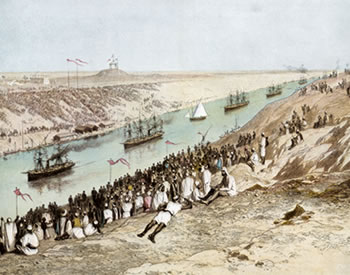
Painting of the Suez Canal

Meanwhile, Egypt fell into an economic crisis. The Khedive, Isma’il Pasha, turned to European investors to help with the expensive construction of the Suez Canal. These investors, mostly British and French, took an increasingly demanding role in all of Egypt’s economic affairs after the Canal’s 1869 opening. The British exerted more and more control over the Egyptian state, at a time when European powers imposed colonial administration over much of the Islamic world. Many Muslim scholars turned their attention to the threat of Europeanization (taghrib). These scholars traveled, wrote, and publicly spoke about religious reform against colonial authority. One well-established scholar, Jamal al-Din al-Afghani, met ‘Abduh while he was still a student at al-Azhar. In their meeting, they discussed Qur’anic exegesis and theology, and ‘Abduh became one of al-Afghani’s most devoted students.

As the political situation in Egypt worsened, ‘Abduh turned to the press and became politically active. Eventually becoming the chief editor of the Egyptian Official Gazette (Al-Waqai al-Misriya), ‘Abduh published numerous articles critical of what he saw as the most damaging facet of Egypt and the Islamic world: unchecked deference to authority. Taqlid and Europeanization were equally dangerous; ‘Abduh criticized the local ‘ulema for their “obsolete and rambling” denouncements of rubbing alcohol while the British exerted control over Egypt’s finances. Both parties, he argued, were responsible for Egypt’s problems.

Battle of Tel El Kebir 1882

The Battle of Tel-El-Kebir, 1882, leading to the British defeat of the Urabis

‘Abduh and al-Afghani were part of a nationalist movement in Egypt in the 1870s, which culminated in a militant revolt against the British authorities in 1879. Led by Ahmed Urabi, the revolt briefly established a new government in Egypt. ‘Abduh criticized the revolt but nevertheless offered his support through the press in the hopes that all Egyptians would unite under a movement to throw off British control. The Urabi Government, however, ended in 1882 when the British invaded, installed a colonial regime, and exiled of the revolt’s supporters, including ‘Abduh.

al-Afghani

Jamal al-Din al-Afghani

While in exile, ‘Abduh and al-Afghani worked together, mostly in Paris, publishing articles on Islamic reform and European rhetoric that painted Islam as backwards by the standards of post-Enlightenment liberalism. Their writing emphasized criticism, but not blind dismissal, of European influence. He applied ijtihad to European as well as Islamic ideas. For example, a broad-based European education was useful, but the British authority on the grounds of racial and historical superiority was useless and inaccurate.

After his return to Egypt, ‘Abduh was named Grand Mufti of Egypt by the colonial administrators, and he used the opportunity to reform al-Azhar. He expanded the curriculum, adding western subjects such as political science, history, geography, and mathematics. At the same time, he overturned the outdated, taqlid-based system and instead required students to pass tests on their knowledge of both religious and secular subjects. Not only did ‘Abduh hope to produce morally upstanding students, but he also wanted intellectually sophisticated students with an understanding of economics, politics, military science, math, and natural sciences.

If previous generations would have had such education, Egypt might not have fallen into debt. A moral nation-state would not have felt the need to compete with Europe or would not have wanted such an expensive opening of the Suez Canal. An educated Egypt would have had a sufficient background to combat European rhetoric and influence.

‘Abduh once wrote that “life takes precedence over religion in Islam,” meaning that Islam is meant to improve the quality of life for all its subjects. An Islamic Egypt did not entail imitating the precedence of medieval societies, nor did it mean modernizing Islam to fit contemporary standards. Instead, it meant meeting contemporary challenges and constructing a modern nation-state as devoted, thoughtful, well-reasoned Muslims who continually developed along with the ebb and flow of a globalized world while retaining their identity, faith, and authenticity.
Cairo Book Fair

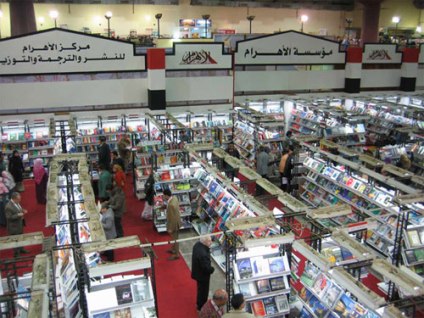
2015 Cairo International Book Fair

‘Abduh was named person of the year at the 2015 Cairo International Book Fair for his reformist discourse. His conceptualization of orthodoxy was a counterexample to numerous forces in his time, the outdated methods of his fellow ‘ulema, khedives trying to compete with the West, and European powers carving the Muslim world into colonies and protectorates. That the Cairo Book Fair would name ‘Abduh their person of the year shows a belief in the continued relevance of his theology. He defied the imperialist rhetoric imposed upon the Muslim world; he still defies the liberal-conservative dichotomy western forces use today to justify forced assimilation of Islamic societies with the West.  ‘Abduh was instead one voice in the diverse scholarly discourse of Islam, a diversity that western media ignore and powerful forces like the Saudi regime and terrorist organizations want to crush.

As such, allowing ‘Abduh to exist in his own context, a reformer trying to implement a more authentic Islam, is an exercise in understanding the intellectual diversity of the Muslim world as a whole, an understanding that over one billion people cannot be reduced to a largely fictional duality.

World War One: The Unpopular Prequel to World War Two

World War One BooksThis semester I’m taking a senior seminar on World War One, for many different reasons: it’s an important event that changed the shape of the world in the twentieth century, I want to know more about it, it’s the hundredth anniversary. I’m also frequently disappointed by how often popular media ignore World War One.

European military history appears in popular arts on a regular basis. We have numerous video games, movies, and documentaries about World War Two. The History Channel has a long list of Hitler-fetish programs (Hitler and the Occult, Hitler’s Henchmen, Hitler’s Women), and in the U.S., WWII movies often come out on or near Christmas Day (Schindler’s List, Valkyrie, and most recently Unbroken, because there’s no better way to celebrate Christmas than by watching portrayals of crimes against humanity). I was excited this past summer when the History Channel announced a six-hour special on both World Wars, but was disappointed when it ignored much of World War One in favor of yet another biography of Hitler; I jokingly called the series Hitler: Origins. Complete with historical inaccuracies, it was effectively a Hollywood trilogy.

Nevertheless, there are some very good portrayals of history in popular media, such as the documentaries of Ken Burns and the BBC series Foyle’s War. These and others pay close attention to detail and often avoid simplifying history. The problem with so many popular depictions is that they present a simple Good Guy/Bad Guy narrative, to the point that World War Two is often reduced to a standard action movie format: bad guys do bad things to good people, good guys intervene, and there’s a happy ending. On the other hand, World War One resists this narrative completely: morally ambiguous empires kept promises to invade each other, millions died without significant progress, and nobody was happy about how it ended.

Popular arts can be useful if treated with the proper attention, and understanding World War One, I think, is sometimes more important than understanding its wildly popular sequel. The problem is that history never translates easily into narrative. It’s not a study of plot and characters, it’s a study of variable circumstance and decision-making without foresight, which can be messy, scary, and uncomfortable. It almost never works out the way we expect or want. Nevertheless, I long for better popular depictions of history. If the History Channel and Hollywood will not grant this wish, then I’ll simply have to do my part as a writer and contribute better, more accurate stories to the canon.

-jk

Election Day Eve Special Post: Elections in History

I VotedTomorrow is an important midterm election in many states in the U.S. That is, if one considers midterm elections important. Elections on a grand scale tend to make the most news: seven billion votes in this year’s election in Afghanistan and nearly a billion in India’s general election. In the UK’s general election in 1918, the nationalist party Sinn Fein won an overwhelming majority in Irish districts and declared the island independent. India’s 1952 general election placed one of the independence movement’s central figures, Jawaharlal Nehru, in the position of Prime Minster, allowing him to shape a newly independent country in a politically and religiously divided atmosphere. These elections involved the participation of millions of people, and received much attention from the world.

Midterm elections may not be on such grand scales, but voting can still make a difference. I researched a few elections where one or two votes determined the outcome. The following are among the more interesting cases:

1887: Conservative Party member Walter Montague won the Canadian federal election in Haldimand, defeating the Liberal Party incumbent Charles Wesley Colter, by one vote. The victory was contested, he was unseated, and won in a second election the same year. That victor was also contested, and he was finally defeated in 1889, which made no difference because he won again in the next election in 1890. He witnessed harsh Canadian politics divided between French Catholics and English Protestants in the relatively new Canadian Confederation formed officially in 1867.

1839: In the gubernatorial election in Massachusetts, considered one of the closest elections in U.S. history, Democrat Marcus Morton defeated Whig Edward Everett by two votes. Although he technically received exactly half of the votes cast and not a majority, he won more than his Whig opponent. A primary concern during the election was the abolition of slavery.

2010: The Kitchener City Council, in Ontario, Canada, saw the victory of Frank Etherington by one vote. Although the city has a population of about 200,000 people, making it a relatively small city, the close call election is still relevant because it went uncontested. Even city council elections are important, and if one or two people chose to vote for another person, the election would have gone another direction.

There are many examples of one or two votes being the deciding factors of elections. Though recounts often differ from the initial results, there are numerous examples of uncontested elections. While there is a history of corruption in United States elections (in Texas in the 1930s “stuffing” ballots was a relatively common practice) and elections in general can often take preposterous turns (some parliamentarians in India have won elections from inside a jail cell after their arrest for corruption or other crimes), these events are all important moments in history. While it is unlikely that tomorrow’s election will later become a marked day in United States history, there is still the opportunity to make minor changes at a local level. A single vote may only make a difference on rare occasions, but such an occasion tomorrow is far from impossible.

-jk

A Changing Interest in the Islamic World

Middle Eastern StudiesToday, i consider myself a student of world history, and I know that an interest in the Islamic world drew me into history. I have not always been fascinated with this region, but I can trace a my interest as far back as my childhood, growing up in a household that read news, politics, and political satire.

If I remember correctly, my family began watching The Daily Show right after the 9/11 terrorist attacks. That was my first introduction into world politics, but I was too young to understand any of it. Years later, in my sophomore year of high school, I developed a greater awareness of the world. It started when I read Persepolis by Marjane Satrapi for a creative writing class. Then, in a world history class, we discussed the spread of Islam. I watched Jon Stewart, Gary Trudeau, and other political humorists dissect the war on terror. Lastly, at the end of the year, my friends and I saw a woman in a niqab pass us in the street. One of my friends turned and asked me if Flagstaff had any mosques. I shrugged. Another friend said that there were none, and then both expressed their thankfulness for the lack of mosques in our town.

That moment left a strange impression on me. It was not my first encounter with bigotry. After all, I grew up in Arizona. But it left a sour taste in my mouth being so close to friends as they said something that to me was unfounded in sound logic. Why be happy that there are no mosques? I was baffled.

In college, I decided to educate myself about the Islamic world. I wanted to combat bigotry at first, but the more I learned about Edward Said and Orientalism, the more I learned about the Safavids and Ottomans and Mughals, the more interviews I saw of Afghan women who smile when they bring up the forty years of warfare they’ve seen, the more I realized that my true interest was not in combating bigotry, but in seeing a region of the world through the eyes of that region’s inhabitants. I don’t know exactly when I arrived at my next conclusion, but I am now fully aware that if I were to study only bigotry, hatred, and misrepresentation, I would still have a skewed view of the Islamic world. Opposing bigotry is necessary, but if it’s the main focus of study, one is left with a perception of Muslims as hapless victims whose lives began with the emergence of an oppressive Europe, and as nothing else. In truth, the history I learned about was full of great passions, eras of peace and poetry contrasted with periods of strife, poverty, combat, and reconstruction. The history of the Islamic world, as is the case with any other history, should be studied not from the perspective of lofty postcolonial analysts, but from the perspective of the history’s communities as they lived and thought.

My interest in world history began with a desire to oppose misrepresentation, and has become an interest in how people lived, ate, thought, worshiped, wrote, constructed buildings, saw the world, saw their neighbors, encountered one another, wrote music, traded goods, and understood their mortality. Postcolonial criticism, I think, should never serve to make scholars feel better about the academic ancestry’s role in justifying colonialism. A liberal European perspective of Europe is still a Eurocentric perspective. Instead, I want to study how Afghans constructed their own identities. I want to study court society in the Mughal Empire. I want to study Palestinian love poetry, the development of algebra and astronomy and science in the medieval era, and different Sufi brotherhoods in North Africa.

How else can we study history?

-jk


The War to Start All Wars

August 4, 1914

Political cartoon by Walter Trier (1890-1951).

Political cartoon by Walter Trier (1890-1951).

Today marks the hundredth anniversary of two major events in the First World War, Germany’s invasion of neutral Belgium to gain strategic access to France, and Britain’s declaration of war with Germany.

France was allied with Russia in 1914 through the Franco-Russian Alliance of 1892. Germany had declared war with Russia on August 1, 1914, to retaliate against Russia’s military organization and its allegiance with Serbia, which was in conflict with Austro-Hungary, Germany’s ally as part of the Triple Alliance of 1882 between Austro-Hungary, Germany, and Italy.

The conflict began with the assassination of Franz Ferdinand, heir to the Austro-Hungarian Throne, on July 28, 1914 in Sarajevo. The assassin, Gavrilo Princip, was one of six Slavic nationalists whose plot was intended to cut ties between Austro-Hungary and Serbia in order to create Yugoslavia as an independent, pan-Slavic state incorporating Bosnia, Croatia, Serbia, and other south-Slavic regions.

As the conflict escalated from a reactionary political crisis to a military conflict between powerful alliances, other nations entered the war, including Bulgaria, Italy, Japan, the Ottoman Empire, and the United States.

WWI

An estimated 9 million people died in the First World War. It brought to light outdated imperial agendas and alliances, introduced horrendous new military technologies including the tank and chemical weapons, and put on hiatus intellectual movements pushing for women’s rights, minority rights, and worker’s rights. Multiple nations are responsible for atrocities, including the German treatment of Belgian civilians and the Ottoman implementation of the Armenian Genocide.

Empires collapsed during the war. Irish and Russian political revolutionaries took up arms during the war, partially motivated by the appalling death toll by 1916 and 1917. As a result of subsequent events, England partitioned Ireland, the USSR replaced the Russian Empire, and the Ottoman empire dissolved along with the centuries-old Caliphate.

In a desperate effort to prevent another such war, the League of Nations was formed. So too was the Treaty of Versailles, which placed astronomical debt on Germany and fueled radical parties left and right. The aftermath of the War led to numerous other conflicts: civil wars, partitions, decolonization, and the Second World War. As a result of World War Two, superpower nations entered the Cold War, accompanied by the Space Race, Arms Race, nuclear proliferation, and military intervention in Latin America, Asia, Africa, and the Arab World.

The War influenced Modernism and ultimately obliterated popular perceptions of war as romantic. It changed art, literature, music, popular culture, and even cinema with the adaptation of Erich Remarque’s All Quiet on the Western Front.

The First World War was a humanitarian calamity; almost all conflicts today can be traced to the War. The exact causes are still contested. Some point to imperial allegiances; others point to an interest, especially by Britain, to suppress political activism from suffragists and socialists. Others point to a moment of panic among imperial leaders. Regardless of the causes, it repeatedly defined and redefined the twentieth century. Today, as Russia enters Ukraine, as Israel assaults Gaza, as complex networks of allegiances overlap and the U.S. flails when asked about whom it considers its allies, the conditions for a world conflict are strikingly similar.

The Great War mutilated the twentieth century, but it is not yet clear if it will do the same to the twenty-first. If political leaders panic in a moment of crisis and declare war within a month, world conflict may continue. Alternatively, we could all take a moment and consider the dangers of reactionary retaliation and ask ourselves if we want another century of war and genocide, if we want to see 9 million more dead for a war that can so easily be avoided. I hope that commemorations such as this one in London will motivate nations to pause before considering military action. One day, I hope military action will no longer be perceived as an easy option, because for the victims and survivors, there’s nothing easy about it.

-jk

A Nation of Writers

Irish Books

In a few days, I will depart across the Atlantic and spend a month in Ireland studying its history and literature. In many ways I’ll be a fish out of water. I willingly admit that I know very little about Ireland. The authors I have read have mostly been from the Americas, and the history I’ve studied has mainly been twentieth century conflict and the Cold War. Apart from a small ancestral connection, Ireland has not played a major role in my studies or my life. So naturally I decided to spend five weeks there, because among the few things I know about Ireland, I know it’s a nation of writers.

Four of Ireland’s writers (William Butler Yeats, George Bernard Shaw, Samuel Beckett, and Seamus Heaney) have been awarded the Nobel Prize in Literature. Countless other Irish writers have left the world with outstanding literary works. A handful of the Irish writers includes James Joyce, Elizabeth Bowen, Oscar Wilde, John B. Keane, Brian Friel, Sean O’Casey, Johnathan Swift, Edna O’Brien, Molly Keane, and numerous others. In contrast to the rich literary tradition, there are few major Irish painters, sculptors, and composers. There is a longstanding oral tradition, and in the past century a theatrical tradition has developed. The essential form of artistic expression in Ireland is the written word.

Ninety years ago, Ireland was engulfed in sectarian violence along religious and geopolitical lines, similar to what is seen today in parts of the Arab world and parts of Africa. A violent uprising and civil war began in 1916 accompanying the First World War, and the country split in two. Meanwhile, the Irish wrote poetry, novels, and plays amid the chaos. Their history is no different from the history I have studied. The Irish have suffered colonialism, violence, and poverty, and have expressed themselves through art and literature the way Russians, Afghans, Indians, Syrians, and Chileans have. I hope to immerse myself in the literature in its original context, to know the ins and outs of literature as thoroughly and intimately as I can.

-JK