Tag Archives: food

Year-End Celebratory Broth

“On the page, I undergo a change of heart, I return to the past and make something new from it, I forgive myself and am freed from old harms, I return to love and am blessed with more than enough to give away.” -Melissa Febos


Since moving to southern Indiana in August, I’ve kept the refuse from the produce I cook with, storing it in plastic cubes in my freezer. For four months, I added skins, stems, and seeds to the stockpile, until yesterday, when I emptied the freezer-burned garbage into a pot of water, sprinkling in peppercorns and cooking over medium heat to make, approximately, a month’s worth of vegetable broth.

Stock and broth can be used interchangeably when discussing vegetables, but I prefer broth because it describes the process, stemming from the Germanic bru, itself the origin of brewing. That process demands patience. Broth is versatile, a necessary part of soup but useful for plenty of other dishes.

But the main reason I make broth is to repurpose produce that I would normally throw in the garbage. The thawing mess is a grafted-together pile of compost: onion skins, carrot ends, sprigs of parsley I couldn’t find a use for, the top of a butternut squash, the seeds of a bell pepper, wrinkly garlic cloves, kale stems, squeezed lemon rinds, half a jalapeno, tomato innards, stray mushrooms, apple cores. Summer into fall into winter, cooked for hours into a liquid the color of Irish breakfast tea.

The nutrients in vegetable skins and stems are locked within unpalatable textures and disquieting flavors. Cooking broth is a way of transforming endings into beginnings, or at least the beginning of another meal, a way of expanding limits.

What have I accumulated this year that I can’t stomach? How can I be resourceful with the loneliness and anxiety I’ve kept hidden away, shoved deep in the cold parts? What dormant memories can I distill to warm me for the winter? Here at the beginning of 2024, in looking back, I really don’t have much to work with. I am at the cutting board again, still hungry for a better world.

Kristine Langley Mahler writes that the “ending of every essay is the same ending of every heavily weighted moment: a return to routine with the incredulity that life goes on, as boring and insultingly indifferent as the moment before the change began. It is not a literary trick to revert to banality as much as it is an acknowledgment that epochs end without fanfare; they begin without obviousness; we are meant to pay attention all the time” (27).

Generally, I dislike New Year resolutions. Spring and fall present more obvious opportunities to measure change, but winter is a dormant period. We’re meant to slow down this time of year, stay together, stick to our routines and cook the apples and squash we accumulated during the harvest. This is, of course, an extremely limited experience with seasons, true to just a handful of ecosystems, and even here, in so many thick, leafless forests on the Ohio River, seasons are becoming, if nothing else, false expectations.

The end of predictable seasons has been on my mind all year, but especially this month because I’ve been reading C Pam Zhang’s Land of Milk and Honey, a near-future dystopian novel about a professional chef wrestling with her ambitions after a sun-blotting smog causes most crops to go extinct. Shortly after she is hired by an enormously wealthy financier to cook elaborate meals at his private estate, to woo scientists and technologists over the long-gone cuisines of their childhoods, the narrator discovers that her taste in organic produce has vanished after years of flavorless, extinction-resistant monocrops:

“After tasting from my employer’s menu, guts roiling with cream and questions of my future, I found myself craving a dab, a pinch, just a soupcon of mung-protein flour. That metallic tang, like medicine. Without my knowing, it had gotten familiar—a link, as I floated alone through days of terrifying uncertain abundance, to the world of gray plates and empty shelves, of starving children in Louisville and Addis Ababa. I imagined small faces pressed against the glass as they watched me throw out pounds of pommes dauphine. The sameness of the smog, it occurred to me, had also felt safe: it was unchanging” (20).

This metallic tang of gray sameness resonates with me. I’ve gotten comfortable in a sick abundance of distractions, screens, voices. So many of the experiences I’ve accumulated have been blandly scripted, redundant, disposable. Lately, it’s gotten to a point where I’ve forgotten that life isn’t meant to be a numb replication of itself.

My disdain for the Gregorian calendar, rigid and anticlimactic, likely has more to do with my disdain for quantification. I understand the impulse to number one’s achievements at the end of the year, to tally up pages written, books read, publications, rejections. But a fixation on numbers, to me, is unappetizingly stale. I don’t remember the meals I cooked in August, or September, or October. I didn’t keep track of new recipes, numbers of ingredients, nutrient totals. What I know is that the broth I cooked from those meals’ residue is layered, unfixed, earthy the way a body is after sweating in a forest but by some miracle a tiny bit sweet.

If I’m going to look back at the year, I don’t want to measure it by numbers, but by the taste and texture of what the year has made of me. How many podcasts did I listen to? Which ones? Your guess is as good as mine, but I learned a lot more than I used to know about the history of Palestine, the politics of unionizing, drafting novels, the nervous system. I learned that Soviet science textbooks are still used in India because their tone was far less condescending than western textbooks, that Martin Luther was fond of fecal jokes, and that perfectionists tend to engage in more self-harm. I read more novels than memoirs. I got better at cooking spaghetti squash. I spent more time on trains, more time looking at rivers. I talked with different writers. I live in Indiana and I teach with more joy than I used to.

It might not be the case that writing, on its own, can shake me out of my numbness, but when Melissa Febos calls writing a life-saving practice, it gives me hope: She writes, “I cannot imagine nurturing a devotion to any practice more consistently than one which yields the reward of transformation, the assurance of lovability, and the eradication of regret. No professional ambition could possibly matter more than the freedom to return, again and again” (151).

If writing doesn’t change the writer, how will it change the reader? Writing this ridiculous blog post after over a year of adding nothing to this silly little website has been, if nothing else, a taste-test of who I am right now.

I want a life of textures, a year of multitudes. I don’t want abundance; too many Americans have too much of that already, to the detriment of the planet. What I want is a more precise way of being. I want smaller numbers and slower minutes. I want to pay attention to everything, for attendance to become a devotion all its own.


Febos, Melissa. Body Work. Catapult, 2022.

Mahler, Kristine Langley. A Calendar is a Snakeskin. Autofocus, 2023.

Zhang, C Pam. Land of Milk and Honey. Riverhead Books, 2023.
Edible Ekphrasis

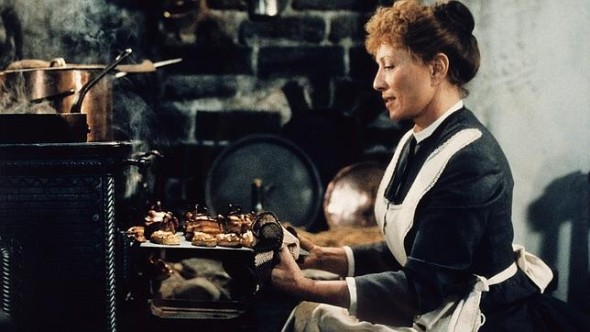
babette's feastLast week, I had the pleasure of watching the 1987 Danish film Babette’s Feast, directed by Gabriel Axel. Based on a short story by Karen Blixen, Babette’s Feast is set in a small village in the nineteenth century, focusing on two sisters in a strict pseudo-Puritan sect and their French cook Babette, whom they took in as an act of charity after she fled violence in France (as we all do from time to time). Her mastery of French cuisine contrasts the bland, simple food the sisters eat. Babette eventually inherits 10,000 francs, and decides to cook an elaborate, “real” French dinner for the churchgoers, who wrinkle their noses at the appearance of her imported ingredients (live quails, a turtle, various wines and champagnes), vowing not to mention the quality of the food to maintain their piety. Their decision to refrain from commenting on the food becomes more and more difficult as they eat, and the wine certainly complicates things, too.

It was one of the two last films that I watched on a Sunday night tradition that has become known as Single Guy Movie Night, hosted by a kind and brilliant PhD student and attended by myself and a fellow second-year MA student (and sometimes a married honorary single guy when he’s available). Since August, I have enjoyed our host’s meals and taste in movies, and he has occasionally tolerated the movie tastes of his guests.

This last year, I have watched more films on Sunday nights than I can remember: The 400 Blows, Road Warrior, Mad Max: Fury Road, Moonlight, Elizabeth, Halloween, Carrie, Akira Kurosawa’s Dreams, Rogue One, The Cook, The Thief, His Wife, and Her Lover, Spartacus, ParaNorman, The VVitch, The Best Little Whorehouse in Texas, among many others. It was fitting, I think, to end with a soft film about food, and perhaps the best film about food I have seen.

There is a small canon of food films. Ratatouille remains my favorite Pixar film, and I enjoyed Stanley Tucci and Campbell Scott’s 1996 Big Night, about Italian cooking. Jon Favreau’s Chef belongs in this canon, and though it is about many other, disturbing and beautiful things, Peter Greenway’s 1989 The Cook, The Thief, His Wife, and His Lover is a fantastic movie centered around the act of eating/consumption.

These movies are ekphrastic, in that they are about other forms of art. Most ekphrastic storytelling tends to be about painting or music. Putting the focus on food, and therefore taste, forces the audience to think about their own taste. The visual emphasis is on preparation, ingredients, cooking, and of course eating, a meta-narrativized mirroring of what audiences do when they watch movies, not literally eating the film but taking it in, enjoying its flavors, the blend of sweet or savory scenes, bitter or vibrant dialogue. As such, these films subtly ask their audience to reckon with the art they consume, the difference between taste and appetite, the difference between taste and quality, and do so in ways that invite variation. There is plenty to choose from on the menu; what will you watch tonight?

Babette’s Feast is different. At the forefront is gentleness. Rather than for competition or financial success, the film’s protagonist chef wants to give her patrons a free, perfect meal to show her gratitude. Her patrons, again contrasting from most food films, want to lower their expectations and resist enjoying the meal. The climax is the feast, but the pleasure of this long, drawn-out scene is watching the characters resist their own pleasure, and in subtle ways fail. The audience gets to see them lose, which means for them enjoying wonderful food. Babette brings them to their satisfaction by what she offers on the plate, giving them permission to enjoy life.

I prefer gentle movies, and that is a matter of taste. I like atmosphere, music, scenery, and subtle character developments that are easy to miss. But this is taste, and I give myself permission to enjoy everything on the menu. Life is short, and if I stuck to the same kind of movie, I’d miss out on the dozens of excellent movies I’ve had the gift of watching this past year with friends. It is too late to prepare a real French dinner for them to show my thanks. This has been an obscenely difficult and unpredictable academic year that left me paranoid, disillusioned, and feeling far from gentle. Babette’s Feast reminds me I am allowed to enjoy what I consume, whatever it is, and there is nothing wrong with taking pleasure in things, in as many things as possible.

The year is over for me. What comes next is new and uncertain, but I would prefer to go into it with an expanded pallet and the energy to enjoy generously.

-jk

John Steinbeck’s Peach Upside-Down Cake

the-lone-survivorIn 1902 on February 27, John Steinbeck was born, kicking off a wonderful century of war and economic strife. To celebrate his birthday, you can either have a disgusting beer milkshake or delicious mush or even a glass of extremely fresh milk. Or you can be sensible about the whole thing and make peach upside-down cake.
First, lose your land to a bank and drive to California, where the good peaches are. You should lose one or two family members on the trip, which means more cake for you. Lucky you. Find work at a peach orchard and collect four to five un-bruised peaches that you can take back to the rusted-out boiler you live in with your seven remaining children back in Monterey. Sell one of those children to buy 1/2 cup of butter, 2/3 cup of brown sugar, 1/2 teaspoon of cinnamon, and use whatever is left to buy as much bourbon as possible. Slice the peaches, melt the butter, add the brown sugar and cinnamon and a little bourbon if there’s any left after you’ve coped with the Great Depression that is living in California.

Work a few shifts at an apple orchard as a scab while a strike occurs and make enough to buy 2 cups of flour, one teaspoon of baking powder, 1/2 teaspoon salt, two sticks of butter, 1/2 teaspoon cinnamon, 2 eggs, 3/4 cup of sugar, 3 teaspoons vanilla, and several more cases of bourbon because one of your children broke into your stash and is no longer with us, which means one more child who doesn’t have to live in California. Beat the butter and sugar together, the way the system has beaten you, until smooth and creamy, unlike you. Mix in eggs, vanilla,and cinnamon. Add flour and baking powder and mix together. Meanwhile, you have probably lost a few more kids in the police raid on the striking apple pickers.

Take the hubcap of a Model T Ford and place the peach slices at the bottom with the butter-sugar mix. Pour the cake batter over it and cook at 350 degrees Fahrenheit or over an open fire on the side of the road for 35 minutes or until the bosses catch you and have you sent to jail with your one remaining child.

Enjoy the cake barefoot at the side of a river while you contemplate modernism and the horrors of living in America and probably a turtle or some worthless birds or some other obvious metaphor. Also, you’re probably a metaphor for Jesus by now, so change your initial to JC.

Also, happy birthday, John Steinbeck.

-jk

Coffee: A Steamy Love Affair

Coffee Poet.jpg

Those who know me know that I love coffee. Those who don’t know me can easily guess, thus far, that I have a moderate fondness for coffee. To be clear, I’m not picky; I like tea, cocoa, water, smoothies, milkshakes, juice. But coffee has a special place in my life.

I had my first cup in my high school cooking class. During one of the baking sessions, our teacher turned on the coffee pot near my station while our muffins were still in the oven. That’s when I had my first cup of caffeinated hot brown acidic water, filled with cream and sugar like most first-timers. After a while, I started drinking coffee whenever I cooked, then every morning, then every morning and afternoon, then several times a day. For a while, I got headaches when I didn’t consume any caffeine by 10:00 AM.

I’ve since become less addicted. I once considered giving it up for Lent but decided that not even Jesus would have gone that far. Nevertheless, I have cut back, and not just because I’ll probably have an ulcer by the age of twenty-six if I don’t.

There are coffee addicts and there are coffee lovers, and I want to be the latter. The difference between a violinist and someone with a violin is making every note a masterpiece. The difference between a chef and somebody who cooks every meal is mastering the kitchen’s tools and ingredients, and cooking with gusto rather than mere hunger. Anything can be an art, and the only way to become an artist is to inhabit a practice so fully that we infuse ourselves with it.

Everything about coffee is perfect to me, and if not I try to make it perfect. Espresso, lattes, dark roasts, light roasts, the smell of the beans, the feel of them in my fingers, the careful measurement of fresh grounds into the coffee pot, pouring the first cup, breathing in the scented steam before the first sip, and feeling it run down my throat hot and fresh, until it bounces around my stomach looking for a place to sit. I write with it; I read with it; I get to know people with it. It’s not for everyone, but it’s certainly for me, which is likely why I haven’t slept since 2015.

What practice or hobby or food do you love? Let me know in the comments!

-jk

P.S. If you thought the title was cheap, consider all the other possibilities I had to work with. Drip coffee was only a starting place.

Leftist Vegetarian Chili

Let’s say you want to make chili for the autumn season, something you can bring to a pot luck at a moment’s notice. If you’re anything like me (an English Major), any pot luck you get invited to will be filled with vegetarians who bring gallons of humus and pita chips by the crate. Here’s an easy recipe for a healthy chili to satisfy any English Major’s left-leaning, postmodernist palate.

The first step is to go to the local farmer’s market to obtain the best locally grown organic non-GMO socialist ingredients. Obtain the following items:

4 or 5 tomatoes1
1 red onion
1 sweet onion
2-3 carrots
2 bell peppers
2 jalapeno peppers
1 green chili pepper
1 habanero pepper
1 yellow summer squash
1 potato
1 copy of Das Kapital
2 cans of black beans

Optional: two bowls of marijuana, but only if you’re serving at a gathering of poets. If the chili is for a faculty meeting, two to three liters of rum (as a side dish) should be provided.

Various seasonings (salt, pepper, cumin, cloves, cinnamon, ginger, turmeric, grassroots activism) should be added to your own taste (which should be excellent because you’re an English Major).

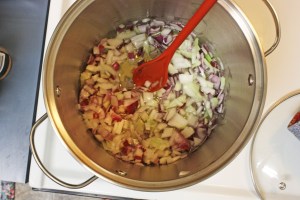
First, lay out the ingredients and tell them that cuisine is a social construct. Then chop up the onions and dump them into a cooking pot with an inch of oil. Stir them enough to keep them from burning, and add salt and pepper. The onions should be strong enough to make you cry, if you aren’t already crying about the TPP.

2

Next, chop up the tomatoes. Add a can of tomato sauce if you really want to give money to the 1 percent, you terrible monster.

Add the cans of beans, ignoring the fact that Big Canning got your hard-earned money. In a vegetarian chili, you need protein, and the beans will provide enough protein to help you resist the man.

Chop up the vegetables; carve them the way you’d carve up Wall Street, and redistribute their wealth in the pot. Season liberally with spices.

4

Next, chop up the peppers. Be careful to protect your hands, otherwise your fingers will burn the way the Christian right wants you to burn in hell. Be especially careful chopping the habanero, which will provide the amount of spiciness needed to smash the patriarchy. You can also add smashed patriarchy to the chili, but don’t add too much; patriarchy has very little nutritional value, because it’s mostly fatty acids and blood.

5

Stir all ingredients and continue to season as you see fit, because you are a creative and unique individual and however you season it will be an expression of your individuality in the rising tide of fascism. However, don’t add too much cinnamon or ginger; if you wanted a pumpkin spice latte, you’d go to a coffee shop with your Mac and write a screenplay in the corner.

6Let the chili simmer the way the working class simmers before the coming revolution, for two or three hours. Feel free to freeze it for the future or emergency pot lucks. Because your vegetarian Marxist postcolonial chili will be as spicy as your attitude (on tumblr), serve with lots of bread, or over rice. This chili is not for the faint of tongue.

Feel free, even, to serve it to your conservative friends. It may be meatless, but that’s no reason to be afraid of it. Take it to a tailgate party, or an NRA meeting. Use it to bring people together. What we eat may be politically driven, but sharing a meal is universal. At least that’s what the shoeless hippies who sold me the onions said.

-jk