Category Archives: Travel

Writers Are Against Forgetting

The poet Aaron Abeyta spoke these words in his keynote address at the 37th Annual Fishtrap Gathering of Writers near Wallowa Lake in eastern Oregon. This line, more than anything else, has stuck with me for almost a month. Writers are tasked with remembrance. Writers are responsible for carrying ancestral memory, childhood memory, cultural memory, everything that might be easily forgotten. Writing is a way of taking an experience, preserving it in a jar, and handing it to someone else, saying “Here, hold onto this while I’m gone.” Abeyta made it clear that in his view, remembrance is an act of love, as painful as it can often be.

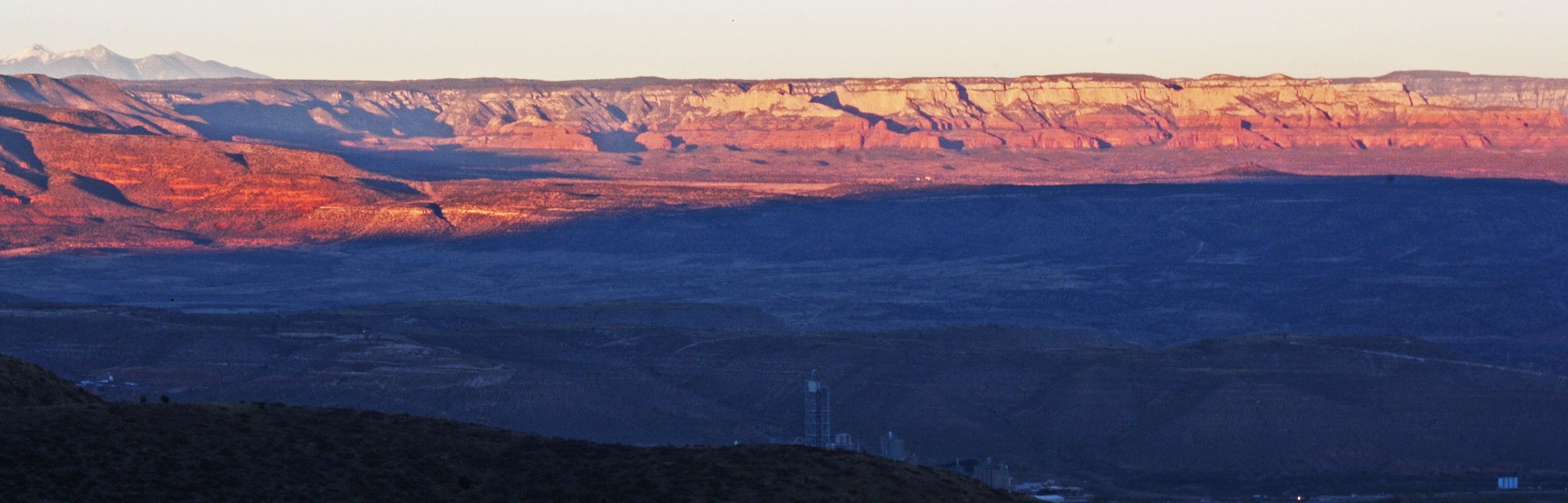
I spent July recollecting the 1990s. I had the chance to see a defining ’90s creature-feature from my childhood, Tremors, in theaters. The hours I spent in a car driving from Indiana to Oregon to Arizona, I listened to podcasts, often movies and books and culture from the ’90s. Because of a last-minute schedule change, I spent a few days in western Washington after Fishtrap as an accidental tourist. I’ve driven past the turn to Roslyn a dozen times before, but never realized that it was the same Roslyn where Northern Exposure was filmed until eating cherry pie in North Bend, where Twin Peaks was filmed, and happened to overhear a customer behind me mention the other cult ’90s show filmed an hour away.

I can’t really claim proper nostalgia for the show. I watched Northern Exposure on DVD when I was in high school in the late aughts, more than a decade removed from the show’s original audience. The town of Roslyn remembers the show, though, and it was surreal to walk the same street that became familiar and mysterious to me on screen. I have a stronger emotional attachment to the fictional town of Cicily, Alaska, than other fictional towns. Northern Exposure luxuriated in the inexplicable, forcing its logic-driven protagonist to accept his limits, the meaninglessness and disorder of life, first for comic relief but later in the show with a more serious attention to the stakes of that mystery. It was the one artifact I remember from adolescence whose message was to confront impermanence rather than attack, deny, or confine it.

The truth is that lately, I’ve lost my appetite for TV. It was always on when I was a child, often when nobody was watching. It’s not that I find it bad or not worthwhile, but something about episodic structures turns me off these days. I’m reading more books, and watching more movies, and often thinking to myself at the end of a movie, that needed at least twenty more minutes. I want things to take time. I want to be slower.

The last night of Fishtrap, I talked with familiar writers from the Northwest. I met writers from Butte, Spokane, Moscow, Portland, Eugene. Every night, writers used their platform to discuss the importance of investing their time and energy into something larger than themselves, into a community that will outlast them and probably forget them.

Still half-asleep on that last night, I ran into another writer where I camped, who was packing her things for an early departure. She Bugs Bunnied a tarot deck from an impossibly small backpack pocket and asked if I was up for a reading. I drew the Three of Cups, the High Priestess, and the Princess of Pentacles. Her advice, after interpreting the cards, was to embrace feminine energies and be courageous in going through weird doors, to walk confidently into the unfamiliar.

Three days later, I found out a friend of mine had passed away two months earlier. Hers was the second funeral I should have gone to this year, but missed.

As easy as it is to talk about mining the past for stories, the phrase “writers are against forgetting” took on a very different meaning at the end of the month when I saw an image of Al Jazeera journalists mourning 27-year-old Ismail al-Ghoul, one of the most recent of the 165 journalists Israel has killed in Gaza since October. In the image, journalists hold up their PRESS signage, otherwise a symbol meant to protect war correspondents, writers, keepers of memory.

Roslyn, Washington, is also a coal town. There is an immense memorial to coal miners killed in the extraction process, overlooking the town’s main intersection. The names go on and on, and because the monument is located where tourists will stop to see the storefront used as the radio station in Northern Exposure, the town has proven that it, too, is against forgetting.

That’s a memoirist trick. There is a narrative thread on the surface and a hidden thread below. There is the town where a cult TV show was filmed, and then there’s a memorial to the town’s working class. Essayists remember everything all at once, all the time, because everything reminds us of everything else, because our job is to remember everything. This is an essay about traveling in July but it’s also about memory and TV and grief. It’s about writing, and writing about writing, and a willingness to disavow conclusion.
Notes from Flagstaff

burn 2

“As for me, I am a watercolor./I wash off.” -Anne Sexton, “For My Lover, Returning to his Wife


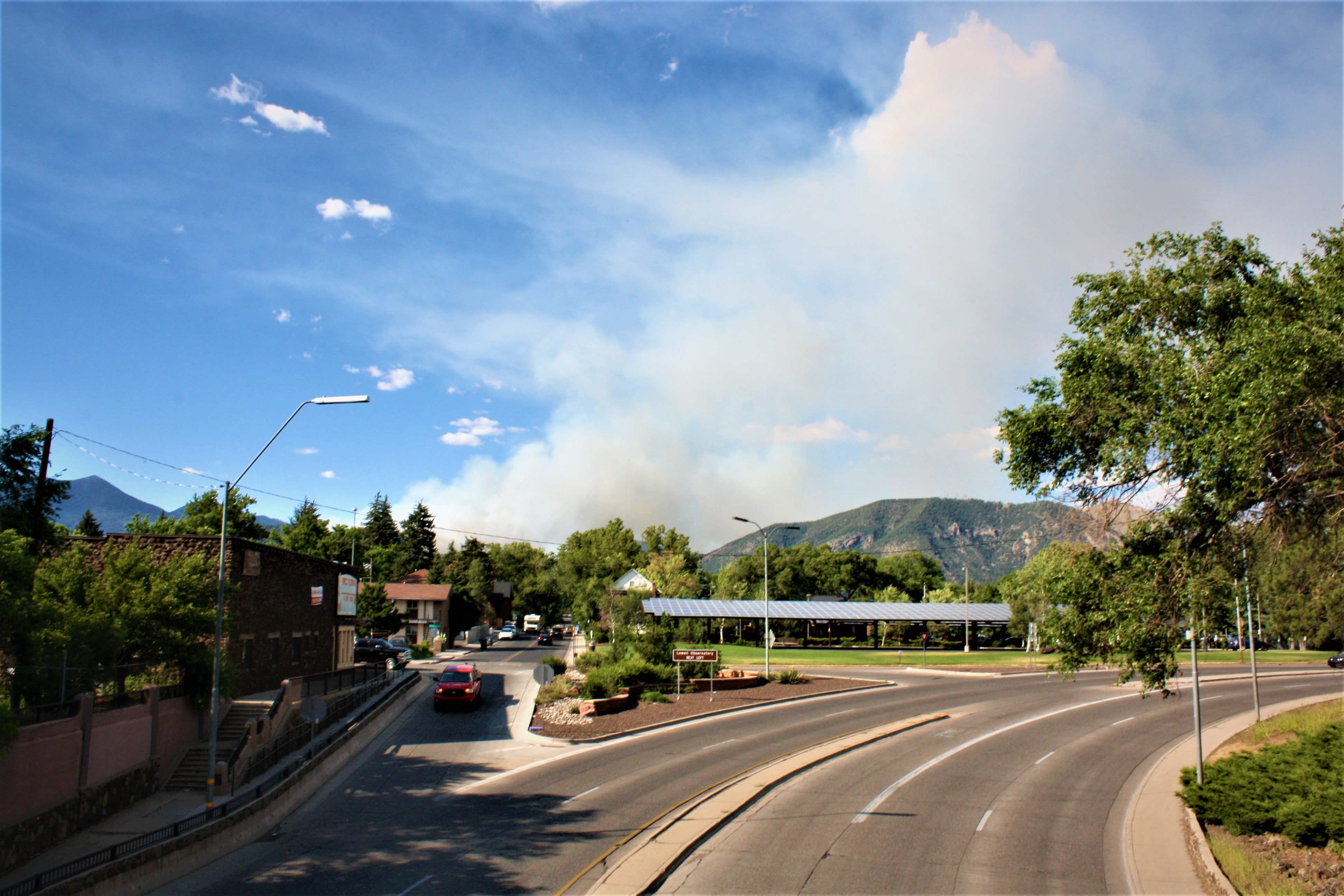
It should be monsoon season in Flagstaff but the air is bone-dry and the only thing in the sky that isn’t hazy blue is a plume of wildfire smoke. I sit in a tea house while “Back in the USSR” plays on the radio, sipping oolong and watching passerby walk up Aspen Avenue in downtown Flagstaff. It’s just like the old days, or just like how I remember the old days, but something is different. I’m just like the passerby now. I can no longer be a smug local people-watching the tourists.

My childhood in northern Arizona was defined by two local features: The inevitability of wildfires and the possibility of leaving for outer space. In 1884, a fire destroyed Old Town, leaving only the part of the city closest to the tracks. Ten years later, Percival Lowell founded an observatory on a hill above the city to look for life on Mars, though his research would later lead to the discovery of Pluto. Flagstaff is a city of dreamers, artists, mystics, and scientists. I landed squarely in one of these quadrants, or all of them.

I left Flagstaff four years ago. It’s not as if this city is completely different. Instead, Flagstaff to me has entered the uncanny valley. It’s familiar enough that I recognize it for what it’s supposed to be, but enough of it has changed that it just doesn’t feel right. I am also a different person. We meet one another, the city and I, halfway at our respective crossroads, doing double takes.

Still, I have connections. In a tiny house in a semi-familiar neighborhood, I help fold veggies into egg roll dough with four Flagstaff friends, two married couples, both of whose weddings I missed because I was traveling or had already skipped town. We sit outside under strings of lights in the now seasonably warm evening air and catch up.

I used to live with one friend here in a house on Talkington Street near the ski resort. I’m glad how familiar this scene still is, how easy it is to cook with friends after so long apart. Later, we chat about people we remember from high school, wherever they’ve ended up. Sammie shows me an art project. Cari is going to seminary in New England in a few weeks. Ryan is preparing another album after a month-long tour.

This is the Flagstaff I have always known, catering to the ambitious and the adamant. Following the emergence of art, mysticism, and dreams, though, there is always some form of commercialization, and Flagstaff is not immune from the power of Capital to market nostalgia.

It’s fitting that the first settler structure here was a saloon, before the loggers and miners moved in. Gun violence was commonplace. In one apocryphal account, there was a saloon murder every week between 1882 and ’83. Were it not for the scientists who took an interest in the region, John Wesley Powell and Percival Lowell, Flagstaff would have likely become one more ghost town or company town, its residents finally driven out when logging and mining came to a standstill. Instead, Flagstaff became a tourist town and a college town. And, at a certain point, the college experience is sold to high school graduates using the same advertising techniques that tourist traps use. Come for the mountain view, stay for the nostalgia.

Except, most people who can afford to stay in Flagstaff are long-time residents. And expensive student housing structures have popped up across from the tracks, and parking is now regulated with warnings and tickets, and there’s a fire close to my old neighborhood. The last few days I’m here, my phone is constantly buzzing with evacuation alerts and flash flood warnings from late rainstorms. I am used to waiting for evacuation notices. This is something they don’t advertise in the college brochures, to be ready to go at a moment’s notice, to have a bag packed at the door. And I heed the warning. I am ready to leave.

-jk

Notes from the Four Corners

Desert 6.JPG“I cannot hate them, the tourists, because I am one.” -Nabil Kashyap, The Obvious Earth

They say that when you first encounter the Mona Lisa at the Louvre, it can be disappointing for two reasons. First, it is situated in a relatively small room that is always packed with visitors, so many that you have to shove to reach the painting, and second, even if you make it to the Mona Lisa, the painting itself is small and unsurprising. You already know what the Mona Lisa looks like. You can buy a poster of it in the gift shop. Instead, it’s the art in the hallway outside the Mona Lisa room, the unfamous work you’ve never seen before, that leaves an impression. The Four Corners Monument is similar.

Two days before the country celebrates its independence, I drive through the desert to Colorado, and make a stop at the Four Corners, between Navajo and Ute Mountain land. I drive slowly over the dirt road, following cars and followed by campers. I find a parking space and step out of the air conditioning into the heat. It is exceptionally hot, barely a cloud in the sky. I’m used to this. I’ve almost missed the heat, living in northern Idaho for so long.

Desert 7

The Four Corners Monument is a square of shaded stands around the circular marker itself, directly where the four state borders meet at 90 degree angles, distinguishing jurisdictions and electoral districts from one another. When I enter the square, I’m confused about which state I’m in, but it becomes clear when I see the four stone markers around the circle indicating each respective state, like cardinal directions. There is a long line of people in front of the circle, each tourist standing in summer wear and waiting to stand in the circle to have their picture taken straddling as many US states as one can.

I don’t get in line because it’s hot and I’m on my way to meet a friend I haven’t seen since I visited Albuquerque in winter, and I impulsively don’t want to be a tourist. I grew up in a tourist town, as a local. It’s a habit I can’t shake off, wanting to distinguish myself from them. I’m not any different from the tourists, though, not here. I walk the square of shops in the shade, passing people eating fry bread from paper plates, passing locals selling jewelry, knives, Kokopelli decorations.

In Portland this spring, I saw Nabil Kashyap give a talk about the colonial nature of travel writing, the fraught history of the travelogue. Historically, the genre frames the traveler as a hero and the place visited as a backdrop for the hero’s self-discovery, transforming locals into objects, props. Kashyap’s own collection of travelogues wrestles with this history. In his panel, he advocated for a more ethical form of travel writing that “decenters the visitor” and emphasizes the place, the people, without claiming ownership over the stories that are intrinsic to the place and people. This time last year, a lot of people noted that Anthony Bourdain was an exemplar of this kind of travelogue, taking the role of a reporter, letting people tell their stories on their own terms.

Desert 2At the edge of the square, there is a sign telling visitors not to spread ashes of the deceased here because the scattering of human remains on this land goes against Navajo custom. I wonder how many tourists scattered their dead relatives at the Four Corners before the locals had to put up the sign. Despite the signs, tourists still come to the Four Corners and spread cremated relatives on this special dot on a map. I think about how weird it is to celebrate the alignment of state borders here in the Southwest. 150 years ago, this was Brigham Young’s Mormon territory called Deseret. 160 years ago, this was Mexico. 250 years ago, this was Spain. 450 years ago, this was Pueblo land. Statehood was only granted to Arizona in 1912. The land may appear static, but its cartographic meaning is always changing.

Instead of standing on the corners, I wander out to the trailhead up the hill from the square, but only a little ways. I’m not equipped for a hike in the desert at noon. I look out at the windswept emptiness of one state or another, this stateless terrain. I’m the only one who walks this way, and I’m glad to be out of the crowd. Later, I use the bathroom. I buy some fry bread. I take some photos. I leave with my fingers sticky with powdered sugar, wishing I could hike around this place in cooler weather, see what else it has to offer.

-jk


Notes from Portland

Portland

“Maybe 1978 was the year the 1960s ended and the 1980s began. Maybe there were no 1970s.” -Rebecca Solnit, The Encyclopedia of Trouble and Spaciousness

My generation talks about Portland, Oregon, the way my parents’ generation talked about California in the 1960s, in that supposedly magical decade when Haight-Ashbury was for free-thinkers and runaways and Hollywood was a place of romance rather than violence, a place of paradise, freedom, and escapism, or at least just a place to escape to.

For a lot of us born in the 1990s, I think, the Pacific Northwest is still seen as a kind of paradise. I know a dozen people who went to Portland after graduating from college or instead of college, and I know more who talk about going there sometime in the future. In the American West, I think, many of us see it as the only remaining authentic counter-cultural scene, now that Seattle has been corrupted by Amazon and Boeing. It’s paradise, and like California before the cults and murders, this reputation is equally earned and exaggerated.

I will admit that, when I visited last week, I was struck by this city, by its oblique beauty and opaque optimism. But I’m also ambivalent. It’s not romantic to me, but familiar. It’s just like being back home in Flagstaff, Arizona in all the best and worst ways, because it’s a tourist destination, which means that what is visible to the visitor is only one side of the stage the city wants to present. Tourists never peek behind the curtain to see the other city inside the city, or rather, they do, constantly, but choose to ignore anything that disrupts the sense of paradise, the escapism that tourism is built on, a centuries-old colonial logic that treats any visited people or place as a cultural buffet. I recognize the theatricality, the performativity. I lived for two decades as a local in Flagstaff, on the side of town the tourists never go to.

Gentrification is to tourism as imperialism is to capitalism, in which those with economic power, in a given city’s financial Center, invade a marginalized community or neighborhood, buy out its necessary businesses (laundromats, corner stores, diners), and replace them with yuppy businesses that those in the community cannot afford, forcing them to look elsewhere for laundry or food. Meanwhile, the gentry have a new colony in a part of town with cheap rent from which to sell artisinal donuts to wealthy newcomers, or to all the tourists.

I went to Portland as a tourist—as the gentry, as the colonist—for the annual AWP conference. 15,000 writers and publishers descended on the City of Roses to network and share journals and thoughts and their creative work. To be clear, this conference was productive for publishers, writers, for a variety of literary communities, and for me personally as well as professionally. But like all conferences, it came at the expense of the environment and the local community.

Portland is a strange place because it simultaneously compels me to want to be more compassionate to others, while also reminding me how insufficient compassion is, despite its urgency, despite its necessity.

But I see the appeal of the dream here, too. I see why my friends relocated to this gritty, green, rusting city, this place of wondrous contradiction, where the river pushes past the streets and Mount Hood is always watching over the mossy brown cacophony of the landscape, the patches of cherry blossom trees, the network of trains and the bicyclists and the sense of cheerful nihilism. I want to be a part of this scene. I want to fit in here. I do fit in here, feel a kinship with the sense of possibility, the sense of communal towardness to one another, despite the likeliness that this sense is more a product of my 1990s imagination, driven by Twin Peaks and The X-Files. But, like any glorified past, maybe there were no 1990s.

Portland is no paradise—I’m not naïve; I grew up in a city that people from Phoenix called utopic when they came to ski and drink while my friends on the other side of the tracks dealt with floods, fires, and catastrophic rent hikes. But still: I’ve always felt out-of-place until coming to Portland, where I felt like it didn’t matter if I was a tourist or a local, as if the difference dissolved and waking up in Portland felt like deja vu, but in a good way, like delirium. A tourist seals this feeling up for himself, like a trinket; what can I do, instead, to fight for a world in which this sense of immediate community, this impulse toward affinity despite factual difference, is common for everyone else?

-jk

Notes from Albuquerque

four horseman of the western statueEvery time I visit this city, it finds new ways to surprise me. There is no planning for contingency here. Last week, I returned to Albuquerque for the 40th annual Southwest Popular/American Culture Association Conference to present a paper (animal studies, rats, Paris, Ratatouille, and so on) alongside a broad, interdisciplinary spectrum of scholars.
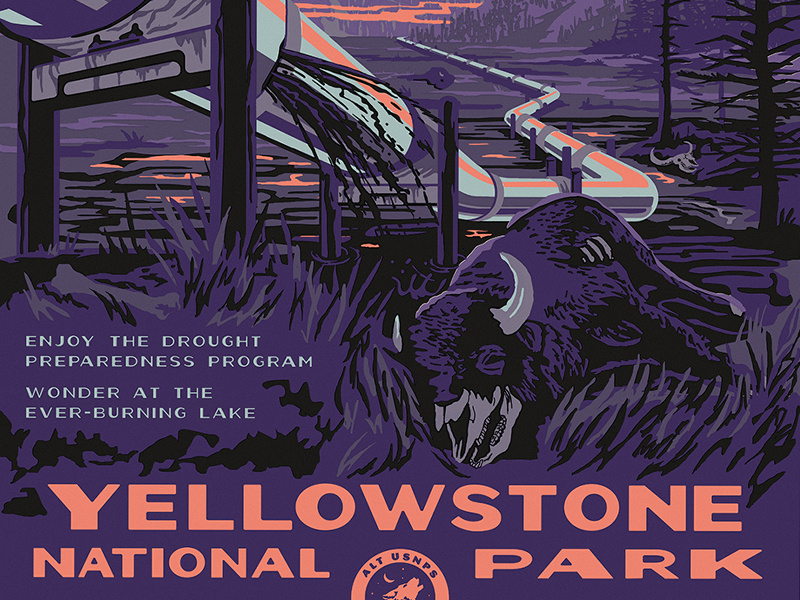
There was an eco-feminist reading of Hey Arnold! There was a close reading of Nick White and Paulo Bacigalupi’s portrayal of toxic water (in the context of the crisis in Flint, Michigan). There was a critical assessment of whether or not altering National Parks iconography is a useful political strategy against selling public lands to corporate interests. This conference is my  favorite, more than the national PCA conference and even AWP (where everyone is trying to hide how stressed-out they are). Maybe it’s the Breaking Bad T-shirts in the hotel lobby, or the actual meth dealers just down the street on Central Avenue, but for whatever reason, this particular conference allows scholars, an otherwise overly serious bunch, to take themselves just a little less seriously.

I’ve missed the high desert, the southwestern aesthetics, the tan and adobe architecture. I’ve missed the sunlight and the dryness. But this is Albuquerque, a city of endless surprise. So I should have expected that the restaurant a friend and I taxied to would be closed in the middle of a snow storm, forcing us to walk down Central Avenue looking for an emergency alternative. Right now, nearly every place that I have known is covered in snow: Flagstaff, Lincoln, Moscow, Spokane, and for a while even Albuquerque, New Mexico.

I neurotically plan for contingencies at every step, but it’s good to know that the unexpected isn’t always bad. For me, it takes an effort to relax and take things less seriously. Shout-laughing at the high desert snow while looking for an Italian restaurant in the wind and snow with one of my best friends reminds me that some of the most productive, engaging experiences are surprises, without prediction and against planning.

The stakes are high, for interdisciplinary academic work that actually makes a difference. Back home at the University of Idaho, there are two interdisciplinary efforts to address climate change, first an ecocriticism reading group and second an emerging collaboration between the humanities and sciences to communicate accurate climate science to local communities. This weekend, I realized that not only is pop culture necessary to communicating serious climate science, but framing it all as a doom-and-gloom apocalypse is also counter-productive. The most important part of the countless post-apocalyptic films and novels that have come out in the last five years is that, one way or another, people express survival in terms of art. Despite zombies, drought, or plagues, characters always make room for culture, whatever that culture is, no matter how subtle its recreation and preservation is.

Image result for alt national parksPopular culture studies finds a comfortable home in Albuquerque. This academic field, like the city itself, resists expectations. It forces people to recognize that grave concerns and lightheartedness can coincide.

This conference is an (expensive and limited) opportunity for scholars to “make sense of the things they love.” It’s a space to recognize the ambiguity inherent in everything we interact with: TV, movies, comics, music, genre. All of it has a radical potential to shape the way people see themselves and the world around them. It’s not that pop culture is sacred, but that it has the potential, like the most radical aspects of the world itself, to surprise us.


-jk

Road Stops: A Photo Essay, Part 3

The Daly Mansion is just outside Hamilton, Montana. It belonged to the copper baron Marcus Daly in the late 1800s, and was previously a homestead in the Bitterroot Valley. During his life, Daly was owned and expanded the Anaconda Copper Company during the copper boom in western Montana. The mansion served as his summer home and has now been remade into a museum, a testament to the wealth that the nineteenth century copper kings accumulated. There are strange things on the grounds, though. There are creepy statues in a shed near the mansion, and a trophy room with dozens of animal heads and furs.


See part 1, in northern Idaho, and part 2, in Montana and southern Idaho, respectively.

-jk

Road Stops: A Photo Essay, Part 2

On a rainy day in summer, Butte, Montana, and nearby Anaconda are rich with shades of green and rust. Mining rigs from its copper boom remain scattered around town, alongside monuments to the victims of mining disasters. More permanent is the Berkeley Pit, a toxic lake in an abandoned pit mine. Driving out of western Montana through the mountains on Highway 43 in this weather brought me through fog obscuring the road and the pines, but the clouds gave way to wind when I reached southern Idaho, still populated by ghosts from the Second World War, including a prison for German POWS and a Japanese internment camp. There are only a few remaining buildings from the internment camp recently preserved, a haunting and increasingly familiar testament to the scapegoating and indefinite detention of thousands of families. The remains are not as physically toxic as the Berkeley Pit, but the landscape is just as still and silent as the lake’s surface.

More to come. See Part One, in northern Idaho, here.

jk

Road Stops: A Photo Essay, Part 1

Here is a collage of photos taken at various stops on Interstate 90 between Couer d’Alene, Idaho, and Missoula, Montana, including Cataldo Mission at Old Mission State Park and the historic town of Wallace, Idaho. The road out west is weird and long and very quiet on a Sunday morning. In most towns in northern Idaho, nobody is awake. It’s spooky.

More to come.

-jk

Nobody Plans to Stay in Spokane

SpokaneMy plan for the break was to take a bus from Spokane to Missoula, and get a ride from there to Hamilton, Montana, to visit my grandparents, then travel to Arizona with my parents. To make a short story shorter, the bus was delayed, and now I’m stuck in Spokane for the night. I will depart in the morning, I hope.
My aunt was kind enough to give me a ride to Spokane from Moscow, on her birthday no less. In her profound generosity, she booked a hotel room for me in Spokane after learning the bus was delayed twelve hours. She then joined a friend for per-arranged birthday plans, hurrying because apparently there was an active shooter in downtown Spokane. She told me that her well-traveled husband has only ever been afraid of Spokane. Moscow, Russia? Fine. Dubai? Sure. But not Spokane. Anything but Spokane at night.

Of course 2017 would draw to a close with me stuck in a hotel room in Spokane where there’s an active shooter on the last day of the semester, listening to “Pale Green Things” by The Mountain Goats on repeat. There are worse endings.

The last time I was in Spokane, I was with the only other nonfiction first-year student in my department. He was picking up a friend from New York at the same Greyhound station I will (hopefully) depart from. He and I wandered the town at night, what my well-traveled uncle would strongly advise against. We found cool bars, he visited a dispensary, and we waited for his friend’s bus in his car listening to Utah Philips sing “Solidarity Forever” on repeat, talking about the possibility of unionizing grad students to protect ourselves from the multitude of organizations attacking higher education.

A month later, he had to leave. His story is not mine to tell, but I know that a graduate student union might have been able to help him stay. A better healthcare system, or even expanded medicaid, would also have helped, and stricter environmental regulations would have spared his health from the start. But, as with so many things this year, it’s too late now.

I didn’t expect to be in Spokane tonight. I expected to explain again to my grandparents what a vegetarian diet involves and sleeping in a comfortable old house in the Bitterroot Valley. Instead, tonight I can see the spot my friend and I parked and shared our insecurities from the view of this hotel. What an unexpected gift, to remember the people who have helped me survive this semester. I needed this reminder of the many people who unintentionally hold me together at the seams just by being themselves. At the end of a dreadful year, what an unexpected gift.

-jk

Surrendering a Pocket Knife

IMG_4603There wasn’t much going on at the Spokane International Airport. Its two runways did not seem busy yesterday as I navigated the rigid airport security system. I diligently took off my shoes, placed my laptop in its own plastic tub, and placed my sparsely packed backpack in another tub. Shoeless, coatless, without my glasses and a little sleepy, I went through security. Past the body scan, I then waited as a TSA agent rummaged through my backpack.

“It looks like there’s a knife in here,” he said to me, casually.

Of course. My air travel backpack is the same as my camping backpack. Before packing, I had emptied my backpack of all my camping equipment, and even emptied it of pens and pencils, just in case. It seems I had missed a pocketknife, which took the agent a few minutes to locate after it slipped into one of my backpack’s many pockets. Only an X-ray could detect it. He held the knife in front of me, saying I had three options. I could have it delivered somewhere from the airport, put it in my car (I didn’t drive there), or, as he put it, I could “surrender it and let it go to knife heaven.”

I paused for a second. My flight would begin boarding in thirty minutes, and I probably had enough time to have it mailed back to my apartment and then go through security again, even though the knife was the only issue. But the line behind me and the agent’s calm patience made me feel embarrassed, even ashamed, at not doing my civic duties and preparing my backpack for Thanksgiving travel thoroughly enough. I chose to surrender the knife.

During my flight, I mulled over the word surrender. There are so many other ways of putting it: confiscate, disavow, give up. Instead, the situation looked like this: a TSA agent held my knife at me and told me to surrender.

It occurred to me that I felt safer at an airport than I do in my own classroom. I cannot take a knife on a plane (fair enough), but if I wanted to, I could bring a concealed handgun into my classroom while teaching. Idaho’s laws are finicky, and concealed-carry gun-owners, while on campus, are not allowed to reveal their weapons, but I still have the option to have one, and so do my students.

The argument is that the only thing stopping a bad guy with a gun is a good guy with a gun, and yet we don’t apply this logic to airplanes. On the plane, we cannot trust anyone with a pocket knife, or scissors, or toothpaste, so we regulate these things, or at least we collectively agree to embrace the cognitive dissonance required to believe that the good guy/bad guy hypothetical situation works everywhere except a plane. Nobody is trusted on a plane, but we have to trust that good guys will be everywhere else.

While teaching my last class before the holiday break, a man walked into my classroom, abrasively opening the door and marching toward me. He was older, balding, and looked frantic. Before I could panic, before I could beg him not to shoot me, he pointed to the lectern at which I stood and said, “I need to get a flash drive.” Then, in a few quick moves, he unplugged a flash drive from the computer. Evidently, he was another professor who had previously used the same classroom, and had left his equipment there. He apologized for the inconvenience and walked out. My students didn’t seem bothered. Maybe they’re all just good guys.

As my plane landed, I thought about something Charles Olson wrote in his 1947 literary criticism Call Me Ishmael: “I take SPACE to be the central fact to man born in America, from Folsom cave to now. I spell it large because it comes large here. Large, and without mercy.” I’m skeptical that there is one central fact of America, but after the twin incidents in the classroom and airport, I’m inclined to think the central fact of America might be surrendering. This might be the case for every nation-state, but I cannot speak to other countries, but it seems more widespread in America: If I were not white, I can’t imagine what the TSA agents would have done to me after discovering a pocket knife in my backpack.

The word surrender has another, more sinister layer. Only combatants can surrender to another authority, lesser or greater in force. Soldiers surrender in war, and criminals surrender to cops. It suggests a more equal power dynamic than what is actually recorded in history. Native Americans surrendered land and life, Afghan children surrender security under drones, politicians surrender principles and we surrender to them our votes and our privacy, the working poor surrender their labor. What the state calls surrender is more like seizure because those who are asked to surrender are made to feel responsible for their defeat, as if it was their choice to enter into a conflict with America, large and without mercy.

And what was I ashamed of? That I was caught not remembering the state of terror we live in? I think, in truth, I was ashamed that the first time I relaxed this semester was walking into an airport, that I felt safer in a security complex designed to reinforce fear than I do in a classroom designed for comfort and an easy pace, and that I’m made to feel responsible because I’m not a good guy with a gun. Instead, I walk into a classroom with pens, pencils, markers, books, and slideshows, but none of those things, it seems, are enough to make me good.

-jk