Category Archives: Cooking

Adventures in the culinary arts, mistakes and all.

I Bought a Pumpkin. Now What?

Orange

Leaves are changing colors, candy is getting cheaper and oranger, and the farmer’s market is filled with freshly harvested pumpkins. Resisting temptation is hard; now I have a pumpkin. What does one even do with a pumpkin?

Orange Triptych

The first thing to do is get to know the pumpkin. Give it a cute name, something like Fred. Spend a few nights drinking with Fred. Really get to know him. From there, it’ll be easier to figure out what you want to do with Fred. In my case, I wanted to make Fred into a pie.

Fred 1

Give Fred a good bath, remove Fred’s stem, and slice Fred laterally with a large cutting knife. This might upset Fred, but he’ll just have to learn to live with it. Using a large spoon or ice cream scoop, remove all of Fred’s insides, scraping against the flesh to get all the strands and seeds out. It goes without saying you can save Fred’s inside for later consumption. Dash a little salt onto Fred’s flesh, place his two halves flesh-side down on a covered cookie sheet, and bake at 400 degrees Fahrenheit for about thirty minutes, or until Fred is nice and mushy, like he always gets after a few beers.

Fred 2

Again, using an ice cream scoop or large spoon, scrape out Fred’s flesh, which should come out easily after baking Fred. He may be confused at this point, but just remind him it’s for a good cause. Mash (or blend in a food processor) Fred’s flesh, until it’s nice and smooth. You can store some of Fred’s flesh in the freezer for future endeavors. For example, you can make muffins out of Fred, too.

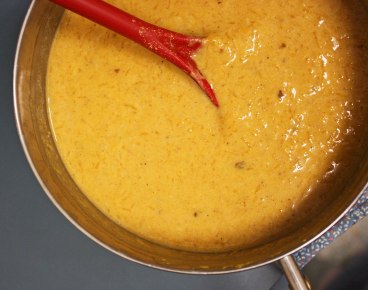
Toss 1 cup of Fred’s pureed flesh into a sauce pan and cook until it simmers. Add 1 cup milk, 1 teaspoon nutmeg, 1 teaspoon ginger, 1/2 teaspoon cinnamon, and 1/4 teaspoon ground cloves. Feel free to adjust the spices to make Fred as spicy as you like. Fred, of course, prefers to be very spicy, if his sass didn’t tell you anything. Mix well and let simmer.
Fred 5

In a separate bowl, combine two eggs and 1 cup of brown sugar. Add this to Fred’s simmering remains and stir to combine.

Fred 4

Once the eggs, sugar, cream, and Fred are thoroughly combined, pour into a pie dish with a prepared crust. You can make your own crust (like I did, in a completely unpretentious way), or buy a premade crust. Place the pie dish on a cleaned cookie sheet and bake Fred at 350 degrees for forty to fifty minutes. Fred will be very disappointed, but delicious. You can make it up to Fred by covering him in whipped cream and serving him with hot beverages. Like all gingers, Fred loves whipped cream and hot beverages.

Fred 6

-jk

Leftist Vegetarian Chili

Let’s say you want to make chili for the autumn season, something you can bring to a pot luck at a moment’s notice. If you’re anything like me (an English Major), any pot luck you get invited to will be filled with vegetarians who bring gallons of humus and pita chips by the crate. Here’s an easy recipe for a healthy chili to satisfy any English Major’s left-leaning, postmodernist palate.

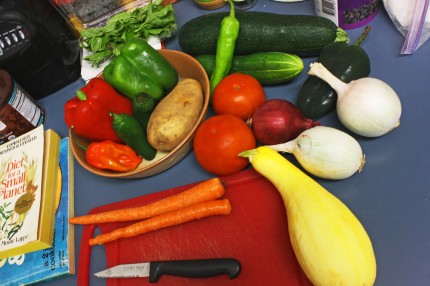
The first step is to go to the local farmer’s market to obtain the best locally grown organic non-GMO socialist ingredients. Obtain the following items:

4 or 5 tomatoes1
1 red onion
1 sweet onion
2-3 carrots
2 bell peppers
2 jalapeno peppers
1 green chili pepper
1 habanero pepper
1 yellow summer squash
1 potato
1 copy of Das Kapital
2 cans of black beans

Optional: two bowls of marijuana, but only if you’re serving at a gathering of poets. If the chili is for a faculty meeting, two to three liters of rum (as a side dish) should be provided.

Various seasonings (salt, pepper, cumin, cloves, cinnamon, ginger, turmeric, grassroots activism) should be added to your own taste (which should be excellent because you’re an English Major).

First, lay out the ingredients and tell them that cuisine is a social construct. Then chop up the onions and dump them into a cooking pot with an inch of oil. Stir them enough to keep them from burning, and add salt and pepper. The onions should be strong enough to make you cry, if you aren’t already crying about the TPP.

2

Next, chop up the tomatoes. Add a can of tomato sauce if you really want to give money to the 1 percent, you terrible monster.

Add the cans of beans, ignoring the fact that Big Canning got your hard-earned money. In a vegetarian chili, you need protein, and the beans will provide enough protein to help you resist the man.

Chop up the vegetables; carve them the way you’d carve up Wall Street, and redistribute their wealth in the pot. Season liberally with spices.

4

Next, chop up the peppers. Be careful to protect your hands, otherwise your fingers will burn the way the Christian right wants you to burn in hell. Be especially careful chopping the habanero, which will provide the amount of spiciness needed to smash the patriarchy. You can also add smashed patriarchy to the chili, but don’t add too much; patriarchy has very little nutritional value, because it’s mostly fatty acids and blood.

5

Stir all ingredients and continue to season as you see fit, because you are a creative and unique individual and however you season it will be an expression of your individuality in the rising tide of fascism. However, don’t add too much cinnamon or ginger; if you wanted a pumpkin spice latte, you’d go to a coffee shop with your Mac and write a screenplay in the corner.

6Let the chili simmer the way the working class simmers before the coming revolution, for two or three hours. Feel free to freeze it for the future or emergency pot lucks. Because your vegetarian Marxist postcolonial chili will be as spicy as your attitude (on tumblr), serve with lots of bread, or over rice. This chili is not for the faint of tongue.

Feel free, even, to serve it to your conservative friends. It may be meatless, but that’s no reason to be afraid of it. Take it to a tailgate party, or an NRA meeting. Use it to bring people together. What we eat may be politically driven, but sharing a meal is universal. At least that’s what the shoeless hippies who sold me the onions said.

-jk

In Search of the Perfect Beer Milkshake

Beer Shake

“If a man ordered a beer milk shake, he thought, he’d better do it in a town where he wasn’t known. But then, a man with a beard, ordering a beer milk shake in a town where he wasn’t known–they might call the police.” -John Steinbeck in Cannery Row.

My favorite author, John Steinbeck, is known for his epic novels about the lives of the working poor like The Grapes of Wrath. While I love his longer works, the Steinbeck novel that has had the most influence on me is Cannery Row, more a collection of interconnected stories than a novel. I first discovered it four years ago, and I have reread it every fall to rediscover the magic of Steinbeck’s Cannery Row in Montery, California, which he calls “a poem, a stink, a grating noise, a quality of light, a tone, a habit, a nostalgia, a dream.”

In one story, the main character Doc remembers somebody commenting that he loves beer so much, “someday [he’ll] go in and order a beer milk shake.” Because he is safely out of town, he takes the bet and orders one, providing the following recipe: “Put in some milk, and add half a bottle of beer. Give me the other half in a glass–no sugar in the milk shake.” Because Doc is one of my favorite literary characters, I attempted to make a beer milkshake following Doc’s specifications.

It turned out dreadfully, so I worked on changing the recipe. Because several restaurants have already experimented with beer milkshakes, one can probably find several recipes online, but here, I offer my own.

1 bottle of beer (preferably a flavorful ale or stout)

3 scoops vanilla ice cream

1/4 cup milk

1 tablespoon sugar

2-3 icecubes

Beer Shake

Combine all ingredients in a blender and serve fresh and cold.

Beer Shake I tested numerous variations of the beer milkshake. With dark beers, I tried adding chocolate sauce. With ales, I tried using only ice cream and beer, nothing else. I don’t know what Steinbeck was thinking when he wrote about Doc’s excursions into the world of beer milkshakes; he wrote that “it wasn’t so bad–it just tasted like stale beer and milk.” I may have taken Steinbeck fandom to an extreme, but his work is dear to my heart. For now, I’m content to read my favorite writer, take his jokes too seriously, and remember his reflections on the world:

Cannery Row’s “inhabitants are, as the man once said, ‘whores, pimps, gamblers, and sons of bitches,’ by which he meant Everybody. Had the man looked through another peephole he might have said, ‘Saints and angels and martyrs and holy men,’ and he would have meant the same thing.”