

April is National Poetry Month, and by tradition I dedicate this month to writing thirty poems, one each day. I may never have reached that goal, but it’s still an opportunity to write forward. Poetry is a nearly religious part of my life, but I treat every other form of writing the same way.
As long as I’ve written I’ve juggled poetry, fiction, and nonfiction, but in grad school I’m unofficially designated a fiction student. My master’s thesis will (probably, maybe, don’t ask me) be a collection of short stories, but I’ve never thought of myself as a specialist. Most writers do specialize, though, and as April begins, I can understand why writers might want to dedicate themselves to mastering only one form.
During March, I pushed myself to the writerly limits. I churned out four short story drafts and seven poems, and started a nonfiction essay. While planning my Fall schedule, I schemed ways to take both a poetry tutorial and a creative nonfiction class. The few publications I can claim have ranged from poetry to prose to drama. As a result, my overall portfolio increases steadily, but my skill as a writer continues to be scattered across genres, and while all forms have some things in common, they each require different kinds of effort.
I probably should focus on just one form. I could master fiction, inhabiting characters and pushing plots, or poetry, and improve how I carve roads out of language. Mastering nonfiction would force me into my own head, and theater would confine my characters to the concrete realm of the stage. Or I could shock the world by submitting a series of interconnected Foucauldian pizzas to my committee for cooking competition-style judgment.
The truth is that I simply don’t want to specialize. I started writing because I loved reading and wanted to make others feel what I feel. If my prose suffers for my poetry, or the other way around, so be it. I know the consequences of being scattered, and I’ll write forward in spite of them.
-jk
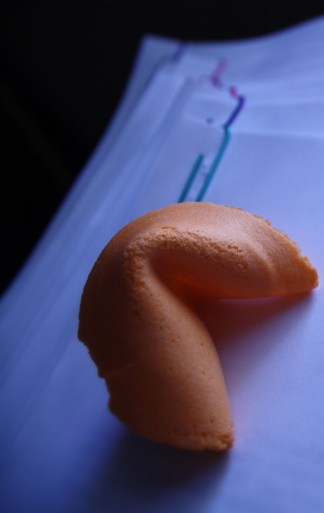 For an exercise in my fiction workshop, each student was given a fortune cookie and asked to interact with it. We interacted: we broke them, read the fortunes, nibbled on the cookie chunks or chomped them down in one bite. The exercise was about magical thinking in our own lives and our readers’ lives, and how stories so often rely upon the magic of symbols, the mystical confluence of coincidences. Despite of our capacity for logic, we often attach special meaning to mundane things.
 I’m twenty-five percent of the way finished with my Master’s Degree in English at the University of Nebraska-Lincoln. Most of what I’ve encountered is unsurprising: the workload is tough, the Midwest is flat. However, there are certain things I’ve learned, perhaps unique to my own situation, that I wish I’d known earlier this summer.
 Keene Short