Category Archives: Writing

“Don’t be a writer. Be writing.” -William Faulkner

Séance

At 7:00 PM, the hooded medium taps his phone and the music on the Bluetooth speaker switches to some esoteric chanting. He unsheathes a sword and holds it over the participants—eight people consisting of one couple, one of the bookstore’s employees, his girlfriend, a trio of women who could be sisters, and myself. The medium says something muted as he taps the sword three times in the air, then repeats with a few sprinkles of water from a glass. He takes his role seriously, explaining that he is casting circles to protect the room from ill-intentioned spirits while still making room for benevolent ones.

He pulls back his hood to reveal a long white beard and thick glasses. He smiles and says in a Kentucky accent, “Hi, there, I’m Drew.” I want to add, “And you’re a Druid?” but I keep that to myself. I’m here to take this seriously. I write about horror movies and ghost stories for a living (or part of one). If nothing else, this is research.

We are gathered in an indie bookstore for a séance of the spirit of Emily Bronte, whom we will try to summon in southern Indiana using soil from the Bronte Sisters’ grave in England stored in a glass vial that looks like a test tube, a gift to the bookstore owner from a patron years ago. This is not a performance the way improv comedy is a performance, but I understand the guide’s showmanship. He asks us if there are any mediums in the room, anyone who is used to feeling strange, significant changes in temperature, casual premonitions, dreams that come true. A few participants raise their hands for each; I don’t raise my hand at all. As much as I want to believe, I am skeptical, always Agent Scully instead of Spooky Fox Mulder.

As an afterthought, the medium asks, “Are there any standup comedians here this evening?” I can’t tell if he’s looking at me while he explains that the impulse to crack a joke to fill an awkward silence breaks the tension necessary for a séance. This is a literary explanation: holding tension, like staying in pitch while singing, is a craft technique. Tension builds atmosphere, holds the reader’s attention, keeps us in the moment.

“As a child,” writes Melissa Febos at the end of Body Work, “I did not understand spiritual, cathartic, and aesthetic processes as discrete and I still don’t. It is through writing that I have come to know that for me they are inextricable” (153). A séance for a British author is aesthetically appealing during the month of October and cathartic to a certain extent, but I’m still hungry for spiritual meaning. I can appreciate the theatrics involved in any kind of ritual, a form of adornment like the robes a priest wears, the gold shimmer of a communion chalice. I know a campus pastor who often said, half-seriously, that a modern Eucharist should involve pizza and cola. A community meal would be spiritually satisfying and certainly cathartic, but the gravitas of gold and robes adds a layer of distinction, demarcating rituals from habits.

The medium passes around Emily’s grave soil. We hold it one at a time, seeing how it changes what we notice in the air, what magnetism we can find. It is heavier than I expected; the glass is cool to the touch, but not cold. One of the intuitive women in the room, though, feels its warmth. She walks around the room gauging the spirit’s rambunctiousness, looking for where the warmth is thickest, and stops in front of me. I don’t know where to shift my gaze; there is a density of warmth in front of me, she says. The medium’s glasses are so thick and the room is so dark that I think he is looking past me when he asks me if I’m comfortable proceeding.      

Eager, almost giddy, he stands above me and draws a card from a tarot deck to see if the spirit of Emily Bronte or whomever else the circles invited in has a message for me.

He draws the Ten of Cups. He smiles. Red light reflects off his glasses, obscuring his eyes. He tells me that this is a sign that familial connections will come together soon, that questions of community and purpose will be resolved. That there is a reason to rejoice at something in the future.

I want to believe this. I’m actually taken aback by my own knee-jerk skepticism. I don’t know what spiritual force this is meant to resolve or why somebody would feel warm energy anywhere near somebody like me, so often told how cold I seem.

But this is just a prelude. The real séance requires two volunteers from the audience. One volunteer sticks his hand in a hole in the floor and leaves it dangling in the cold air above the basement. Another lies flat on his back with two death pennies on his eyes, pennies left on the eyes of the dead and uncovered decades later by gravediggers who had to shift bodies to narrower graves to make room for more of the dead. He has a vision of a worker whose whole family, generation upon generation, is at a mansion party, but the worker must leave. He almost hears the worker’s name, something with a T, but that’s all. The worker spirit must depart in a hurry, he cannot stay in our circle, in our waking world. Then, someone feels chills. Then, the warmth in the room falls away. The tension breaks before the ritual is over and the bookstore is a bookstore before it is supposed to be a bookstore. I walk out into the night, haunted by some ache I couldn’t name.

Stress, Growth

Numerous red-orange mushrooms sprouting from the bark of a fallen tree.
Mushrooms crowding for attention on a tree in the Hoosier National Forest.

“Trees that develop without setbacks stand straight and proud. At first their branches grow upwards, then sideways, and finally a little downwards, so they can bend with the rain and snow. Most adult trees, however, have gone through something in their lives: another tree falling against them; branches broken by the weight of snow or ice; fungus; holes in their trunks made by woodpeckers or beetles. All these have changed their form and they’ve acquired scars” (Meijer 37-38).


I can’t remember if it was The Rise of Silas Lapham by William Dean Howells or Sister Carrie by Theodore Dreiser that we were discussing. In either case, the professor for the Great American Novel seminar asked the class whether or not our character, our own as living people, are the accumulation of material accomplishments or the outgrowth of an innate set of traits we are destined to wrestle with. I argued for the latter in a paper about one novel or the other. Over a decade later, my thinking has evolved, as all thinking should, but reading Eva Meijer’s The Limits of My Language last month provided a solid counterbalance to the idea that who we are is innately fixed.

Subtitled Meditations on Depression, Meijer takes an essayist’s approach to a clinical experience that can only be expressed through language, which she states in the title is limited at best. Among the metaphors she uses to inspect her own depression, what struck me the most was that of a tree. She doesn’t go with the obvious route and describe tree rings that accumulate layers of weather and smoke and toxins and bark beetles. Instead, she describes the exterior of a tree, the way its branches twist and wend and warp, the shape it is in a constant state of taking. A tree has an innate direction to follow, but grows around the damage done to it. To access tree rings, after all, the tree must first be cut down.

What I remember about Sister Carrie is that the protagonist navigates continual limitations on her agency. Environmental factors play a role in shaping her decisions, from the length of a table between her and a powerful man to the layout of the city where the novel is set. What I remember of The Rise of Silas Lapham is a hulking all-American rags-to-riches figure who has attained excessive wealth but not the cultural capital that should, in his mind, accompany it. The novel opens with Silas giving an interview, uncomfortable with his circumstances. Silas has his wealth, but not his peers’ respect. Sister Carrie, on the other hand, gradually attains fame but is faced in the end with the same sense of emptiness with her success.

What exactly makes personal growth meaningful is still very much the appeal of literature today. It’s not surprising that the runaway horror movies of the summer, Sinners and Weapons, devote the bulk of their scripts to developing a wide cast of complicated characters, keeping their respective villains relatively in the background. It’s no surprise that one of the most popular fiction genres today, the romance novel, is predicated on the fact that people are bound to change when met with new circumstances. Trajectories like friends-to-lovers, enemies-to-lovers, lovers-to-enemies-to-lovers, and so on, all attest to a recognition that character is far from static.

A spider's web hanging in a forest in front of a tall tree surrounded by green but blurry leaves.
The spider was busy when I asked for life advice.

When he accepted the Nobel Prize in Literature in 1962, John Steinbeck said that “a writer who does not passionately believe in the perfectibility of man has no dedication nor any membership in literature,” meaning, I believe, that fatalism is incompatible with the craft of literature.

Essays like Meijer’s, on the other hand, are more confronting than fiction. In memoir, we’re not following a rags-to-riches or riches-to-rags plot, we’re not growing to more effectively confront vampires and witches, but taking our own growth (or lack thereof) and putting it under a microscope.

I find more comfort in Meijer’s tree metaphor because a healthy tree is measured by what other species it helps to foster. Like every organism in every ecosystem, nothing lives in isolation. A tree provides nutrients to fungus, shade to mammals, shelter to bugs and birds. These are all outcomes that a healthy tree is bound to provide by virtue of what a tree is: the transformation of sunlight and minerals and water into sugars and nuts and foliage. The shape of a tree is irrelevant; gnarled, twisted, straight, even, split—what matters is the processes that a tree recycles, the absorption of carbon dioxide, the excretion of oxygen and nutrients, the miraculous flow of care that its roots and branches provide to the rest of the forest.


Meijer, Eva. The Limits of My Language. Pushkin Press, 2021.

On Writing That Cannot Be Replaced

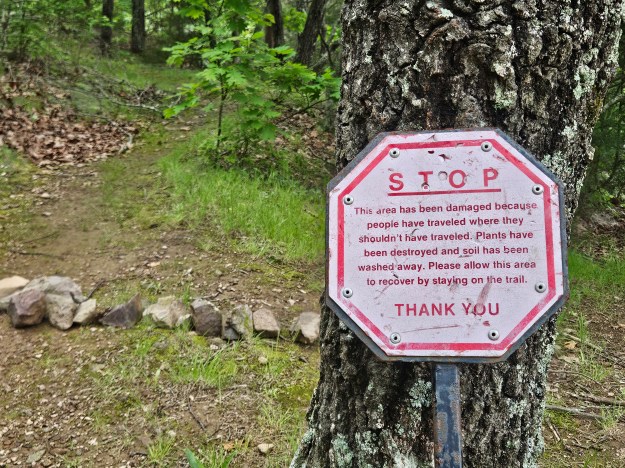
A STOP sign on a tree on a trail that reads "STOP. This area has been damaged because people have traveled where they shouldn't have traveled. Plants have been destroyed and soil has been washed away. Please allow this area to recover by staying on the trail."
An ominous but compelling sign on the Ozark Trail in Missouri.

“I don’t expect life to bring me subjects but unknown structures for writing. The thought ‘I only want to write the texts that only I can write’ refers to texts whose very form is provided by the reality of my life. I could never have foreseen the text we are writing. Though it definitely came from life. Conversely, the writing under the photos, in multiple fragments which will themselves be broken up by those of M., as yet unknown, give me (among other things) the chance to create a minimal narrative out of this reality.” -Annie Ernaux.


Between the administration’s cuts to NEA grants that now put dozens of literary venues at risk of shuttering, and venture capitalists pushing software built on plagiarism and prone to error (branded under the umbrella term “artificial intelligence”), this country’s leadership has thoroughly cemented its disdain for the written word.

I had the privilege of articulating my own specific syllabus policy on AI for my university’s magazine this spring. As an English teacher, I emphasize to my students that writing itself is thinking, or a process of decision-making that allows people to articulate their own original ideas in a way that others can comprehend. What I tell my students is that good writing is not about “rules you have to follow” but rather “understanding actions and their consequences.” That language is inherently idiosyncratic, a consequence of the actions that its participants take. Its value derives from its dexterity, from being put to the limit. E. E. Cummings broke the conventions of grammar, and the consequence is that his poetry is thought-provoking, confronting, memorable. Shakespeare invented almost 3,000 words. George Orwell’s fictional world-building remains a popular lexicography for expressing the devaluation of language to “Newspeak” ordained by “Big Brother.”

Generative AI cannot innovate our language in the same way because it is not a writing machine, but a customer service machine designed to give people answers that will 1) satisfy them and 2) make them come back to the customer service machine again. Imagine a slot machine that always gives you the exact amount of money necessary to pull the lever again, but never more.

Annie Ernaux articulates the value of writing as an exercise in self-expression in The Use of Photography, a memoir of the roughly one-year period when she underwent treatment for breast cancer. The book is a series of reflections about photographs she took of piles of her and her lover’s clothing during their affair during the same time period. Each photograph is followed by a reflection by Ernaux, and one by her lover at the time, the journalist Marc Marie. Strikingly, the project is about the wide gap in each co-authors’ memory about the specific intimate moment captured with each photograph.

At one point, Marc jokes that Annie got cancer “just so she could write about it,” which she jokingly concedes but also rejects because she sees life not as source material for writing, not as “subjects” but as “structures.” Cancer creates a structural change that the author then occupies and, subsequently through the act of writing, volunteers to make sense of.

“I only want to write the text that only I can write” shouldn’t strike me as profound, but it does. It justifies my profession and my art in a context in which the most powerful people want to replace my work with software. What makes Annie Ernaux such a compelling writer is the specificity of how she uses language to express herself.

There are many memoirs about breast cancer. It’s an unavoidable subject if one studies memoir as a genre. Terry Tempest Williams places it in the context of her Mormon heritage as a downwinder from Utah in her essay “The Clan of One-Breasted Women.” Anne Boyer’s memoir The Undying takes a maximalist approach, connecting the history of medicine to Youtube video essays and the drugs involved in chemo. Audre Lorde’s The Cancer Journals takes a critical view of the empty promises carcinogen-producing corporations make when adopting pink ribbon logos one month a year. Each memoir is an artifact of the author’s individual exploration of their own experience, decades condensed into paragraphs, minutes extended into chapters. As memoir, each artifact attests to the individually specific nature of empathy. Each author has something different to say. As the reader, I anticipate friction, contradiction, distinction.

Ernaux decides to explore her own cancer treatment in one of the least obvious ways possible, through romantic entanglement expressed through photographs of clothes, removing concrete depictions of her body entirely and thus relegating the illness and treatment alike to memory that she then shares with another person, layered beneath the topography of intimacy and fulfillment.

In an interview with Alison L. Strayer in Southwest Review, Ernaux explains that for a lot of people, “when you have cancer, pleasure is not allowed. End of story. You do your chemo and you don’t bother other people with all that. The less they see you, the better it is for everyone. Because there’s that, too: people don’t talk. They don’t know how to be around someone who has cancer.”

In writing about an uncomfortable subject, Ernaux, like many other women before her, opens up avenues for a difficult subject matter to be made accessible to those who may encounter it in the future, and to those who should learn to empathize with those who share her experience. Writing, then, is an act of creating pathways where there had previously been none. Readers live in a richer, more textured world because they have access to a wide variety of very different memoirs about breast cancer, and memoirs about military experience, and novels about gardeners and poetry about addiction recovery and short stories about truckers and immigrants.

The destruction of literary venues and the expansion of a plagiarism machine both threaten to obscure the value of the written word as a mode of empowerment. To put it differently: I don’t study cooking because I intend to cook every single meal I eat, but because the ability to cook for myself and for others, whenever I want to, is valuable in itself. I’m tired of having to explain this to tech bro losers and their devotees, but I will never stop explaining it as long as I have to.


Ernaux, Annie. The Use of Photography. Seven Stories Press, 2024.

Planting Season

Summer is icumen in
Lhude sing cuccu
Groweþ sed
nd bloweþ med

So read the opening lines of a 13th-century English round, possibly written by a monk at Reading Abbey in Berkshire. The text is Middle English, distinct enough from the early modern English of Shakespeare, but possibly more legible than the Old English of Beowulf. In translation, the lines mean:

Summer has come in,
Loudly sing, Cuckoo!
The seed grows and the meadow blooms
And the wood springs anew.

When sung aloud by a Scottish commune during a May Day festivity in The Wicker Man (1973), the Middle English verse might be mistaken for modern English as sounding like “Summer is a-coming in, low sings the cuckoo.” The difference is slight but attests to the uncanny similarities and fractious differences between the past and the present that the film plays with. Referred to once as “the Citizen Kane of horror movies” by Cinefantastique, The Wicker Man is one of the most important folk horror films. Undercutting many of the Gothic origins of horror—full of structurally decaying mansions and frayed institutions and hidden secrets and buried psychic Protestant shame—the use of Pagan May Day festivities in The Wicker Man brought the bucolic and Edenic tropes of Romanticism into the horror genre.

This year, I devoted much of my time and energy to an academic book project about food, agriculture, and ecology in folk horror movies. I can’t summarize the book well in a single blog post. It’s about the importance of the ambient threat of starvation in rural horror and the limits of Gothic literature and the surge in popularity of a horror subgenre about communal identity against encroaching political and economic forces. It’s about the desire to go back to the Old Ways when the modern nation-state seems doomed. There’s also a fair bit about mushrooms.

In any case, if you or someone you know suffers from being an academic (symptoms include teaching a film studies class or something about ecocriticism, assuming that’s legal this time next year), might I suggest looking out for pre-order dates for Late Harvest: Food, Landscape, and Agriculture in Folk Horror from McFarland Books. It will likely come out in the spring of 2026, when the next season’s planting season will commence.

Christopher Lee, Diane Cilento, and Britt Ekland in The Wicker Man (1973).

The book was partly driven by my obsession with the changing of the seasons. I planted the seeds for the book last June when I took a risk and chatted with a representative from McFarland at an online pop culture studies conference. I’ve always enjoyed spooky aesthetics, though. I grew up wandering around in the woods, being perceived by crows, and so forth. The book proposal was accepted in August, and I spent the harvest season writing the first draft in a frenzy. I submitted the draft on Halloween during thematically appropriate thunderstorms, and revised the book during the dead months of winter and early spring. The timeline is seasonal, another cycle of birth, growth, death, and rebirth.

Halloween is famously an iteration of the ancient Celtic holiday known as Samhain, the mysterious cousin to May Day, a time when the veil between this world and the spirit world is thin and winter is doomed to sweep aside the abundance of autumn. What folk horror films in the tradition of The Wicker Man take seriously is the fact that for agricultural communities, planting practices are more important than toasting the spirits at the end of a good harvest. Without a proper spring, there would be no harvest to celebrate.

To me, the more interesting moments in folk horror are when nostalgia for an imagined past runs into conflict with the realities of the present. Christopher Lee’s character in The Wicker Man, Lord Summerisle, is the grandson of an agronomist who genetically modified crops to grow in Scotland’s climate, while also replicating Pagan Celtic tradition, clashing scientific futurity with the customs of antiquity. The cult he leads is bound together by two artificial structures, one that is built on the myth that the cure for modernity’s failures is in returning to the old ways, and another that is built on the illusion that stability is found in extreme isolationism.

Medievalist historian Dr. Eleanor Janega unintentionally sums up how folk horror pulls from historical and cultural records to play with nostalgia as a response to modernity. In a blog post titled “On spooky animals,” Janega writes, “There was a big drive to identify what the hell Baphomet was in the nineteenth century as a part of the general uptick in occultism as well as the nationalist drive to find medieval heroes to justify the project of statecraft.” An interest in understanding the past coincided with an interest in replicating a perceived, if rarely accurate, interpretation of what made the past meaningful to the people who lived it. Rowan Lee notes that “to have nostalgia for a past that never existed, you must go further and further back, until the details are murky enough that you can project any fantasy you’d like onto the period.” The central tension in much of folk horror is what causes people to run away from the present or the future into a nostalgic idea of how people used to live, what lost wisdom is just beneath the topsoil.

I’ve never been nostalgic, though. I want to learn from the past, but not relive it. I get excited for each new season when the previous one has run its course, and that’s about it. I plant one foot forward. Now that summer is coming in and this book project is finally finished, I want to plant something new, something different, to see what comes to fruition.

Fixing Hearts or Dying

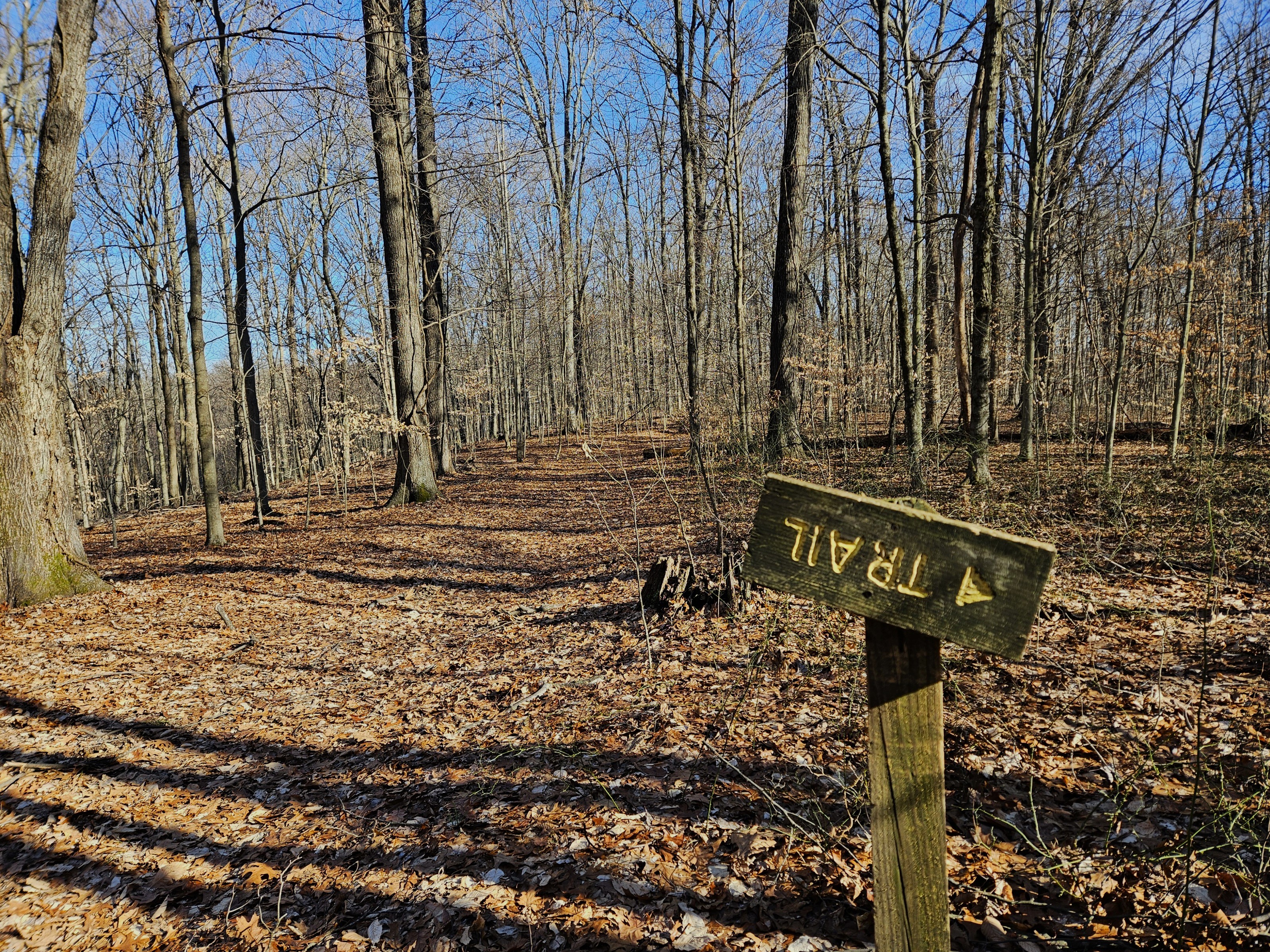
A trail in south-central Indiana.

Ancient alchemy, as Erin Vachon described it to a handful of writers over Zoom for a workshop through SmokeLong Quarterly, began with a process of decomposition called Melanosis. Transformation is a long procedure in this sense, and it begins with fragmentation. For writers, as Erin put it, this extends to our understanding of the assumed form and content of what we seek to revise. This could be as simple as writing from the perspective of another character. For nonfiction writers, this might be an exercise in empathy. As they walked us through this workshop built on the esoteric, I understood what they meant as I found myself writing from the perspective of Irish bog bodies looking up from the water, scolding the living.

Somewhere in my notes, I wrote the word subcutaneous to describe the underlying thematic concerns in a story, which are baked into the language at the sentence level. The story I selected to revise was an older work from almost a decade ago, and the prose was embarrassingly self-explanatory. This realization would have been mortifying were it not for the necessarily destructive first step. Like water from a sponge, I compressed the story to see what meaning would drip out between the lines.

The further along I walked, the more decrepit the signposts became.

I’ve been working to revise the story so much that it has become something else entirely. Maybe this means the loss of one story, and maybe it means the creation of something new, but if the logic of alchemy holds, the transformation is more of a visible realignment of what appears on the surface. The energy is the same, but metabolized differently.

I have not written anything new in a long time. I have been stuck in a revision-spiral reexamining my work, squeezing it, seeing what I can extract from it and then losing sleep over not writing anything new.

But I did have the pleasure of seeing an interview I conducted with another writer friend, Cavar, be published in Archer Magazine. Describing their process for writing a speculative, dystopian novel, they said something that has stuck with me: “I realised that part of writing a book like this means writing up to the very point at which I don’t know enough to write anymore, which is why you see so many crumbling syntactical moves and blanknesses in the novel.” The narrator in Failure to Comply gets around the challenges inherent to their world by dodging the inevitably limited power of language to convey meaning. Even if everything is knowable, it is certainly not all expressible.

After this point, the trail vanished beneath overgrowth and fallen trees.

Blankness and absence are confronting when they lack a clear explanation, when language offers nothing to describe what isn’t there. Shouldn’t it be obvious what needs to be said? Shouldn’t the words be abundant?

As much as I try not to lean too hard into esoteric mysticism in describing writing, there’s comfort in being able to attribute its power to something obscure. The late David Lynch described his own process similarly: “A film or TV show is like a magic act,” he said in 2018, “and magicians don’t tell how they did a thing.”

In grad school, colleagues told me my writing style was intentional and precise, which I attributed to the dry but grounded historians I read so much. Lately, to help me sleep or because I have rotted and decomposed into my elements through melanosis, I have been reading Vladislav M. Zubok’s Collapse: The Fall of the Soviet Union before bed, which I got over a year ago after seeing that Noah Kulwin, of the podcast Blowback, recommended it. The language in historical writing is intentionally unambiguous, which is a false comfort. Writing against ambiguity is like eating to never be hungry again.

The mystical veers uncomfortably close to the diagnostic. I discourage my students from thinking of revision as a way of “fixing” their writing, but I’m susceptible to that language, too. It suggests a wrongness, and more wrongly, it suggests that the removal of that wrongness is all that good writing needs. But fixing is more urgent than alchemy. Heaters and plumbing and bigots need to be fixed. Writing is in a constant and gradual state of change.

Because there is no “correct” form that a piece of writing will take, there is no predictable future for an artistic vision. What I want to write could become anything, and it takes confidence to give up so much control that I might constrict what my writing can become.

What Breaks Open the Seed

“Nature reinvents itself over and over again. This process of constant creation leaves behind a track record of successes and failures, new life forms that live or die depending on their innate genetic flexibility, their ability to find and fit into their own niche. This learning to live with others may take seconds or years or millennia.” – Diana Beresford-Kroeger, Our Green Heart: The Soul and Science of Forests, 41


A second year in Indiana has not prepared me for how startling winter is in the forests, how completely the deciduous woodlands shed their leaves and transform into quiet, desolate fogs of spindly twigs. I am still too used to the coniferous evergreens of the west, where the ponderosas only shrug at the changing seasons.

I started 2024 with two goals in mind: To write more and to read more books. I didn’t keep track of these goals, of course. Famously, I dislike quantifying previous years. I’m more interested in qualitative reflections on the past. This has been a very difficult year for me for a lot of reasons; I know this year has been exceptionally horrifying for so many. A new year won’t change that. Instead, I want to attend to the quality of the days ahead, to the slowness of winter and what possibilities I can find in that slowness.

Maybe it was fitting, then, that the last book I read in 2024 was Our Green Heart, by Irish botanist Diana Beresford-Kroeger, about forest ecology, Celtic history, growth, and the strangeness of forest ecosystems.

I appreciate (and am jealous of) the sense of wonder in Beresford-Kroeger’s prose. Her description of seeds was particularly striking: “Most seeds,” she writes, “carry a dormancy factor, the proteins of their endosperm food supply coiled and folded into resting states that wait for a particular signal. These signals are a form of divination, an assurance strong enough that the seed bets its future on that message. They are not properly understood in science and have not been studied in great depth” (85). Here, there is poetry in unexplained biology. Some seeds evolved to sprout in reaction to heat from wildfires; others evolved to travel far distances, to be eaten and carried off by birds and rodents. Dormant seeds are hard and singular for months or years until the right external prompt cracks them open and they grow into roots, trunks, branches.

When I teach, I emphasize revision as the more important process in writing, more than drafting or research. Recently, I have brought in a novel-revising technique from Jane Smiley’s notion that sentences are either seeds or pebbles. Matt Bell elaborates on this idea in his craft book Refuse to be Done, writing that “If it’s a pebble, it’s just the next sentence and it sits there. But if it’s a seed it grows into something that becomes an important part of the life of the novel. The problem is, you can’t know ahead of time whether a sentence will be a seed or a pebble, or how important a seed is going to be” (Bell 77).

I’ve never before thought of this exercise as an exploration of dormancy. If a sentence, a paragraph, or even an unspoken idea is a seed, that means it is awaiting something external to activate it, to bring it out of its shell. This is not that far from artistic inspiration, almost all of which, I believe, comes from external experience: long walks, a healthy community, traveling someplace new, the changing seasons. At least, these are the things that put me in a writing mood. It’s true that when I’m writing, I never know which ideas will take root and grow. Maybe all writing is secretly fertile in this way.

This past year has felt thoroughly dormant, but this is also normal for me. I live in a shell that I rarely come out of, and for such painfully long periods of time that I think dormancy is my natural state. But I have also been rootless for a decade now, following grad school programs and jobs from town to town, leaving behind friends and family for other valleys. What spark am I waiting for? What divination will finally break me open?

Beresford-Kroeger also finds comfort in the secret and illegal hedge schools that existed in Ireland for “those five hundred years during which the Penal Laws made it illegal for the Irish to teach their children” (35). She describes one school as having been nestled in the wilderness, protected by the landscape. It is partly through these hedge schools that Irish language and culture were passed on from generation to generation, where old knowledge was stored, sustained, kept safe like the dormant trees preserved within seeds. These secret schools were a long-standing form of resistance to the occupying British colonists, who could not stamp out Irish identity through force or erasure, an important lesson for the coming year.

Maybe I’ll take this to heart: Dormancy is protective, not restrictive. In writing, this is true of the stories we want to tell and those that need more time.

In the town I grew up, at a museum of regional history, there happened to be a poetry display I had the privilege of visiting last week. A local poet had her typewriter stationed there, along with post cards, paperclips, fancy paper. When she offered to write me a poem, the prompt I gave was full of the obvious cliches: a new year, getting back into a healthy routine, trying to break out of a sense of stagnation. The poem, of course, was much more thoughtful than my jumbled words. The museum display was full of poems commemorating the beauty of the Coconino National Forest, the huge and ancestral evergreens that loom over my hometown.

This year, I intend to slow down, take my time, pay attention. I don’t want to toss out any seeds thinking they’re only pebbles. I don’t think there’s a magical break between one year and the next, but I do think growth continues, even if that growth only takes the form of preservation. Eventually, once winter has stayed its welcome, the spindly, empty trees in Indiana will sprout their leaves again.


Bell, Matt. Refuse to Be Done: How to Write and Revise a Novel in Three Drafts. Soho Press, 2022.

Beresford-Kroeger, Diana. Our Green Heart: The Soul and Science of Forests. Random House Canada, 2024.

Season

“I thought moving here had largely been a gesture of love. For the desert. For the lion man. But in that move, I was looking at the horizon, and my imagination ran romantically wild. I forgot how tightly people drew together against everything outside themselves. And I hadn’t realized how ethereal things were—my identity, my beliefs, my life. ” -Amy Irvine, Trespass, 197


Amy Irvine’s memoir about moving to San Juan County with her partner to write and join him as a wilderness conservation advocate is ultimately a story of growth through isolation. Irvine returns to Mormon country despite her father raising her out of the faith. She outgrows her partner and grows into a deeper sense of herself, drawn in stark contrast to the LDS anti-government ranchers despite her intense desire for some, any, social life with the very people who treat her with suspicion.

Isolation invites introspection, and Irvine even explores this fact at an anthropological level, writing that evidence of increasingly elaborate “attention to the dead and to the rituals performed on their behalf actually point to a life that had diminished so much in quality that its participants were looking to the afterworld as an escape. Perhaps too they saw the spirit world world as a place of reward, a place where they would live well for having endured the terrestrial plane—for all the endless labor, the constant vigilance, the pervasive violence, the stifling immobility” that resulted from the transition from nomadic hunter-gatherer cultures to settled domestic agriculture (229).

I am now settling into my second year in Indiana. It is isolating be design. My neighborhood has no sidewalks, for example, and there are very few bike lanes. It is impossible to be a hunter-gatherer here, so life is very settled, interior, rife for introspection. For a memoirist, this is should be a good thing.

Summer was nomadic for me, but now I am ready for a routine and a place to write and cook. I am engaged in a research project about food and agriculture in folk horror movies. I am back to making soup every Sunday (despite the lingering summer heat). I have peaches I want to make into a pie. Ancestrally, I understand the impulse to settle into an agricultural life, despite the isolation involved. Maybe writing, reading, and researching are all rituals for a life to come, another season in the near future.


Irvine, Amy. Trespass: Living at the Edge of the Promised Land. North Point Press, 2008.

Writers Are Against Forgetting

The poet Aaron Abeyta spoke these words in his keynote address at the 37th Annual Fishtrap Gathering of Writers near Wallowa Lake in eastern Oregon. This line, more than anything else, has stuck with me for almost a month. Writers are tasked with remembrance. Writers are responsible for carrying ancestral memory, childhood memory, cultural memory, everything that might be easily forgotten. Writing is a way of taking an experience, preserving it in a jar, and handing it to someone else, saying “Here, hold onto this while I’m gone.” Abeyta made it clear that in his view, remembrance is an act of love, as painful as it can often be.

I spent July recollecting the 1990s. I had the chance to see a defining ’90s creature-feature from my childhood, Tremors, in theaters. The hours I spent in a car driving from Indiana to Oregon to Arizona, I listened to podcasts, often movies and books and culture from the ’90s. Because of a last-minute schedule change, I spent a few days in western Washington after Fishtrap as an accidental tourist. I’ve driven past the turn to Roslyn a dozen times before, but never realized that it was the same Roslyn where Northern Exposure was filmed until eating cherry pie in North Bend, where Twin Peaks was filmed, and happened to overhear a customer behind me mention the other cult ’90s show filmed an hour away.

I can’t really claim proper nostalgia for the show. I watched Northern Exposure on DVD when I was in high school in the late aughts, more than a decade removed from the show’s original audience. The town of Roslyn remembers the show, though, and it was surreal to walk the same street that became familiar and mysterious to me on screen. I have a stronger emotional attachment to the fictional town of Cicily, Alaska, than other fictional towns. Northern Exposure luxuriated in the inexplicable, forcing its logic-driven protagonist to accept his limits, the meaninglessness and disorder of life, first for comic relief but later in the show with a more serious attention to the stakes of that mystery. It was the one artifact I remember from adolescence whose message was to confront impermanence rather than attack, deny, or confine it.

The truth is that lately, I’ve lost my appetite for TV. It was always on when I was a child, often when nobody was watching. It’s not that I find it bad or not worthwhile, but something about episodic structures turns me off these days. I’m reading more books, and watching more movies, and often thinking to myself at the end of a movie, that needed at least twenty more minutes. I want things to take time. I want to be slower.

The last night of Fishtrap, I talked with familiar writers from the Northwest. I met writers from Butte, Spokane, Moscow, Portland, Eugene. Every night, writers used their platform to discuss the importance of investing their time and energy into something larger than themselves, into a community that will outlast them and probably forget them.

Still half-asleep on that last night, I ran into another writer where I camped, who was packing her things for an early departure. She Bugs Bunnied a tarot deck from an impossibly small backpack pocket and asked if I was up for a reading. I drew the Three of Cups, the High Priestess, and the Princess of Pentacles. Her advice, after interpreting the cards, was to embrace feminine energies and be courageous in going through weird doors, to walk confidently into the unfamiliar.

Three days later, I found out a friend of mine had passed away two months earlier. Hers was the second funeral I should have gone to this year, but missed.

As easy as it is to talk about mining the past for stories, the phrase “writers are against forgetting” took on a very different meaning at the end of the month when I saw an image of Al Jazeera journalists mourning 27-year-old Ismail al-Ghoul, one of the most recent of the 165 journalists Israel has killed in Gaza since October. In the image, journalists hold up their PRESS signage, otherwise a symbol meant to protect war correspondents, writers, keepers of memory.

Roslyn, Washington, is also a coal town. There is an immense memorial to coal miners killed in the extraction process, overlooking the town’s main intersection. The names go on and on, and because the monument is located where tourists will stop to see the storefront used as the radio station in Northern Exposure, the town has proven that it, too, is against forgetting.

That’s a memoirist trick. There is a narrative thread on the surface and a hidden thread below. There is the town where a cult TV show was filmed, and then there’s a memorial to the town’s working class. Essayists remember everything all at once, all the time, because everything reminds us of everything else, because our job is to remember everything. This is an essay about traveling in July but it’s also about memory and TV and grief. It’s about writing, and writing about writing, and a willingness to disavow conclusion.

Myths

“Besides, again, it was not part of my disguise, which I’d myself become convinced by. I was there to write nonfiction, ostensibly cultural reportage on the cranes, something about migration and the diaspora, border states, not art criticism, and certainly not the poems littering my little green notebook.” – Jed Munson, 21.


In the London Review of Books, Eric Foner reviews historian Richard Slotkin’s new assessment of US history, A Great Disorder: National Myth and the Battle for America. Adding Slotkin to the slew of historians who have examined the centrality of myth-making to US historiography, Foner writes, “I vividly recall Richard Hofstadter’s remark in a graduate seminar at Columbia University that Turner’s ‘frontier thesis’ was the only truly original idea ever developed by a historian of the United States.”

Originality and myth-making seem contradictory, and Foner even suggests that, in Slotkin’s assessment, most US historians are invested in “identifying the origins of the current moment, not charting a path to an uncertain future.”

I am increasingly invested in the idea that mass media is a more productive reflection of collective memory than the work of historians, despite the obvious necessity of archival research. This month, I read two two books that attest to two different forms of collective memory.

First: Jed Munson’s Commentary on the Birds, from the always good Rescue Press, is about the art installations, TV shows, and ecologies related to the Demilitarized Zone dividing the Democratic People’s Republic of Korea to the north and the Republic of Korea to the south. Munson reflects on his own biracial identity in a bifurcated space where history is filtered through geographic boundaries. He writes that “the DMZ builds imaginations of Korea. It makes imaginable not only a Korea without it, but also other Koreas with other DMZs, views into other worlds” (65). The DMZ is not just a historical myth-making tool that organizes the past into presentist camps, but an allowance of imagination. It invites counterfactual history that I simply do not see in US collective memory, in which America must follow the path it has followed, and any imagined deviation is implicit treason.

Second: The French crime novelist Jean-Patrick Manchette legendarily maintained that his chosen genre was “the great moral literature of our time.” In his 1977 pulp novel Fatale, an unnamed woman rides a train to a small coastal village, embeds herself into the town’s fishing industrial elites, and waits for the inevitable tensions to emerge, to exploit for profit. In Manchette’s world, crime is a necessary output of history. French national myths are less apparent than they are in, say, the works of Victor Hugo, but localized history is necessary in creating the conditions the novel’s main character can exploit.

Third: My view is limited, but I think that history is deliberately left out of US culture, in a marked departure from other cultural media. Munson writes at length about a South Korean television show, Crash Landing on You, about a South Korean woman who ridiculously lands in the DMZ and falls in love with her North Korean captor. Manchette’s femme fatale rips morality from an otherwise quiet fishing village, to the point that one local official exclaims desperately, “We are choirboys compared with our ancestors” (87). History does not shape the plots in contemporary US fiction the way it does in so many other canons. When US fiction utilizes history, it is almost always military history. This includes Westerns, and even those should be understood in the context of the Cold War and the Space Race. Most war fiction centers victories in Europe, rather than defeats in Korea, Vietnam, or Iraq. My country cycles through national myths so often, I think, because tradition itself is an unstable concept, decided in the moment in which someone deploys it. What is and is not traditional, or foundational or mythic, depends entirely on who needs to use history to achieve present ends.

As far as national myths go, World War Two lingers more pervasively in US culture than the Revolution, the Civil War, the Lost Cause, or the conquest of the frontier that Slotkin and his predecessors value so much. World War Two has metabolized into mainstream US culture at an intractable level, infiltrating video games, cinema, and electoral myths about “the good fight.”

Like a lot of millennials, I became interested in history because of the influence of Band of Brothers contextualizing America as a global military power. World War Two is by no means the beginning of that presence, nor was Easy Company’s experience ubiquitous, but World War Two serves as such a loud nexus between old European and nascent American imperial institutions that it provided me with two doorways. One led to the Cold War, the other led to the Great War.

I am interested in Slotkin’s views of US history, but I am still skeptical of any historiography that centers myth-making. Mythology and history are strange bedfellows, and any effort to pair the two without a material perspective (like Manchette’s) or a geographic realism (like Munson’s) seems doomed from the start.

My sense is that for a lot of Americans, the Second World War was a moment of national unity paired with an unchallenged series of victories, both globally and locally. If mass media remains a marker of collective memory, the success of Oppenheimer is a testament to historical memory about US global relevance, but the film’s box office success also suggests an interest in an actual, critical interrogation of what this country actually is. To be fair, actuality is not the realm of literature, but it serves, nonetheless, as an operable means of discussing US history in real, material terms.


Manchette, Jean-Patrick. Fatale. Translated by Donald Nicholson-Smith. Editions Gallimard, 2011.

Pastiche

“Alice Munro saw it all. And it doesn’t matter if you’ve never eaten nanaimo bars sitting on the shag carpet at a Grey Cup Party, or carried a pitcher of beer to a table of tipsy grown-ups at a bonspiel, rink rafters thick with cigarette smoke; just as one need not have felt the summer sun fading on a dacha five-days ride from St. Petersburg to metabolize the truths of Chekhov (to whom she is rightly compared) one need not ever have set foot in Canada to understand Munro. 

Because she wrote for all of us, everywhere.” –Jonny Diamond


Describing a collage of particular styles, I shouldn’t be surprised that pastiche shares a root with pasta and pastry and paste. There’s nothing in the word that suggests a process. Paste is cruder than pasta, which is comparatively cruder than pastry. A pastiche might be a paste of references mashed together or the flaky layering of stylistic choices, dependent on the audience’s familiarity with the style imitated.

My familiarity with the Midwest is mostly external. I have lived in Indiana for less than a year. By Midwestern standards, that makes me still a tourist. I don’t know how to imitate the deeper sensibilities of this place. A pastiche of southern Indiana might include corn, basketball, tornadoes, cicadas, and politeness. All superficial images, borderline cliche.

Jonny Diamond, writing in Literary Hub about the similarities his mother shared with the late Alice Munro, creates a pastiche of the Canadian Midwest to demonstrate Munro’s independence from such references. Munro’s fiction looks inward. As a writer, I struggle to stop looking outward at my surroundings, at the billboards and forests and empty storefronts and the enormous sky.

The biggest cliche about the Midwest is the supposedly rampant politeness. Kaveh Akbar even describes it in his debut novel Martyr! In one scene, he writes:

“At the intersection of Iranian-ness and Midwestern-ness was pathological politeness, an immobilizing compulsivity to avoid causing distress in anyone else. Cyrus thought about this a lot. You cooed at their ugly babies, nodded along at their racist bullshit. In Iran it was called taarof, the elaborate and almost entirely unspoken choreography of etiquette that directs every social interaction. Midwestern politeness felt that way too, Cyrus learned, like it was burning cigarette holes in your soul. You bit your tongue, then bit it a little harder. You tried to keep your face still enough to tell yourself you hadn’t been complicit, that at least you weren’t encouraging what was happening around you. To you” (134).

Martyr! is another story that looks inward, to an almost painful degree. It is a character study, layers deep and rich and raw, and though it is neither about Indiana nor Iran, the main character’s presence between both places constitutes many of those layers.

I spent May revising the last dregs of a novel I started writing just shy of ten years ago, shortly after I started this blog. In fact, the first iteration of this novel came to me when I visited Ireland in the summer of 2014. Then, it was a shapeless pastiche of my hometown. Building on feedback from an agent who saw promise in it but declined to represent me, I added layers and layers to the characters. The novel didn’t need more where, but more who and why.

Pastiche is a comfortable place to write from, I think, because it allows me to direct the reader’s attention to something else, a subject outside the text. It replaces layers of interiority with vibe curation, which is certainly enjoyable, the way a good detective story can be. But I also want to practice writing through the layers, rather than skating across a single, flat plane.


Akbar, Kaveh. Martyr! Knopf Publishing Group, 2024.