Tag Archives: MEmoir

2013

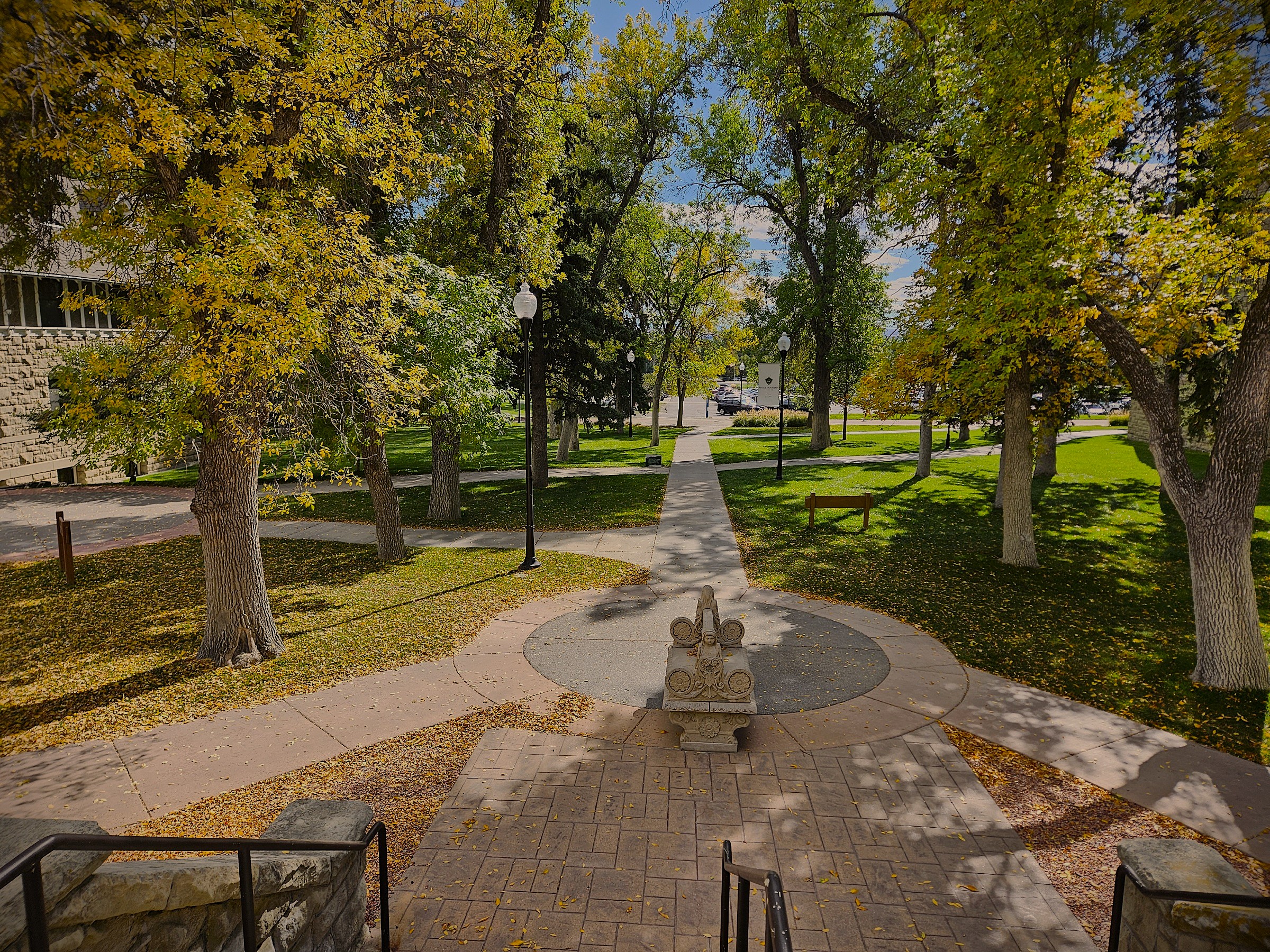
A paved walkway with a stone bench in the center. The walkway is arched with trees that are starting to turn yellow in autumn.

By chance, I joined a tour of the newest of my new towns through the Montana History Conference, and by chance, I stumbled upon a concert venue and used media store and soup kitchen in a century-old grocery store called Kirk’s. There was a dog who ignored me and a story about an axe murder where the musicians play shows for a venue smaller than my classrooms.

It reminded me of places I knew well in my actual hometown, downtown places in the hallways of old western buildings with office space and apartments and studios where local artists would set up their weird installations, pour some crackers on a plate next to a box of wine, and play what I would later recognize as shoegaze music while I wandered around downtown Flagstaff with college friends, drifting in and out of stores reeking of incense and espresso.

I’m not nostalgic, or at least I don’t think I am. But every so often I think of the year 2013, which was, for me, a year of art and anxiety. My memories are mostly positive until I think for a moment. My cousin Bill died that year. I had my first publication. I wanted to pursue a PhD in history and study genocide trials and sectarian violence. I started this stupid blog in October of that year. I spent time with friends I’m no longer in touch with. Maybe I was in love with someone, but looking back it was probably the kind of crush Hanif Abdurraqib writes about in They Can’t Kill Us Until They Kill Us, the kind that, after it fizzles like radio static and “whatever love I’ve claimed fades, I find myself renewed, in search of the feeling once again.”

So maybe I am nostalgic sometimes. Kirk’s Grocery rekindled a kind of want I have for what theorists like Henry Jenkins call participatory culture. The history conference, I think, was a good reminder of how common this desire is among people I could get to know better.

I listened to Hanif Abdurraqib read They Can’t Kill Us Until They Kill Us on audiobook on a drive across Montana at the start of the month when the first glimmers of autumn showed in the trees, the wind, the clouds. I share his desire for, not hope, but honesty, which is not the opposite of hope, but is also not an alternative to hope, either.

Like a lot of writers these days, I’ve been thinking about Walter Benjamin’s 1935 essay “The Work of Art in the Age of Mechanical Reproduction.” Benjamin’s approach to history could, potentially, be accused of leaning on nostalgia, but his critique of the industrialization of art in the interwar years seems more salient now than in the last few decades.

For Benjamin, the process of photographing or filming a work of art reproduces its image, but not its interpersonal ritualistic utility “embedded in the fabric of tradition” that originally clarified the meaning of that particular image. His point, of course, is not that photography or film are inferior modalities—the Soviet film theorist Lev Kuleshov had already developed a theory of the montage that would later influence everyone from Alfred Hitchcock to Jane Schoenbrun—but that the reproduction of art through industrialized means puts art at an arm’s length from its ritualistic context, which originally “found its expression in the cult.”

Beholding a statue is a ritualistic experience with endless possible angles that situate the viewer in the same possible station as the artist, whereas looking at a picture of that same statue filters its possible meaning through the lens of the photographer who acts as a third-party interpreter. The problem is not photography as a medium, but the use of photography as a replacement for interacting with art. A film cannot replace a political speech; a video cannot replace a concert; a film review cannot replace a film; a video benediction, though sometimes necessary, cannot take the place of the ritual of benediction at the end of a church service.

This is all well and good when considering classical oration. The opening scene in Christopher Nolan’s The Odyssey depicts the cultic expression of art through a poet engaging, in real time, with a captive audience. The same thing happens in Sinners when Sammie pierces the veil of time and space with his music. Sculptures evoke awe, paintings evoke curiosity, live music aligns us to rhythm. What about my genre, creative nonfiction?

I’m sure hearing Abdurraqib speak in person is different from a curated audio book, which is a form of mechanical reproduction. Still, I found myself pulled in by the cadence and pause of his voice, his momentary reflections over his own diction, the structure of his interrogation.

Good memoir isn’t nostalgic; it’s also not tragedy porn, either, like Hillbilly Elegy, a curated platter of suffering to shore up credentials and advance policy from afar. Good memoir is captured by writers like Abdurraqib’s essay “Defiance, Ohio, is the Name of a Band,” which genuinely feels like a spell being cast when I hear it in his own voice. Good memoir is like Gabrielle Hamilton’s memoir Blood, Bones, and Butter: The Inadvertent Education of a Reluctant Chef, in which Hamilton describes her childhood in New Jersey with a magic trick of contrast: “We trespassed, drag raced, smoked, burgled, and vandalized. We got ringworm, broken bones, tetanus, concussions, stitches, and ivy poisoning” (Hamilton 6). If there is nostalgia here, it is clarified by consequence, and if there is regret, it is pulled apart by nostalgia.

The renewed attention in Benjamin’s essay stems from fears about the imposition of algorithmic technology on art. The key question, I think, is about how we relate to ourselves through art, not how we relate to art in and of itself. I am against, at this point, any firm rule about what is or is not good writing, but for now, what makes memoir worthwhile is the potential for specificity to become universal, however momentarily.


Abdurraqib, Hanif. They Can’t Kill Us Until They Kills Us. TwoDollarRadio, 2023.
Hamilton, Gabrielle. Blood, Bones, and Butter: The Inadvertent Education of a Reluctant Chef. Random House, 2012.

On Writing That Cannot Be Replaced

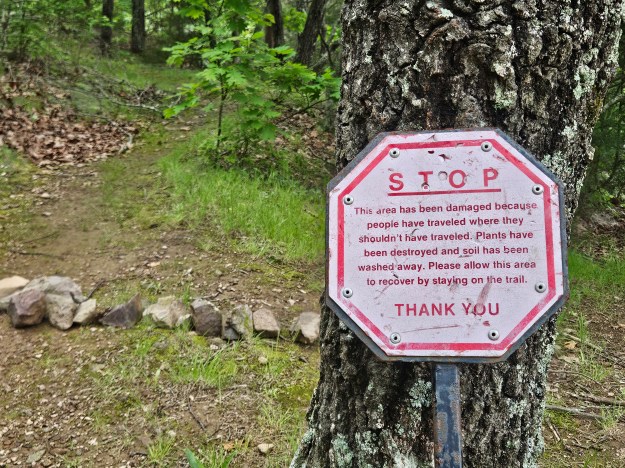
A STOP sign on a tree on a trail that reads "STOP. This area has been damaged because people have traveled where they shouldn't have traveled. Plants have been destroyed and soil has been washed away. Please allow this area to recover by staying on the trail."
An ominous but compelling sign on the Ozark Trail in Missouri.

“I don’t expect life to bring me subjects but unknown structures for writing. The thought ‘I only want to write the texts that only I can write’ refers to texts whose very form is provided by the reality of my life. I could never have foreseen the text we are writing. Though it definitely came from life. Conversely, the writing under the photos, in multiple fragments which will themselves be broken up by those of M., as yet unknown, give me (among other things) the chance to create a minimal narrative out of this reality.” -Annie Ernaux.


Between the administration’s cuts to NEA grants that now put dozens of literary venues at risk of shuttering, and venture capitalists pushing software built on plagiarism and prone to error (branded under the umbrella term “artificial intelligence”), this country’s leadership has thoroughly cemented its disdain for the written word.

I had the privilege of articulating my own specific syllabus policy on AI for my university’s magazine this spring. As an English teacher, I emphasize to my students that writing itself is thinking, or a process of decision-making that allows people to articulate their own original ideas in a way that others can comprehend. What I tell my students is that good writing is not about “rules you have to follow” but rather “understanding actions and their consequences.” That language is inherently idiosyncratic, a consequence of the actions that its participants take. Its value derives from its dexterity, from being put to the limit. E. E. Cummings broke the conventions of grammar, and the consequence is that his poetry is thought-provoking, confronting, memorable. Shakespeare invented almost 3,000 words. George Orwell’s fictional world-building remains a popular lexicography for expressing the devaluation of language to “Newspeak” ordained by “Big Brother.”

Generative AI cannot innovate our language in the same way because it is not a writing machine, but a customer service machine designed to give people answers that will 1) satisfy them and 2) make them come back to the customer service machine again. Imagine a slot machine that always gives you the exact amount of money necessary to pull the lever again, but never more.

Annie Ernaux articulates the value of writing as an exercise in self-expression in The Use of Photography, a memoir of the roughly one-year period when she underwent treatment for breast cancer. The book is a series of reflections about photographs she took of piles of her and her lover’s clothing during their affair during the same time period. Each photograph is followed by a reflection by Ernaux, and one by her lover at the time, the journalist Marc Marie. Strikingly, the project is about the wide gap in each co-authors’ memory about the specific intimate moment captured with each photograph.

At one point, Marc jokes that Annie got cancer “just so she could write about it,” which she jokingly concedes but also rejects because she sees life not as source material for writing, not as “subjects” but as “structures.” Cancer creates a structural change that the author then occupies and, subsequently through the act of writing, volunteers to make sense of.

“I only want to write the text that only I can write” shouldn’t strike me as profound, but it does. It justifies my profession and my art in a context in which the most powerful people want to replace my work with software. What makes Annie Ernaux such a compelling writer is the specificity of how she uses language to express herself.

There are many memoirs about breast cancer. It’s an unavoidable subject if one studies memoir as a genre. Terry Tempest Williams places it in the context of her Mormon heritage as a downwinder from Utah in her essay “The Clan of One-Breasted Women.” Anne Boyer’s memoir The Undying takes a maximalist approach, connecting the history of medicine to Youtube video essays and the drugs involved in chemo. Audre Lorde’s The Cancer Journals takes a critical view of the empty promises carcinogen-producing corporations make when adopting pink ribbon logos one month a year. Each memoir is an artifact of the author’s individual exploration of their own experience, decades condensed into paragraphs, minutes extended into chapters. As memoir, each artifact attests to the individually specific nature of empathy. Each author has something different to say. As the reader, I anticipate friction, contradiction, distinction.

Ernaux decides to explore her own cancer treatment in one of the least obvious ways possible, through romantic entanglement expressed through photographs of clothes, removing concrete depictions of her body entirely and thus relegating the illness and treatment alike to memory that she then shares with another person, layered beneath the topography of intimacy and fulfillment.

In an interview with Alison L. Strayer in Southwest Review, Ernaux explains that for a lot of people, “when you have cancer, pleasure is not allowed. End of story. You do your chemo and you don’t bother other people with all that. The less they see you, the better it is for everyone. Because there’s that, too: people don’t talk. They don’t know how to be around someone who has cancer.”

In writing about an uncomfortable subject, Ernaux, like many other women before her, opens up avenues for a difficult subject matter to be made accessible to those who may encounter it in the future, and to those who should learn to empathize with those who share her experience. Writing, then, is an act of creating pathways where there had previously been none. Readers live in a richer, more textured world because they have access to a wide variety of very different memoirs about breast cancer, and memoirs about military experience, and novels about gardeners and poetry about addiction recovery and short stories about truckers and immigrants.

The destruction of literary venues and the expansion of a plagiarism machine both threaten to obscure the value of the written word as a mode of empowerment. To put it differently: I don’t study cooking because I intend to cook every single meal I eat, but because the ability to cook for myself and for others, whenever I want to, is valuable in itself. I’m tired of having to explain this to tech bro losers and their devotees, but I will never stop explaining it as long as I have to.


Ernaux, Annie. The Use of Photography. Seven Stories Press, 2024.