Category Archives: Travel

Boots on the Ground

Civil War Soldiers

Statue Commemorating Civil War Veterans

Some of the best advice I received about historical research is that oftentimes the surest way to find sources is to have boots on the ground and look for sources in person. This usually involves going into public archives or getting access to private ones, but I’ve heard tales of finding rare documents forgotten in the trunk of a car or simply on display in a book fair. This week, while visiting family in Appleton, Wisconsin, I decided to experiment with boots-on-the-ground-history.

March to SocialismI discovered that historical research is more than just skimming through a few letters. It’s detective work, a methodological investigation, and I did not rise to the challenge. As I prepare to go to graduate school to study creative writing, I worry that I may leave history behind. History is close to my heart, but requires a patient diligence.
McCarthy

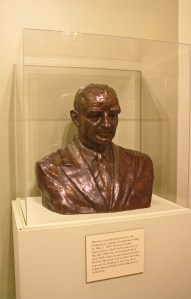
Statue of Senator Joseph McCarthy

The challenge of in-person research yielded a few interesting results. Appleton’s public history emphasizes its positive qualities, such as the fact that magician Harry Houdini claimed it as his hometown, though he was born in Hungary. There is a museum with an entire floor devoted to Houdini’s life and work. However, another famous man claimed Appleton as his hometown, Senator Joseph McCarthy, who engaged in congressional witch hunts during the early 1950s to remove suspected communists. Popular opinion has since turned against McCarthy, but as journalist Edward R. Murrow said in an open challenge to the Senator’s unethical methods, “He did not create this situation of fear, he merely exploited it.” Now that Red SpiesMcCarthy is remembered as an aggressive demagogue, his hometown has taken a statue of him that once stood in public view and placed it in a museum’s bottom floor, under the stairs.

Apart from some obscure anti-communist propaganda, one from 1950 and the other from 1967, a World War One Dough Boy memorial statue and a Civil War memorial statue, I could not find any major historical documents in Appleton’s history, simply because I did not look that hard. It is not surprising that they hide McCarthy’s image and highlight a still-popular celebrity. Any research on the Cold War in Wisconsin daily life would require interviews with those who remember it, access to radio and news archives, local newspapers, and other hidden sources. Perhaps I might be able to dig up a few rare pieces of propaganda if I looked deeper, or uncover a story of Cold War espionage, but such research requires more time and energy than I can offer. I’m not a specialist, or a driven detective. I am, for the time being, only an interested amateur.

Patriotic WWI Statue

Doughboy Statue Commemorating World War One Veterans

Perhaps I can one day conduct better historical research. Perhaps I will one day dare to dig deeper, open doors that should not be opened, find people who have answers. I was inspired by a year-old article about Amor Masovic, who has been looking for burial sites from the Srebrenica massacre in Bosnia-Herzegovina, in 1995. That massacre, part of the Bosnian Genocide, was the first act of genocide on European soil since the Holocaust, and one that the world ignored for years. Today, the perpetrators still live side-by-side with the families of the victims, and reconciliation is a great challenge. But Masovic pursues burial grounds, is still looking for the missing victims to piece together the community of Bosniak Muslims that existed before the massacre. He’s been working for nearly twenty years and there are still bodies unaccounted for.

Will I ever be such a researcher? Will I ever contribute to as admirable an effort as Masovic? It’s unlikely, but I do not want to leave history behind. I’m too compelled and too haunted by its ghosts to allow myself to give it up completely. History truly is obsessive, and maybe the only way to make a difference is to simply embrace that obsession, dig my boots into the ground, and dig as deep as the past will allow.

-jk


Ghosts of the West in Jerome’s Public History

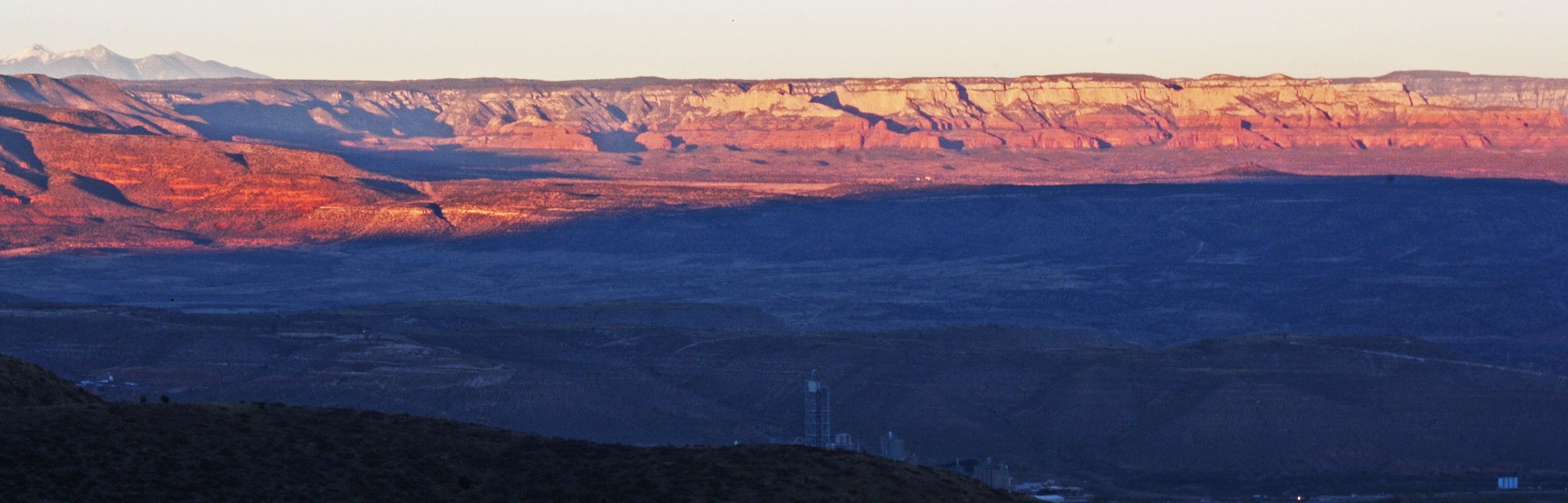
Jerome Jerome, Arizona, is one of the oddest, most colorful towns in the state. Its history is rich, and its public history is thriving. Now a major tourist destination, as well as a small artists’ community, one can see Arizona history, and indeed U.S. history, in every corner. At a wine tasting one can see a passing motorcycle gang maneuver up the narrow streets, while a ghost tour marches downhill toward one of Jerome’s many historic sties. Jerome is itself a museum, an exercise in public history, but it is caught along the fault lines that make public history a contentious endeavor.

ruins

Ruins of a primary school.

Many go to Jerome to see the Old West as John Wayne, Clint Eastwood, John Ford, and others portrayed it. By the time How the West Was Won debuted in 1963, the Jerome Historical Society, founded a decade earlier, was already busying itself purchasing saloons, churches, mining equipment, and other property to advertize Jerome as a ghost town. Today, the Jerome Historical Society tends to dominate public history, and their goal from the beginning was to draw a crowd. Popularizing the town’s title, ghosts are now a prevalent motif. One can go on a ghost tour, visit a haunted hotel, then eat lunch at a ghost-themed restaurant. The Wild West narrative appears in the ruins of Jerome’s schools, jails, brothels, and saloons, and a past rife with outlaws, sheriffs, and western debauchery in a lawless city where anybody can make it big with the swing of a pickaxe.

The Cuban Queen

Entrance to an abandoned brothel, The Cuban Queen.

Jerome is haunted by this history, but by other histories as well. History is contentious, often snagged between fragmented political agendas. Today, several state legislatures want to change AP U.S. History curriculum to emphasize American Exceptionalism, a word that makes most historians cringe. Jerome may not be as fraught with politics, but the ghosts that haunt it are more than the usual characters in a typical western.


BenchThere is Charley Hong, who emigrated from China in 1880, two years before the U.S. passed the Chinese Exclusion Act. He became a wealthy businessman, owner of the popular Bon Ton Restaurant (later the English Kitchen). Though a local celebrity in Jerome, the xenophobic climate in the west persisted, to the point that his restaurant was bombed in 1909. Miners haunt the town as well. Making it rich by mining may sound appealing, but the work was arduous, usually deadly, and compensation was minimal. To make matters worse, in 1917 corporate managers rounded up miners suspected of affiliating with workers’ rights organizations like the Industrial Workers of the World (IWW), forced them onto cattle trains, and deported them out of town. Meanwhile, the local hospital witnessed approximately 9,000 deaths.

Ruins of a prison

Ruins of a prison

It is impossible to fully capture the diversity of Jerome’s history, and here I fail to do it justice. Public history, however, is an important venue for historical inquiry. The ghosts that haunt Jerome are more than just a handful of quirky characters. Jerome is haunted by the miners, the migrants, the unnamed lawbreakers, the women who worked in the town under challenging and dangerous conditions, the indigenous communities in the area. Jerome is indeed haunted, but most of its ghosts remain unheard. I intend to conduct more research, because for me history is about listening past the vast silence of time to let the old voices speak, and Jerome is shaking with eager voices.

Jerome Landscape


Instructions for a Camping Trip: An Interactive Short Story

I love camping, so I wrote a short story (in the form of an instruction manual) about it.

shadows

Step One: Pack matches, a tent, sleeping bags, pads, pillows, snacks, beer, camera, books, flashlights, water, knives, and then proceed to follow directions from printed maps, a GPS, and a passenger’s memory of “shortcuts” from five years ago.
If you make a wrong turn, proceed to Step Two.
If you miraculously make all the right turns, proceed to Step Four.

Step Two: Following one of several misleading directions, you find yourself in a condo development several miles off course. Find the nearest dirt road back to the freeway.
If you make it back to the freeway, proceed to Step Four.
If you find yourself in a deserted farm with fifteen scarecrows all facing you, proceed to Step Fifteen.
If you stop and ask for directions, proceed to Step Three.

Step Three: After finding the right directions back to the freeway, having asked between one and thirteen grizzled old farmers holding shotguns and potted daisies, you get back on track two hours late but determined nevertheless. Proceed to Step Four.

Step Four: You pull into the campsite, pay the grizzled old camp director holding a shotgun and a potted daisy, and proceed to set up the camping equipment.
If the tent you brought is not broken, proceed to Step Seven.
If the tent you brought is broken, proceed to Step Five.

Step Five: Use everything in your car to fix the tent (clamps, chairs, knives, potted daisies, etc.). Proceed to Step Six.

Step Six: After fixing the tent, you find yourselves exhausted and take a nap. Missing an hour of daylight, you wake up and realize
that someone forgot the bug spray and you are surrounded by bees (proceed to Step Sixteen), or
that you all brought and used bug spray but it inevitably failed and you are nevertheless surrounded by bees (proceed to Step Seven).

bees

Step Seven: You set up all camping equipment, including a bee trap fashioned from a plate of syrup well away from your tent, and you proceed to make a campfire.
If you succeed on the first try, proceed to Step Ten.
If you fail on the first try, proceed to Step Eight.

Step Eight: Nobody can get the fire started.
If you put your heads together and manage to build a successful fire using old copies of Dan Brown novels, proceed to Step Ten.
If you insist on starting the fire the way you saw that survivalist on TV do it involving a shoelace and several ounces of beer, inevitably failing, proceed to Step Nine.

Step Nine: You all give up and decide to camp without a fire, end up freezing, and drink what little alcohol is left for warmth. Proceed to Step Sixteen.

Step Ten: The tent is up, the fire is going, and you are all sitting comfortably in a circle making s’mores and drinking frosty cold beers. You lean back, gaze up at the stars, and
realize that you are insignificant but stranded beautifully on a fragile planet, and that it is your responsibility to care for your world (proceed to Step Eighteen), or
realize that you are insignificant, which induces an existential crisis causing increased alcohol consumption (proceed to Step Nineteen), or
fall backward in your chairs and wonder why you went camping in the first place (proceed to Step Eleven).

Step Eleven: Annoyed at camping in general, you all pull out your phones to see which celebrities have started dating each other, but discover there is no service in the woods.
If this frustrates you, proceed to Step Twelve.
If you return to toasting marshmallows, proceed to Step Thirteen.

Step Twelve: Your unquenchable desire for modern technology drives you to wander into the woods holding your smartphones into the air hoping to find a signal. Proceed to Step Seventeen.

Step Thirteen: Somebody pulls out a harmonica and plays a soulful rendition of Paul Simon’s “You Can Call Me Al.” Proceed to Step Fourteen.

Step Fourteen: You realize that a desire for luxury is the last chain enslaving humankind to capitalism, and that if we all lived a minimalist’s life together in a commune and devoted ourselves to art and human companionship, the corporations would all go extinct and we would open up the doors to Heaven on Earth. Proceed to Step Eighteen.

Step Fifteen: Now stuck countless miles from any sign of human life, you all get out of the car and proceed to argue. Proceed to Step Sixteen.

Step Sixteen: Furious at one another for your collective insensitivities, self-centeredness, and refusal to accept responsibility for your mistakes, you use all the camping equipment to kill each other. Proceed to Step Seventeen.

Step Seventeen: You are all eaten by coyotes. The End.

Step Eighteen: After waking up to the sound of birds and running water the next day, you feel spiritually and socially invigorated and return to the plastic confines of civilization with a renewed sense of meaning and a deeper understanding of the divine, determined to be a better person to the world as a whole. You then sell all the pointless crap you’ve spent decades accumulating, give the money to charity, and finally start playing music again. The End.

Step Nineteen: Having had too much to drink, you sob about the terrible state of the world, the wars, the power that big business has over you, how expendable you are in the scheme of things, the fact that Unfriended was ever produced in the first place, and wander around the campground despondent and terrified.
When the camp director finds you, he
uses his shotgun to “motivate” you back into your tent for a night of silent introspection (proceed to Step Eighteen), or he
uses his shotgun to “motivate” you out of the campground entirely (proceed to Step Seventeen), or he
kindly offers you bread, water, and painkillers, then proceeds to teach you about Zen Buddhism, which you diligently listen to as long as drunk people can before falling asleep (Proceed to Step Eighteen).

Campfire

For more information on camping, consult your nearest grizzled old farmer.

-jk

Copyright Keene Short, 2015

A Brief Note About the Best Weekend of the Year*

*or, That Time I Went to the Association of Writers and Writing Programs 2015 Conference in Minneapolis

Conference 1

“Listen to the language you start with in the first paragraphs. That will shape the rest of the story more than you are aware.” –Pamela Painter on first drafts.

Every year, thousands of writing programs, small presses and literary magazines, publishing companies, writers new and old, writing teachers, and students flock together to share their books, writing programs, new releases, and innovations in the literary community. Thanks to the NAU Honors Program, I joined several friends in attending the conference, and it was one of the most beneficial experiences of my academic life.

“The MFA program is useful because it’s a break from the capitalist shitstorm. It lets you work without giving you black lung, and lets you focus on writing. The problem is that it doesn’t prepare you for life back in the capitalist shitstorm after it’s over.” –Claire Vaye Watkins.

Conference 2

Despite our travel plans going wrong, we made it. Because Arizona does not acknowledge daylight savings time  (but Greyhound does), we missed our bus by an hour. We decided to take a shuttle to Phoenix and ended up taking two different shuttles an hour apart, but eventually gathered in Sky Harbor with enough time to bankrupt ourselves from airport food. By late afternoon and with much applause, we landed in Minneapolis, Minnesota, amidst rain and snow.

“One of the hardest things for an Arab to accomplish is to live apolitically.” –Hayan Charara on whether or not writing should be political.

The conference has two features, an exhaustive list of panels and a colossal book fair. I spent most of my time in the less popular conferences, and tried to explore as rich and diverse a selection of topics as possible:

conference swagLiterature from communities in diaspora, featuring Vietnamese-, Korean-, and Arab-American writers; a reading of flash fiction, from six-word memoirs to 1,000-word short-shorts; a reading from Cuban poet Víctor Rodríguez Núñez and a signing of his newest collection With a Strange Scent of World; a set of memoir readings from U.S. veterans of the wars in Iraq and Afghanistan; a discussion on translating Brazilian minority poets; a lengthy discussion from MFA teachers about the usefulness of seeking an MFA in Creative Writing in the first place; a panel on the usefulness of historical fiction and the rules one can break with it; a beautiful poetry reading from Iranian Farzaneh Milani, Syrian Mohja Khaf, and Iraqi Dunya Mikhail plus a list of historical women poets in the Arab-speaking world; a panel on writing as advocacy; and a reading of creative nonfiction about the value of speculation in nonfiction works.

“The ‘other’ for the writer is simply everyone.” –Elizabeth Kadetsky on the relationship between writers and the world.

The conference reinvigorated my love of writing, but unmasked a great many myths and expectations upon which I had previously built my understanding of the writing life. I now understand that the MFA racket is not all it’s cracked up to be; though certainly useful if applied correctly, MFAs are neither necessary nor financially sustainable if one wants to be a writer. I now have a greater appreciation for the need for good translators, and how deeply politicized translations can become when meaning and identity are at stake crossing the thresholds between languages. Flash fiction is more than an exercise in economizing language but a growing form of art itself.

Lastly, and most importantly, being a lone writer, while romantic, is terrible; good writing can only ever come from the experiences a writer internalizes and interprets, so I must accumulate as many experiences as possible, good, unpleasant, awkward, funny, humiliating, beautiful, terrifying, or calming. Time is not what I need as a writer; a community of friends, loved ones, people who inspire me, are what I really need. This trip generated more ideas for stories than anything I’ve done inside a classroom, and it is to my friends that I owe my ability to write, if I can say I possess such an ability in the first place.

friends

-jk

A Brief Note About Galway

Corrib River

On the furthest western edge of Europe, on the western coast of Ireland, is a city called Galway. The River Corrib flows through the city into the Atlantic, and Galway is crisscrossed with bridges and waterways. Although it seems to be far-removed from most of European activity, an isolated region of an isolated country, Galway is exceptionally cosmopolitan, with roots as a trading network and a social junction during the seventeenth century. Galway merchants sailed to Italy with Irish wool, and returned with goods from the Mediterranean, including fine wines and art. Maritime commerce was, and still is, a central part of life here.

Galway

Today, it reminds me of my hometown, Flagstaff. The National University of Ireland, Galway, brings in new students and faculty, and with them ideas, to the city. There is a flourishing art scene here, which includes the Galway Film Fleadh, the Arts Festival, and a farmer’s market every Saturday. But more like Flagstaff, it is a point between destinations. Flagstaff is on Route 66 and in addition sees about a hundred trains pass through each day, it is a stopping point for many people; similarly, Galway is a coastal trading city where travelers, ideas, cuisine, and cultures converge. Both cities are driven by university life and academic patronage, whose dispensation is evident in artistic displays, festivals, and even graffiti. In fact, I have seen more graffiti in Galway than my own town. Graffiti

Medium-sized, quirky communities can be found anywhere, I think. They act like cities and small towns at the same time. They are twilight cities on the edge of the new and the old. For a writer, these are the best places, because they tend to be the strangest, in my experience. Places like Boulder, Missoula, Flagstaff, and even Galway on the edge of the Atlantic, are in my opinion the most authentic, appealing communities in the world.

-jk