Category Archives: Reflection

Stress, Growth

Numerous red-orange mushrooms sprouting from the bark of a fallen tree.
Mushrooms crowding for attention on a tree in the Hoosier National Forest.

“Trees that develop without setbacks stand straight and proud. At first their branches grow upwards, then sideways, and finally a little downwards, so they can bend with the rain and snow. Most adult trees, however, have gone through something in their lives: another tree falling against them; branches broken by the weight of snow or ice; fungus; holes in their trunks made by woodpeckers or beetles. All these have changed their form and they’ve acquired scars” (Meijer 37-38).


I can’t remember if it was The Rise of Silas Lapham by William Dean Howells or Sister Carrie by Theodore Dreiser that we were discussing. In either case, the professor for the Great American Novel seminar asked the class whether or not our character, our own as living people, are the accumulation of material accomplishments or the outgrowth of an innate set of traits we are destined to wrestle with. I argued for the latter in a paper about one novel or the other. Over a decade later, my thinking has evolved, as all thinking should, but reading Eva Meijer’s The Limits of My Language last month provided a solid counterbalance to the idea that who we are is innately fixed.

Subtitled Meditations on Depression, Meijer takes an essayist’s approach to a clinical experience that can only be expressed through language, which she states in the title is limited at best. Among the metaphors she uses to inspect her own depression, what struck me the most was that of a tree. She doesn’t go with the obvious route and describe tree rings that accumulate layers of weather and smoke and toxins and bark beetles. Instead, she describes the exterior of a tree, the way its branches twist and wend and warp, the shape it is in a constant state of taking. A tree has an innate direction to follow, but grows around the damage done to it. To access tree rings, after all, the tree must first be cut down.

What I remember about Sister Carrie is that the protagonist navigates continual limitations on her agency. Environmental factors play a role in shaping her decisions, from the length of a table between her and a powerful man to the layout of the city where the novel is set. What I remember of The Rise of Silas Lapham is a hulking all-American rags-to-riches figure who has attained excessive wealth but not the cultural capital that should, in his mind, accompany it. The novel opens with Silas giving an interview, uncomfortable with his circumstances. Silas has his wealth, but not his peers’ respect. Sister Carrie, on the other hand, gradually attains fame but is faced in the end with the same sense of emptiness with her success.

What exactly makes personal growth meaningful is still very much the appeal of literature today. It’s not surprising that the runaway horror movies of the summer, Sinners and Weapons, devote the bulk of their scripts to developing a wide cast of complicated characters, keeping their respective villains relatively in the background. It’s no surprise that one of the most popular fiction genres today, the romance novel, is predicated on the fact that people are bound to change when met with new circumstances. Trajectories like friends-to-lovers, enemies-to-lovers, lovers-to-enemies-to-lovers, and so on, all attest to a recognition that character is far from static.

A spider's web hanging in a forest in front of a tall tree surrounded by green but blurry leaves.
The spider was busy when I asked for life advice.

When he accepted the Nobel Prize in Literature in 1962, John Steinbeck said that “a writer who does not passionately believe in the perfectibility of man has no dedication nor any membership in literature,” meaning, I believe, that fatalism is incompatible with the craft of literature.

Essays like Meijer’s, on the other hand, are more confronting than fiction. In memoir, we’re not following a rags-to-riches or riches-to-rags plot, we’re not growing to more effectively confront vampires and witches, but taking our own growth (or lack thereof) and putting it under a microscope.

I find more comfort in Meijer’s tree metaphor because a healthy tree is measured by what other species it helps to foster. Like every organism in every ecosystem, nothing lives in isolation. A tree provides nutrients to fungus, shade to mammals, shelter to bugs and birds. These are all outcomes that a healthy tree is bound to provide by virtue of what a tree is: the transformation of sunlight and minerals and water into sugars and nuts and foliage. The shape of a tree is irrelevant; gnarled, twisted, straight, even, split—what matters is the processes that a tree recycles, the absorption of carbon dioxide, the excretion of oxygen and nutrients, the miraculous flow of care that its roots and branches provide to the rest of the forest.


Meijer, Eva. The Limits of My Language. Pushkin Press, 2021.
On Writing That Cannot Be Replaced

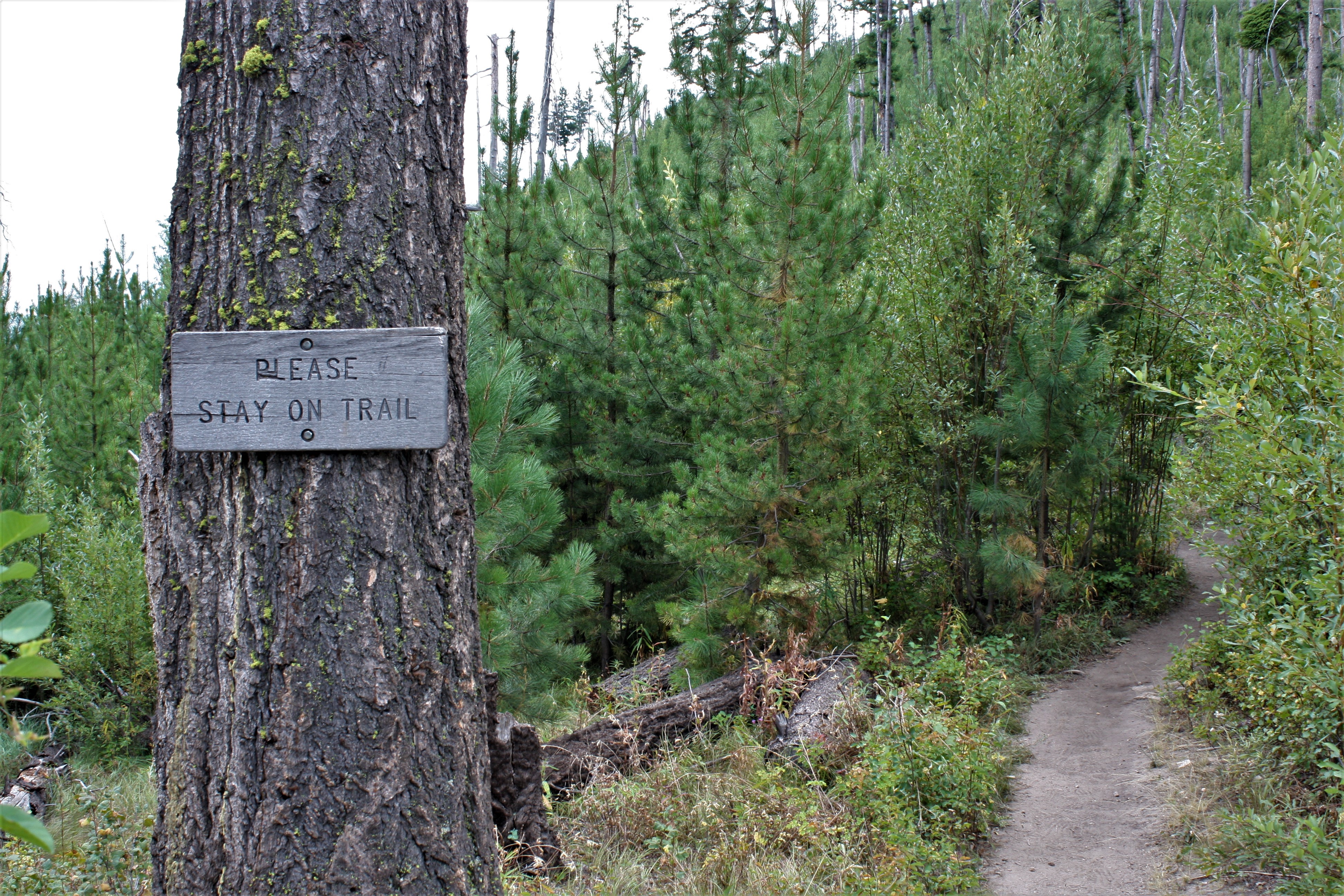
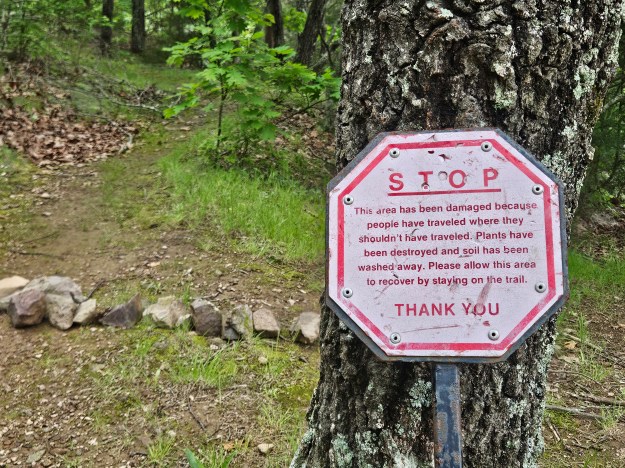
A STOP sign on a tree on a trail that reads "STOP. This area has been damaged because people have traveled where they shouldn't have traveled. Plants have been destroyed and soil has been washed away. Please allow this area to recover by staying on the trail."
An ominous but compelling sign on the Ozark Trail in Missouri.

“I don’t expect life to bring me subjects but unknown structures for writing. The thought ‘I only want to write the texts that only I can write’ refers to texts whose very form is provided by the reality of my life. I could never have foreseen the text we are writing. Though it definitely came from life. Conversely, the writing under the photos, in multiple fragments which will themselves be broken up by those of M., as yet unknown, give me (among other things) the chance to create a minimal narrative out of this reality.” -Annie Ernaux.


Between the administration’s cuts to NEA grants that now put dozens of literary venues at risk of shuttering, and venture capitalists pushing software built on plagiarism and prone to error (branded under the umbrella term “artificial intelligence”), this country’s leadership has thoroughly cemented its disdain for the written word.

I had the privilege of articulating my own specific syllabus policy on AI for my university’s magazine this spring. As an English teacher, I emphasize to my students that writing itself is thinking, or a process of decision-making that allows people to articulate their own original ideas in a way that others can comprehend. What I tell my students is that good writing is not about “rules you have to follow” but rather “understanding actions and their consequences.” That language is inherently idiosyncratic, a consequence of the actions that its participants take. Its value derives from its dexterity, from being put to the limit. E. E. Cummings broke the conventions of grammar, and the consequence is that his poetry is thought-provoking, confronting, memorable. Shakespeare invented almost 3,000 words. George Orwell’s fictional world-building remains a popular lexicography for expressing the devaluation of language to “Newspeak” ordained by “Big Brother.”

Generative AI cannot innovate our language in the same way because it is not a writing machine, but a customer service machine designed to give people answers that will 1) satisfy them and 2) make them come back to the customer service machine again. Imagine a slot machine that always gives you the exact amount of money necessary to pull the lever again, but never more.

Annie Ernaux articulates the value of writing as an exercise in self-expression in The Use of Photography, a memoir of the roughly one-year period when she underwent treatment for breast cancer. The book is a series of reflections about photographs she took of piles of her and her lover’s clothing during their affair during the same time period. Each photograph is followed by a reflection by Ernaux, and one by her lover at the time, the journalist Marc Marie. Strikingly, the project is about the wide gap in each co-authors’ memory about the specific intimate moment captured with each photograph.

At one point, Marc jokes that Annie got cancer “just so she could write about it,” which she jokingly concedes but also rejects because she sees life not as source material for writing, not as “subjects” but as “structures.” Cancer creates a structural change that the author then occupies and, subsequently through the act of writing, volunteers to make sense of.

“I only want to write the text that only I can write” shouldn’t strike me as profound, but it does. It justifies my profession and my art in a context in which the most powerful people want to replace my work with software. What makes Annie Ernaux such a compelling writer is the specificity of how she uses language to express herself.

There are many memoirs about breast cancer. It’s an unavoidable subject if one studies memoir as a genre. Terry Tempest Williams places it in the context of her Mormon heritage as a downwinder from Utah in her essay “The Clan of One-Breasted Women.” Anne Boyer’s memoir The Undying takes a maximalist approach, connecting the history of medicine to Youtube video essays and the drugs involved in chemo. Audre Lorde’s The Cancer Journals takes a critical view of the empty promises carcinogen-producing corporations make when adopting pink ribbon logos one month a year. Each memoir is an artifact of the author’s individual exploration of their own experience, decades condensed into paragraphs, minutes extended into chapters. As memoir, each artifact attests to the individually specific nature of empathy. Each author has something different to say. As the reader, I anticipate friction, contradiction, distinction.

Ernaux decides to explore her own cancer treatment in one of the least obvious ways possible, through romantic entanglement expressed through photographs of clothes, removing concrete depictions of her body entirely and thus relegating the illness and treatment alike to memory that she then shares with another person, layered beneath the topography of intimacy and fulfillment.

In an interview with Alison L. Strayer in Southwest Review, Ernaux explains that for a lot of people, “when you have cancer, pleasure is not allowed. End of story. You do your chemo and you don’t bother other people with all that. The less they see you, the better it is for everyone. Because there’s that, too: people don’t talk. They don’t know how to be around someone who has cancer.”

In writing about an uncomfortable subject, Ernaux, like many other women before her, opens up avenues for a difficult subject matter to be made accessible to those who may encounter it in the future, and to those who should learn to empathize with those who share her experience. Writing, then, is an act of creating pathways where there had previously been none. Readers live in a richer, more textured world because they have access to a wide variety of very different memoirs about breast cancer, and memoirs about military experience, and novels about gardeners and poetry about addiction recovery and short stories about truckers and immigrants.

The destruction of literary venues and the expansion of a plagiarism machine both threaten to obscure the value of the written word as a mode of empowerment. To put it differently: I don’t study cooking because I intend to cook every single meal I eat, but because the ability to cook for myself and for others, whenever I want to, is valuable in itself. I’m tired of having to explain this to tech bro losers and their devotees, but I will never stop explaining it as long as I have to.


Ernaux, Annie. The Use of Photography. Seven Stories Press, 2024.

Planting Season

Summer is icumen in
Lhude sing cuccu
Groweþ sed
nd bloweþ med

So read the opening lines of a 13th-century English round, possibly written by a monk at Reading Abbey in Berkshire. The text is Middle English, distinct enough from the early modern English of Shakespeare, but possibly more legible than the Old English of Beowulf. In translation, the lines mean:

Summer has come in,
Loudly sing, Cuckoo!
The seed grows and the meadow blooms
And the wood springs anew.

When sung aloud by a Scottish commune during a May Day festivity in The Wicker Man (1973), the Middle English verse might be mistaken for modern English as sounding like “Summer is a-coming in, low sings the cuckoo.” The difference is slight but attests to the uncanny similarities and fractious differences between the past and the present that the film plays with. Referred to once as “the Citizen Kane of horror movies” by Cinefantastique, The Wicker Man is one of the most important folk horror films. Undercutting many of the Gothic origins of horror—full of structurally decaying mansions and frayed institutions and hidden secrets and buried psychic Protestant shame—the use of Pagan May Day festivities in The Wicker Man brought the bucolic and Edenic tropes of Romanticism into the horror genre.

This year, I devoted much of my time and energy to an academic book project about food, agriculture, and ecology in folk horror movies. I can’t summarize the book well in a single blog post. It’s about the importance of the ambient threat of starvation in rural horror and the limits of Gothic literature and the surge in popularity of a horror subgenre about communal identity against encroaching political and economic forces. It’s about the desire to go back to the Old Ways when the modern nation-state seems doomed. There’s also a fair bit about mushrooms.

In any case, if you or someone you know suffers from being an academic (symptoms include teaching a film studies class or something about ecocriticism, assuming that’s legal this time next year), might I suggest looking out for pre-order dates for Late Harvest: Food, Landscape, and Agriculture in Folk Horror from McFarland Books. It will likely come out in the spring of 2026, when the next season’s planting season will commence.

Christopher Lee, Diane Cilento, and Britt Ekland in The Wicker Man (1973).

The book was partly driven by my obsession with the changing of the seasons. I planted the seeds for the book last June when I took a risk and chatted with a representative from McFarland at an online pop culture studies conference. I’ve always enjoyed spooky aesthetics, though. I grew up wandering around in the woods, being perceived by crows, and so forth. The book proposal was accepted in August, and I spent the harvest season writing the first draft in a frenzy. I submitted the draft on Halloween during thematically appropriate thunderstorms, and revised the book during the dead months of winter and early spring. The timeline is seasonal, another cycle of birth, growth, death, and rebirth.

Halloween is famously an iteration of the ancient Celtic holiday known as Samhain, the mysterious cousin to May Day, a time when the veil between this world and the spirit world is thin and winter is doomed to sweep aside the abundance of autumn. What folk horror films in the tradition of The Wicker Man take seriously is the fact that for agricultural communities, planting practices are more important than toasting the spirits at the end of a good harvest. Without a proper spring, there would be no harvest to celebrate.

To me, the more interesting moments in folk horror are when nostalgia for an imagined past runs into conflict with the realities of the present. Christopher Lee’s character in The Wicker Man, Lord Summerisle, is the grandson of an agronomist who genetically modified crops to grow in Scotland’s climate, while also replicating Pagan Celtic tradition, clashing scientific futurity with the customs of antiquity. The cult he leads is bound together by two artificial structures, one that is built on the myth that the cure for modernity’s failures is in returning to the old ways, and another that is built on the illusion that stability is found in extreme isolationism.

Medievalist historian Dr. Eleanor Janega unintentionally sums up how folk horror pulls from historical and cultural records to play with nostalgia as a response to modernity. In a blog post titled “On spooky animals,” Janega writes, “There was a big drive to identify what the hell Baphomet was in the nineteenth century as a part of the general uptick in occultism as well as the nationalist drive to find medieval heroes to justify the project of statecraft.” An interest in understanding the past coincided with an interest in replicating a perceived, if rarely accurate, interpretation of what made the past meaningful to the people who lived it. Rowan Lee notes that “to have nostalgia for a past that never existed, you must go further and further back, until the details are murky enough that you can project any fantasy you’d like onto the period.” The central tension in much of folk horror is what causes people to run away from the present or the future into a nostalgic idea of how people used to live, what lost wisdom is just beneath the topsoil.

I’ve never been nostalgic, though. I want to learn from the past, but not relive it. I get excited for each new season when the previous one has run its course, and that’s about it. I plant one foot forward. Now that summer is coming in and this book project is finally finished, I want to plant something new, something different, to see what comes to fruition.

Tree of 40 Fruits

“To write of the self is to write not the story of one’s journey through the labyrinth—it is to write the labyrinth itself. To write of the self is to write in the shape of a wound that never stops healing” (Tudor-Sideri 125).


The former utopian community of New Harmony, Indiana, is today a living museum of nineteenth century visions of what the twenty-first century could have looked like. It is a time capsule of previous generations’ hopes for the future. It is layered with iterations of its namesake project, a place of harmony. There are centuries-old cabins along the Wabash River, two labyrinths, low brick walls around deliberately patterned gardens. There is a roofless church, a library, a once-futuristic Atheneum.

The Tree of 40 Fruits is one of the newest editions. Created by a sculptor at the University of Syracuse named Sam Van Aken, New Harmony planted (transplanted, installed, relocated) two such trees in 2016. Each Tree of 40 Fruits is grafted with multiple branches from many different stone fruit trees, yielding a wild assortment of plums, peaches, almonds, cherries.

I have visited New Harmony once per season so far, and I will have to come back again to see what fruits the tree will boast. It is too early to show even a hint of its produce, but its branches are already awash with different leaves of lime green, crimson, and eggshell. Some branches are flowering already, while others sprout green-red bulbs.

The tree itself is another vision of the future, a new limb grafted onto the town’s foundation. It fits with many of the other ill-fit features the town has accumulated, the collection of golf carts, the alley-narrow beer garden, the Twin Peaks-themed coffee shop where I get a sunburn reading about theories of tourism and kitsch in Alexandra Teague’s new memoir.

I am still making my way through the pile of books I brought back from AWP. It is a wild assortment of memoirs, chapbooks, zines, slim volumes and limited runs. All of them are from small presses, most of which have been adversely affected (if not outright betrayed) by Small Press Distribution‘s sudden decision to not only shutter their doors, but to, at least momentarily, restrict presses from accessing the books currently in their possession.

Writing that “it is unclear when and how we will be able to access the 18,289 Black Lawrence Press books that were in the SPD warehouse as of last week,” Black Lawrence Press editors created a GoFundMe to cover such an apparent loss of inventory. Elsewhere, presses like Gasher Press and Malarkey Books and Sarabande Books have noted that the best ways for you, as readers, to support independent publishing are to 1) buy books directly from publishers (which ensures writers get a bigger cut of the profit), 2) request independent books at your local library and local bookstore, and 3) support presses and writers by per-ordering books, getting ahold of ARCs to write reviews, and share indie titles and presses with your peers. In other words, you need to participate in the literary community, much the same way you need to participate in democracy and gardens and family.

These are hardly sustainable solutions. If anything, these are only the seeds of a better publishing system that we could build. Usually, such discussions are about procuring the fruits of workers’ labor, so that the workers who produce commodities no longer need to relinquish the majority of exchanged funds to bosses and landlords who produce nothing. Art is slightly different. It is produced to be shared rather than used, not to be eaten or rendered or plastered, but to repeatedly be enjoyed.

One such indie book I have repeatedly enjoyed (or been pleasantly baffled by) is Christina Tudor-Sideri’s Under the Sign of the Labyrinth. Exploring memory, folklore, self, reflection, and probably ten other themes I’m not smart enough to pick up on, I still find comfort in the language she uses to perplex, at one point writing that “if ecstatic blissfulness represents the sole possibility of tending to the ontological rupture between consciousness and life, between the individual and the world, then achieving it can only happen when I have embraced the agony caused by that rupture, for a painless wound does not crave healing” (93).

I don’t know what a utopian vision of indie publishing will look like, but I think it’s imperative to move through the growing pains of web decay and bear markets by enacting, continuously, our own visions of what it can look like. What I do know with absolute certainty is that market forces or big tech will not save publishing, and that venture capitalists who treat presses as “assets” have only ever been, and should permanently be regarded as, vampires on the publishing industry.

Written language has existed for five thousand years, spoken language for about thirty-three thousand. I write and read for the exact same reasons that every religion and every culture in human history is grounded in the cyclical reiteration of our favorite stories.

I think there’s something utopian about fruit trees. It’s not just the biblical imagery of a garden or paradise, but the symbiosis of fruit that has evolved to be delicious to so many species. We get fructose and glucose, fiber and potassium, vitamins and pleasure from eating fruit, and in turn we toss the rock-hard seeds into other meadows and riverbeds or pocket them for other gardens.

Tending to trees is a matter of cycles, not trends or endless growth. There’s no boom and bust market, but the reliable flow of extremes in summer and winter so that atmospheres and organic matter can find harmony in spring and autumn. It’s not utopian to want harmony in publishing, but harmony between writer and reader is, at least, a necessary starting point.


Tudor-Sideri, Christina. Under the Sign of the Labyrinth. Sublunary Editions, 2020.

Four Sundays in Indiana

“The desire to write comes (is the feeling you get) from certain readings: the kind of reading that agitates you into making a trace of itself. Or to put it another way, and reaching a little further for an answer to his outrageous, unanswerable question, Barthes arrives at the following claim: ‘to want to write is to want to rewrite,’ he says. And then: ‘Every beautiful work, or even every work to make an impression, every impressive work, functions as a desired work, but I would say, and it’s here that it starts to get interesting, that every work I read as desirable, even as I am desiring it, I experience as incomplete and somehow lost, because I didn’t do it myself, and I have to in some way retrieve it by redoing it; in this way, to write is to rewrite.'” -Kate Briggs, quoting Roland Barthes, 115.


i

I can’t remember where I heard (a professor, a book, a lecture, hearsay) that creative nonfiction is about distinction.

The genre is trustworthy hearsay, an oxymoron. The phrase creative nonfiction already raises more question than it answers.

I think of distinction as central to observation, and central to questions, the kind worth asking: What am I doing with my day? What makes it different? What distinguishes this breath this meal this prayer this walk from the last?

I’ve always hated February, how eager it is to be finished despite how slowly it takes. In my head, the month is pale blue, like gas station mint gum that loses its flavor as quickly as its shape. How do I distinguish these days beyond shades of murk and rhyme? What makes this February distinct from the previous thirty?

I am writing about February, if translator Kate Briggs (translating Roland Barthes) is correct, because I want to rewrite February.

ii

    At a panel at a conference in Kansas City, Lilly Dancyger says that creative nonfiction is about asking questions, which only raise more questions. It’s the act of asking that matters most, not the questions or the answers but this Socratic mitosis. I write this in my notebook, but fail to cite who in the panel said the following: “There are no answers, just a deepening and sharpening of the question.”

    In Evansville, a rideshare driver tells me about her life in this city that is actually a town. She tells me about her plans to leave. She tells me that people born in Evansville find themselves stuck because of one of two things: they get wrapped up in the legal system, its labyrinth of parole, fines, probation, and technicalities, or because of poverty. This is not a town anybody wants to stay in.

    The west side of town is where immigrant labor built bricks and commerce on the Ohio River. The east side is where the new money pools. The east side of town is a horizonless expanse of malls and chains and products and solutions and parking lots that never reach a quarter of their capacity. Buildings stand apart, hands in their pockets, trying to be noticed.

    Driving home from the conference on Superbowl Sunday, the roads are quiet and I have ten thousand things to think about/through/with. I listen to music, podcasts, audiobooks, podcasts, music. I laugh so hard at a podcaster’s stupid joke about the Internet, tears in my eyes, that I almost drive into a ditch. It seals the deal, really, to commit to a decision I had made months before. To get it over with.

    iii

    It is windy on the Ohio River. On the first Sunday of Lent, a season of repentance, I dress in black for a vigil. I recognize a few faces from the library, from bookstores, from somewhere indistinct. Some wear keffiyehs. Some carry flags. It is too windy to light the candles we hold but we manage. We share the flame from civilian to civilian as the wind snuffs it out. When my candle goes out in a burst of wind, I turn to a stranger and she lends me her flame. I share the fire with someone else after another gust of wind. Our hands numb, I think, but we keep the fire alive together. Is it a different fire from candle to candle? Do we carry the same message, or does it change meaning with every curved hand protecting it from the elements?

    People speak. People listen. A man describes his memories of Palestine before the Nakba. Another, his memories as a refugee in Syria. I am glad that there is so much turnout from Evansville. I thought about driving to Louisville or Indianapolis for such a vigil, but even here, there are enough hands to protect the fire from the wind.

    iv

    I used to think of Sundays as the simplest days. I have used them to do chores, prepare meals for the week, and rest for the next morning. That’s what a sabbath should be, a reiteration of itself, a returning-to. Right?

    Briggs likens translation to a group of women dancing in a gym. One line of women cannot see the dance instructor, so they imitate the moves the women in front of them do. Likewise, the women in the row behind them cannot see the instructor, so they imitate the women in the line ahead of them as they imitate the women in the line ahead of them. Each dance move is a translation of the instructor’s through the translation of each concurrent row of dancers.

    I go to the library before the screening and help the coalition set up for a documentary. I see more familiar faces. I see colleagues from the university. There is coffee, there are books, art displays about the fact that gauze may originate from the weavers of ancient Gaza City. And there are platters of dates. Once, I worked for a chef who insisted during Ramadan that we, her prep cooks, put down our knives and ladles and join her in breaking her fast at sundown with a feast of dates. That was in May, 2021, during another Israeli bombardment of Gaza, or, as one Israeli official has described it, mowing the grass.

    Is it enough to call a sabbath, a sabbatical (a respite, a prepared-for invitation to contemplate) a translation of the previous? Does this mean the dance instructor is God resting on the seventh day and we are all, in some way, trying to imitate the restfulness that follows Creation? And what does that mean for the eighth day? What comes after a sabbath? Is it recreation, a translation of the same creation, an apocalypse of the old to make way for another creation? Are these Sundays a thesis, antithesis, or synthesis?

    I like how Barthes (translated by Briggs, one dancing after the other) describes it: “I have to in some way retrieve it by redoing it.” This is about reading literature and responding by writing literature, but I think the same is (must be) true of looking at one’s weekly calendar, at oneself and one’s place in the community. I want to retrieve the previous week by redoing it. I want to find my previous self, shake him like a dusty rug. I want a second chance. Should or shouldn’t doesn’t (shouldn’t) matter. That I can do better is what propels me, what keeps me writing and rewriting and rerewriting.


    Briggs, Kate. This Little Art. Fitzcarraldo Editions, 2017.

    Bookshelves

    “Where exactly do people think they are going? A life can be significant without having a goal, just as a work of art can be. What is the purpose of having children or wearing shocking pink tights? Works of fiction like Tristram Shandy, Heart of Darkness, Ulysses, and Mrs. Dalloway can serve to free us from seeing human life as goal-driven, logically unfolding and rigorously coherent. As such, they can help us to enjoy it more.” -Terry Eagleton (114).


    This Christmas, I asked my dad if I had too many books. It was hardly a joke for how obvious the answer was. If anything, what I need are more shelves for the books I will inevitably accumulate.

    My family never misses a chance browse a used bookstore. We locate them like churches, make plans for visits while on the road. The more obscure titles, the more chaos among the shelves, the better.

    Among the stacks, there’s a randomness that can’t be replicated by any algorithm. It would take a whole biography to explain how a book came to appear on a shelf, whose hands produced, gifted, read, bought, lost, or relinquished it. Buying books secondhand (or thirdhand or forty-seventhhand) is a way of picking up where someone left off, gambling with time well spent.

    Years ago, when I visited my uncle in Appleton, Wisconsin, one of the first things we did was go to a local used bookstore. I don’t remember the name of the bookstore now, but I remember how sunny it was inside, how the outside looked more like a hunting cabin. I remember how familiar my uncle was with the owner, chatting about new artifacts, Indigenous authors, sharing ideas they had read about, both of them listening to each other. How easy he made it look.

    I remember buying a paperback novel about, or from, the Cold War, and thinking about a story one of my history professors told me about stumbling across the one manuscript he needed in the trunk of a car near a book fair in Oman.

    The first thing I did when I learned that my uncle passed away last month was to go downstairs and stand in front of my bookshelf, scanning the titles, until the sun went down. I’m not really sure why, but it was the only thing I could do that made any sense. I looked at the titles, the books my uncle had given me as gifts, the ones I’d wanted to suggest back.

    Since moving to Indiana, I’ve mostly been going to the library for books. The stacks are more curated; there’s less chaos, maybe something I’ve needed. After finishing grad school, I cobbled together a year’s life with odd jobs at a restaurant, a state park, freelancing, and, for a few months, working in a library. That was when the second used bookstore in my Idaho college town closed its doors. The owner and I actually did get to know each other a little. She was talkative and curious, with a thick Boston accent and a penchant for obscure political treatises, the kind you could never find in a library.

    The pace of the library is pleasant, though. I was tempted to earmark and underline the copy of Terry Eagleton’s How to Read Literature that I checked out three weeks ago, but instead I resorted to taking photos of paragraphs with my phone. It’s a simple but thoughtful and extremely British text, erudite in the way that’s difficult not to read in Stephen Fry’s voice. I appreciated his generosity with the purpose of literature, how flexible he lets the form be.

    Can books help make life more enjoyable? Eagleton contends that books “do not so much contain meaning as produce it” (144). This, too, cannot be replicated algorithmically.

    Two Christmases ago, in a bookstore in Missoula, my brother handed me a book he’d found by chance, The True Subject, a collection of lectures writers have given at conferences and workshops. I never would have found it otherwise. In one lecture, Mary Clearman Blew writes of memoir that “any story depends upon its shape. In arranging the scraps that have been passed down to me, which are to be selected? Which are to be discarded? The boundaries of creative nonfiction will always be as fluid as water” (Blew 62).

    This month, I’ve been all scraps and no story. For years, I’ve only been able to write in fragments and braids and collages. Some writer friends agree. It’s just where our heads are at these days.


    Blew, Mary Clearman. “The Art of Memoir,” in The True Subject, edited by Kurt Brown. Graywolf Press, 1993, pp. 59-63.

    Eagleton, Terry. How to Read Literature. Yale University Press, 2019.

    Desserts for the New Year

    The last month has been a blur. I spent the holidays on the road visiting family and friends, driving long hours across the inner west. Days before Christmas, I met up with my father in southern Idaho. From there, we drove to Salt Lake City to visit my grandfather as he returned from the hospital to settle into hospice. The details are for another time, but he passed away shortly after.

    One of the last things he said, something that I keep thinking about, was how much he enjoyed the chocolate cake he ate the day he left the hospital. It was a small, tangible memory, something that let him direct the conversation toward a simple pleasure, away from the situation. I remember the way he emphasized the dessert clearly in his otherwise unclear voice, a little louder and more precise, so that we could share the memory with him.

    I entered the new year in a series of late-night panic attacks, my heart rate spiking and my mind racing, unable to sleep nights in a row. These come and go but lately they’ve been getting worse. The holidays are an increasingly difficult time for me, which I deny because I want to enjoy them. For a few years now, I’ve started to rely on cooking to calm me down, especially baking. It gives me a small, tangible activity to focus on, something to keep my mind and body occupied.

    After the funeral in southern Idaho, my dad and I wandered into a used bookstore in his hometown, run by volunteers. I perused the cooking section and was intrigued by a rare artifact: A cookbook issued by the Church of Jesus Christ of Latter-Day Saints, in 1981, addressed to Salt Lake families to provide “easy, economical recipes that will add variety and interest to your diet.” The very brief introduction insists that its readers should cook, “nutritious meals to build strong bodies and alert minds” (ii). The dessert section is the longest and most obviously used, peppered with little brown stains from batters or syrups, though someone has drawn a large X across a recipe for graham crackers and written “Awful” above it.

    This is Mormon country, where keeping “strong bodies and alert minds” through diet is considered a divine ordinance commonly referred to as the word of wisdom. Terry Tempest Williams writes that the word of wisdom, “a religious doctrine of health, kept the women in [her] family aligned with good foods: no coffee, no tea, tobacco, or alcohol” (Williams 183). She attributes her family’s long life prior to atomic testing in the 1950s to this strict Mormon diet, and she’s not alone. Physicians and sociologists have studied Mormon communities to determine a correlation between the word of wisdom and statistically lower-than-average cancer rates among practicing Saints (Badanta et al., 1581).

    It’s also commonly accepted that Mormons eat a lot of desserts, especially ice cream. Without coffee or alcohol, sweets are the only remaining vice for LDS social life.

    My grandfather was not particularly religious, nor did he adhere to the word of wisdom. He had a good, long life, anyway, enjoying it as much as he could. He was a trucker with a union job procured before the era of deregulation, and much of his social life was in the Elks Club. In fact, the local Elks Lodge hosted a small meal after the funeral, consisting of sandwiches, pasta salad, and cookies for dessert.

    Dessert as a concept comes from French culinary tradition, referring to the last course of a meal. Its etymology, though, has nothing to do with sweets or cakes. The prefix des means “remove,” from Latin dis, as in dissolve, disassociate, distance. The root, sert, comes from service. Dessert, then, is the removal of what has been served, a clearing of the table.

    October through December is the prime season for bakery sales, as bakers work overtime to satisfy demands for pumpkin pies, Christmas cookies, and treats for New Year’s parties that pair well with champagne. Claire Saffitz writes that a love of baking—and by extension a love of desserts—is “about embracing cooking and eating as fundamental sources of pleasure,” and that through her own recipes, she favors “an approach to food that is celebratory, abundant, and at times a tad luxurious” (Saffitz 12). This is the opposite of the word of wisdom, which treats food as purely utilitarian. Dessert doesn’t just mean closure, but a triumphant closure, something to celebrate: birthday cakes, the cakes at retirement parties, even wedding cakes signal both an ending and a beginning.

    I have hardly felt celebratory lately. Every New Year’s ends up being the same for me: I want to clear away the old year’s detritus and start with a clean table, but when I tug away the tablecloth, a mess of dirty dishes remains. I never find closure. The idea that “a new year means a new you” feels like just as much an illusion.

    Unable to afford therapy, I start each year trying to manage my anxiety similarly to the word of wisdom. I cut back on caffeine and alcohol, cut down on salt, rededicate myself to eating piles of vegetables and homemade fruit-based desserts that mold in a week. I take vitamin D supplements to make up for the limited sunlight. I imagine that I can minimize panic attacks by regulating what I consume, but I can never tell if it works.

    Nevertheless, two weeks into January, I took pleasure in baking a small layer cake for my girlfriend’s birthday. I spent the hours she was at work baking two sponge cakes, one chocolate and one vanilla, waiting for them to cool and then carving them into thin discs and layering them between swaths of butter cream, then frosting the stack in thick chocolate ganache with piped buttercream kisses and chocolate shavings on top. It may not have been abundant or even luxurious, but it was at least celebratory, and in the process of baking, I felt calm, even a little cocky.

    This year is not off to a promising start, but I keep thinking about the chocolate cake my grandfather mentioned. It mattered enough that he enjoyed it, that he made room for that joy. There isn’t much to celebrate these days, as this country fails once again to serve the welfare of its population, but I want to find what little there is, bring to the table what little I have, and make it last through yet another terrible year.


    Author unknown. Deseret Recipes. 1981.

    Badanta, Barbara, Giancarlo Lucchetti, Rocio de Diego-Cordero. “‘A Temple of God’: A Qualitative Analysis of the Connection Between Spiritual/Religious Beliefs and Health Among Mormons.” Journal of Religion and Health 59 (2020), 1580-1595.

    Saffitz, Claire. Dessert Person. Clarkson-Porter, 2020.

    Williams, Terry Tempest. “The Clan of One-Breasted Women.” Northern Lights, ed. Deborah Clow and Donald Snow. Vintage Books, 1994, 183-191.

    Ratatouille for One

    My new apartment is small. People tell me it’s too small and I shrug them off, but when I cook here, I realize how important kitchen space is to me. I stack three plastic bins of books (lacking the shelf space for all my fiction) as a makeshift island. I leave dishes next to my modem to dry on a mat.

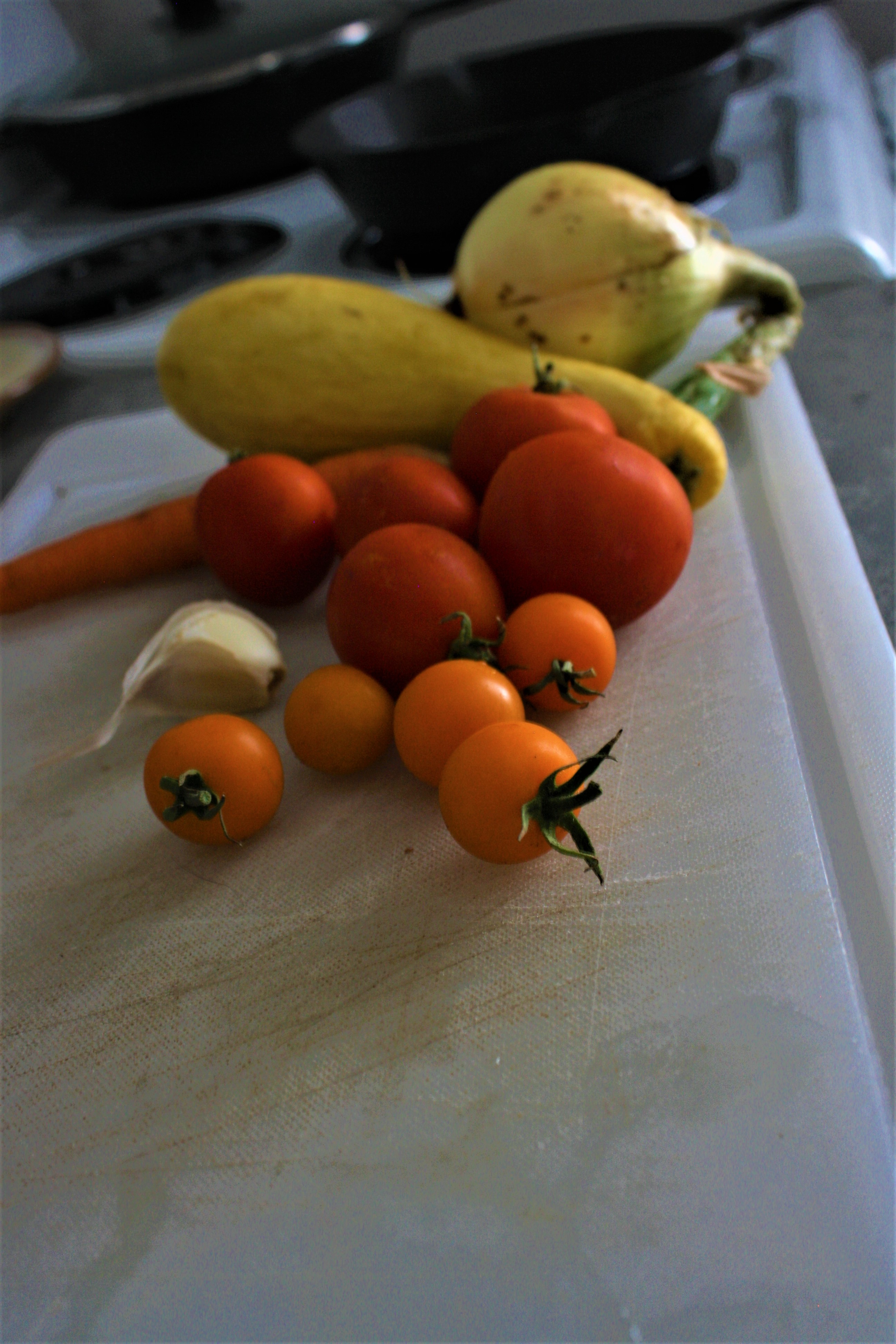
    Pile of uncooked tomatoes, yellow squash, carrot, garlic, and onion.

    I moved to Spokane for several reasons: A fresh start, to teach part-time, to live in a state with (relatively) better healthcare, and to get professional training as a baker. I can write, read, and sleep well enough just about anywhere, but I didn’t realize how precious kitchen space can be.

    When I get home with a bag of squash, tomatoes, and onions from my grandparents’ garden after visiting them in Montana, I squeeze myself between my door as it barges against a lamp and my fridge. Here, I feel like I’m in a scene from the 2007 Pixar film Ratatouille, in which Linguini brings Remy to his own similarly tiny Parisian apartment, where Remy takes in the view of the Eiffel Tower from the studio window. My new place doesn’t have an equivalent view, though, no apparent silver lining. I can only make do with what I bring to this place.

    As I assemble my ingredients and begin heating oil in a small cast iron skillet for a lone vegetarian dinner, I think about the bright, colorful ratatouille that Remy makes in the film. The premise is much like an old fable: Remy the rat emerges from the sewers, befriends a garbage boy, and reinvigorates a restaurant and the soul of a pretentious critic, Anton Ego, with his cooking.

    In the film, the character Colette calls ratatouille “a peasant dish” and Ego balks at it when presented with a plate of it before taking a bite. It’s telling that his first bite transports him to memories of his childhood eating a heaping bowl of stewed vegetables in the countryside, reminding him of what we can assume are the working-class roots he pushes away now as an arbiter of expense and prestige.

    The twist is predicated on the dish’s obscurity. Mollie Katzen describes ratatouille as a “Mediterranean vegetable stew” in the original Moosewood Cookbook, to be served “on a bed of rice, or in a bowl” (Katzen 119). Rebecca Seal notes that in the nineteenth century, ratatouille was “a staple for the armed forces and prisoners.” Like other peasant dishes of nineteenth century Europe, it was probably similar to the gruel that Ebeneezer Scrooge sulkily eats in his miserable apartment, alone with his ghosts. Laure Murat makes much of the dish’s obscurity, observing that the Tresor de la langue francaise, a voluminous French dictionary, locates the origins of ratatouille in “a crossing between ‘tatouiller’ which means ‘to stir, to handle a lot; to spill in the mud’ and ‘ratouiller,’ ‘to make murky, to shake, to stir; to make dirty'” (Murat 144).

    The dish is broad, flexible, open to interpretation. In fact, what Remy makes in the film is actually based on a culinary variation of ratatouille called confit biyaldi, which the pioneering health-conscious chef Michel Guérard invented in the 1970s during the Nouvelle cuisine movement, which revolutionized what is now an accepted standard in Western cuisine (and partly stolen from Japanese traditions) for culinary presentation, with an emphasis on a smaller quantity of food neatly organized at the center of the plate. What Ego eats—a small stack of carefully prepared vegetables and sauce—is the culmination of cultural changes in Europe that some scholars trace to the May 1968 protests that swept across France. After May ’68, Nouvelle cuisine began as “a bid to enhance the professional control of restaurants by chefs” by transforming cooks into “inventors rather than mere technicians” (Rao et al. 805).

    Murat’s interpretation is that the murkiness of the dish is one of several ways that Remy is marked as an outsider generally, as queer specifically. For Murat, the movie “suggests that the culinary work of art implies the transformation of what the norm treats as discarded material. . . it is no coincidence that it is cooked by the ‘rejects’ of society” (Murat 144). The title of the movie could refer to the cast of characters themselves, who come together to form a better community through collaboration, to be inventors rather than rehashing the restaurant’s same old recipes.

    This has its limits. The film is not kind to its one female protagonist, Colette, whose hard work in the industry Remy supplants at the last minute. Likewise, Linguini and Remy lose whatever intimate friendship they have when Linguini chooses to be with Colette, who is then expected to let her new lover’s former mentor (or friend or top or something) take the role of innovator, subjugating her again to the role of a technician. The film really only suggests radical shifts against hierarchy without fully arriving at them. It is Disney, after all.

    Chefs like Guérard and Thomas Keller (of the French Laundry) popularized ratatouille for their generation, but for my generation, the 2007 film drew attention to the dish in the playful way it deserves. Ratatouille can be made from the detritus of castaway ingredients. Like other stews, it’s useful for getting rid of ingredients before they go bad. It’s a way of making the best of what’s available, easily adapted to new and changing circumstances. It’s a good dish to master in my tiny, viewless apartment. It’s a dish that, literally, anyone can cook, and ultimately, it’s a good dish for the Anthropocene, adaptable to whatever manages to grow in the garden after abnormal weather patterns, drought, smoke, and other effects of climate change. This is true of my grandparents’ garden, which has taken hit after climatic hit this year, and yet they still have plenty of squash.

    My version of this dish uses ingredients available at most farmers markets in the Northwest, or from a variety of backyards if you have friends who are homeowners.

    Dish of ratatouille with yellow squash and zucchini over tomato sauce.
    1. Assemble vegetables. Eggplant is traditional but I had yellow squash, tomatoes, onions, garlic, and zucchini.
    2. Add olive oil to a cast iron skillet (the size depends on who you’re cooking for). Chop the onion and mince garlic and add to the oil on medium heat with a pinch of salt and pepper, to brown.
    3. Add sliced red tomatoes and halved cherry tomatoes. Add basil, oregano, and a dash of red wine vinegar or a squeeze of fresh lemon.
    4. Stir occasionally for fifteen minutes. Slice veggies thinly, using a mandoline if available.
    5. Remove the skillet from the heat when the sauce is stewed down a bit. Arrange veggies in a stack on top of the tomato sauce, fitting in as many as possible. You can be fancy and make it a confit byaldi by packing in the slices vertically, or go for a rustic look with something more pile-shaped. You can make it vegan or top with grated cheese, before or after baking. You can garnish with parsley, or basil, or more cherry tomatoes. This recipe is open-minded. It’s up for whatever.
    6. Cover the pan with foil. Bake in the oven at 450 degrees Fahrenheit for 25-30 minutes (use more time for a bigger pan).
    7. Serve with bread, or with wine, or on a bed of rice, or whatever you have available.
    8. If dining alone, watch a movie or listen to the radio while eating. If ghosts or rats arrive, listen carefully to what they have to say.

    Katzen, Mollie. Moosewood Cookbook. Ten Speed Press, 1977.

    Murat, Laure. “What’s Queer About Remy, Ratatouille, and French Cuisine?” What’s Queer About Europe? Productive Encounters and Re-Enchanting Paradigms, edited by Mireille Rosello & Sudeep Dasgupta, Fordham University Press, 2014, 136-147.

    Rao, Hayagreeva, Philippe Monin & Rodolphe Durand. “Institutional Change in Toque Ville: Nouvelle Cuisine as an Identity Movement in French Gastronomy.” American Journal of Sociology Vol. 108 No. 4 (2003), 795-843.

    Seal, Rebecca. “Deconstructing Ratatouille. National Geographic, May 10, 2019.

    Where the Time Went

    In the last year, I did not write a single blog posts. No updates, no quirky lists, no publication news, no under-researched history essays with unoriginal theses.

    That’s not because I had nothing to write about. In 2020, I finished my MFA in creative writing and launched into the academic job market (though launch is hardly the right word for it). I started reading manuscripts for Split/Lip Press and co-edited a print issue of Fugue. I had a few essays published, and one was nominated for Best American Travel Writing.

    Last year was rough. Beginning in January, I started applying for teaching jobs. In Spring, I shifted my last semester to online only and did my best to shelter in place. In Summer, I worked at one of Idaho’s state parks for the season. When Fall started, I was able to teach part-time online composition courses for a university and a community college, but as an adjunct, the work was not sustainable into the next semester. Now, in January, as I apply for another round of teaching jobs and brace myself for another season of rejections, it feels like I’m exactly where I was a year ago, except that now I have a degree and am no longer a student.

    I spent the last year waiting for emails and phone calls that mostly never came. I spent my time waiting for things to get better, waiting for leaders to act, waiting for many of my fellow Idahoans to do their part, wear a mask at the grocery store, stop going to large indoor parties, stop treating other people’s health like a joke. 2021 will most definitely have more of the same.

    But I also did a lot of hiking (safe and outdoors) and spent time with someone I love. I got better at making bean salads and had a few publications at the end of the year. Some writers tally up their submissions, rejections, and acceptances, but I’m just not that competitive. I think that’s why I don’t normally do New Year’s resolutions: I don’t want to turn my life into a series of measurements, quantifying their accomplishments and setbacks. I already check my email after dinner; I need to draw the line between work and life somewhere.

    But this year, the idea of a list of concrete resolutions appeals to me because it has the potential to establish something different. I want the next chapter of my life to start, and right now I feel stuck in a second draft of the last one. I don’t believe a resolution will help me get to that next chapter, but maybe it could help give it shape.

    So, this year, I resolve as much as possible to

    1. get a steady job doing something with my degree;
    2. publish a book;
    3. hike new places;
    4. become a better baker;
    5. cook more vegan meals;
    6. participate in more (safely distanced) community activism; and
    7. practice more humility.

    Some of these resolutions are more pressing than others. An implicit resolution, too, is to blog more. This blog has become more a professional website and portfolio (though I have plenty of work to do to actually professionalize it), and I’m sure I’ll tinker with this site in coming months. Until then, please stay safe.

    -jk

    On Revisiting a Daybook I Gave Up On

    Garden.jpgHere’s what happened: on September 1, 2018, I started a daybook. My goal was to write a few paragraphs every single day, usually a detailed description of something I observed or did. The goal was to think in the present tense, to not compare moments, but simply describe what happened.

    I made it two months and six days, stopping short at Election Day, adding a few posts in November and December. By January, I cut my losses. Life got weird. I was involved with some political activism and needed to grade mid-term and term papers for my composition classes, and holiday travel coupled with other writing goals pushed the daybook out of my routine. What I have as a result is a detailed sketch of life in Moscow, Idaho, during the autumn of 2018. An artifact from which I can mine for inspiration.

    I wrote a total of seventy posts. Most of them were redundant, but some choice scenes emerged. Here is one scene: one evening in October, I stopped to pet a dog named Tuna outside the one good bar in town, the Garden, and a woman ran out to let Tuna lick her face. Tuna’s human apologized for the dog’s bad breath, but the woman said, “It’s okay,  I just had a shot of gin so I can’t smell anything,” before jogging off in the direction of the police station.

    I spent a lot of time in the daybook reflecting on the Muscovites I see everywhere. There is a man with a beard and a panama hat. There are the Neo-Confederate church members downtown. There are the activists I trucked with, a retired state senator I ate donuts with every Saturday morning in October.

    This last year, I’ve started to view my writing in the long tradition of creative nonfiction stemming from journalism: the dispatch, the report, the place study, the travelogue. I wonder how many notes essayists record that never make it to print, the observations that get cut. The simplest description of creative nonfiction I can think of is this: to describe what happened.

    In mining my daybook from last fall, I have now collected material for three essays by categorizing and cutting. I wrote a lot about food, a lot about politics, a lot about anxiety, plenty about the sheer weirdness of this town in the Idaho panhandle. I described, in the most boring details possible, what happened between September 1 and November 6, not just my experience, but the lay of the land writ large, the season, the changes and my acclimation to the changes.

    After the experience, I cannot recommend the practice of keeping a daybook strongly enough to other writers. It is tedious and boring in the moment, but so is exercise and meditation and learning to play music. A daybook for a writer is like scales for a musician. It is foundational, elemental, the bedrock of storytelling and keen observation. Maybe I’m becoming more of a reporter like Joan Didion, Truman Capote, Tom Wolfe. Maybe I’m just doing what poets and novelists do to build image and character. In any case, my writing style has come out better for the exercise, simply a paragraph at the end of a long day, a scene, a drink, a ritual like prayer.

    -jk