Category Archives: Literature

“Literature is as old as speech. It grew out of human need for it, and it has not changed except to become more needed.” -John Steinbeck

To Hear Hamlet (In a Cemetery)

Graveyard

This weekend, I had the pleasure of seeing a live production of Hamlet by Lincoln’s Flatwater Shakespeare Company. The performance was held in the Swan Theater, which also happens to be in Lincoln’s historic Wyuka Cemetery. The show started at sunset; as the characters progressed into madness and scheming, the night grew darker and colder, and the full moon rose higher and higher. The experience was exhilarating.
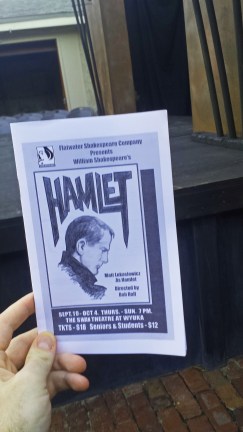
Ham1As I’ve mentioned in previous posts, I love theater despite my minimal experience with it. Plays are not meant to be read, but seen, and heard. Words are powerful enough in print, but when given a voice, they have so much more power to move the audience. Some readers are familiar with how important voice is to me. I’m drawn to people with strong voices; to me, it’s the first part of attraction. I grew up caring about voice more than any other part of a person. Garrison Keillor’s rusty voice on the radio; the beautiful harmonies produced by folk singers, The Wailin’ Jennys or Peter, Paul, and Mary. Of course Renaissance theater isn’t for everyone; nothing is. But hearing Shakespeare’s words put to the instrumentation of a cast of strong voices makes it impossible for me not to enjoy those words.

But the experience of hearing Hamlet in a cemetery was even more gripping. When the ghost of Hamlet’s father appears, the audience is reminded that hundreds of ghosts are in the ground behind him. When Hamlet contemplates mortality, that undiscovered country, we are forced to remember that emigrants to that undiscovered country are just a few yards away. Finally, when a clown digs up a grave, tossing skulls out of the earth, we cannot help but think that an actual gravedigger is performing the same task, under the full moon. We are surrounded by actual skulls while Hamlet picks up Yorick’s skull; we are surrounded by actual corpses while Ophelia is placed in the grave.

The very ground the audience walks on to reach the stage is defined by mortality. The theatricality of undoing the grave’s permanence, of waking up the dead and gazing into their empty eye sockets, hits us uncomfortably close. The stage mocks the dead we struggle to leave hallowed; we depart from the performance facing the cemetery illuminated by a full moon wondering if our own skulls will be unburied, if a tragedy will be staged on the field we’re confined to.

In this case, the play’s the thing wherein the audience finds its own conscience, and as we all know, conscience does make cowards of us all. That’s the power of theater, and poetry, and art. It places mortality in our face and invites us to wonder. To look around. To investigate. To consider that soon we’ll be departing for an undiscovered country, and we can either go mad waiting in line for our plane ticket, or we can enjoy the graces the terminal has to offer. Thus conscience does make cowards of us all, unless we muster up the courage to laugh at all the skulls surrounding us. Why not laugh? Aye, there’s the rub.

-jk
 

Out of the Frying Pan, Into Graduate School

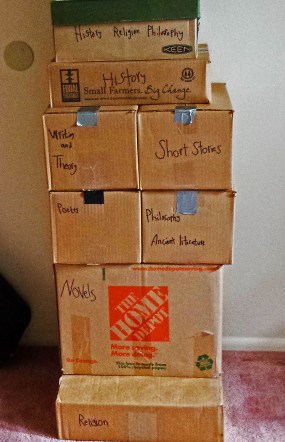
book boxes A few months ago, I attended the AWP Conference where eager representatives from MA and MFA programs stuffed fliers into my hands. They all offered the same possibility: a few years in paradise with nothing to do but write, read, workshop, and inevitably publish. I was drawn into the illusion that ignored the work, the expenses, the debt, and the difficulty in getting anything published.

While preparing for life after NAU, I knew that graduate school was not the only way to become a writer. I could serve overpriced coffee to people in suits, slipping them poems on their receipts to show them my talent, or I could work as a governess for a rich man with gigantic muttonchops who helps me publish my sad story. Or I could take the realistic approach and work, write, and submit short pieces to journals, like most writers I know, gradually building up a longer and longer list of published works.

After I returned from the conference, I received an email from the University of Nebraska-Lincoln. I had applied to eight schools last fall, and all rejected me but UNL; late in April they informed me they would offer me full funding and a stipend through a research assistantship. It was a lucky break, and I took the offer, not because I believed it was the only path I could take, but because I believed it was the best path for me at the moment. It’s the opportunity to get a Master’s Degree in English without any debt, which is just short of a fantasy these days. I don’t believe I deserve such an opportunity over other applicants, but because I have the opportunity now, it’s my responsibility to make the best of it that I can.

I’m not going just to improve my writing, though of course my emphasis will be in creative writing, and of course I intend to come out of it a better writer. But I also hope to become a more scholarly reader, a better student, a more disciplined person.  I was born into academia, and I can handle it a few more years without losing my mind. I am immensely grateful for the opportunity. So I’ll buckle down, pack up my four thousand books and my no. 2 pencils, and plunge into the fire.

-jk

The Great Summer Reading List

books

The Summer Reading List is a staple of summer vacations. Like beaches, fireworks, and barbecues, books are a necessity for good summers. I’m sure countless psychologists, anthropologists, literary scholars, and social scientists have devoted hour after hour to calculating the best equation for a summer reading list. It should be filled with books one has meant to read but hasn’t had time to yet. It should be diverse in genre, not just balancing poetry, novels, and plays, but adventure, drama, comedy, romance, or any combination of the reader’s personal preferences. Often they have new releases paired with classics. My summer reading list is hefty; it has books I’ve been meaning to get around to for over five years, as well as books I just discovered months ago. Some come recommended by friends, others I picked up off the shelf on a whim. However, it is most important for a summer reading list to be leisurely and enjoyable. I’ve certainly enjoyed my list so far, and have no intention of slowing my reading until I have to get back to work in the Fall.

My list is as follows:

The Iraqi Nights by Dunya Mikhail (Iraqi poetry)

A Dog About Town by J. F. Englert (murder mystery narrated by a dog)

The Long and Short of It by Pamela Painter (short stories)

The Theory and Practice of Rivers by Jim Harrison (poetry)

With a Strange Scent of World by Víctor Rodríguez Núñez (Cuban poetry)

The Propheteers by Max Apple (historical fiction novel)

Of Mice and Men by John Steinbeck (novel)

The Penguin Book of Modern African Poetry

Literature from the ‘Axis of Evil’ by various authors (anthology of works from Iraq, Iran, North Korea, Cuba, Libya, Sudan, and Syria)

The Penguin Book of First World War Poetry 

Fall 2014 edition of Cardinal Sins (literary journal)

Book of Grass by J. V. Brummels (Midwestern poetry)

They Came to Jerome by Herbert Young (Arizona History)

Salt by Earl Lovelace (Trinidadian novel)

Our Father Who Wasn’t There by David Carlin (Australian memoir)

Death and the King’s Horseman by Wole Soyinka (Nigerian play)

Volume 35, No. 1 of Mid-American Review (literary journal)

Healing Earthquakes by Jimmy Santiago Baca (poetry)

Aimless Love by Billy Collins (poetry)

Waiting for the Barbarians by J. M. Coetzee (South African novel)

The Blizzard Voices by Ted Kooser (Midwestern poetry)

All Quiet on the Western Front by Erich Remarque (WWI novel)

The Wayward Bus by John Steinbeck (novel)

The Business of Fancydancing by Sherman Alexie (poetry and short stories)

Emails from Scheherazad by Mohja Khaf (Syrian-American poetry)

What books are on your summer reading list? Any favorites? Leave a comment and let me know what you’ve been reading.

-jk

A Brief Note About the Best Weekend of the Year*

*or, That Time I Went to the Association of Writers and Writing Programs 2015 Conference in Minneapolis

Conference 1

“Listen to the language you start with in the first paragraphs. That will shape the rest of the story more than you are aware.” –Pamela Painter on first drafts.

Every year, thousands of writing programs, small presses and literary magazines, publishing companies, writers new and old, writing teachers, and students flock together to share their books, writing programs, new releases, and innovations in the literary community. Thanks to the NAU Honors Program, I joined several friends in attending the conference, and it was one of the most beneficial experiences of my academic life.

“The MFA program is useful because it’s a break from the capitalist shitstorm. It lets you work without giving you black lung, and lets you focus on writing. The problem is that it doesn’t prepare you for life back in the capitalist shitstorm after it’s over.” –Claire Vaye Watkins.

Conference 2

Despite our travel plans going wrong, we made it. Because Arizona does not acknowledge daylight savings time  (but Greyhound does), we missed our bus by an hour. We decided to take a shuttle to Phoenix and ended up taking two different shuttles an hour apart, but eventually gathered in Sky Harbor with enough time to bankrupt ourselves from airport food. By late afternoon and with much applause, we landed in Minneapolis, Minnesota, amidst rain and snow.

“One of the hardest things for an Arab to accomplish is to live apolitically.” –Hayan Charara on whether or not writing should be political.

The conference has two features, an exhaustive list of panels and a colossal book fair. I spent most of my time in the less popular conferences, and tried to explore as rich and diverse a selection of topics as possible:

conference swagLiterature from communities in diaspora, featuring Vietnamese-, Korean-, and Arab-American writers; a reading of flash fiction, from six-word memoirs to 1,000-word short-shorts; a reading from Cuban poet Víctor Rodríguez Núñez and a signing of his newest collection With a Strange Scent of World; a set of memoir readings from U.S. veterans of the wars in Iraq and Afghanistan; a discussion on translating Brazilian minority poets; a lengthy discussion from MFA teachers about the usefulness of seeking an MFA in Creative Writing in the first place; a panel on the usefulness of historical fiction and the rules one can break with it; a beautiful poetry reading from Iranian Farzaneh Milani, Syrian Mohja Khaf, and Iraqi Dunya Mikhail plus a list of historical women poets in the Arab-speaking world; a panel on writing as advocacy; and a reading of creative nonfiction about the value of speculation in nonfiction works.

“The ‘other’ for the writer is simply everyone.” –Elizabeth Kadetsky on the relationship between writers and the world.

The conference reinvigorated my love of writing, but unmasked a great many myths and expectations upon which I had previously built my understanding of the writing life. I now understand that the MFA racket is not all it’s cracked up to be; though certainly useful if applied correctly, MFAs are neither necessary nor financially sustainable if one wants to be a writer. I now have a greater appreciation for the need for good translators, and how deeply politicized translations can become when meaning and identity are at stake crossing the thresholds between languages. Flash fiction is more than an exercise in economizing language but a growing form of art itself.

Lastly, and most importantly, being a lone writer, while romantic, is terrible; good writing can only ever come from the experiences a writer internalizes and interprets, so I must accumulate as many experiences as possible, good, unpleasant, awkward, funny, humiliating, beautiful, terrifying, or calming. Time is not what I need as a writer; a community of friends, loved ones, people who inspire me, are what I really need. This trip generated more ideas for stories than anything I’ve done inside a classroom, and it is to my friends that I owe my ability to write, if I can say I possess such an ability in the first place.

friends

-jk

In Search of the Perfect Beer Milkshake

Beer Shake

“If a man ordered a beer milk shake, he thought, he’d better do it in a town where he wasn’t known. But then, a man with a beard, ordering a beer milk shake in a town where he wasn’t known–they might call the police.” -John Steinbeck in Cannery Row.

My favorite author, John Steinbeck, is known for his epic novels about the lives of the working poor like The Grapes of Wrath. While I love his longer works, the Steinbeck novel that has had the most influence on me is Cannery Row, more a collection of interconnected stories than a novel. I first discovered it four years ago, and I have reread it every fall to rediscover the magic of Steinbeck’s Cannery Row in Montery, California, which he calls “a poem, a stink, a grating noise, a quality of light, a tone, a habit, a nostalgia, a dream.”

In one story, the main character Doc remembers somebody commenting that he loves beer so much, “someday [he’ll] go in and order a beer milk shake.” Because he is safely out of town, he takes the bet and orders one, providing the following recipe: “Put in some milk, and add half a bottle of beer. Give me the other half in a glass–no sugar in the milk shake.” Because Doc is one of my favorite literary characters, I attempted to make a beer milkshake following Doc’s specifications.

It turned out dreadfully, so I worked on changing the recipe. Because several restaurants have already experimented with beer milkshakes, one can probably find several recipes online, but here, I offer my own.

1 bottle of beer (preferably a flavorful ale or stout)

3 scoops vanilla ice cream

1/4 cup milk

1 tablespoon sugar

2-3 icecubes

Beer Shake

Combine all ingredients in a blender and serve fresh and cold.

Beer Shake I tested numerous variations of the beer milkshake. With dark beers, I tried adding chocolate sauce. With ales, I tried using only ice cream and beer, nothing else. I don’t know what Steinbeck was thinking when he wrote about Doc’s excursions into the world of beer milkshakes; he wrote that “it wasn’t so bad–it just tasted like stale beer and milk.” I may have taken Steinbeck fandom to an extreme, but his work is dear to my heart. For now, I’m content to read my favorite writer, take his jokes too seriously, and remember his reflections on the world:

Cannery Row’s “inhabitants are, as the man once said, ‘whores, pimps, gamblers, and sons of bitches,’ by which he meant Everybody. Had the man looked through another peephole he might have said, ‘Saints and angels and martyrs and holy men,’ and he would have meant the same thing.”

Nothing Gets Past Hercule Poirot

PoirotOne of the most influential fictional detectives, Hercule Poirot, achieved a unique fame during his literary life. Created by Agatha Christie, he appeared in thirty-three novels, numerous more short stories, and upon his death became the only fictional character whose obituary was published in The New York Times. Although his creator despised him as a character, Poirot’s fans loved him. Recently, Poirot died a second time with the final portrayal by David Suchet, who played the Belgian detective in an adaptation of every story Christie wrote about him, ending a lengthy career with his final story, Curtain: Poirot’s Last Case.

Poirot may not be the most famous fictional detective. He has not entered popular culture the way Sherlock Holmes has; Christie, unlike Arthur Conan Doyle, did not choose to bring him back from his death, making his demise far more permanent than Holmes’s. But he is one of the most important detectives in the genre, relying on his “little grey cells” and watching the world with a meticulous eye. Perpetually calculating, though always a gentleman, he is far from the theatrically awkward, over-the-top socially inept kind of detective so common today, ranging from Batman to Dexter Morgan. Instead, Poirot falls into the believably quirky set of detectives, Miss Marple, Inspector Morse, Nero Wolfe, and Colombo. He is self-assured, confident, slightly neurotic, easily discomforted, and obsessive. His fans love him for many of the same reasons Christie hated him.

For many Poirot fans including myself, it is impossible to think of the detective without also thinking of Suchet’s portrayal. When I read Christie’s novels and stories, I hear Suchet’s light, Belgian accent, his distinct articulation, and his intonation whenever Poirot speaks. I picture Suchet with a curled mustache, cautious eyes, and fine suit when I read Poirot’s descriptions. Like many Poirot fans, I watched Suchet’s final performance with great difficulty because I knew it was his last act. But his adaptation is so fine-tuned after decades of practice, watching Poirot wither away in a wheelchair and struggle to solve an impossible case made me cringe. I know it was only an adaptation, but I would like to think that Suchet would have made Christie admire her Belgian detective, even though she loathed him by the end.

Bringing Poirot to life was Suchet’s magnum opus as an actor, or so I thought. Now I know the importance of bringing a character to death, to place him in the grave with dignity, to do justice to his final breaths and make audiences lament their loss. Suchet prompted such a lament.

-jk