Some flash fiction set in London, late November, 1945.
 Because his favorite pub was closed for repairs, Simon hobbled into a new one, closing his umbrella and dripping puddles onto the hardwood floors. The room was mostly empty, but warm and dry. He set his hat and coat on a rack and leaned the umbrella against the wall, next to four other identical coats and hats, each one drier than the last. Four men sat at the bar drinking a pint and reading copies of the morning paper. None of them spoke or looked up, not even when the news correspondent on the radio described the mess of Poland and Germany and France. It was only when Simon hobbled toward the bar, leaning on his cane for support, that he realized he had forgotten a key element in his post-war life: a newspaper. When he sat down, he leaned the wooden cane next to him and ordered a pint from the barkeep, a gaunt woman with a fat scar on her left cheek.The four other men turned to look at him, each head tilting slowly to the right.
“Forgot my paper,” he mumbled.
One of the men looked back at his own paper, but the other three men, none of whom had completely dried off yet, glared at Simon for several seconds longer, then returned to their reading. The barkeep placed a dark beer in front of him, the foam sloshing over the top and down the side as she set it down.
Simon drank idly and listened to the static-ridden BBC radio from the corner. Radio was only so helpful in describing the ugliness of warfare, Simon thought, but he did not need any help remembering.
“Excuse me,” he asked as the barkeep passed. “Could you switch to something else? I think the London Symphony might be on this evening.”
“The radio?” she asked. Simon was caught off guard by her Russian accent. At the same time, the four men turned once again and glared at him. The one furthest on the left folded up his paper and left two grimy pound coins on top of it, got up, and walked out with his coat, hat, and umbrella.
“Why do you want me to change it?” she asked.
“I just. . . I’d rather listen to music.” Another man got up and left, leaving two more pounds atop his folded, wrinkled paper.
“You don’t want to hear the news?”
“No. I can only handle so much of it.”
When he said this, the last two men stood up and left in the same fashion as the others. The woman paused, then walked toward the radio at the other end of the bar, collecting the pounds two by two as she went. As she turned the dial, static flooded the pub, slowly giving way to more news, more static, and finally an old recording of the London Symphony Orchestra performing Edward Elgar’s cello concerto. It was somewhere in the second movement. Simon closed his eyes and finished the beer in three gulps.
“One more, please?”
“Very well, then.” As she poured him another pint, he squinted in the dark, gray light at the scar beneath her eye. “What?” she asked.
“You’re from Russia, are you?”
“Yes, I came from Russia. Why?”
“Just curious.” Simon took a sip. “Before or after? If you don’t mind, that is.”
She folded her arms.
“I was a soldier, just like you,” she said. “I was in the Red Army. I came here while it was ending.”
The music thrummed against the rain, which grew louder as it shifted direction and pummeled the windows and the door. Taking another sip, Simon paused, closed his eyes again, and listened to the orchestra interrupted by brief pauses of rusty static.
“You are very different,” the barkeep noted. Simon opened his eyes.
“I beg your pardon?”
“You won’t listen to anything about the war or read anything about the war, but you feel free talking about it. Why is that? If you don’t mind, that is.”
“Oh. I don’t know. I can’t help it, sometimes.” He gulped half the beer. “Do you ever talk about it? I imagine the Red Army is much more interesting than just an old British infantry division.”
“Before the war, do you know what I used to do? I was a musician. A clarinetist.”
“You were?”
“Yes. I played all over the country. Then they came and told me I had to fight to save the motherland. So I went and fought. I was in Leningrad for some time.”
“Well, I’m glad you got out of there. I could never play. I was a terrible musician. I still love to listen, though.” He drained the last of the beer and stood up. “Thank you for listening. It’s getting late, though. I need to be off.”
“I’m closing up soon, anyway.”
As he stood up, he dumped a pile of pound coins around the empty glass like presents beneath a tree. He reached for his cane; she collected the coins and picked up the glass. The concerto continued to rise and fall, to lean forward and pull back like dancers. She pulled off her dusty white apron as he slid into his nearly dried coat and hat. Looking around, he turned on the axis of his cane.
“My umbrella is gone. I. . . did one of them take it? I don’t suppose you have a spare?”
“I only have mine.”
“Oh. Thanks anyway.”
“Wait a moment.”
Putting on her own coat and hat, the barkeep stepped out and tossed her own black umbrella to him while she turned stools up onto the smooth wooden top of the bar. She switched the lights off and finally did the same to the radio. Together, they stepped outside; he opened the umbrella while she turned around and locked the door, before they walked up the street. She took the umbrella as Simon limped forward, frowning as she opened the umbrella and swung it above their heads.
“Did you ever play Tchaikovsky?” he asked.
“Oh, yes.” They walked slowly and Simon’s cane clicked against the hard cobblestone with every other step. “I haven’t thought of music since the bombing.”
“Tell me about Tchaikovsky. About music before the war. If you don’t mind, that is.”
Around them, rings of rain slid off the umbrella as they passed empty pubs and shops together.
-JK
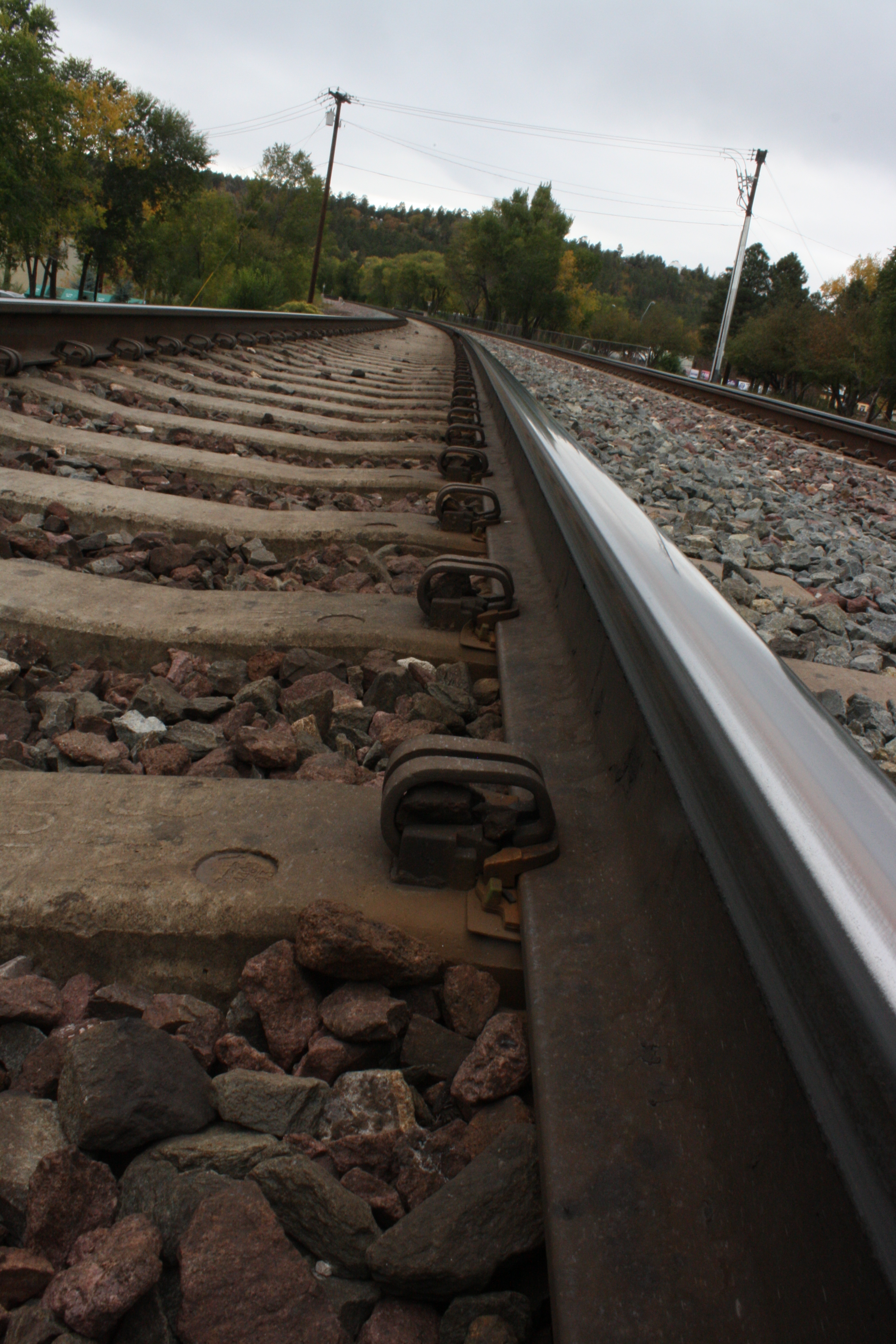 The chainlink fence delicately rattles. There is nothing in the distance, but the rattling persists like a stick dragged through broken glass. Then, in the distance, we hear it, the horn calling from the right. It’s coming. The fence shakes violently. At last, it spills into view, the bright lights on the front forming a trio of eyes glaring at us as we scurry up the gravel slope to the tracks. The train soars closer.
 Keene Short