At 7:00 PM, the hooded medium taps his phone and the music on the Bluetooth speaker switches to some esoteric chanting. He unsheathes a sword and holds it over the participants—eight people consisting of one couple, one of the bookstore’s employees, his girlfriend, a trio of women who could be sisters, and myself. The medium says something muted as he taps the sword three times in the air, then repeats with a few sprinkles of water from a glass. He takes his role seriously, explaining that he is casting circles to protect the room from ill-intentioned spirits while still making room for benevolent ones.
He pulls back his hood to reveal a long white beard and thick glasses. He smiles and says in a Kentucky accent, “Hi, there, I’m Drew.” I want to add, “And you’re a Druid?” but I keep that to myself. I’m here to take this seriously. I write about horror movies and ghost stories for a living (or part of one). If nothing else, this is research.
We are gathered in an indie bookstore for a séance of the spirit of Emily Bronte, whom we will try to summon in southern Indiana using soil from the Bronte Sisters’ grave in England stored in a glass vial that looks like a test tube, a gift to the bookstore owner from a patron years ago. This is not a performance the way improv comedy is a performance, but I understand the guide’s showmanship. He asks us if there are any mediums in the room, anyone who is used to feeling strange, significant changes in temperature, casual premonitions, dreams that come true. A few participants raise their hands for each; I don’t raise my hand at all. As much as I want to believe, I am skeptical, always Agent Scully instead of Spooky Fox Mulder.
As an afterthought, the medium asks, “Are there any standup comedians here this evening?” I can’t tell if he’s looking at me while he explains that the impulse to crack a joke to fill an awkward silence breaks the tension necessary for a séance. This is a literary explanation: holding tension, like staying in pitch while singing, is a craft technique. Tension builds atmosphere, holds the reader’s attention, keeps us in the moment.
“As a child,” writes Melissa Febos at the end of Body Work, “I did not understand spiritual, cathartic, and aesthetic processes as discrete and I still don’t. It is through writing that I have come to know that for me they are inextricable” (153). A séance for a British author is aesthetically appealing during the month of October and cathartic to a certain extent, but I’m still hungry for spiritual meaning. I can appreciate the theatrics involved in any kind of ritual, a form of adornment like the robes a priest wears, the gold shimmer of a communion chalice. I know a campus pastor who often said, half-seriously, that a modern Eucharist should involve pizza and cola. A community meal would be spiritually satisfying and certainly cathartic, but the gravitas of gold and robes adds a layer of distinction, demarcating rituals from habits.
The medium passes around Emily’s grave soil. We hold it one at a time, seeing how it changes what we notice in the air, what magnetism we can find. It is heavier than I expected; the glass is cool to the touch, but not cold. One of the intuitive women in the room, though, feels its warmth. She walks around the room gauging the spirit’s rambunctiousness, looking for where the warmth is thickest, and stops in front of me. I don’t know where to shift my gaze; there is a density of warmth in front of me, she says. The medium’s glasses are so thick and the room is so dark that I think he is looking past me when he asks me if I’m comfortable proceeding.
Eager, almost giddy, he stands above me and draws a card from a tarot deck to see if the spirit of Emily Bronte or whomever else the circles invited in has a message for me.
He draws the Ten of Cups. He smiles. Red light reflects off his glasses, obscuring his eyes. He tells me that this is a sign that familial connections will come together soon, that questions of community and purpose will be resolved. That there is a reason to rejoice at something in the future.
I want to believe this. I’m actually taken aback by my own knee-jerk skepticism. I don’t know what spiritual force this is meant to resolve or why somebody would feel warm energy anywhere near somebody like me, so often told how cold I seem.
But this is just a prelude. The real séance requires two volunteers from the audience. One volunteer sticks his hand in a hole in the floor and leaves it dangling in the cold air above the basement. Another lies flat on his back with two death pennies on his eyes, pennies left on the eyes of the dead and uncovered decades later by gravediggers who had to shift bodies to narrower graves to make room for more of the dead. He has a vision of a worker whose whole family, generation upon generation, is at a mansion party, but the worker must leave. He almost hears the worker’s name, something with a T, but that’s all. The worker spirit must depart in a hurry, he cannot stay in our circle, in our waking world. Then, someone feels chills. Then, the warmth in the room falls away. The tension breaks before the ritual is over and the bookstore is a bookstore before it is supposed to be a bookstore. I walk out into the night, haunted by some ache I couldn’t name.
Here’s what I’m working on lately: a paper on folk horror films for the College English Association conference in Atlanta, Georgia.
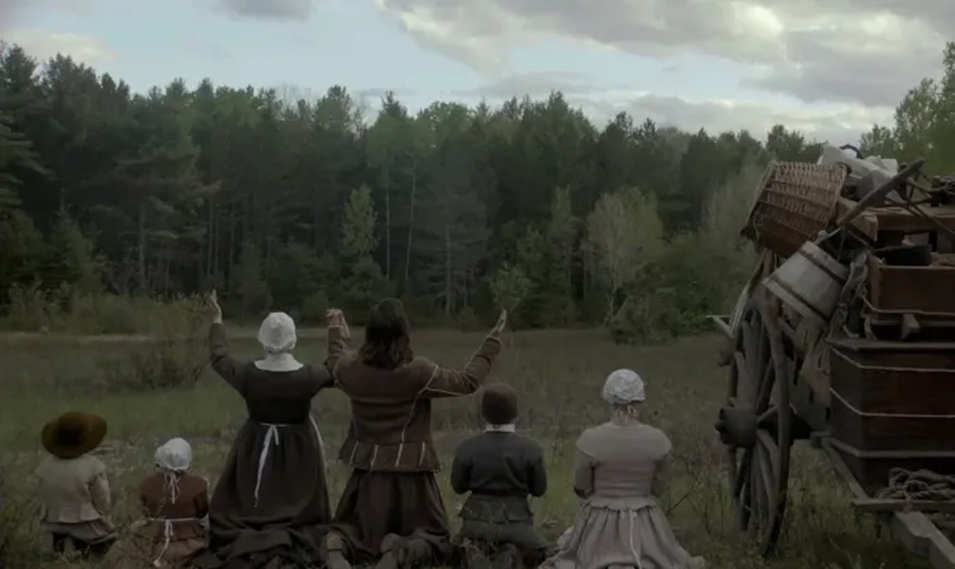
The Witch (2015)
THE GENRE
Scholarship about horror often highlights the genre’s ability to “render abject the subject of its gaze” (Chambers 12). 1980s body horror resonated with the AIDS epidemic, just as the Saw franchise is best understood in the context of the invasion of Iraq, and the zombie craze of the 2010s in the context of the Great Recession. Despite its rapid cult following, there is less consensus about folk horror.
Jamie Chambers notes that “theoretical approaches to folk horror remain in their infancy” (10) and Paul Cowdell writes that while “clear generic definitions are elusive,” the genre has a distinct atmosphere: folk horror films “rely on location in a landscape that acquires almost the status of an active character” whose influence results in what Adam Scovell calls “‘skewed belief systems and morality’ [enabling] the plots’ actual ‘happening/summoning’” (Cowdell 296).
Others have argued that folk horror exploits rural communities as sensational and backwards. As Chambers puts it, “folk denotes a productive way of seeing with an unstable inference of us and them” (17). Elsewhere, Cowdell argues that folk horror necessarily relies upon interdisciplinary interests in folklore studies, claiming that “The Wicker Man, then, would not exist without the development of an actual discipline of folklore” (309).
Is folk horror merely the abjection of folklore? While I find it admirably subversive to suggest that because the movies we love are just reboots of older folk stories, then we are not, in fact, morally or socially better than our ancestors, I also find this definition limiting. With obvious exceptions (The Witch), the legends in folk horror are usually fictitious. The traditions that drive the imagined peasant communities in Children of the Corn, The Wicker Man, and The Blood on Satan’s Claw are diegetic imitations of actual folklore.
Instead, folk horror is defined by the countryside, historicized between economic relations. Antonio Gramsci’s words on the subject are now famous to the point that they’re a meme: “The old world is dying, and the new world struggles to be born. Now is the time of monsters.” The question I want to pursue is whether or not those monsters are the peasants left behind by modernity, or modernity itself.
THE UNHOLY TRINITY
Most scholars agree that three unrelated English films, known informally as the Unholy Trinity, mark the first era of folk horror: Witchfinder General (1968), The Blood on Satan’s Claw (1971), and The Wicker Man (1973).
Witchfinder General is based on the real self-proclaimed witchfinder Matthew Hopkins, who abuses his authority in seventeenth century England. The Blood on Satan’s Claw portrays the satanic influence of Pagan artifacts on rural youths, who can only be saved by a witchfinder-like state agent. Meanwhile, The Wicker Man depicts a neo-Pagan Scottish cult whose mere existence challenges the English state’s internal stability by selecting a devout Anglican police officer for human sacrifice.
The most striking thing about these films is how ideologically incongruent they are. Whatever binds them together, then, is their shared depiction of an unresolved conflict between agricultural communities and an increasingly powerful class of landowners.
ENCLOSURE AND THE COMMONS
A Field in England (2013).
Economies in Europe were structurally and politically diverse during the thousand-year reign of feudalism, but were mostly built on social contracts between peasants who lived on the land and lords who held religious and political titles to that land. Peasants were also granted access to parcels of common land useful for procuring firewood, hunting and gathering, and grazing.
As early as the 1200s, feudal lords began violating those contracts by terminating customary rights to fish, graze, hunt, or harvest. Ellen Meiksins Wood writes that “enclosure meant the extinction, with or without a physical fencing of land, of common and customary use rights on which many people depended for their livelihood” (83). A much larger wave of enclosures began in the sixteenth century, placing the means by which one lives to see another day—food, water, and shelter—exclusively under market forces.
“As a result, enclosure could lead to the elimination of small owner-occupiers, who were bought out by large proprietors” (623), writes S. J. Thompson. Meanwhile, Silvia Federici notes the relationship between enclosure and the violence of the witch trials. In Caliban and the Witch, she writes, “women were those who suffered most when the land was lost and the village community fell apart” because “a nomadic life exposed them to male violence” (73).
Folk horror calls back to what capital presumes to be extinct: the practice of holding resources in common. Witchfinder General portrays the agents of enclosure as monstrous, cruel figures. In contrast, The Blood on Satan’s Claw suggests that enclosure is a necessary step in social progress, and The Wicker Man depicts a community struggling to recreate premodern agricultural (emphasis on cultural) conditions.
THE HORROR OF MATERIAL CONDITIONS
One central premise of folk horror is that people and wilderness should be separate, that monstrosity emerges from too close an association with the land. This is the logic of Enlightenment-era liberalism. John Locke explicitly argued that land can only be considered property if the people on that land use it for profit, oras he called it, improvement.
Thompson writes that “improvers defended enclosure on the grounds that it was more compatible with individual liberty than the open-field system it replaced” (639). Employing the rhetoric of natural liberty and natural rights, the agents of enclosure redefined nature itself. Locke argued that “the value inherent in land comes not from nature, but from labor,” which in Wood’s assessment means that, for Locke, “unimproved land is waste” (Wood 85). In the sixteenth century, improvement looked like agriculture. By the 1960s, agricultural spaces had replaced the commons as the imagined backwaters of modernity.
The Wind (2018)
This is much more evident in the US corollary to English folk horror, known as hicksploitation. Ranging from Deliverance (1972) to The Texas Chainsaw Massacre (1974), American “hillbilly horror” is arguably more exploitative. In these films, isolated (usually white) communities in overgrown landscapes become monstrous. These films center harsh landscapes that are difficult to “improve,” despite the most industrious efforts of long-gone colonialist projects, which themselves become the subject of more recent American folk horror. The Witch (2015) and The Wind (2018) both emphasize the isolation of frontier spaces.
For Chambers, “the pleasures of the folk aesthetic frequently arise from depictions of cultural-geographic difference” (26). While I think Chambers underestimates the critical thinking skills of horror fans, his observation that the appeal of films like The Wicker Man for western liberal audiences is an imagined rural authenticity seems correct. Folk horror scratches a very particular itch; it confirms about ourselves whatever we want it to.
Today, there are dozens of studies about a contemporary epidemic of loneliness, contrasting a genre of memes about the desire to leave modern society and live in a cabin in the woods, to “retvrn with a V” to “the past,” because “medieval peasants” presumably worked fewer hours and because life was somehow “better” in “the past.” These memes traffic in the same metonymy for “the good old days” that folk horror encodes with monstrosity.
With more scholarship, I want to explore the ways that recent folk horror has reinterpreted landscapes from wastelands into spaces of mystery and open exploration, ecologically but also historically and economically, where present conditions can be seen, with both admiration and disgust, in sharp relief from afar.
Chambers, Jaime. “Troubling Folk Horror: Exoticism, Metonymy, and Solipsism in the ‘Unholy Trinity.’ Journal of Cinema and Media Studies, vol. 61, no. 2, Winter 2022, pp. 9-34. EBSCO, https://doi.org/10.1353/cj.2022.0014. Accessed 3 October, 2023.
Cowdell, Paul. “‘Practicing Witchcraft Myself During the Filming.’ Folk Horror, Folklore, and the Folkloresque.” Western Folklore, vol. 78, no. 2, Fall 2019, pp. 295-326. JSTOR. https://www.jstor.org/stable/10.2307/26864166. Accessed 18 October, 2023.
Federici, Silva. Caliban and the Witch. Autonomedia, 2014.
Thompson, S.J. “Parliamentary Enclosure, Property, Population, and the Decline of Classical Republicanism in Eighteenth-Century Britain. The Historical Journal, vol. 51, no. 3, 2008, pp. 621-642. JSTOR, https://www.jstor.org/stable/20175187. Accessed 19 March, 2024.
Wood, Meiksins Ellen. The Origins of Capitalism. Monthly Review Press, 1999.
My neighbors are letting their fruit rot. For weeks, I have walked by a house with three bountiful peach trees at the edge of the sidewalk, spilling fruit onto their lawn and gravel driveway, where it has turned into a mash and rotted under October’s weekly record-breaking temperatures, leaving a smell like stale beer in the air.
I’m tempted to nab a few good ones, take them home, can them or make a pie to bring back to the neighbors. But they have boarded their home with PRIVATE PROPERTY signs. Sometimes a man uses a chainsaw on the lawn to cut large chunks of wood next to the peaches. POSTED: PRIVATE PROPERTY. DO NOT DISTURB. This is Eastern Washington. This is the American West. I leave the wasted fruit alone. THIS LAND IS MY LAND.
I try to eat with the seasons. Eating locally, eating fresh, is easiest in the summer and fall, when fruit plummets freely from the trees with the evolutionary expectation that animals will eat it and take the seeds to flourish elsewhere. Taste is a necessary part of a thriving ecosystem. As Robin Wall Kimmerer puts it, “food arises from partnership” (126).
Winter is a different story. Without natural abundance, I try to choose to refuse unseasonable produce. Frances Moore Lappé wrote, back in 1982, that the American diet, defined by “unbridled freedom” to eat, grow, and sell whatever, whenever, is “a frontier concept” that has led to lasting damage: “There’s only so much farmland in the United States, and it’s shrinking, not growing. Yet we give some the right to own 100,000 acres when we know this denies dozens of farm families the right to own any land at all. Is this democratic?” (Lappé 110-111).
I love fall, and all the food associated with it, from peaches to winter squash. Thanksgiving and Halloween both derive from western European harvest festivals—Harvest Home in England, Samhain for the Celts of Ireland and its Welsh equivalent, Nos Galan Gaeaf. As much a way to prepare for winter as to celebrate the harvest, what remains of these old festivals today are the stories they associate with changing seasons.
While agriculture shaped a city-centered and often vegetable-based diet along the Mediterranean, the “modes of production and cultural values” at the edges of the Roman Empire—Celtic and Germanic—“had for centuries criss-crossed the great forests of central and northern Europe,” which shaped food access, and therefore cuisine: “Hunting and fishing, the gathering of wild fruits, and the free pasturing of livestock in the woods” made wild meat the primary dish for many Celts (Montanari 6).
Agricultural development was not necessarily absent, but less structural. Roman colonization “forced the Celts to start growing wheat on a large scale; once the wheat had been reaped and threshed the grain went to Rome,” and after the Romans fell into decline, a series of “invasions and poor or failed harvests sent people back to wild cereals” throughout the early Medieval period (Toussaint-Samat 129). Likewise, after the relative climatic stability of the Bronze Age, “the weather took a turn for the worse towards the beginning of the first millennium” across much of Europe, when “heavy rainfall and strong winds impoverished the soil, peat bogs proliferated, deforestation was rife and upland farms were deserted with alarming swiftness” (Jenkins 15).
Far from reliably cyclical, agricultural development experienced constant disruption, and as farmers adapted, so too did the culture. The harvest festivals of the Celts focused on bonfires, harvesting and storing barley and other wild cereals, apples, turnips, and ale brewed with wild hops. The prime feature of the feast was whichever animals could feed the most people, while guaranteeing they had enough cattle and pigs to make it through the winter.
After Julius Caesar led the first Roman invasion of Britain, he and others claimed that the Druids committed human sacrifice for religious purposes, for which there is modest archaeological evidence. While that evidence does notsuggest the sacrifices coincided with the Celtic harvest festivals that predated Halloween—the period of human sacrifice may have been over long before the Romans arrived, who had a vested interest in portraying the Celts negatively anyway—legends about rural pagan sacrifice for mystical purposes have persisted. In The Wicker Man (1973) the residents of Summerisle endure failing harvests, either because the gods are unhappy or because the GMO fruit strains the island’s leader brought from the mainland are unsustainable in northern Scotland. Likewise, an elder in Midsommar (2019) introduces an isolated Swedish village’s festivities by remarking, “And what poetry that it’s now the hottest and brightest summer on record,” in a cheerful voice.
The 2021 Welsh language film The Feast is more overt. The film follows a wealthy, politically powerful family in the Welsh countryside who want to throw a feast for a traditional farming couple, Mair and Lori, whose land Gwyn, the head of the household and the local MP, wants to open up to oil drilling. Mair is angry at the prospect because it’s her farm, but also because of an old, vague legend about a goddess locked where the oil is, a hill called the Rise. Unfortunately, Gwyn and his business partner Euros have already started secretly drilling.
The family hires a maid from the countryside, Cadi, to help cook the feast, consisting of wine, a seasonal but tropical fruit salad, and rabbit. Cadi is mysterious, quiet, horrified at the death of the rabbits but fascinated by the people in the house, especially two spoiled sons. One, Guto, asks her for drugs, and she takes him to the woods to find psychedelic mushrooms. Another, Gweirydd, is a disgraced doctor known for his sexual aggression.
The film has a somewhat obvious ecological message (drilling for oil will incite the revenge of the land), but I think that’s the most surface-level interpretation. Read as folk horror, it’s about a working class woman whose presence disrupts and uncovers a wealthy family’s secrets, her labor in the kitchen an infiltration of the natural world into the enforced order of the aristocracy.
Glenda, Gwyn’s wife, helps Cadi prepare the feast. Early in the film, she praises herself for using local ingredients but complains about the local market’s limits while opening a Styrofoam package of mail-order produce: mangoes, pineapple, and pomegranate. Gwyn comes in with two freshly shot rabbits, casually dropping them onto the counter for Cadi to skin. The food is a mix of local and imported ingredients, all of which the family can access with their wealth and the scale of their land for hunting.
As a food movie, The Feast does something surprising: Every scene of someone eating is utterly disgusting. Euros eats with his bare hands, jamming rabbit deep into his throat, at times sliding his fingers well past his teeth. Gweirydd brags about his special diet of raw game meat, a version of the paleo diet, while the mushrooms Guto mashes into his food cause him to hallucinate maggots in his leg, which Cadi (either in reality or as another hallucination) graciously licks from his leg to devours in front of him. That leg is eventually severed in the woods by Gweirydd, which Glenda, in a trance, cuts into bacon-thin strips while Euros fills his jaw with unidentifiable meat.
The Feast is an eco-Gothic parable that ties together the rural symbolism of folk horror, the class anxieties of Gothic literature, and the environmental terror of ecohorror. Director Lee Haven Jones has explicitly stated that Cadi was inspired by the Welsh story of Blodeuwedd, in which two magicians create a woman from flowers and oak to give the legendary hero Lleu Llaw Gyffes a wife. Much like Frankenstein’s monster, though, Blodeuwedd is angered at her creators for bringing her into their world to serve someone else’s needs, and takes revenge on them.
With rural, agricultural settings as the backdrop and harvesting a common plot device, folk horror often calls back to premodernity. Many classic English folk horror movies—The Witch, The Blood on Satan’s Claw, Witchfinder General, and A Field in England—take place in the seventeenth century. Starvation is a looming threat in folk horror, before something even worse emerges from the woods, the same woods the ancient Celts used to scavenge freely for their food. Horror often reflects broader social anxieties—body horror mirrored the AIDS epidemic, ecohorror reflects climate change. What secrets buried in the woods does English folk horror seek to uncover?
Seventeenth century England saw another round of political disruptions to established agricultural practices. Parliament began passing a series of laws known as the Acts of Enclosure, which codified “the abolition of the open-field system, an arrangement by which villagers owned non-contiguous strips of land in a non-hedged field. Enclosing also included the fencing off of the commons and the pulling down of the shacks of poor cottagers who had no land but could survive because they had access to customary rights” (Federici 69).
The Enclosure Acts allowed English lords to privatize the commons—the woods and fields that peasants had used to freely gather food and firewood for centuries—as well as state-owned and communal Catholic land. Previously, King Henry VII had propped up individual peasant families by mandating that small-scale farmers possess a minimum standard of sheep and acreage, the effect of which, according to Francis Bacon, allowed English farmers to “keep the plough in the hands of the owners and not mere hirelings.” In Marx’s formulation, the destruction of the commons and often violent privatization of state land, “given away, sold at ridiculous prices, or even annexed to private estates by direct seizure,” coincided with the expulsion of peasants from their familial estates. With nowhere to go, they became the first proletariat, a class of workers who, for the first time in history, were legally required to purchase the privilege of shelter (Marx 884). Building on this analysis, Silvia Federici looks at the effect of enclosure on women through the lens of Europe’s witch hunts, which “destroyed a whole world of female practices, collective relations, and systems of knowledge that had been the foundation of women’s power in pre-capitalist Europe” (Federici 103). By privatizing state and common land, by legislating away centuries of agricultural relationships to reclassify as “private property” as many forests and lakes as possible, the state-sanctioned beginning of capitalism marked a severe turning point in people’s relationship with land, and therefore food.
Nia Roberts as Glenda in The Feast (2021), making a good case for vegetarianism.
Horror has plenty of gastronomical elements: Dracula drinks blood, zombies eat brains, and cannibalism appears in everything from Silence of the Lambs to Sweeney Todd. In ecohorror, as in folk horror, food is understood to be a collective problem that dwells on contamination. Food is poisoned, crops fail, or we bring into the kitchen something unwanted. Food in horror is often a reminder of how fragile we are to interruptions in season, diet, and health.
Gwyn’s motive in The Feast mirrors the enclosure acts, and Cadi reflects the classed, gendered, and ecological consequences of enclosure. English folk horror calls back to a world that was understood to be held in common. Anyone could fish, hunt, or pick fruit in the wild forests, so starvation was primarily a concern during winter. A successful harvest, after all, was an important communal affair.
Maybe I’m a coward for not picking those peaches. The warm months are finally over in Spokane, and the fruit is no longer falling from the trees. I could have baked a late harvest pie, a dozen pies even, but instead I stick to what I have from my grandparents’ little garden, carrots and tomatoes and buttercup squash, making chili and roast squash. I cook for myself. Private property has broken so many people’s brains out West that it’s become a kind of religion. It can turn people into outright monsters. If there’s one lesson horror movies have taught me, it’s that you never, ever, leave the group and set out on your own.
Federici, Silvia. Caliban and the Witch. Autonomedia, 2014.
Jenkins, Geraint H. A Concise History of Wales. Cambridge University Press, 2008.
Kimmer, Robin Wall. Braiding Sweet Grass. Milkweed Editions, 2013.
Lappé, Frances Moor. Diet for a Small Planet. Ballantine Books, 1982.
Marx, Karl. Capital Vol. 1. Penguin Books, 1990.
Montanari, Massimo. The Culture of Food. Blackwell Publishers, 1994.
Toussaint-Samat, Maguelonne. A History of Food. Blackwell Publishing, 2009.
He skipped class for few days when flu season started, just to stay healthy, and a few days turned into watching every episode of Seinfeld. Ten weeks, when he finally left his dorm room after realizing his roommate hadn’t returned in weeks, he found that campus was dead empty. Garbage cans were upturned and trash was everywhere, and it wasn’t even football season. Posters were stapled to the bulletin boards encouraging students to get flu shots, and next to those were more recent-looking posters calling for military intervention in the university, only some of which were from Turning Point USA.
In the cafeteria, he heard rustling among the tables, the weeks-old bowls of cereal on the floor and ominously empty orange juice bottles. Another student hobbled out of the corner, limbs stiff, eyes glazed over. This student was wrapped in several layers of winter clothes, but still she was pale and had a terrible cough. He recognized all the symptoms: it was the flu. The infected student hobbled toward him asking for vitamin C, so he fled the cafeteria and went to find his 8:30 AM class.
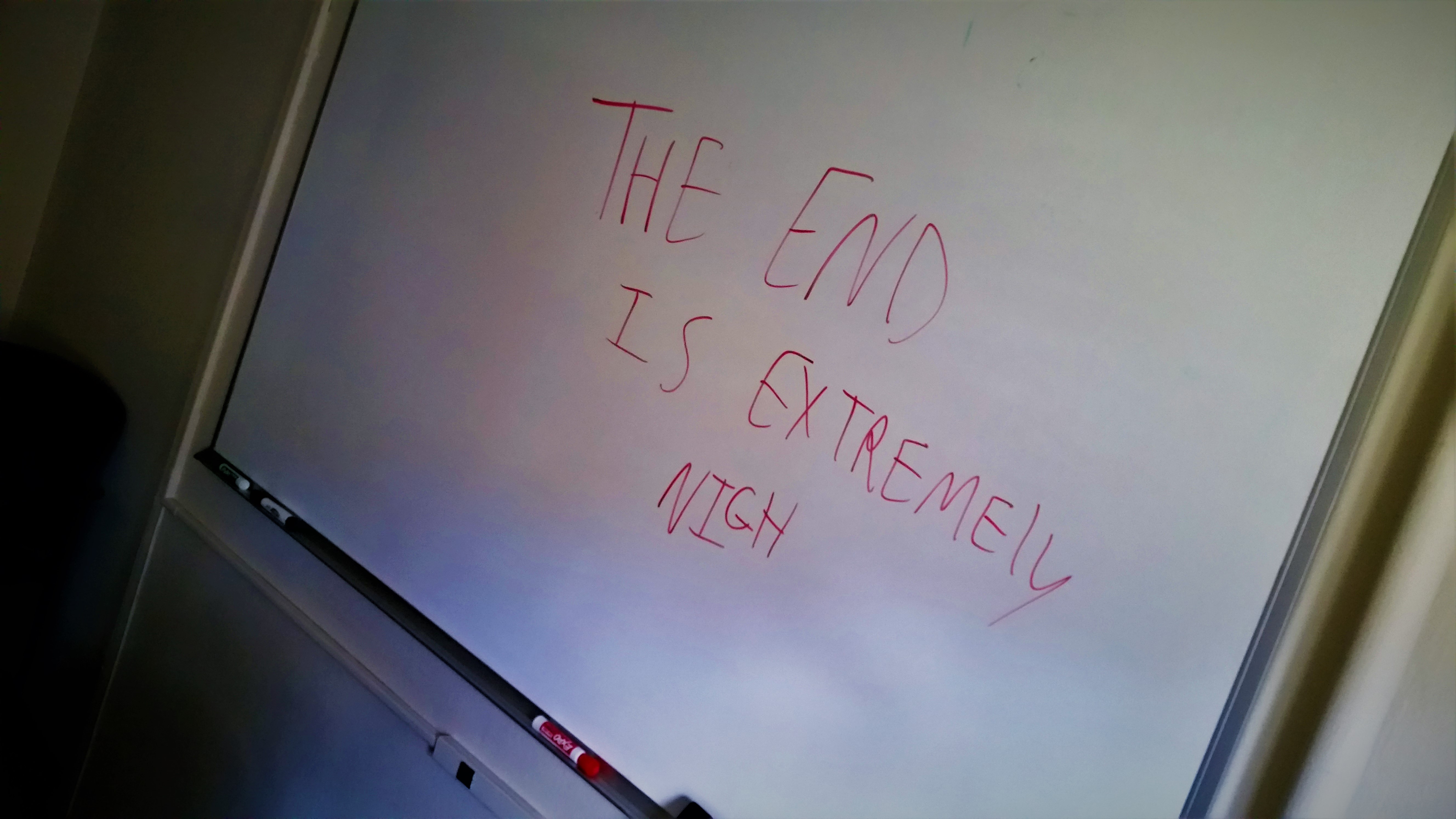
He ran to his classroom, which was deserted except for a few stray backpacks and a desperate warning to get out scribbled on the whiteboard in red dry erase marker. Desks were upturned and a misplaced syllabus was on the floor. He picked it up and wondered if his professor would still give him a D even after missing 28 days of class.
A stack of in-class writing he found next to the computer detailed the gradual collapse of the university as the flu spread across campus. The President ran away as a faction of armed deans staged a coup to protect themselves from the infected. The football coaches drove off, and the business administration faculty barricaded themselves in their offices, armed with the elephant guns that all business administration professors are required to have at all times to protect themselves from the critical theorists. Chaos reigned: the tenured preyed on the adjuncts, the biological science majors feasted on the humanities students, and a rogue band of pre-med students took to finding a cure. They were holed up in the math building, the last place anybody would look for survivors, where they intended to make a break for it as soon as they had enough hand sanitizer.
The student stood in his classroom and wished he had skipped class again today. He started to feel a little chill, too, and his throat was starting to get sore. He went out looking for the surviving pre-med students, to see if they had any OJ or chicken noodle soup. He didn’t even realize he was coughing when he left the building.




 Keene Short