Category Archives: Writing

“Don’t be a writer. Be writing.” -William Faulkner

On Not Going to AWP

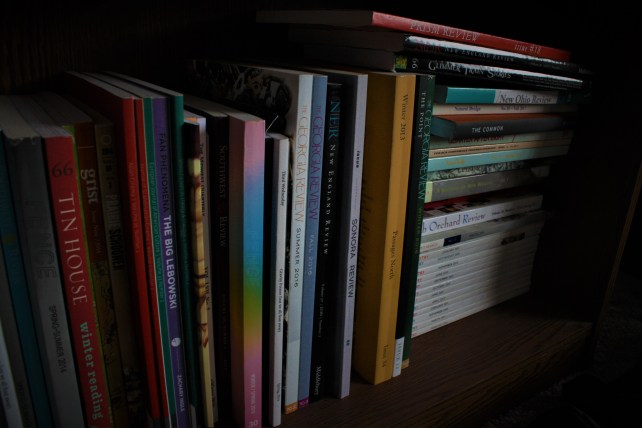
Lit Mag ShelfThis year, I will not be attending the AWP conference in Tampa. I will not receive a tote bag, nor will I peruse the book fair and return with conference swag like pins or bookmarks or back copies of cool literary magazines. I will not hear any talented writers read their work, nor will I go to a poetry slam or watch creative writing professors dance awkwardly, nor will I hit up any local bars and wake up too hungover to attend the panel I’m supposed to present at, and when I don’t have time, I certainly won’t visit the many tourist attractions and restaurants that probably exist somewhere in Tampa, possibly.

Academic conferences are big and expensive and time-consuming. This is not to say that they aren’t beneficial, but conferences can be stressful. I know that I’ll be missing out on the best that AWP has to offer. I’ve only been to one AWP conference, way back in 2015, which was intellectually fruitful. Two years after that, I went to regional and national Popular Culture Association conferences. I’ve had plenty of good experiences at conferences. I’ve been introduced to new books, new authors, and some new ideas. But as an institution, and worse, an expectation, conferences are unruly and cumbersome.

(I might be the only remaining academic of my generation who attends conferences only for the panels. I admit it; I’m a nerd. But I don’t want to spend a few hundred dollars just to drink and eat in another city. I don’t know how to be anything short of earnest about it. That’s just who I am).

I won’t be able to meet the editors of journals who have accepted and published my work, or who have rejected it, to see what they have published. To get to know the journals I want to see my work in somewhere. I won’t be able to see friends and colleagues in creative writing I haven’t seen in a long time.

All academic conferences have the same issues. If the amount of money it took to give every attendee a tote bag went to making conferences more accessible or less expensive, or if conferences could find ways to include people without the carbon emissions of travel,  they could become less unruly, less cumbersome. What we get from conferences, most importantly, should not be exclusively available at them.

Instead of going this year, I’m setting my sights on next year’s AWP, which will be in Portland, Oregon, a short trip from Moscow, Idaho. I know more people in Portland; I can visit more friends and family between as many panels as possible. Traveling to Portland from Moscow will be less costly, less polluting, and if nothing else, by then I’ll have forgotten about my conference-induced stress.

-jk

Creative Writing and Creative Revising

moose

There is some way this moose blanket connects to revision, but that’s on you to figure out.

When I first started writing, I thought the process was simple: First, I sit down and write a bad rough draft over the course of a few winter months, possibly in a snowed-in haunted Colorado hotel. Then, I read through it again and make extensive revisions. Then, I read through it a third and final time to make smaller, cosmetic revisions. Then, the final draft goes out to editors and journals for just shy of an eternity. Writing is almost always discussed as primary, and revision as the after-hours, secondary work. Or, the other way around, revision is portrayed as tedious, noncreative work, challenging only because it is time-consuming, as opposed to writing, which is the entire creative process.

Now that I have dissected, deleted, severed, multiplied, and brutalized a few dozen story drafts in the after-writing process of revision, I have realized how messy these two tasks, writing and revision, actually are. Writers talk about writing as if the best stories we can produce are done with as little revision as possible. We say “I wrote this essay, and here’s my process.” We say “While I was writing this.” We say “I am a writer.” We never say “I am a reviser,” even though we (should) spend the bulk of our creative time revising our work.

It’s easy to say that writing and revision are synonymous because they are part and parcel. But I think there is a subtle difference. We write for the present but revise for the future. We write in the moment, but revise across time. We work under the assumption that the hardest part of the process is finding inspiration and then typing it up, and the rest is smooth but tedious polishing. But I think the opposite is true. The hardest part of writing is revising. Ideas come and build up, and when they don’t, we have forty thousand writing exercises and freewriting prompts to help with that.

What if we used the same language to talk about revision? What if we had entire workshops devoted to revision exercises, revision prompts, and revision craft talks?  Creative revising is a much more useful and accurate description of the process.

Revision, at least, should be discussed as more than an afterthought. It is the bulk of the work involved, and we should discuss it with the same sense of working pleasure we use when talking about writing. Revision requires as much, if not more, creativity.

Writing is the discovery of a crime, and revision is the entire investigation, arrest, and legal proceedings, not to mention the healing process that follows. We lose nothing by placing revision at the forefront of our discussions about writing. The only thing we have to lose is our notion that revision is secondary.

-jk


We Have Decided to Keep the Flags Perpetually Half-Mast

flag

After careful consideration, we have decided, out of convenience, to keep all the flags at half-mast for the duration of the year. We figure it will just save us all a lot of time and energy if we left the flags lowered for this week’s tragedy at half-mast for the next tragedy, which we’re sure will come but don’t want to do anything meaningful about. This is the easiest thing for us, the people who lower all the flags, to do.

For especially horrific tragedies, we will have the flags lowered three quarters, to show you that we recognize your pain is serious this time, but still not serious enough to do anything about it. For something really, really bad, we’ll just remove all the flags entirely and burn them in the streets. At that point, a lot of Americans will probably be happy to see the symbols of their country burning. We also expect that, if things somehow but predictably get that much worse, whomever takes charge of the country will remove and burn all flags for us, at which point we will consider it our solemn duty to retire and take our large sums of money so we can spend it in another, safer country.

Lowering all the flags is a way of showing you that we know you are in pain, and keeping them perpetually lowered will show you that we know your pain is constant and ongoing. This is literally the least we can do for you, to the point that it’s almost like we don’t actually care. But we do, because we’ll keep the flags lowered on your behalf. The flags are all for you. That, and basically nothing else from us, the people who lower the flags for you.

Half-mast is the way of life in America. The United States is a half-mast country run by people with half-mast efforts. But we appreciate your hashtags and dedication to showing support through gestures rather than actions, and we’re especially grateful to you for not voting us, the people who definitely totally care if your children are murdered in a school, out of office. We’re glad to stay as long as you let us.

We feel it is redundant to continually raise the flags, just as it is redundant for you to continually raise your hopes, because hope is no more useful in preventing violence than lowering flags for a day. Hope has to be earned through action, not the other way around and your hopeful inaction means a lot to us. As long as we’re here, all the flags will be at half-mast indefinitely, to account for the tragedies that will likely come next week, and the week after that, and the week after that.

-jk

28 Unexcused Absences Later

nigh

He skipped class for few days when flu season started, just to stay healthy, and a few days turned into watching every episode of Seinfeld. Ten weeks, when he finally left his dorm room after realizing his roommate hadn’t returned in weeks, he found that campus was dead empty. Garbage cans were upturned and trash was everywhere, and it wasn’t even football season. Posters were stapled to the bulletin boards encouraging students to get flu shots, and next to those were more recent-looking posters calling for military intervention in the university, only some of which were from Turning Point USA.

In the cafeteria, he heard rustling among the tables, the weeks-old bowls of cereal on the floor and ominously empty orange juice bottles. Another student hobbled out of the corner, limbs stiff, eyes glazed over. This student was wrapped in several layers of winter clothes, but still she was pale and had a terrible cough. He recognized all the symptoms: it was the flu. The infected student hobbled toward him asking for vitamin C, so he fled the cafeteria and went to find his 8:30 AM class.

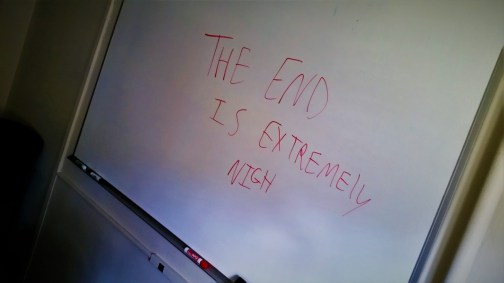
He ran to his classroom, which was deserted except for a few stray backpacks and a desperate warning to get out scribbled on the whiteboard in red dry erase marker. Desks were upturned and a misplaced syllabus was on the floor. He picked it up and wondered if his professor would still give him a D even after missing 28 days of class.

A stack of in-class writing he found next to the computer detailed the gradual collapse of the university as the flu spread across campus. The President ran away as a faction of armed deans staged a coup to protect themselves from the infected. The football coaches drove off, and the business administration faculty barricaded themselves in their offices, armed with the elephant guns that all business administration professors are required to have at all times to protect themselves from the critical theorists. Chaos reigned: the tenured preyed on the adjuncts, the biological science majors feasted on the humanities students, and a rogue band of pre-med students took to finding a cure. They were holed up in the math building, the last place anybody would look for survivors, where they intended to make a break for it as soon as they had enough hand sanitizer.

The student stood in his classroom and wished he had skipped class again today. He started to feel a little chill, too, and his throat was starting to get sore. He went out looking for the surviving pre-med students, to see if they had any OJ or chicken noodle soup. He didn’t even realize he was coughing when he left the building.

-jk

Irish Goodbyes

treeI have a bad habit of leaving places without saying goodbye first. I recognize that many consider it rude, but I know I’m not alone in this habit. We have multiple terms for it: the Irish goodbye, the French leave, ghosting. I promise I’m not being rude. This social practice is more common than you’d think.

Ghosting suggests a kind of permanence, because it implies death. It might be a complement to accuse someone of ghosting, a backhanded way of telling someone you value their presence by suggesting that person’s absence feels in some ways tragic. But ghosting doesn’t make sense, as a word for leaving without announcing so. Ghosts spend their energy trying to be known. They knock on doors and haunt people at night. When I leave early, duck out into the snow past the smokers huddled together, I’m not leaving forever. I’m not going to the afterlife, just back home for the night.

Supposedly the French leave was a practice among wealthy French elites at dinner parties, but the Irish goodbye came from impoverished women and men leaving Ireland for America during the Famine. The Irish goodbye is more permanent in this sense, but the drama of leaving a starved nation is a bit much to describe leaving a party early. The French leave is more accurate.

It’s disconcerting how often shyness is interpreted as rudeness, how often presence accompanies the expectation that I need to remind people that I’m there. Will I be forgotten if I don’t? Will I be made to feel like a ghost if I’m not quiet? I don’t like to interrupt, or be interrupted. My silent departures are a way of saving you time, a way of not interrupting you. Your time is precious, and I don’t want to shave off sections of it for myself to announce my leave.

I’m not a ghost, so far I know, but if I were that would be an unsurprising plot twist. I’m not French, or rich, or starved, or Irish. I’m not running away from you, or even running away. I just need to breathe for a bit, get a good night sleep, a long breakfast, maybe spend the weekend on an armchair reading so I can catch my breath.

I promise it’s not personal. I really do enjoy your company; that’s why I listen so much to those around me. I want to listen to everything because I’m afraid I’ll interrupt a brilliant insight or a kind attitude, because I’m surrounded by brilliant and kind people every day whose thoughts are so regularly cut off or never even asked for in the first place. I want to hear from you without interruption. I want to know where you’ll arrive with your thinking, to understand how it works and where it goes. I promise I’m not being rude. I’m just a little shy.

-jk

On Writing as a Profession (But Not as a Career)

IMG_4605For me, writing is a practice. More than a hobby, writing is a profession, though I’ve never been paid for it. Writing is work that I enjoy, but it’s not labor. It’s production, but not a job.

My job is to teach on an organized schedule broken into lesson plans, weeks, units, semesters, and academic calendars. I know roughly what I’ll be doing on May 10 (grading final papers) and I know what I’ll be doing on January 10 (introducing a syllabus). Between those dates, I have a little more room for spontaneity, but not much. This is a job, for better or worse: reliably predictable and strictly regimented.

As such, I cannot call writing a job or a career. The point isn’t to make money by providing a unique service, but to make stories and essays, some of which I publish on this blog and others I submit to journals with a broader readership, almost always operating on minuscule budgets. But I can call writing a profession.

I want to completely separate the word profession from its frequent association with economics and careerism. The Oxford English Dictionary traces the word profession to Anglo-Norman and Old French. The OED cites one of the earliest uses of the word to a thirteenth century text called the Ancrene Wisse, meaning “manual for anchoresses.” Authored by an unknown medieval priest, possibly in Wales, the Ancrene Wisse was a religious manual addressed to three sisters to instruct their code of spiritual, monastic conduct. This text, like most early uses of profession, aligns with the OED‘s first definition of the word: “The declaration, promise, or vow made by a person entering a religious order. . . Any solemn declaration, promise, or vow.”

Writing may not be a religious order (though graduate school certainly feels monastic at times), but writing is a profession in its oldest sense, a solemn declaration, a promise. When I write, I profess what I am capable of knowing at the time, and I do so for the creative and intellectual benefit of my readers (first) and myself (second). More importantly I read the writing of others, to benefit from my fellow cloistered writers. Writing is a profession of what I know and want to know, a profession of the questions I have.

Not everything needs to be monetized. I don’t want to market my writing as an asset, and I certainly don’t want to think of writing as an extension of my own commodification. If I do one day get paid to write, I’ll be grateful. If not, I’ll be happy for the stories I’ve had published online for the world to view for free. That my professions can be made public is what matters.

-jk

Nobody Plans to Stay in Spokane

SpokaneMy plan for the break was to take a bus from Spokane to Missoula, and get a ride from there to Hamilton, Montana, to visit my grandparents, then travel to Arizona with my parents. To make a short story shorter, the bus was delayed, and now I’m stuck in Spokane for the night. I will depart in the morning, I hope.

My aunt was kind enough to give me a ride to Spokane from Moscow, on her birthday no less. In her profound generosity, she booked a hotel room for me in Spokane after learning the bus was delayed twelve hours. She then joined a friend for per-arranged birthday plans, hurrying because apparently there was an active shooter in downtown Spokane. She told me that her well-traveled husband has only ever been afraid of Spokane. Moscow, Russia? Fine. Dubai? Sure. But not Spokane. Anything but Spokane at night.

Of course 2017 would draw to a close with me stuck in a hotel room in Spokane where there’s an active shooter on the last day of the semester, listening to “Pale Green Things” by The Mountain Goats on repeat. There are worse endings.

The last time I was in Spokane, I was with the only other nonfiction first-year student in my department. He was picking up a friend from New York at the same Greyhound station I will (hopefully) depart from. He and I wandered the town at night, what my well-traveled uncle would strongly advise against. We found cool bars, he visited a dispensary, and we waited for his friend’s bus in his car listening to Utah Philips sing “Solidarity Forever” on repeat, talking about the possibility of unionizing grad students to protect ourselves from the multitude of organizations attacking higher education.

A month later, he had to leave. His story is not mine to tell, but I know that a graduate student union might have been able to help him stay. A better healthcare system, or even expanded medicaid, would also have helped, and stricter environmental regulations would have spared his health from the start. But, as with so many things this year, it’s too late now.

I didn’t expect to be in Spokane tonight. I expected to explain again to my grandparents what a vegetarian diet involves and sleeping in a comfortable old house in the Bitterroot Valley. Instead, tonight I can see the spot my friend and I parked and shared our insecurities from the view of this hotel. What an unexpected gift, to remember the people who have helped me survive this semester. I needed this reminder of the many people who unintentionally hold me together at the seams just by being themselves. At the end of a dreadful year, what an unexpected gift.

-jk

Surrendering a Pocket Knife

IMG_4603There wasn’t much going on at the Spokane International Airport. Its two runways did not seem busy yesterday as I navigated the rigid airport security system. I diligently took off my shoes, placed my laptop in its own plastic tub, and placed my sparsely packed backpack in another tub. Shoeless, coatless, without my glasses and a little sleepy, I went through security. Past the body scan, I then waited as a TSA agent rummaged through my backpack.

“It looks like there’s a knife in here,” he said to me, casually.

Of course. My air travel backpack is the same as my camping backpack. Before packing, I had emptied my backpack of all my camping equipment, and even emptied it of pens and pencils, just in case. It seems I had missed a pocketknife, which took the agent a few minutes to locate after it slipped into one of my backpack’s many pockets. Only an X-ray could detect it. He held the knife in front of me, saying I had three options. I could have it delivered somewhere from the airport, put it in my car (I didn’t drive there), or, as he put it, I could “surrender it and let it go to knife heaven.”

I paused for a second. My flight would begin boarding in thirty minutes, and I probably had enough time to have it mailed back to my apartment and then go through security again, even though the knife was the only issue. But the line behind me and the agent’s calm patience made me feel embarrassed, even ashamed, at not doing my civic duties and preparing my backpack for Thanksgiving travel thoroughly enough. I chose to surrender the knife.

During my flight, I mulled over the word surrender. There are so many other ways of putting it: confiscate, disavow, give up. Instead, the situation looked like this: a TSA agent held my knife at me and told me to surrender.

It occurred to me that I felt safer at an airport than I do in my own classroom. I cannot take a knife on a plane (fair enough), but if I wanted to, I could bring a concealed handgun into my classroom while teaching. Idaho’s laws are finicky, and concealed-carry gun-owners, while on campus, are not allowed to reveal their weapons, but I still have the option to have one, and so do my students.

The argument is that the only thing stopping a bad guy with a gun is a good guy with a gun, and yet we don’t apply this logic to airplanes. On the plane, we cannot trust anyone with a pocket knife, or scissors, or toothpaste, so we regulate these things, or at least we collectively agree to embrace the cognitive dissonance required to believe that the good guy/bad guy hypothetical situation works everywhere except a plane. Nobody is trusted on a plane, but we have to trust that good guys will be everywhere else.

While teaching my last class before the holiday break, a man walked into my classroom, abrasively opening the door and marching toward me. He was older, balding, and looked frantic. Before I could panic, before I could beg him not to shoot me, he pointed to the lectern at which I stood and said, “I need to get a flash drive.” Then, in a few quick moves, he unplugged a flash drive from the computer. Evidently, he was another professor who had previously used the same classroom, and had left his equipment there. He apologized for the inconvenience and walked out. My students didn’t seem bothered. Maybe they’re all just good guys.

As my plane landed, I thought about something Charles Olson wrote in his 1947 literary criticism Call Me Ishmael: “I take SPACE to be the central fact to man born in America, from Folsom cave to now. I spell it large because it comes large here. Large, and without mercy.” I’m skeptical that there is one central fact of America, but after the twin incidents in the classroom and airport, I’m inclined to think the central fact of America might be surrendering. This might be the case for every nation-state, but I cannot speak to other countries, but it seems more widespread in America: If I were not white, I can’t imagine what the TSA agents would have done to me after discovering a pocket knife in my backpack.

The word surrender has another, more sinister layer. Only combatants can surrender to another authority, lesser or greater in force. Soldiers surrender in war, and criminals surrender to cops. It suggests a more equal power dynamic than what is actually recorded in history. Native Americans surrendered land and life, Afghan children surrender security under drones, politicians surrender principles and we surrender to them our votes and our privacy, the working poor surrender their labor. What the state calls surrender is more like seizure because those who are asked to surrender are made to feel responsible for their defeat, as if it was their choice to enter into a conflict with America, large and without mercy.

And what was I ashamed of? That I was caught not remembering the state of terror we live in? I think, in truth, I was ashamed that the first time I relaxed this semester was walking into an airport, that I felt safer in a security complex designed to reinforce fear than I do in a classroom designed for comfort and an easy pace, and that I’m made to feel responsible because I’m not a good guy with a gun. Instead, I walk into a classroom with pens, pencils, markers, books, and slideshows, but none of those things, it seems, are enough to make me good.

-jk
Having Blogged for Four Years

Arboretum

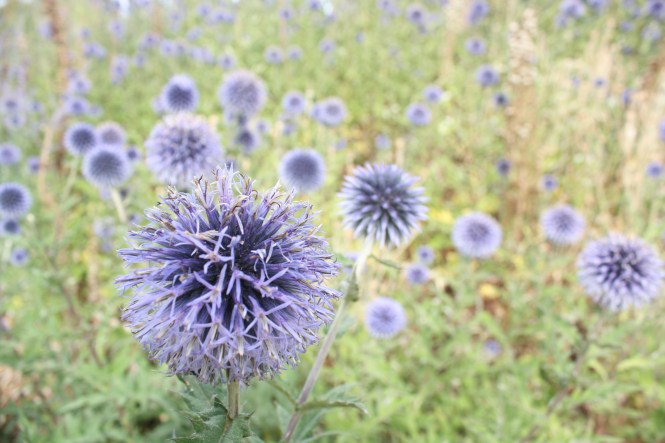
Photo taken at the University of Idaho Arboretum and Botanical Garden

. . . I wonder if this is the only anniversary in my life that matters. I started this blog four years ago. Hopefully, the quality of posts has improved just as the quality of the world has diminished.

I’m knee-deep in the first semester in my third college program, this time an MFA in creative nonfiction. Since October 27, 2016, I have started a blog series about the Russian Revolution, had one essay published and one short story published, finished my Master’s degree in English, and moved from Nebraska to Idaho. I’ve also started writing for the Idaho MFA blog, reading nonfiction submissions for Fugue, and volunteering as an editorial assistant for Western American Literature. My literary life has expanded substantially in a year, and yet I’m still ambitious. I have writing and reading to finish, journals to curate, places to visit, sweeping political generalizations to make.

This has been a rough year for the country and the planet. Regardless, I will blog away into oblivion. Here’s to another year.

-jk

Writing Lamentation, Writing Celebration

Close Acorn“I dote on myself, there is that lot of me and all so luscious,/Each moment and whatever happens thrills me with joy,/I cannot tell how my ankles bend, nor whence the cause of my faintest wish,/Nor the cause of the friendship I emit, nor the cause of the friendship I take again.” -Walt Whitman, “Song of Myself,” Leaves of Grass

Recently, one of my nonfiction professors mentioned that, if the tone and texture of writing can be divided into either writing of lamentation or writing of celebration, my writing style tends toward lamentation. She said, unlike Whitman’s celebratory exaltation, my writing texture is more like Emerson’s, brooding and internal.

To me, this makes sense: my writing broods. Maybe that’s why my stand-up comedy special The Writer of Lamentations has done so poorly on Netflix. It’s not that I avoid celebration. I try (and often fail) to celebrate others. I try to support my friends and praise their successes as much as possible, but this celebration rarely enters my writing. Instead, my writing fixates on losses.

More and more, I write about the environment, the west, and disparate interests like history and music, and I think my essays do, in fact, have a sense of lamentation: for places that will soon no longer be, for talents I used to have, for wars that I never fought in, and for friends who have shaped and continue to shape me, even in their absence. Despite my best efforts, friends come and go. I lament being unable to continue being shaped by them, and departure starts to feel normal and they have their lives. Thank goodness they have their lives. And still, I brood.

And what does it mean to celebrate? A friend and colleague of mine shared a poem by Abu al-Qasim al-Shabi called “The Will of Life” about embracing “the love of life,” an active, rather than passive, task. Even in the midst of what is worth lamenting, there is room for celebration. This makes me think of Prior in Angels in America refusing to be a prophet, telling the angels he wants more life: “We can’t just stop. We’re not rocks. Progress, migration, motion is modernity, it’s animate. It’s what living things do. We desire. Even if all we desire is stillness, it’s still desire for. . . . It’s so much not enough. It’s so inadequate. But still: Bless me anyway. I want more life.”

It’s been almost a year since I saw Angels in America with friends whom I miss dearly. I will admit that I desire, and I often desire stillness. I don’t want to celebrate myself the way Whitman does, but lamentation requires life in memory, the shadow of what was and could be. It is an act of wanting, but it is always active, not passive. To lament is to recognize that life, friendship, love, the burning world will never be enough, will always be inadequate, but to want to celebrate it anyway. Can there be lamentation without celebration, even in possibility? I write for the past while stuck in the present, constantly spiraling headlong into whatever disaster the future holds, one after another.

I want more life, and I want to mourn life for all that it is, all that it isn’t, all that it used to be. Someone should. Life requires lamentation as much as celebration, but the opposite holds true. To lament is to want, but to want without striving toward celebration misses the point completely.

-jk