Tag Archives: New Year

What Breaks Open the Seed

“Nature reinvents itself over and over again. This process of constant creation leaves behind a track record of successes and failures, new life forms that live or die depending on their innate genetic flexibility, their ability to find and fit into their own niche. This learning to live with others may take seconds or years or millennia.” – Diana Beresford-Kroeger, Our Green Heart: The Soul and Science of Forests, 41


A second year in Indiana has not prepared me for how startling winter is in the forests, how completely the deciduous woodlands shed their leaves and transform into quiet, desolate fogs of spindly twigs. I am still too used to the coniferous evergreens of the west, where the ponderosas only shrug at the changing seasons.

I started 2024 with two goals in mind: To write more and to read more books. I didn’t keep track of these goals, of course. Famously, I dislike quantifying previous years. I’m more interested in qualitative reflections on the past. This has been a very difficult year for me for a lot of reasons; I know this year has been exceptionally horrifying for so many. A new year won’t change that. Instead, I want to attend to the quality of the days ahead, to the slowness of winter and what possibilities I can find in that slowness.

Maybe it was fitting, then, that the last book I read in 2024 was Our Green Heart, by Irish botanist Diana Beresford-Kroeger, about forest ecology, Celtic history, growth, and the strangeness of forest ecosystems.

I appreciate (and am jealous of) the sense of wonder in Beresford-Kroeger’s prose. Her description of seeds was particularly striking: “Most seeds,” she writes, “carry a dormancy factor, the proteins of their endosperm food supply coiled and folded into resting states that wait for a particular signal. These signals are a form of divination, an assurance strong enough that the seed bets its future on that message. They are not properly understood in science and have not been studied in great depth” (85). Here, there is poetry in unexplained biology. Some seeds evolved to sprout in reaction to heat from wildfires; others evolved to travel far distances, to be eaten and carried off by birds and rodents. Dormant seeds are hard and singular for months or years until the right external prompt cracks them open and they grow into roots, trunks, branches.

When I teach, I emphasize revision as the more important process in writing, more than drafting or research. Recently, I have brought in a novel-revising technique from Jane Smiley’s notion that sentences are either seeds or pebbles. Matt Bell elaborates on this idea in his craft book Refuse to be Done, writing that “If it’s a pebble, it’s just the next sentence and it sits there. But if it’s a seed it grows into something that becomes an important part of the life of the novel. The problem is, you can’t know ahead of time whether a sentence will be a seed or a pebble, or how important a seed is going to be” (Bell 77).

I’ve never before thought of this exercise as an exploration of dormancy. If a sentence, a paragraph, or even an unspoken idea is a seed, that means it is awaiting something external to activate it, to bring it out of its shell. This is not that far from artistic inspiration, almost all of which, I believe, comes from external experience: long walks, a healthy community, traveling someplace new, the changing seasons. At least, these are the things that put me in a writing mood. It’s true that when I’m writing, I never know which ideas will take root and grow. Maybe all writing is secretly fertile in this way.

This past year has felt thoroughly dormant, but this is also normal for me. I live in a shell that I rarely come out of, and for such painfully long periods of time that I think dormancy is my natural state. But I have also been rootless for a decade now, following grad school programs and jobs from town to town, leaving behind friends and family for other valleys. What spark am I waiting for? What divination will finally break me open?

Beresford-Kroeger also finds comfort in the secret and illegal hedge schools that existed in Ireland for “those five hundred years during which the Penal Laws made it illegal for the Irish to teach their children” (35). She describes one school as having been nestled in the wilderness, protected by the landscape. It is partly through these hedge schools that Irish language and culture were passed on from generation to generation, where old knowledge was stored, sustained, kept safe like the dormant trees preserved within seeds. These secret schools were a long-standing form of resistance to the occupying British colonists, who could not stamp out Irish identity through force or erasure, an important lesson for the coming year.

Maybe I’ll take this to heart: Dormancy is protective, not restrictive. In writing, this is true of the stories we want to tell and those that need more time.

In the town I grew up, at a museum of regional history, there happened to be a poetry display I had the privilege of visiting last week. A local poet had her typewriter stationed there, along with post cards, paperclips, fancy paper. When she offered to write me a poem, the prompt I gave was full of the obvious cliches: a new year, getting back into a healthy routine, trying to break out of a sense of stagnation. The poem, of course, was much more thoughtful than my jumbled words. The museum display was full of poems commemorating the beauty of the Coconino National Forest, the huge and ancestral evergreens that loom over my hometown.

This year, I intend to slow down, take my time, pay attention. I don’t want to toss out any seeds thinking they’re only pebbles. I don’t think there’s a magical break between one year and the next, but I do think growth continues, even if that growth only takes the form of preservation. Eventually, once winter has stayed its welcome, the spindly, empty trees in Indiana will sprout their leaves again.


Bell, Matt. Refuse to Be Done: How to Write and Revise a Novel in Three Drafts. Soho Press, 2022.

Beresford-Kroeger, Diana. Our Green Heart: The Soul and Science of Forests. Random House Canada, 2024.

Desserts for the New Year

The last month has been a blur. I spent the holidays on the road visiting family and friends, driving long hours across the inner west. Days before Christmas, I met up with my father in southern Idaho. From there, we drove to Salt Lake City to visit my grandfather as he returned from the hospital to settle into hospice. The details are for another time, but he passed away shortly after.

One of the last things he said, something that I keep thinking about, was how much he enjoyed the chocolate cake he ate the day he left the hospital. It was a small, tangible memory, something that let him direct the conversation toward a simple pleasure, away from the situation. I remember the way he emphasized the dessert clearly in his otherwise unclear voice, a little louder and more precise, so that we could share the memory with him.

I entered the new year in a series of late-night panic attacks, my heart rate spiking and my mind racing, unable to sleep nights in a row. These come and go but lately they’ve been getting worse. The holidays are an increasingly difficult time for me, which I deny because I want to enjoy them. For a few years now, I’ve started to rely on cooking to calm me down, especially baking. It gives me a small, tangible activity to focus on, something to keep my mind and body occupied.

After the funeral in southern Idaho, my dad and I wandered into a used bookstore in his hometown, run by volunteers. I perused the cooking section and was intrigued by a rare artifact: A cookbook issued by the Church of Jesus Christ of Latter-Day Saints, in 1981, addressed to Salt Lake families to provide “easy, economical recipes that will add variety and interest to your diet.” The very brief introduction insists that its readers should cook, “nutritious meals to build strong bodies and alert minds” (ii). The dessert section is the longest and most obviously used, peppered with little brown stains from batters or syrups, though someone has drawn a large X across a recipe for graham crackers and written “Awful” above it.

This is Mormon country, where keeping “strong bodies and alert minds” through diet is considered a divine ordinance commonly referred to as the word of wisdom. Terry Tempest Williams writes that the word of wisdom, “a religious doctrine of health, kept the women in [her] family aligned with good foods: no coffee, no tea, tobacco, or alcohol” (Williams 183). She attributes her family’s long life prior to atomic testing in the 1950s to this strict Mormon diet, and she’s not alone. Physicians and sociologists have studied Mormon communities to determine a correlation between the word of wisdom and statistically lower-than-average cancer rates among practicing Saints (Badanta et al., 1581).

It’s also commonly accepted that Mormons eat a lot of desserts, especially ice cream. Without coffee or alcohol, sweets are the only remaining vice for LDS social life.

My grandfather was not particularly religious, nor did he adhere to the word of wisdom. He had a good, long life, anyway, enjoying it as much as he could. He was a trucker with a union job procured before the era of deregulation, and much of his social life was in the Elks Club. In fact, the local Elks Lodge hosted a small meal after the funeral, consisting of sandwiches, pasta salad, and cookies for dessert.

Dessert as a concept comes from French culinary tradition, referring to the last course of a meal. Its etymology, though, has nothing to do with sweets or cakes. The prefix des means “remove,” from Latin dis, as in dissolve, disassociate, distance. The root, sert, comes from service. Dessert, then, is the removal of what has been served, a clearing of the table.

October through December is the prime season for bakery sales, as bakers work overtime to satisfy demands for pumpkin pies, Christmas cookies, and treats for New Year’s parties that pair well with champagne. Claire Saffitz writes that a love of baking—and by extension a love of desserts—is “about embracing cooking and eating as fundamental sources of pleasure,” and that through her own recipes, she favors “an approach to food that is celebratory, abundant, and at times a tad luxurious” (Saffitz 12). This is the opposite of the word of wisdom, which treats food as purely utilitarian. Dessert doesn’t just mean closure, but a triumphant closure, something to celebrate: birthday cakes, the cakes at retirement parties, even wedding cakes signal both an ending and a beginning.

I have hardly felt celebratory lately. Every New Year’s ends up being the same for me: I want to clear away the old year’s detritus and start with a clean table, but when I tug away the tablecloth, a mess of dirty dishes remains. I never find closure. The idea that “a new year means a new you” feels like just as much an illusion.

Unable to afford therapy, I start each year trying to manage my anxiety similarly to the word of wisdom. I cut back on caffeine and alcohol, cut down on salt, rededicate myself to eating piles of vegetables and homemade fruit-based desserts that mold in a week. I take vitamin D supplements to make up for the limited sunlight. I imagine that I can minimize panic attacks by regulating what I consume, but I can never tell if it works.

Nevertheless, two weeks into January, I took pleasure in baking a small layer cake for my girlfriend’s birthday. I spent the hours she was at work baking two sponge cakes, one chocolate and one vanilla, waiting for them to cool and then carving them into thin discs and layering them between swaths of butter cream, then frosting the stack in thick chocolate ganache with piped buttercream kisses and chocolate shavings on top. It may not have been abundant or even luxurious, but it was at least celebratory, and in the process of baking, I felt calm, even a little cocky.

This year is not off to a promising start, but I keep thinking about the chocolate cake my grandfather mentioned. It mattered enough that he enjoyed it, that he made room for that joy. There isn’t much to celebrate these days, as this country fails once again to serve the welfare of its population, but I want to find what little there is, bring to the table what little I have, and make it last through yet another terrible year.


Author unknown. Deseret Recipes. 1981.

Badanta, Barbara, Giancarlo Lucchetti, Rocio de Diego-Cordero. “‘A Temple of God’: A Qualitative Analysis of the Connection Between Spiritual/Religious Beliefs and Health Among Mormons.” Journal of Religion and Health 59 (2020), 1580-1595.

Saffitz, Claire. Dessert Person. Clarkson-Porter, 2020.

Williams, Terry Tempest. “The Clan of One-Breasted Women.” Northern Lights, ed. Deborah Clow and Donald Snow. Vintage Books, 1994, 183-191.

For Me, the Year is Only Half Over

I won’t be making New Year’s Resolutions on January 1. To be honest, I never have, but not because I’m against resolutions. It’s because for me a new year won’t begin on January 1. As long as I can remember, I’ve never marked new and old years by the Gregorian calendar. These twelve-month chunks don’t reflect my own endings and beginnings. Instead, I’ve always marked years by the academic calendar.

I count school years instead of Gregorian years because summers have always marked the major changes for me: every June I leave behind classes and teachers and prepare to meet new ones in August. Friends graduate and leave, relationships end, and the next school year offers new possibilities. The end of 2016 means nothing to me. It’s still winter, I’m still in grad school, I’m still 24. What will actually change tomorrow?

Now, while folks wallow in the regret of not fulfilling their 2016 resolutions, I still have six months left until I have to wallow in regret, and even then I have the whole summer to do my wallowing. I have plenty of time to not get in shape and not get published in The Paris Review.

I also have half a year left to finish my MA, improve my teaching, become a regular at a bar where everybody knows my name, and find inner peace. Piece of cake. Then, in summer, I can start the next year fresh and accomplished. I still don’t know where I’ll be next year, how many publications I’ll have, and whether or not I’ll have to cope with martial law, but that’s fine, because I still have half a year to figure it out.

For the rest of you folks celebrating 2017 like it somehow means something, I wish you a Happy New Year. For me, though, kindly hold your New Year’s wishes until summer. The weather will be nicer then, anyway.

Peace,

-jk

Very Near the Last Best Place

“I’m in love with Montana. For other states I have admiration, respect, recognition, even some affection. But with Montana it is love. And it’s difficult to analyze love when you’re in it.” -John Steinbeck, Travels with Charley

Snowy Horseman

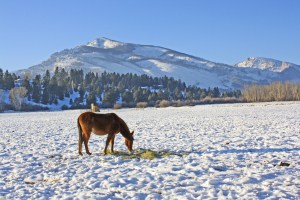
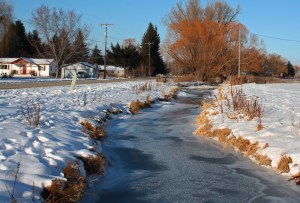
It’s been especially cold in the Bitterroot Valley this week. The air is fat with moisture, and below-freezing temperatures are typical. Still, there is clarity in the cold, standing at the center of the Valley’s balding head. The crown of mountains rolling up and down across the horizon like changing statistics are garnished with snow and the torn fabric of clouds. The trees carry tufts of it, the fields and sleepy barns hold sheets of it stretched thin into ice, and the sky lets down more, flake by perfect, God’s-eye flake.

River Icy

In the middle of the ring of mountains, I stand surrounded by the monumental totality, the jagged white-purple strips draped below a hazy, bitter blue sky, like skin left out in the cold too long.  My nose hairs freeze as I breathe in and look at the sunlit snowscape, a territory lost in cold dreams of something to bloom later, something better to come, something beautiful in the future. I find beauty in the waiting, or try to. The snow is a fixation for me. This frigid terrarium of agriculture and forestry is astounding.

Fence

Maybe there really is such a thing as timelessness. Maybe there’s a way to stop time, step out of it like out of a beater truck, and frame time within electrical confines. Keep it forever, or send the past into the future untarnished by change. But the snow will melt, and something gorgeous will replace it. Trees will philosophize, flowers will converse, and a listlessness of birdsong will fill the air.

Snow Mountain

I pull my camera from my bag, take my gloves off, and take a picture of the landscape. The snow is so lovely, and it melts so quickly when touched, so I try to hold it in another way. I can hardly use my fingers when I lower the camera. I didn’t notice how numb they’d gotten in the photographic thrill of momentlessness.

-jk

All photos copyrighted material of Lost Compass Photography, 2016. Donations, or else get-well-financially cards, are always welcome.